第9章数学モデルと幾何
9.1 Use a Problem Solving Strategy9.1 問題解決の手順を使う
Learning Objectives学習目標
Learning Objectives学習目標
By the end of this section, you will be able to:
この節を終えると、次のことができるようになる。
- Approach word problems with a positive attitude前向きな姿勢で文章題に取り組む
- Use a problem solving strategy for word problems文章題に問題解決の手順を使う
- Solve number problems数についての文章題を解く
Before You Begin (3)準備問題(3題)
Approach Word Problems with a Positive Attitude前向きな姿勢で文章題に取り組む
The world is full of word problems. How much money do I need to fill the car with gas? How much should I tip the server at a restaurant? How many socks should I pack for vacation? How big a turkey do I need to buy for Thanksgiving dinner, and what time do I need to put it in the oven? If my sister and I buy our mother a present, how much will each of us pay?
英語のヒント
世界は文章題であふれている。車のガソリンを満タンにするにはいくら必要か。レストランの給仕にはいくらチップを渡せばよいか。休暇には靴下を何足持っていくべきか。感謝祭の夕食にはどの大きさの七面鳥を買い、何時にオーブンに入れればよいか。姉妹と一緒に母へプレゼントを買うなら、1人いくら払うのか。
Now that we can solve equations, we are ready to apply our new skills to word problems. Do you know anyone who has had negative experiences in the past with word problems? Have you ever had thoughts like the student in Figure 9.2?
英語のヒント
方程式を解けるようになったので、新しい技能を文章題に応用する準備ができた。文章題で以前に嫌な思いをした人を知っているだろうか。図9.2の生徒のように考えたことはあるだろうか。
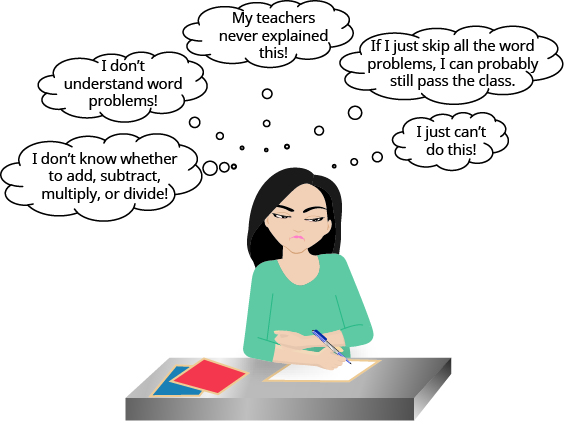
Figure 9.2図 9.2
Negative thoughts about word problems can be barriers to success.
文章題に対する否定的な考えは、成功の障害になりうる。
When we feel we have no control, and continue repeating negative thoughts, we set up barriers to success. We need to calm our fears and change our negative feelings.
英語のヒント
自分ではどうにもできないと感じ、否定的な考えを繰り返すと、成功への障害を自ら作ってしまう。不安を静め、否定的な感情を変える必要がある。
Start with a fresh slate and begin to think positive thoughts like the student in Figure 9.3. Read the positive thoughts and say them out loud.
英語のヒント
気持ちを新たにし、図9.3の生徒のように前向きに考え始めよう。前向きな考えを読み、声に出してみよう。

Figure 9.3図 9.3
When it comes to word problems, a positive attitude is a big step toward success.
文章題では、前向きな姿勢が成功への大きな一歩になる。
If we take control and believe we can be successful, we will be able to master word problems.
英語のヒント
自分から取り組み、できると信じれば、文章題を習得できる。
Think of something that you can do now but couldn't do three years ago. Whether it's driving a car, snowboarding, cooking a gourmet meal, or speaking a new language, you have been able to learn and master a new skill. Word problems are no different. Even if you have struggled with word problems in the past, you have acquired many new math skills that will help you succeed now!
英語のヒント
3年前にはできなかったが、今はできることを考えてみよう。運転、スノーボード、手の込んだ料理、新しい言語で話すことなど、新しい技能を学んで身に付けてきた。文章題も同じである。以前は苦手だったとしても、今は成功に役立つ数学の技能をたくさん習得している。
Use a Problem-solving Strategy for Word Problems文章題に問題解決の手順を使う
In earlier chapters, you translated word phrases into algebraic expressions, using some basic mathematical vocabulary and symbols. Since then you've increased your math vocabulary as you learned about more algebraic procedures, and you've had more practice translating from words into algebra.
英語のヒント
前の章では、基本的な数学の言葉と記号を使って、言葉で書かれた表現を文字式に直した。その後、さらに多くの代数の手続きを学んで数学の語彙を増やし、言葉から式に直す練習も重ねてきた。
You have also translated word sentences into algebraic equations and solved some word problems. The word problems applied math to everyday situations. You had to restate the situation in one sentence, assign a variable, and then write an equation to solve. This method works as long as the situation is familiar to you and the math is not too complicated.
英語のヒント
言葉で書かれた文を方程式に表し、文章題もいくつか解いた。そうした問題は数学を日常の場面に応用するものだった。状況を1文に言い直し、変数を割り当て、解くための方程式を書いた。この方法は、状況が身近で数学があまり複雑でない限り有効である。
Now we'll develop a strategy you can use to solve any word problem. This strategy will help you become successful with word problems. We'll demonstrate the strategy as we solve the following problem.
英語のヒント
ここからは、どの文章題にも使える手順を作る。文章題をうまく解くのに役立つ手順である。次の問題を解きながら示そう。
Example 9.1例題 9.1
Pete bought a shirt on sale for which is one-half the original price. What was the original price of the shirt?
ピートはシャツをセールでで買った。これは元の価格の半分だった。元の価格はいくらか。
Solution解答
Step 1. Read the problem. Make sure you understand all the words and ideas. You may need to read the problem two or more times. If there are words you don't understand, look them up in a dictionary or on the Internet.
手順1.問題を読む。すべての言葉と考え方を理解していることを確かめる。2回以上読む必要があるかもしれない。わからない言葉があれば、辞書やインターネットで調べる。
- In this problem, do you understand what is being discussed? Do you understand every word?この問題で何が話題になっているかわかるだろうか。すべての言葉を理解しているだろうか。
Step 2. Identify what you are looking for. It's hard to find something if you are not sure what it is! Read the problem again and look for words that tell you what you are looking for!
手順2.何を求めるのかを明らかにする。何を求めるかわからなければ、見つけることは難しい。もう一度問題を読み、求めるものを示す言葉を探そう。
- In this problem, the words “what was the original price of the shirt” tell you that what you are looking for: the original price of the shirt.この問題では「シャツの元の価格はいくらか」という言葉から、求めるのはシャツの元の価格だとわかる。
Step 3. Name what you are looking for. Choose a variable to represent that quantity. You can use any letter for the variable, but it may help to choose one that helps you remember what it represents.
手順3.求める量に名前を付ける。その量を表す変数を選ぶ。どの文字を使ってもよいが、何を表すか思い出しやすい文字を選ぶと役立つ。
- Let the original price of the shirtシャツの元の価格とする。
Step 4. Translate into an equation. It may help to first restate the problem in one sentence, with all the important information. Then translate the sentence into an equation.
手順4.方程式に表す。最初に重要な情報をすべて含む1文に言い直すと役立つことがある。その後、方程式に表す。

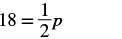
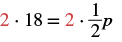
Step 5. Solve the equation using good algebra techniques. Even if you know the answer right away, using algebra will better prepare you to solve problems that do not have obvious answers.
手順5.適切な代数の方法で方程式を解く。すぐ答えがわかる場合でも、代数を使えば、答えが明らかでない問題を解くためのよい準備になる。
Write the equation. 方程式を書く。 |
 |
Multiply both sides by 2. 両辺に2を掛ける。 |
 |
Simplify. 簡単にする。 |
 |
Step 6. Check the answer in the problem and make sure it makes sense.
手順6.答えを元の問題に照らし、意味が通ることを確かめる。
- We found that which means the original price was Does make sense in the problem? Yes, because is one-half of and the shirt was on sale at half the original price.と求まり、元の価格はだった。問題の中では妥当か。妥当である。はの半分で、シャツは元の価格の半額で売られていたからである。
Step 7. Answer the question with a complete sentence.
手順7.完全な文で問いに答える。
- The problem asked “What was the original price of the shirt?” The answer to the question is: “The original price of the shirt was問題は「シャツの元の価格はいくらか」と尋ねていた。答えは「シャツの元の価格はであった」となる。
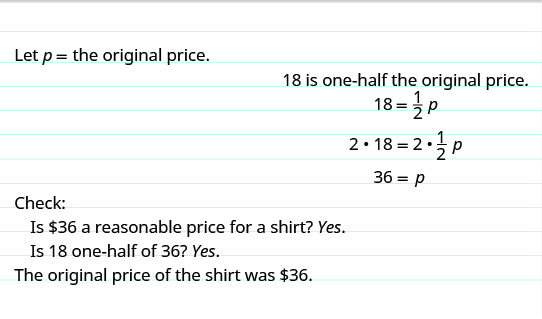
If this were a homework exercise, our work might look like this:
これが宿題なら、解答は次のように書ける。
Try It (2)確認問題(2題)
Let's use this approach with another example.
別の例でこの方法を使おう。
Example 9.2例題 9.2
Yash brought apples and bananas to a picnic. The number of apples was three more than twice the number of bananas. Yash brought apples to the picnic. How many bananas did he bring?
ヤシュはピクニックにリンゴとバナナを持ってきた。リンゴの個数はバナナの本数の2倍より3個多かった。リンゴは個だった。バナナは何本持ってきたか。
Solution解答
Step 1. Read the problem. 手順1 問題を読む。 |
|
Step 2. Identify what you are looking for. 手順2 何を求めるのかを明らかにする。 |
How many bananas did he bring? バナナを何本持ってきたか。 |
Step 3. Name what you are looking for. Choose a variable to represent the number of bananas. 手順3.求める量に名前を付ける。バナナの本数を表す変数を選ぶ。 |
Let とおく。 |
Step 4. Translate. Restate the problem in one sentence with all the important information. Translate into an equation. 手順4.式に表す。重要な情報をすべて含む1文に言い直し、方程式に表す。 |
 |
Step 5. Solve the equation. 手順5 方程式を解く。 |
 |
Subtract 3 from each side. 両辺から3を引く。 |
 |
Simplify. 簡単にする。 |
 |
Divide each side by 2. 両辺を2で割る。 |
 |
Simplify. 簡単にする。 |
 |
Step 6. Check: First, is our answer reasonable? Yes, bringing four bananas to a picnic seems reasonable. The problem says the number of apples was three more than twice the number of bananas. If there are four bananas, does that make eleven apples? Twice 4 bananas is 8. Three more than 8 is 11. 手順6.確認する。まず答えは妥当か。ピクニックにバナナ4本を持っていくのは妥当である。問題では、リンゴはバナナの2倍より3個多いとある。バナナが4本ならリンゴは11個になるか。4の2倍は8で、8より3大きい数は11である。 |
|
Step 7. Answer the question. 手順7 問いに答える。 |
Yash brought 4 bananas to the picnic. ヤシュはピクニックにバナナを4本持ってきた。 |
Try It (2)確認問題(2題)
In Solve Sales Tax, Commission, and Discount Applications, we learned how to translate and solve basic percent equations and used them to solve sales tax and commission applications. In the next example, we will apply our Problem Solving Strategy to more applications of percent.
Example 9.3例題 9.3
Nga's car insurance premium increased by which was of the original cost. What was the original cost of the premium?
ガーの自動車保険料は上がった。これは元の保険料のだった。元の保険料はいくらか。
Solution解答
Step 1. Read the problem. Remember, if there are words you don't understand, look them up. 手順1.問題を読む。わからない言葉は調べることを忘れないようにしよう。 |
|
Step 2. Identify what you are looking for. 手順2 何を求めるのかを明らかにする。 |
the original cost of the premium 元の保険料 |
Step 3. Name. Choose a variable to represent the original cost of premium. 手順3.名前を付ける。元の保険料を表す変数を選ぶ。 |
Let とおく。 |
Step 4. Translate. Restate as one sentence. Translate into an equation. 手順4.式に表す。1文に言い直し、方程式に表す。 |
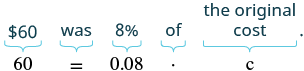 |
Step 5. Solve the equation. 手順5 方程式を解く。 |
 |
Divide both sides by 0.08. 両辺を0.08で割る。 |
 |
Simplify. 簡単にする。 |
|
Step 6. Check: Is our answer reasonable? Yes, a $750 premium on auto insurance is reasonable. Now let's check our algebra. Is 8% of 750 equal to 60? 手順6.確認する。答えは妥当か。自動車保険料750ドルは妥当である。次に式の計算を確かめる。750の8%は60に等しいか。    |
|
Step 7. Answer the question. 手順7 問いに答える。 |
The original cost of Nga's premium was $750. ガーの元の保険料は750ドルだった。 |