第9章数学モデルと幾何
9.3 Use Properties of Angles, Triangles, and the Pythagorean Theorem9.3 角と三角形の性質、およびピタゴラスの定理を使う
Learning Objectives学習目標
Learning Objectives学習目標
By the end of this section, you will be able to:
この節を終えると、次のことができるようになる。
- Use the properties of angles角の性質を使う
- Use the properties of triangles三角形の性質を使う
- Use the Pythagorean Theoremピタゴラスの定理を使う
Before You Begin (3)準備問題(3題)
So far in this chapter, we have focused on solving word problems, which are similar to many real-world applications of algebra. In the next few sections, we will apply our problem-solving strategies to some common geometry problems.
この章ではここまで、実社会における代数の多くの応用によく似た文章題を解くことに重点を置いてきた。続くいくつかの節では、問題解決の手順をよくある図形の問題に応用する。
Use the Properties of Angles角の性質を使う
Are you familiar with the phrase ‘do a It means to turn so that you face the opposite direction. It comes from the fact that the measure of an angle that makes a straight line is degrees. See Figure 9.5.
「をする」という表現を知っているだろうか。反対方向を向くように向きを変えるという意味である。これは、一直線になる角の大きさが度であることに由来する。図9.5を参照せよ。
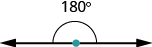
Figure 9.5図 9.5
An angle is formed by two rays that share a common endpoint. Each ray is called a side of the angle and the common endpoint is called the vertex. An angle is named by its vertex. In Figure 9.6, is the angle with vertex at point The measure of is written
英語のヒント
角は、共通の端点を持つ2本の半直線によってできる。それぞれの半直線を角の辺、共通の端点を頂点という。角は頂点によって名前を付ける。図9.6で、は点を頂点とする角である。の大きさはと書く。
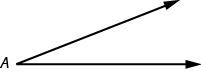
Figure 9.6図 9.6
is the angle with vertex at
はを頂点とする角である。
We measure angles in degrees, and use the symbol to represent degrees. We use the abbreviation for the measure of an angle. So if is we would write
英語のヒント
角は度で測り、度を表す記号を使う。角の大きさには略記を使う。したがって、がなら、と書く。
If the sum of the measures of two angles is then they are called supplementary angles. In Figure 9.7, each pair of angles is supplementary because their measures add to Each angle is the supplement of the other.
英語のヒント
2つの角の大きさの和がなら、その2つの角は互いに補角である。図9.7の各組の角は、大きさを足すとになるので互いに補角である。それぞれがもう一方の補角である。
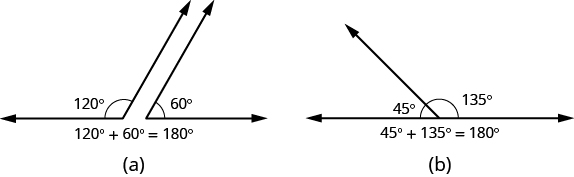
Figure 9.7図 9.7
The sum of the measures of supplementary angles is
互いに補角である角の大きさの和はである。
If the sum of the measures of two angles is then the angles are complementary angles. In Figure 9.8, each pair of angles is complementary, because their measures add to Each angle is the complement of the other.
英語のヒント
2つの角の大きさの和がなら、その2つの角は互いに余角である。図9.8の各組の角は、大きさを足すとになるので互いに余角である。それぞれがもう一方の余角である。
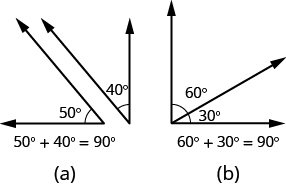
Figure 9.8図 9.8
The sum of the measures of complementary angles is
互いに余角である角の大きさの和はである。
In this section and the next, you will be introduced to some common geometry formulas. We will adapt our Problem Solving Strategy for Geometry Applications. The geometry formula will name the variables and give us the equation to solve.
この節と次の節では、図形に関する基本的な公式をいくつか学ぶ。問題解決の手順を図形の応用問題に合わせて使う。図形の公式によって変数の意味が定まり、解くべき方程式が得られる。
In addition, since these applications will all involve geometric shapes, it will be helpful to draw a figure and then label it with the information from the problem. We will include this step in the Problem Solving Strategy for Geometry Applications.
さらに、これらの応用問題はすべて図形を扱うので、図を描いて問題中の情報を書き込むと役立つ。この手順を、図形の応用問題の解決手順に含める。
The next example will show how you can use the Problem Solving Strategy for Geometry Applications to answer questions about supplementary and complementary angles.
次の例題では、図形の応用問題の解決手順を使って、補角と余角についての問いに答える方法を示す。
Example 9.16例題 9.16
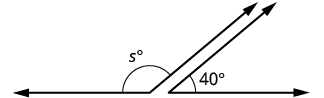
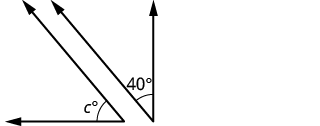
An angle measures Find ⓐ its supplement, and ⓑ its complement.
ある角の大きさはである。ⓐその補角、ⓑその余角を求めよ。
Solution解答
ⓐ |
|
Step 1. Read the problem. Draw the figure and label it with the given information. 手順1 問題を読む。図を描き、与えられた情報を書き込む。 |
 |
Step 2. Identify what you are looking for. 手順2 何を求めるのかを明らかにする。 |
 |
Step 3. Name. Choose a variable to represent it. 手順3 名前を付ける。求める量を表す変数を選ぶ。 |
 |
Step 4. Translate. Write the appropriate formula for the situation and substitute in the given information. 手順4.置き換える。状況に適した公式を書き、与えられた情報を代入する。 |
  |
Step 5. Solve the equation. 手順5 方程式を解く。 |
 |
Step 6. Check: 手順6 確認:   |
|
Step 7. Answer the question. 手順7 問いに答える。 |
 |
ⓑ |
|
Step 1. Read the problem. Draw the figure and label it with the given information. 手順1 問題を読む。図を描き、与えられた情報を書き込む。 |
 |
Step 2. Identify what you are looking for. 手順2 何を求めるのかを明らかにする。 |
 |
Step 3. Name. Choose a variable to represent it. 手順3 名前を付ける。求める量を表す変数を選ぶ。 |
 |
Step 4. Translate. Write the appropriate formula for the situation and substitute in the given information. 手順4.置き換える。状況に適した公式を書き、与えられた情報を代入する。 |
 |
Step 5. Solve the equation. 手順5 方程式を解く。 |
  |
Step 6. Check: 手順6 確認: 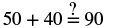  |
|
Step 7. Answer the question. 手順7 問いに答える。 |
 |
Try It (2)確認問題(2題)
Did you notice that the words complementary and supplementary are in alphabetical order just like and are in numerical order?
英語のcomplementary(余角)とsupplementary(補角)は、とが数の小さい順に並ぶのと同じように、アルファベット順に並んでいることに気づいただろうか。
Example 9.17例題 9.17
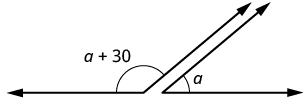
Two angles are supplementary. The larger angle is more than the smaller angle. Find the measure of both angles.
2つの角は互いに補角である。大きい角は小さい角より大きい。両方の角の大きさを求めよ。
Solution解答
Step 1. Read the problem. Draw the figure and label it with the given information. 手順1 問題を読む。図を描き、与えられた情報を書き込む。 |
 |
Step 2. Identify what you are looking for. 手順2 何を求めるのかを明らかにする。 |
 |
Step 3. Name. Choose a variable to represent it. The larger angle is 30° more than the smaller angle. 手順3.文字で表す。それを表す変数を選ぶ。大きい角は小さい角より30度大きい。 |
  |
Step 4. Translate. Write the appropriate formula and substitute. 手順4.式に表す。適切な公式を書き、代入する。 |
 |
Step 5. Solve the equation. 手順5 方程式を解く。 |
       |
Step 6. Check: 手順6 確認:    |
|
Step 7. Answer the question. 手順7 問いに答える。 |
 |