第16章太陽――核エネルギーの源The Sun: A Nuclear Powerhouse
The Sun Is Not Cooling Down太陽は冷え続けてはいない
As everyone who has ever left a window open on a cold winter night knows, heat always flows from hotter to cooler regions. As energy filters outward toward the surface of a star, it must be flowing from inner, hotter regions. The temperature cannot ordinarily get cooler as we go inward in a star, or energy would flow in and heat up those regions until they were at least as hot as the outer ones. Scientists conclude that the temperature is highest at the center of a star, dropping to lower and lower values toward the stellar surface. (The high temperature of the Sun’s chromosphere and corona may therefore appear to be a paradox. But remember from The Sun: A Garden-Variety Star that these high temperatures are maintained by magnetic effects, which occur in the Sun’s atmosphere.)
英語のヒント
寒い冬の夜に窓を開けたままにした経験のある人なら誰でも知っているように、熱は常に高温の領域から低温の領域へ流れる。エネルギーが恒星の表面へ向かって少しずつ外へ流れるなら、それは内部の、より高温の領域から流れてきているはずである。通常、恒星の内側へ進むほど温度が低くなることはない。もしそうなら、エネルギーが内向きに流れ、内側が少なくとも外側と同じ温度になるまで加熱するはずだ。科学者は、温度は恒星の中心で最も高く、表面へ向かって下がり続けると結論する。そのため、太陽の彩層とコロナの高温は矛盾に見えるかもしれない。しかし「太陽――ありふれた恒星」で学んだように、この高温は太陽大気で起こる磁場の作用によって維持されている。
The outward flow of energy through a star robs it of its internal heat, and the star would cool down if that energy were not replaced. Similarly, a hot iron begins to cool as soon as it is unplugged from its source of electric energy. Therefore, a source of fresh energy must exist within each star. In the Sun’s case, we have seen that this energy source is the ongoing fusion of hydrogen to form helium.
英語のヒント
恒星の中をエネルギーが外向きに流れると、内部の熱が奪われる。失ったエネルギーを補わなければ、恒星は冷えてしまうだろう。熱いアイロンも、コンセントを抜いて電力の供給を断つと、すぐに冷え始めるのと同じである。したがって、どの恒星の内部にも新たなエネルギーの供給源がなければならない。太陽の場合には、すでに見たように、水素がヘリウムになる核融合が続いていることが、その供給源である。
Heat Transfer in a Star恒星の中の熱輸送
Since the nuclear reactions that generate the Sun’s energy occur deep within it, the energy must be transported from the center of the Sun to its surface—where we see it in the form of both heat and light. There are three ways in which energy can be transferred from one place to another. In conduction, atoms or molecules pass on their energy by colliding with others nearby. This happens, for example, when the handle of a metal spoon heats up as you stir a cup of hot coffee. In convection, currents of warm material rise, carrying their energy with them to cooler layers. A good example is hot air rising from a fireplace. In radiation, energetic photons move away from hot material and are absorbed by some material to which they convey some or all of their energy. You can feel this when you put your hand close to the coils of an electric heater, allowing infrared photons to heat up your hand. Conduction and convection are both important in the interiors of planets. In stars, which are much more transparent, radiation and convection are important, whereas conduction can usually be ignored.
英語のヒント
太陽エネルギーを生む核反応は奥深くで起こるので、エネルギーは中心から表面まで運ばれなければならない。そこで私たちは、熱と光の形でそれを見る。エネルギーをある場所から別の場所へ運ぶ方法は三つある。伝導では、原子や分子が近くの別の粒子と衝突し、エネルギーを渡す。たとえば、熱いコーヒーを金属のスプーンでかき混ぜると、柄が熱くなるのがこれである。対流では、暖かい物質の流れが上昇し、エネルギーをより低温の層へ運ぶ。暖炉から暖かい空気が上昇するのが、よい例である。放射では、エネルギーをもつ光子が高温の物質から離れ、別の物質に吸収されて、そのエネルギーの一部または全部を渡す。電気ヒーターのコイルに手を近づけ、赤外線の光子で手が温まるときに、これを感じられる。惑星の内部では伝導と対流の両方が重要である。はるかに透明な恒星では、放射と対流が重要で、通常は伝導を無視できる。
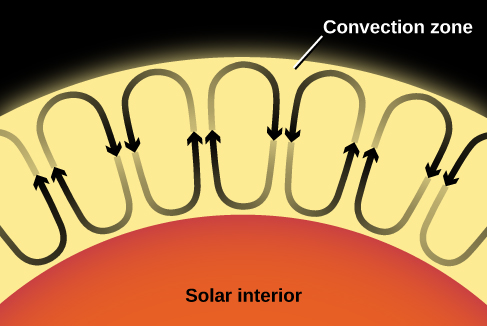
Stellar convection occurs as currents of hot gas flow up and down through the star (Figure 16.12). Such currents travel at moderate speeds and do not upset the overall stability of the star. They don’t even result in a net transfer of mass either inward or outward because, as hot material rises, cool material falls and replaces it. This results in a convective circulation of rising and falling cells as seen in Figure 16.12. In much the same way, heat from a fireplace can stir up air currents in a room, some rising and some falling, without driving any air into or out the room. Convection currents carry heat very efficiently outward through a star. In the Sun, convection turns out to be important in the central regions and near the surface.
英語のヒント
恒星の対流は、高温のガスが内部を上下に流れることで起こる(図16.12)。その流れは適度な速さで、恒星全体の安定を乱さない。高温の物質が上がると、冷たい物質が下がってその場所を埋めるため、差し引きでは、内向きにも外向きにも質量を移動させない。こうして図16.12のように、上昇と下降を繰り返す対流セルの循環が生まれる。暖炉の熱が部屋の中に上昇・下降する空気の流れを起こしても、空気を部屋の内外へ出し入れするわけではないのと、よく似ている。対流は恒星の中を外向きに、非常に効率よく熱を運ぶ。太陽では、中心領域と表面付近で対流が重要になる。
Convection.対流。
OpenStax / Rice University · CC BY 4.0
Figure 16.12 Rising convection currents carry heat from the Sun’s interior to its surface, whereas cooler material sinks downward. Of course, nothing in a real star is as simple as diagrams in textbooks suggest.
図16.12 上昇する対流は太陽内部から表面へ熱を運び、一方で冷たい物質は沈む。もちろん、実際の恒星の中は、教科書の図が示すほど単純ではない。
Unless convection occurs, the only significant mode of energy transport through a star is by electromagnetic radiation. Radiation is not an efficient means of energy transport in stars because gases in stellar interiors are very opaque, that is, a photon does not go far (in the Sun, typically about 0.01 meter) before it is absorbed. (The processes by which atoms and ions can interrupt the outward flow of photons—such as becoming ionized—were discussed in the section on the Formation of Spectral Lines.) The absorbed energy is always reemitted, but it can be reemitted in any direction. A photon absorbed when traveling outward in a star has almost as good a chance of being radiated back toward the center of the star as toward its surface.
英語のヒント
対流が起きないなら、恒星の中で重要なエネルギー輸送の方法は、電磁放射だけである。恒星内部のガスは非常に不透明なので、放射は効率のよいエネルギー輸送法ではない。つまり光子は、太陽では典型的に約0.01メートルという短い距離で吸収されてしまう。原子やイオンが、電離されるときなどに、光子の外向きの流れを妨げる過程は、「スペクトル線のでき方」の節で説明した。吸収されたエネルギーは必ず再放出されるが、どの方向へも放出されうる。恒星の中を外向きに進んで吸収された光子が、表面へ向かって再放射される確率と、中心へ戻る向きに再放射される確率は、ほとんど同じである。
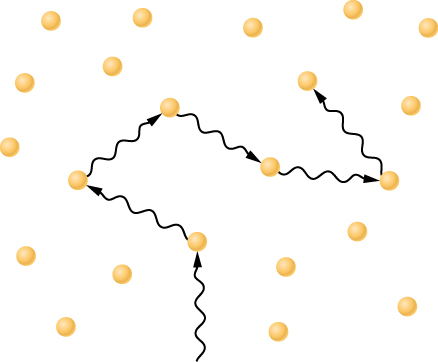
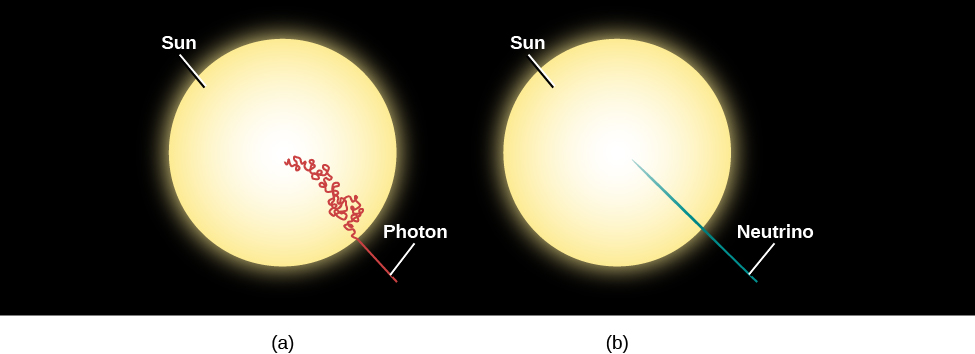
A particular quantity of energy, therefore, zigzags around in an almost random manner and takes a long time to work its way from the center of a star to its surface (Figure 16.13). Estimates are somewhat uncertain, but in the Sun, as we saw, the time required is probably between 100,000 and 1,000,000 years. If the photons were not absorbed and reemitted along the way, they would travel at the speed of light and could reach the surface in a little over 2 seconds, just as neutrinos do (Figure 16.14).
英語のヒント
したがって、ある量のエネルギーは、ほぼ無作為な仕方であちこちへジグザグに進み、恒星の中心から表面へたどり着くまでに長い時間がかかる(図16.13)。見積もりには不確かさがあるが、すでに見たように、太陽ではおそらく10万〜100万年を要する。途中で光子が吸収・再放出されなければ、光速で進み、ニュートリノと同じく、2秒を少し超える時間で表面に届くはずである(図16.14)。
Photons Deep in the Sun.太陽の奥深くにある光子。
OpenStax / Rice University · CC BY 4.0
Figure 16.13 A photon moving through the dense gases in the solar interior travels only a short distance before it interacts with one of the surrounding atoms. The resulting photon usually has a lower energy after each interaction and may then travel in any random direction.
図16.13 太陽内部の高密度のガスの中を進む光子は、短い距離しか進まないうちに、周囲の原子の一つと相互作用する。各相互作用の後に生じる光子は、通常はエネルギーが低くなり、その後は無作為に選ばれたどの方向へも進みうる。
Photon and Neutrino Paths in the Sun.太陽の中の光子とニュートリノの経路。
OpenStax / Rice University · CC BY 4.0
Figure 16.14 (a) Because photons generated by fusion reactions in the solar interior travel only a short distance before being absorbed or scattered by atoms and sent off in random directions, estimates are that it takes between 100,000 and 1,000,000 years for energy to make its way from the center of the Sun to its surface. (b) In contrast, neutrinos do not interact with matter but traverse straight through the Sun at the speed of light, reaching the surface in only a little more than 2 seconds.
図16.14 (a)太陽内部の核融合で生じた光子は、短い距離で原子に吸収または散乱され、無作為な方向へ送り出される。そのため、エネルギーが中心から表面まで進むには、10万〜100万年かかると見積もられる。(b)対照的に、ニュートリノは物質と相互作用せず、太陽の中を光速でまっすぐ進み、わずか2秒余りで表面へ到達する。