第16章太陽――核エネルギーの源The Sun: A Nuclear Powerhouse
16.3 The Solar Interior: Theory16.3 太陽の内部――理論
Learning Objectives学習の目標
By the end of this section, you will be able to:
この節を読み終えると、次のことができるようになる。
Describe the state of equilibrium of the Sun
太陽の平衡状態について述べる。
Understand the energy balance of the Sun
太陽のエネルギーの収支を理解する。
Explain how energy moves outward through the Sun
太陽の中をエネルギーが外向きに移動する仕組みを説明する。
Describe the structure of the solar interior
太陽内部の構造について述べる。
Fusion of protons can occur in the center of the Sun only if the temperature exceeds 12 million K. How do we know that the Sun is actually this hot? To determine what the interior of the Sun might be like, it is necessary to resort to complex calculations. Since we can’t see the interior of the Sun, we have to use our understanding of physics, combined with what we see at the surface, to construct a mathematical model of what must be happening in the interior. Astronomers use observations to build a computer program containing everything they think they know about the physical processes going on in the Sun’s interior. The computer then calculates the temperature and pressure at every point inside the Sun and determines what nuclear reactions, if any, are taking place. For some calculations, we can use observations to determine whether the computer program is producing results that match what we see. In this way, the program evolves with ever-improving observations.
英語のヒント
太陽の中心で陽子の核融合が起こるには、温度が1,200万Kを超えなければならない。太陽が本当にそれほど高温だと、どうしてわかるのだろうか。内部がどのような状態なのかを決めるには、複雑な計算に頼る必要がある。内部は見えないので、物理学の知識と表面での観測を組み合わせ、内部で起きているはずのことを表す数学的モデルを作らなければならない。天文学者は観測を使い、太陽内部で進む物理過程について、わかっていると考えることをすべて盛り込んだコンピュータープログラムを作る。コンピューターは太陽内部のあらゆる場所の温度と圧力を計算し、核反応が起きているなら、それがどの反応かを決める。計算の種類によっては、プログラムの結果が見えているものと一致するかを、観測で確かめられる。こうして、観測が改善し続けるのに伴って、プログラムも発展する。
The computer program can also calculate how the Sun will change with time. After all, the Sun must change. In its center, the Sun is slowly depleting its supply of hydrogen and creating helium instead. Will the Sun get hotter? Cooler? Larger? Smaller? Brighter? Fainter? Ultimately, the changes in the center could be catastrophic, since eventually all the hydrogen fuel hot enough for fusion will be exhausted. Either a new source of energy must be found, or the Sun will cease to shine. We will describe the ultimate fate of the Sun in later chapters. For now, let’s look at some of the things we must teach the computer about the Sun in order to carry out such calculations.
英語のヒント
コンピュータープログラムは、太陽が時間とともにどう変わるかも計算できる。結局、太陽は変化せずにはいられない。中心では、水素の蓄えをゆっくり使い減らし、代わりにヘリウムを作っているからだ。太陽は熱くなるのか、冷たくなるのか。大きくなるのか、小さくなるのか。明るくなるのか、暗くなるのか。中心の変化は最終的には壊滅的なものになりうる。核融合できるほど高温の水素燃料は、いつかすべて尽きるためである。新たなエネルギー源を得られなければ、太陽は輝くのをやめることになる。太陽の最終的な運命は後の章で説明する。ここでは、そのような計算を行うために、太陽についてコンピューターへ教えなければならないことを、いくつか見ていこう。
The Sun Is a Plasma太陽はプラズマである
The Sun is so hot that all of the material in it is in the form of an ionized gas, called a plasma. Plasma acts much like a hot gas, which is easier to describe mathematically than either liquids or solids. The particles that constitute a gas are in rapid motion, frequently colliding with one another. This constant bombardment is the pressure of the gas (Figure 16.10).
英語のヒント
太陽は非常に高温なので、その中の物質はすべて、プラズマと呼ばれる電離した気体の形になっている。プラズマは高温の気体によく似た振る舞いをし、液体や固体よりも数学的に記述しやすい。気体を構成する粒子は素早く動き回り、頻繁に互いと衝突する。この絶え間ない衝突が気体の圧力である(図16.10)。
Gas Pressure.気体の圧力。

OpenStax / Rice University · CC BY 4.0
Figure 16.10 The particles in a gas are in rapid motion and produce pressure through collisions with the surrounding material. Here, particles are shown bombarding the sides of an imaginary container.
図16.10 気体中の粒子は高速で動き、周囲の物質との衝突によって圧力を生む。ここでは、仮想の容器の壁に粒子が衝突する様子を示している。
More particles within a given volume of gas produce more pressure because the combined impact of the moving particles increases with their number. The pressure is also greater when the molecules or atoms are moving faster. Since the molecules move faster when the temperature is hotter, higher temperatures produce higher pressure.
英語のヒント
同じ体積の気体の中に粒子が多くあれば、動く粒子が与える衝撃の合計も増えるので、圧力は高くなる。分子や原子の動きが速い場合も、圧力は高くなる。温度が高いと分子は速く動くため、温度が高いほど圧力も高い。
The Sun Is Stable太陽は安定している
The Sun, like the majority of other stars, is stable; it is neither expanding nor contracting. Such a star is said to be in a condition of equilibrium. All the forces within it are balanced, so that at each point within the star, the temperature, pressure, density, and so on are maintained at constant values. We will see in later chapters that even these stable stars, including the Sun, are changing as they evolve, but such evolutionary changes are so gradual that, for all intents and purposes, the stars are still in a state of equilibrium at any given time.
英語のヒント
太陽はほかの恒星の大半と同じく安定しており、膨張も収縮もしていない。このような恒星は、平衡状態にあるという。内部のすべての力がつり合うため、恒星内部の各点では、温度、圧力、密度などが一定の値に保たれる。後の章で見るように、太陽を含む安定した恒星も進化に伴って変化している。しかしその変化は非常にゆっくりなので、どの時点でも、実用上は平衡状態にあるとみなせる。
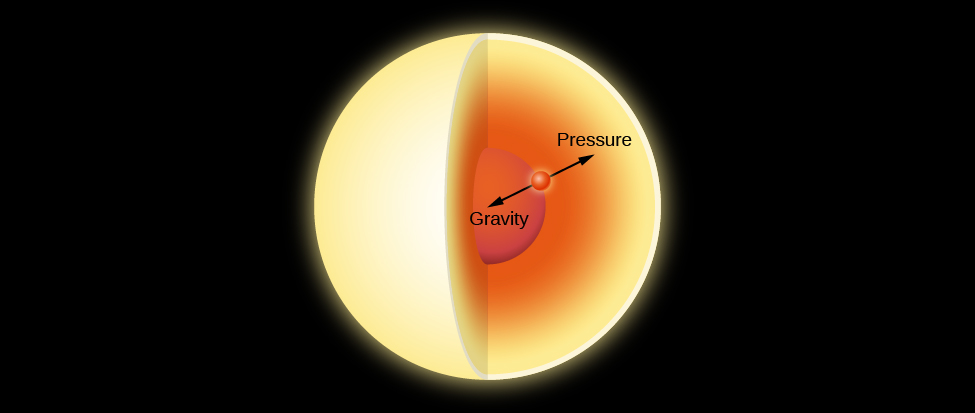
The mutual gravitational attraction between the masses of various regions within the Sun produces tremendous forces that tend to collapse the Sun toward its center. Yet we know from the history of Earth that the Sun has been emitting roughly the same amount of energy for billions of years, so clearly it has managed to resist collapse for a very long time. The gravitational forces must therefore be counterbalanced by some other force. That force is due to the pressure of gases within the Sun (Figure 16.11). Calculations show that, in order to exert enough pressure to prevent the Sun from collapsing due to the force of gravity, the gases at its center must be maintained at a temperature of 15 million K. Think about what this tells us. Just from the fact that the Sun is not contracting, we can conclude that its temperature must indeed be high enough at the center for protons to undergo fusion.
英語のヒント
太陽内部のさまざまな領域にある質量同士が引き合う重力は、太陽を中心へ押しつぶそうとする巨大な力を生む。けれども地球の歴史から、太陽が数十億年にわたり、およそ同じ量のエネルギーを放出してきたことがわかる。だから、非常に長い間、崩壊に抵抗できてきたのは明らかである。したがって、重力には何か別の力が対抗してつり合っていなければならない。その力は、太陽内部の気体の圧力によるものである(図16.11)。重力による崩壊を防ぐだけの圧力を生み出すには、中心の気体が1,500万Kに保たれなければならないことが、計算からわかる。このことが何を教えているかを考えよう。太陽が収縮していないという事実だけから、中心の温度はたしかに陽子の核融合が起こるほど高くなければならない、と結論できるのである。
Hydrostatic Equilibrium.静水圧平衡。
OpenStax / Rice University · CC BY 4.0
Figure 16.11 In the interior of a star, the inward force of gravity is exactly balanced at each point by the outward force of gas pressure.
図16.11 恒星の内部では、内向きの重力と外向きの気体の圧力による力が、各点でちょうどつり合っている。
The Sun maintains its stability in the following way. If the internal pressure in such a star were not great enough to balance the weight of its outer parts, the star would collapse somewhat, contracting and building up the pressure inside. On the other hand, if the pressure were greater than the weight of the overlying layers, the star would expand, thus decreasing the internal pressure. Expansion would stop, and equilibrium would again be reached when the pressure at every internal point equaled the weight of the stellar layers above that point. An analogy is an inflated balloon, which will expand or contract until an equilibrium is reached between the pressure of the air inside and outside. The technical term for this condition is hydrostatic equilibrium. Stable stars are all in hydrostatic equilibrium; so are the oceans of Earth as well as Earth’s atmosphere. The air’s own pressure keeps it from falling to the ground.
英語のヒント
太陽は次のように安定を保つ。内部の圧力が外側の部分の重さを支えるのに足りなければ、恒星は少し崩れるように収縮し、内部の圧力を高める。逆に、圧力が上に重なる層の重さより大きければ、恒星は膨張し、内部の圧力を下げる。内部の各点で圧力とその上の恒星の層の重さがつり合うと、膨張は止まり、再び平衡になる。たとえるなら、膨らませた風船である。風船は内外の空気の圧力がつり合うまで、膨張したり収縮したりする。この状態の専門用語が静水圧平衡である。安定した恒星はすべて静水圧平衡にある。地球の海も大気も同様である。空気は、自分自身の圧力によって、地面へ落ち込まずに保たれている。