第16章太陽――核エネルギーの源The Sun: A Nuclear Powerhouse
Model Stars恒星のモデル
Scientists use the principles we have just described to calculate what the Sun’s interior is like. These physical ideas are expressed as mathematical equations that are solved to determine the values of temperature, pressure, density, the efficiency with which photons are absorbed, and other physical quantities throughout the Sun. The solutions obtained, based on a specific set of physical assumptions, provide a theoretical model for the interior of the Sun.
英語のヒント
科学者は、今説明した原理を使い、太陽の内部がどのようになっているかを計算する。これらの物理的な考えを数学の方程式で表し、それを解いて、太陽全体の温度、圧力、密度、光子の吸収されやすさ、その他の物理量を求める。特定の物理的仮定の組に基づいて得られた解が、太陽内部の理論モデルとなる。
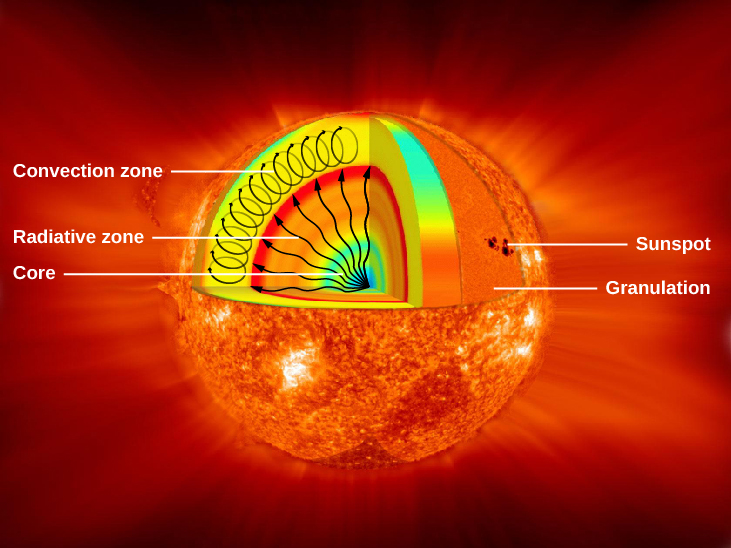
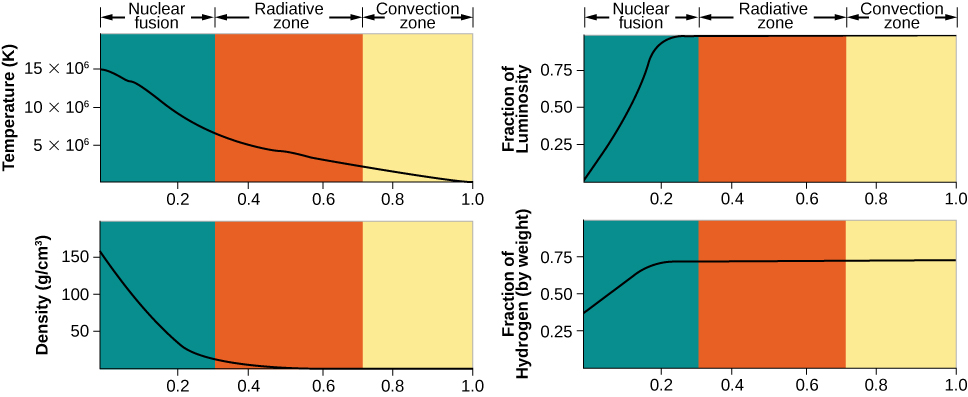
Figure 16.15 schematically illustrates the predictions of a theoretical model for the Sun’s interior. Energy is generated through fusion in the core of the Sun, which extends only about one-quarter of the way to the surface but contains about one-third of the total mass of the Sun. At the center, the temperature reaches a maximum of approximately 15 million K, and the density is nearly 150 times that of water. The energy generated in the core is transported toward the surface by radiation until it reaches a point about 70% of the distance from the center to the surface. At this point, convection begins, and energy is transported the rest of the way, primarily by rising columns of hot gas.
英語のヒント
図16.15は、太陽内部の理論モデルの予測を模式的に示す。エネルギーは中心核の核融合によって作られる。中心核が広がるのは表面までの距離の約4分の1にすぎないが、太陽の全質量の約3分の1が含まれる。中心では温度が最高の約1,500万Kに達し、密度は水の約150倍である。中心核で生じたエネルギーは、中心から表面までの距離の約70%の地点まで、放射によって外へ運ばれる。そこから対流が始まり、残りの道のりでは主に、高温のガスの柱が上昇することによって運ばれる。
Interior Structure of the Sun.太陽の内部構造。
credit: modification of work by NASA/Goddard · NASA media use guidelines
Figure 16.15 Energy is generated in the core by the fusion of hydrogen to form helium. This energy is transmitted outward by radiation—that is, by the absorption and reemission of photons. In the outermost layers, energy is transported mainly by convection. (credit: modification of work by NASA/Goddard)
図16.15 中心核では、水素が融合してヘリウムになることでエネルギーが作られる。このエネルギーは、光子の吸収と再放出、すなわち放射によって外へ運ばれる。最も外側の層では、主に対流がエネルギーを運ぶ。(クレジット:NASA/Goddardの作品を改変)
Figure 16.16 shows how the temperature, density, rate of energy generation, and composition vary from the center of the Sun to its surface.
図16.16は、太陽の中心から表面まで、温度、密度、エネルギー生成率、組成がどのように変化するかを示す。
Interior of the Sun.太陽の内部。
OpenStax / Rice University · CC BY 4.0
Figure 16.16 Diagrams showing how temperature, density, rate of energy generation, and the percentage (by mass) abundance of hydrogen vary inside the Sun. The horizontal scale shows the fraction of the Sun’s radius: the left edge is the very center, and the right edge is the visible surface of the Sun, which is called the photosphere.
図16.16 温度、密度、エネルギー生成率、水素の存在量の百分率(質量比)が、太陽の中でどう変化するかを示す図。横軸は太陽半径に対する割合で、左端は中心そのもの、右端は光球と呼ばれる太陽の見える表面である。
Key Concepts and Summary重要事項のまとめ
Even though we cannot see inside the Sun, it is possible to calculate what its interior must be like. As input for these calculations, we use what we know about the Sun. It is made entirely of hot gas. Apart from some very tiny changes, the Sun is neither expanding nor contracting (it is in hydrostatic equilibrium) and puts out energy at a constant rate. Fusion of hydrogen occurs in the center of the Sun, and the energy generated is carried to the surface by radiation and then convection. A solar model describes the structure of the Sun’s interior. Specifically, it describes how pressure, temperature, mass, and luminosity depend on the distance from the center of the Sun.
太陽の中は見えなくても、内部がどのようになっているはずかを計算することはできる。その計算への入力には、太陽についてわかっていることを使う。太陽はすべて高温の気体からなり、ごくわずかな変化を除けば、膨張も収縮もしていない。すなわち静水圧平衡にあり、一定の割合でエネルギーを放出している。中心で水素の核融合が起こり、作られたエネルギーは放射、それから対流によって表面へ運ばれる。太陽モデルは内部の構造を記述する。具体的には、圧力、温度、質量、光度が、中心からの距離によってどう変わるかを表す。
conduction
伝導
process by which heat is directly transmitted through a substance when there is a difference of temperature between adjoining regions caused by atomic or molecular collisions
隣り合う領域の温度が異なるとき、原子や分子の衝突によって、物質の中を熱が直接伝わる過程。
convection
対流
movement caused within a gas or liquid by the tendency of hotter, and therefore less dense material, to rise and colder, denser material to sink under the influence of gravity, which consequently results in transfer of heat
気体や液体の中で、高温で密度の低い物質が上昇し、低温で密度の高い物質が重力によって沈む傾向から生じる運動。その結果、熱が運ばれる。
hydrostatic equilibrium
静水圧平衡
balance between the weights of various layers, as in a star or Earth’s atmosphere, and the pressures that support them
恒星や地球大気などで、さまざまな層の重さと、それを支える圧力がつり合っている状態。
radiation
放射
emission of energy as electromagnetic waves or photons also the transmitted energy itself
電磁波や光子としてエネルギーを放出すること。また、そのように伝わるエネルギーそのもの。