第16章太陽――核エネルギーの源The Sun: A Nuclear Powerhouse
Solar Neutrinos太陽ニュートリノ
The second technique for obtaining information about the Sun’s interior involves the detection of a few of those elusive neutrinos created during nuclear fusion. Recall from our earlier discussion that neutrinos created in the center of the Sun make their way directly out of the Sun and travel to Earth at nearly the speed of light. As far as neutrinos are concerned, the Sun is transparent.
英語のヒント
太陽内部の情報を得る第2の方法は、核融合で生じる、あの捉えにくいニュートリノの、ごく一部を検出することである。以前の議論を思い出そう。中心でできたニュートリノは太陽から直接出て、ほぼ光速で地球へ進む。ニュートリノにとっては、太陽は透明なのである。
About 3% of the total energy generated by nuclear fusion in the Sun is carried away by neutrinos. So many protons react and form neutrinos inside the Sun’s core that, scientists calculate, 35 million billion (3.5 × 10¹⁶) solar neutrinos pass through each square meter of Earth’s surface every second. If we can devise a way to detect even a few of these solar neutrinos, then we can obtain information directly about what is going on in the center of the Sun. Unfortunately for those trying to “catch” some neutrinos, Earth and everything on it are also nearly transparent to passing neutrinos, just like the Sun.
英語のヒント
太陽の核融合が生み出す全エネルギーの約3%は、ニュートリノによって持ち去られる。中心核では非常に多くの陽子が反応してニュートリノを作るため、計算によると、地表の1平方メートルを毎秒3京5,000兆個(3.5 × 10¹⁶個)の太陽ニュートリノが通り抜ける。このうちわずかでも検出する方法を考案できれば、太陽の中心で起きていることについて、直接情報を得られる。しかし、ニュートリノを「捕まえよう」とする人には不運なことに、地球も、その上にあるすべてのものも、太陽と同じく、通過するニュートリノにはほぼ透明なのである。
On very, very rare occasions, however, one of the billions and billions of solar neutrinos will interact with another atom. The first successful detection of solar neutrinos made use of cleaning fluid (C2Cl4), which is the least expensive way to get a lot of chlorine atoms together. The nucleus of a chlorine (Cl) atom in the cleaning fluid can be turned into a radioactive argon nucleus by an interaction with a neutrino. Because the argon is radioactive, its presence can be detected. However, since the interaction of a neutrino with chlorine happens so rarely, a huge amount of chlorine is needed.
英語のヒント
ただし、ごく、ごくまれには、莫大な数の太陽ニュートリノの一つが、別の原子と相互作用する。太陽ニュートリノの検出に初めて成功した実験では、洗浄液C₂Cl₄を使った。大量の塩素原子を集めるのに、最も安価な方法だったからである。洗浄液中の塩素Cl原子の核は、ニュートリノとの相互作用によって、放射性のアルゴン原子核へ変わることがある。アルゴンには放射能があるため、その存在を検出できる。しかしニュートリノと塩素の相互作用は極めてまれなので、莫大な量の塩素が必要になる。
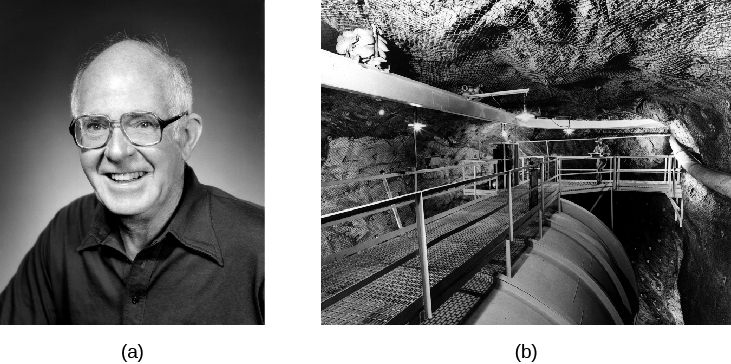
Raymond Davis, Jr. (Figure 16.19) and his colleagues at Brookhaven National Laboratory, placed a tank containing nearly 400,000 liters of cleaning fluid 1.5 kilometers beneath Earth’s surface in a gold mine at Lead, South Dakota. A mine was chosen so that the surrounding material of Earth would keep cosmic rays (high-energy particles from space) from reaching the cleaning fluid and creating false signals. (Cosmic-ray particles are stopped by thick layers of Earth, but neutrinos find them of no significance.) Calculations show that solar neutrinos should produce about one atom of radioactive argon in the tank each day.
英語のヒント
レイモンド・デイヴィス・ジュニア(図16.19)とブルックヘブン国立研究所の同僚たちは、サウスダコタ州リードにある金鉱の地下1.5キロメートルに、約40万リットルの洗浄液を入れたタンクを設置した。鉱山を選んだのは、周囲の地球の物質で、宇宙から来る高エネルギー粒子である宇宙線が洗浄液へ届き、偽の信号を作るのを防ぐためだった。宇宙線の粒子は地球の厚い層で止められるが、ニュートリノにはその層も大した意味をもたない。計算によると、太陽ニュートリノはタンクの中で、1日当たり約1個の放射性アルゴン原子を作るはずだった。
Davis Experiment.デイヴィスの実験。
credit a: modification of work by Brookhaven National Laboratory; credit b: modification of work by the United States Department of Energy · U.S. government work; OpenStax adaptation CC BY 4.0
Figure 16.19 (a) Raymond Davis received the Nobel Prize in physics in 2002. (b) Davis’ experiment at the bottom of an abandoned gold mine first revealed problems with our understanding of neutrinos. (credit a: modification of work by Brookhaven National Laboratory; credit b: modification of work by the United States Department of Energy)
図16.19 (a)レイモンド・デイヴィスは2002年のノーベル物理学賞を受賞した。(b)廃金鉱の底でのデイヴィスの実験が、ニュートリノについての私たちの理解に問題があることを初めて明らかにした。(クレジットa:Brookhaven National Laboratoryの作品を改変、b:United States Department of Energyの作品を改変)
This was an amazing project: they counted argon atoms about once per month—and remember, they were looking for a tiny handful of argon atoms in a massive tank of chlorine atoms. When all was said and done, Davis’ experiment, begun in 1970, detected only about one-third as many neutrinos as predicted by solar models! This was a shocking result because astronomers thought they had a pretty good understanding of both neutrinos and the Sun’s interior. For many years, astronomers and physicists wrestled with Davis’ results, trying to find a way out of the dilemma of the “missing” neutrinos.
英語のヒント
これは驚くべき計画だった。彼らは約1か月ごとにアルゴン原子を数えたが、巨大な塩素原子のタンクの中で、ごくひと握りのアルゴン原子を探していたことを忘れてはならない。1970年に始まったデイヴィスの実験は、最終的に、太陽モデルの予測するニュートリノの約3分の1しか検出しなかった。天文学者は、ニュートリノも太陽内部もかなりよく理解していると考えていたため、衝撃的な結果だった。天文学者や物理学者は長年、この結果と格闘し、「失われた」ニュートリノの難問から抜け出す道を探した。
Eventually Davis’ result was explained by the surprising discovery that there are actually three types of neutrinos. Solar fusion produces only one type of neutrino, the so-called electron neutrino, and the initial experiments to detect solar neutrinos were designed to detect this one type. Subsequent experiments showed that these neutrinos change to a different type during their journey from the center of the Sun through space to Earth in a process called neutrino oscillation.
英語のヒント
最終的にデイヴィスの結果は、ニュートリノには実際には3種類あるという驚くべき発見によって説明された。太陽の核融合が作るのは、電子ニュートリノと呼ばれる1種類だけであり、初期の太陽ニュートリノ検出実験は、この1種類を検出するよう設計されていた。後の実験により、ニュートリノは太陽の中心から宇宙空間を通って地球へ来る旅の途中で、ニュートリノ振動と呼ばれる過程によって、別の種類へ変わることがわかった。
An experiment, conducted at the Sudbury Neutrino Observatory in Canada, was the first one designed to capture all three types of neutrinos (Figure 16.20). The experiment was located in a mine 2 kilometers underground. The neutrino detector consisted of a 12-meter-diameter transparent acrylic plastic sphere, which contained 1000 metric tons of heavy water. Remember that an ordinary water molecule contains two hydrogen atoms and one oxygen atom. Heavy water instead contains two deuterium atoms and one oxygen atom, and incoming neutrinos can occasionally break up the loosely bound proton and neutron that make up the deuterium nucleus. The sphere of heavy water was surrounded by a shield of 1700 metric tons of very pure water, which in turn was surrounded by 9600 photomultipliers, devices that detect flashes of light produced after neutrinos interact with the heavy water.
英語のヒント
カナダのサドベリー・ニュートリノ観測所で行われた実験は、3種類すべてのニュートリノを捉えるよう設計された、最初の実験だった(図16.20)。実験施設は鉱山の地下2キロメートルにあった。検出器は、直径12メートルの透明なアクリル樹脂の球で、1,000トンの重水が入っていた。普通の水分子には、水素原子2個と酸素原子1個が含まれることを思い出そう。重水では代わりに、重水素原子2個と酸素原子1個が含まれる。到来するニュートリノはときおり、重水素原子核を作る、比較的弱く結び付いた陽子と中性子を引き離せる。重水の球は、1,700トンの非常に純粋な水の遮蔽層に囲まれ、その外側を9,600本の光電子増倍管が囲んでいた。光電子増倍管は、ニュートリノが重水と相互作用した後に生じる光の閃光を検出する装置である。
Sudbury Neutrino Detector.サドベリーのニュートリノ検出器。
Figure 16.20 The 12-meter sphere of the Sudbury Neutrino Detector lies more than 2 kilometers underground and holds 1000 metric tons of heavy water. (credit: A.B. McDonald (Queen’s University) et al., The Sudbury Neutrino Observatory Institute)
図16.20 サドベリーのニュートリノ検出器の直径12メートルの球は、地下2キロメートルより深い場所にあり、1,000トンの重水を収めている。(クレジット:A. B. McDonald〈Queen’s University〉ほか、The Sudbury Neutrino Observatory Institute)
To the enormous relief of astronomers who make models of the Sun, the Sudbury experiment detected about 1 neutrino per hour and has shown that the total number of neutrinos reaching the heavy water is just what solar models predict. Only one-third of these, however, are electron neutrinos. It appears that two-thirds of the electron neutrinos produced by the Sun transform themselves into one of the other types of neutrinos as they make their way from the core of the Sun to Earth. This is why the earlier experiments saw only one-third the number of neutrinos expected.
英語のヒント
太陽モデルを作る天文学者が大いに安堵したことに、サドベリーの実験は1時間当たり約1個のニュートリノを検出し、重水に届くニュートリノの総数が、太陽モデルの予測どおりであると示した。しかし、そのうち電子ニュートリノは3分の1だけだった。太陽が生み出した電子ニュートリノの3分の2は、太陽の中心核から地球へ進む途中で、ほかの種類のいずれかに変わるらしい。そのため、初期の実験では予想された数の3分の1しか見えなかったのである。
Although it is not intuitively obvious, such neutrino oscillations can happen only if the mass of the electron neutrino is not zero. Other experiments indicate that its mass is tiny (even compared to the electron). The 2015 Nobel Prize in physics was awarded to researchers Takaaki Kajita and Arthur B. McDonald for their work establishing the changeable nature of neutrinos. (Raymond Davis shared the 2002 Nobel Prize with Japan’s Masatoshi Koshiba for the experiments that led to our understanding of the neutrino problem in the first place.) But the fact that the neutrino has mass at all has deep implications for both physics and astronomy. For example, we will look at the role that neutrinos play in the inventory of the mass of the universe in The Big Bang.
英語のヒント
直観的には明らかでないが、このようなニュートリノ振動が起きるには、電子ニュートリノの質量がゼロであってはならない。ほかの実験は、その質量が電子に比べても小さいことを示している。2015年のノーベル物理学賞は、ニュートリノの変化する性質を確立した研究によって、梶田隆章とアーサー・B・マクドナルドに授与された。レイモンド・デイヴィスは、そもそもニュートリノ問題の理解へつながった実験により、日本の小柴昌俊とともに、2002年のノーベル賞を受賞している。それでも、ニュートリノにそもそも質量があるという事実は、物理学と天文学の両方に深い意味をもつ。たとえば「ビッグバン」では、宇宙の質量を数え上げる際に、ニュートリノが果たす役割を見る。
The Borexino experiment, an international experiment conducted in Italy, detected neutrinos coming from the Sun that were identified as coming from different reactions. Whereas the p-p chain is the reaction producing most of the Sun’s energy, it is not the only nuclear reaction occurring in the Sun’s core. There are side reactions involving nuclei of such elements as beryllium and boron. By probing the number of neutrinos that come from each reaction, the Borexino experiment has helped us confirm in detail our understanding of nuclear fusion in the Sun. In 2014, the Borexino experiment also identified neutrinos that were produced by the first step in the p-p chain, confirming the models of solar astronomers.
英語のヒント
イタリアで行われた国際実験ボレキシノは、太陽から来たニュートリノを検出し、異なる反応から来たものを識別した。太陽エネルギーの大半を生み出すのはp-p連鎖反応だが、中心核で起こる核反応はそれだけではない。ベリリウムやホウ素などの原子核が関わる、副次的な反応もある。各反応から来るニュートリノの数を調べることにより、ボレキシノ実験は太陽内部の核融合についての理解を、詳しく確かめる助けとなった。2014年には、p-p連鎖反応の第1段階で生じたニュートリノも識別し、太陽を研究する天文学者のモデルを裏付けた。
In 2020, scientists with the Borexino experiment were also able to identify neutrinos coming specifically from the CNO cycle of nuclear fusion. As discussed toward the end of Mass, Energy, and the Theory of Relativity, CNO fusion plays a very minor role in the Sun, but becomes important in stars that are more massive and hotter than the Sun.
英語のヒント
2020年には、ボレキシノ実験の科学者は、核融合のCNOサイクルから来たニュートリノを特定することにも成功した。「質量・エネルギーと相対性理論」の終わり近くで説明したように、CNO核融合は太陽ではごく小さな役割しか果たさないが、太陽より質量が大きく、高温の恒星では重要になる。
It’s amazing that a series of experiments that began with enough cleaning fluid to fill a swimming pool brought down the shafts of an old gold mine is now teaching us about the energy source of the Sun and the properties of matter! This is a good example of how experiments in astronomy and physics, coupled with the best theoretical models we can devise, continue to lead to fundamental changes in our understanding of nature.
英語のヒント
プールを満たせるほどの洗浄液を古い金鉱の坑道へ下ろすことから始まった一連の実験が、今では太陽のエネルギー源や物質の性質を教えているとは、驚くべきことである。これは、天文学や物理学の実験が、私たちの考えうる最良の理論モデルと結び付いて、自然の理解を根本から変え続けることの、よい例である。