第16章太陽――核エネルギーの源The Sun: A Nuclear Powerhouse
16.4 The Solar Interior: Observations16.4 太陽の内部――観測
Learning Objectives学習の目標
By the end of this section, you will be able to:
この節を読み終えると、次のことができるようになる。
Explain how the Sun pulsates
太陽がどのように脈動するかを説明する。
Explain what helioseismology is and what it can tell us about the solar interior
日震学とは何か、太陽内部について何を教えてくれるかを説明する。
Discuss how studying neutrinos from the Sun has helped understand neutrinos
太陽から来るニュートリノの研究が、ニュートリノの理解にどう役立ったかを論じる。
Recall that when we observe the Sun’s photosphere (the surface layer we see from the outside), we are not seeing very deeply into our star, certainly not into the regions where energy is generated. That’s why the title of this section—observations of the solar interior—should seem very surprising. However, astronomers have indeed devised two types of measurements that can be used to obtain information about the inner parts of the Sun. One technique involves the analysis of tiny changes in the motion of small regions at the Sun’s surface. The other relies on the measurement of the neutrinos emitted by the Sun.
英語のヒント
太陽の光球、すなわち外から見える表面の層を観測しても、太陽の奥深くを見ているわけではない。まして、エネルギーが生み出される領域を見てはいないことを思い出そう。だから、この節の題名「太陽内部の観測」は、とても意外に思えるはずである。しかし天文学者は、太陽の内側の情報を得られる2種類の測定法を実際に考案した。一つは、表面の小さな領域の動きの、ごくわずかな変化を分析する方法。もう一つは、太陽が放出するニュートリノを測定する方法である。
Solar Pulsations太陽の脈動
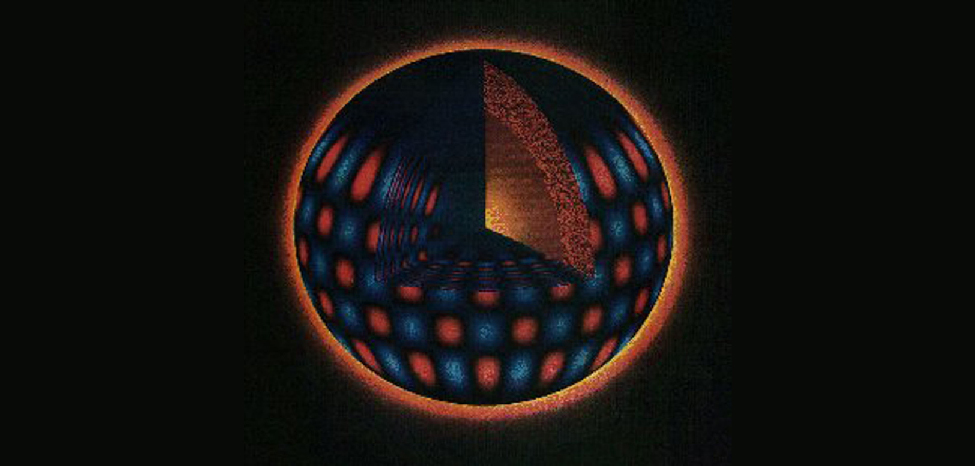
Astronomers discovered that the Sun pulsates—that is, it alternately expands and contracts—just as your chest expands and contracts as you breathe. This pulsation is very slight, but it can be detected by measuring the radial velocity of the solar surface—the speed with which it moves toward or away from us. The velocities of small regions on the Sun are observed to change in a regular way, first toward Earth, then away, then toward, and so on. It is as if the Sun were “breathing” through thousands of individual lungs, each having a size in the range of 4000 to 15,000 kilometers, each fluctuating back and forth (Figure 16.17).
英語のヒント
天文学者は、太陽が脈動することを発見した。呼吸するときに胸が膨らんだり縮んだりするように、太陽も交互に膨張・収縮するのである。この脈動はごく小さいが、太陽表面が私たちに近づいたり遠ざかったりする速さ、すなわち視線速度を測れば検出できる。太陽の小さな領域の速度は、初めは地球へ向かい、次に遠ざかり、また向かう、というように規則正しく変わる。まるで太陽が、大きさ4,000〜15,000キロメートルの別々の肺を数千個も使い、それぞれを前後に動かして「呼吸」しているかのようである(図16.17)。
Oscillations in the Sun.太陽の振動。
credit: modification of work by GONG, NOAO · CC BY 4.0
Figure 16.17 New observational techniques permit astronomers to measure small differences in velocity at the Sun’s surface to infer what the deep solar interior is like. In this computer simulation, red shows surface regions that are moving away from the observer (inward motion); blue marks regions moving toward the observer (outward motion). Note that the velocity changes penetrate deep into the Sun’s interior. (credit: modification of work by GONG, NOAO)
図16.17 新しい観測技術により、天文学者は太陽表面の速度のわずかな違いを測り、奥深い内部の様子を推測できる。このコンピューターシミュレーションでは、観測者から遠ざかる、すなわち内向きに動く表面の領域を赤、観測者へ近づく、すなわち外向きに動く領域を青で示す。速度の変化が太陽内部の深くまで及ぶことに注目しよう。(クレジット:GONG、NOAOの作品を改変)
The typical velocity of one of the oscillating regions on the Sun is only a few hundred meters per second, and it takes about 5 minutes to complete a full cycle from maximum to minimum velocity and back again. The change in the size of the Sun measured at any given point is no more than a few kilometers.
英語のヒント
太陽の振動する領域の典型的な速さは、秒速わずか数百メートルである。速度が最大から最小になり、再び戻る1周期には約5分かかる。ある場所で測った太陽の大きさの変化は、数キロメートル以下にすぎない。
The remarkable thing is that these small velocity variations can be used to determine what the interior of the Sun is like. The motion of the Sun’s surface is caused by waves that reach it from deep in the interior. Study of the amplitude and cycle length of velocity changes provides information about the temperature, density, and composition of the layers through which the waves passed before they reached the surface. The situation is somewhat analogous to the use of seismic waves generated by earthquakes to infer the properties of Earth’s interior. For this reason, studies of solar oscillations (back-and-forth motions) are referred to as helioseismology.
英語のヒント
驚くべきことに、この小さな速度変化から、太陽内部の状態を調べられる。表面の動きは、内部の深い場所から届く波によって起こされる。速度変化の振幅と周期を調べると、波が表面へ届くまでに通った層の、温度、密度、組成がわかる。これは、地震が生む地震波を使って地球内部の性質を推定することに、いくらか似ている。そのため、太陽の振動、すなわち行ったり来たりする動きの研究は、日震学と呼ばれる。
It takes a little over an hour for waves to traverse the Sun from center to surface, so the waves, like neutrinos, provide information about what the solar interior is like at the present time. In contrast, remember that the sunlight we see today emerging from the Sun was actually generated in the core several hundred thousand years ago.
英語のヒント
波が太陽の中心から表面まで通過するには、1時間余りかかる。したがって波は、ニュートリノと同じく、現在の太陽内部についての情報を伝える。対照的に、今日、太陽から出てくるのを見ている光は、実際には数十万年前に中心核で生み出されたものであることを思い出そう。
Helioseismology has shown that convection extends inward from the surface 30% of the way toward the center; we have used this information in drawing Figure 16.15. Pulsation measurements also show that the differential rotation that we see at the Sun’s surface, with the fastest rotation occurring at the equator, persists down through the convection zone. Below the convection zone, however, the Sun, even though it is gaseous throughout, rotates as if it were a solid body like a bowling ball. Another finding from helioseismology is that the abundance of helium inside the Sun, except in the center where nuclear reactions have converted hydrogen into helium, is about the same as at its surface. That result is important to astronomers because it means we are correct when we use the abundance of the elements measured in the solar atmosphere to construct models of the solar interior.
英語のヒント
日震学は、対流が表面から中心へ向かう距離の30%まで、内向きに広がることを示した。図16.15を描く際にも、この情報を使っている。脈動の測定からは、表面に見られる、赤道で最も速く回る差動回転が、対流層の中まで続くこともわかる。しかし対流層の下では、太陽は全体が気体でできているにもかかわらず、ボウリングの球のような固体であるかのように回転する。日震学の別の発見は、太陽内部のヘリウムの存在比が、核反応で水素をヘリウムに変えている中心を除けば、表面とほぼ同じだということである。この結果は、太陽大気で測った元素存在比を使って内部モデルを作るのが正しいと示すため、天文学者にとって重要である。
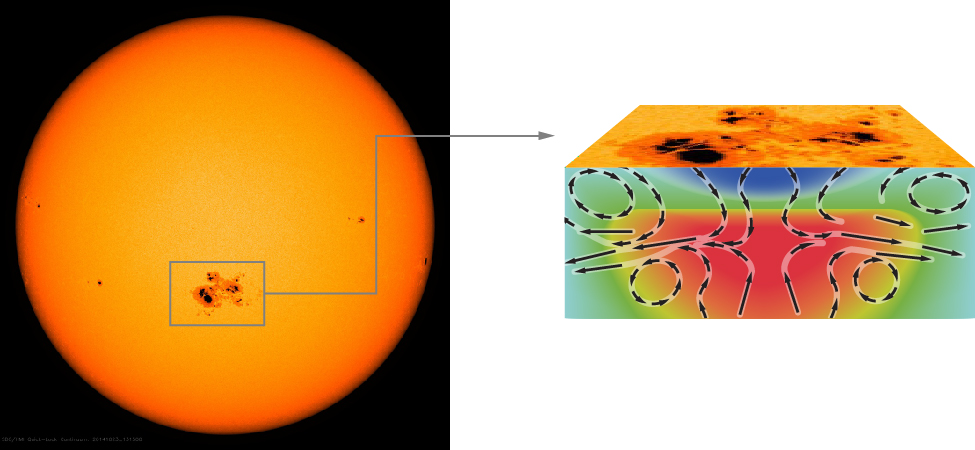
Helioseismology also allows scientists to look beneath a sunspot and see how it works. In The Sun: A Garden-Variety Star, we said that sunspots are cool because strong magnetic fields block the outward flow of energy. Figure 16.18 shows how gas moves around underneath a sunspot. Cool material from the sunspot flows downward, and material surrounding the sunspot is pulled inward, carrying magnetic field with it and thus maintaining the strong field that is necessary to form a sunspot. As the new material enters the sunspot region, it too cools, becomes denser, and sinks, thus setting up a self-perpetuating cycle that can last for weeks.
英語のヒント
日震学を使うと、黒点の下を調べ、その仕組みを見ることもできる。「太陽――ありふれた恒星」では、強い磁場が外向きのエネルギーの流れを妨げるため、黒点が低温になると述べた。図16.18は、黒点の下でガスがどう動くかを示す。黒点の冷たい物質は下へ流れ、周囲の物質は内側へ引き込まれる。その際、磁場も一緒に運ぶため、黒点を作るのに必要な強い磁場が保たれる。新しい物質が黒点領域へ入ると、それも冷えて密度を増し、沈む。こうして、何週間も続きうる、自らを持続させる循環が生まれる。
Sunspot Structure.黒点の構造。
credit: modification of work by NASA, SDO · NASA media use guidelines
Figure 16.18 This drawing shows our new understanding, from helioseismology, of what lies beneath a sunspot. The black arrows show the direction of the flow of material. The intense magnetic field associated with the sunspot stops the upward flow of hot material and creates a kind of plug that blocks the hot gas. As the material above the plug cools (shown in blue), it becomes denser and plunges inward, drawing more gas and more magnetic field behind it into the spot. The concentrated magnetic field causes more cooling, thereby setting up a self-perpetuating cycle that allows a spot to survive for several weeks. Since the plug keeps hot material from flowing up into the sunspot, the region below the plug, represented by red in this picture, becomes hotter. This material flows sideways and then upward, eventually reaching the solar surface in the area surrounding the sunspot. (credit: modification of work by NASA, SDO)
図16.18 日震学から新たにわかった、黒点の下の様子を示す図。黒い矢印は物質の流れる向きである。黒点に伴う強い磁場が、高温の物質の上昇を止め、高温のガスを遮る一種の栓を作る。栓の上の物質は、青で示すように冷えると密度を増し、内側へ急に沈んで、その後ろからさらにガスと磁場を黒点へ引き込む。集中した磁場はさらに冷却を起こし、黒点を数週間存続させる、自らを持続させる循環を生み出す。栓は高温の物質が黒点へ上がるのを防ぐため、図の赤い部分に当たる、栓の下の領域はさらに熱くなる。この物質は横へ流れ、それから上昇し、最終的に黒点の周囲で太陽表面へ届く。(クレジット:NASA、SDOの作品を改変)
The downward-flowing cool material acts as a kind of plug that block the upward flow of hot material, which is then diverted sideways and eventually reaches the solar surface in the region around the sunspot. This outward flow of hot material accounts for the paradox that we described in The Sun: A Garden-Variety Star—namely, that the Sun emits slightly more energy when more of its surface is covered by cool sunspots.
英語のヒント
下へ流れる冷たい物質は、高温の物質の上昇を遮る一種の栓として働く。高温の物質はそこで横へ向きを変え、最終的に黒点の周囲で太陽表面に達する。この高温物質の外向きの流れによって、「太陽――ありふれた恒星」で述べた一見した矛盾が説明される。すなわち、表面のより広い範囲が冷たい黒点で覆われると、太陽が放出するエネルギーは少し多くなるのである。
Helioseismology has become an important tool for predicting solar storms that might impact Earth. Active regions can appear and grow large in only a few days. The solar rotation period is about 28 days. Therefore, regions capable of producing solar flares and coronal mass ejections can develop on the far side of the Sun, where, for a long time, we couldn’t see them directly.
英語のヒント
日震学は、地球に影響しかねない太陽の嵐を予測する、重要な道具になっている。活動領域は、わずか数日で現れて大きくなりうる。太陽の自転周期は約28日である。したがって、太陽フレアやコロナ質量放出を生み出せる領域が、長い間直接は見えなかった、太陽の裏側で発達することがある。
Fortunately, we now have space telescopes monitoring the Sun from all angles, so we know if there are sunspots forming on the opposite side of the Sun. Moreover, sound waves travel slightly faster in regions of high magnetic field, and waves generated in active regions traverse the Sun about 6 seconds faster than waves generated in quiet regions. By detecting this subtle difference, scientists can provide warnings of a week or more to operators of electric utilities and satellites about when a potentially dangerous active region might rotate into view. With this warning, it is possible to plan for disruptions, put key instruments into safe mode, or reschedule spacewalks in order to protect astronauts.
英語のヒント
幸い、今ではあらゆる角度から太陽を監視する宇宙望遠鏡があり、太陽の反対側で黒点が形成されているかどうかがわかる。さらに、音波は磁場の強い領域では少し速く進むので、活動領域で生じた波は、静穏領域で生じた波より約6秒速く太陽を通り抜ける。この微妙な違いを検出すると、科学者は、危険かもしれない活動領域が自転によっていつ見えてくるかについて、電力会社や人工衛星の運用者へ、1週間以上前に警告できる。この警告があれば、障害を見越して計画を立て、重要な機器をセーフモードにしたり、宇宙飛行士を守るために船外活動の日程を変更したりできる。