第16章太陽――核エネルギーの源The Sun: A Nuclear Powerhouse
Nuclear Attraction versus Electrical Repulsion核力による引力と電気的な反発
So far, we seem to have a very attractive prescription for producing the energy emitted by the Sun: “roll” some nuclei together and join them via nuclear fusion. This will cause them to lose some of their mass, which then turns into energy. However, every nucleus beyond simple hydrogen has two or more protons—and protons all have positive charges. Since like charges repel via the electrical force, the closer we get two nuclei to each other, the more they repel. It’s true that if we can get them within “striking distance” of the nuclear force, they will then come together with a much stronger attraction. But that striking distance is very tiny, about the size of a nucleus. How can we get nuclei close enough to participate in fusion?
英語のヒント
ここまでで、太陽が放出するエネルギーを作る、非常に魅力的な処方箋が見つかったように思える。原子核をいくつか「転がして」集め、核融合によって結び付ければよい。すると質量の一部が失われ、それがエネルギーに変わる。しかし、単純な水素以外の原子核には、どれにも2個以上の陽子があり、陽子はすべて正の電荷をもつ。同じ符号の電荷は電気的な力で反発するため、二つの核を近づけるほど、強く反発する。たしかに、核力の「射程内」まで近づけられれば、今度ははるかに強い引力で結び付く。しかし、その射程は原子核の大きさほどしかなく、極めて小さい。どうすれば、核融合に参加できるほど原子核を近づけられるのだろうか。
The answer turns out to be heat—tremendous heat—which speeds the protons up enough to overcome the electrical forces that try to keep protons apart. Inside the Sun, as we saw, the most common element is hydrogen, whose nucleus contains only a single proton. Two protons can fuse only in regions where the temperature is greater than about 12 million K, and the speed of the protons average around 1000 kilometers per second or more. (In old-fashioned units, that’s over 2 million miles per hour!)
英語のヒント
答えは熱、途方もない高温である。高温は陽子を十分に速く動かし、陽子同士を引き離そうとする電気的な力に打ち勝たせる。すでに見たように、太陽の内部で最も多い元素は水素で、その核には陽子が1個だけ入っている。二つの陽子が融合できるのは、温度が約1,200万Kを超え、陽子の平均の速さが秒速約1,000キロメートル以上になる領域だけである。昔ながらの単位では、時速200万マイルを超える速さだ。
In our Sun, such extreme temperatures are reached only in the regions near its center, which has a temperature of 15 million K. Calculations show that nearly all of the Sun’s energy is generated within about 150,000 kilometers of its core, or within less than 10% of its total volume.
英語のヒント
太陽で、このような極端な高温に達するのは、温度1,500万Kの中心に近い領域だけである。計算によると、太陽エネルギーのほぼすべては、中心から約150,000キロメートル以内、すなわち全体積の10%未満の領域で生み出されている。
Even at these high temperatures, it is exceedingly difficult to force two protons to combine. On average, a proton will rebound from other protons in the Sun’s crowded core for about 14 billion years, at the rate of 100 million collisions per second, before it fuses with a second proton. This is, however, only the average waiting time. Some of the enormous numbers of protons in the Sun’s inner region are “lucky” and take only a few collisions to achieve a fusion reaction: they are the protons responsible for producing the energy radiated by the Sun. Since the Sun is about 4.5 billion years old, most of its protons have not yet been involved in fusion reactions.
英語のヒント
このような高温でも、二つの陽子を結合させるのは極めて難しい。太陽の混み合った中心核では、陽子は平均して毎秒1億回、ほかの陽子と衝突しては跳ね返り、別の陽子と融合するまでに約140億年を要する。ただし、これはあくまで平均待ち時間である。太陽内部にある莫大な数の陽子の中には、「幸運」にも、ほんの数回の衝突で核融合反応を起こすものがある。そうした陽子が、太陽から放射されるエネルギーの生成を担っている。太陽の年齢は約45億年なので、その陽子の大部分はまだ核融合反応に参加していない。
Nuclear Reactions in the Sun’s Interior太陽内部の核反応
The Sun, then, taps the energy contained in the nuclei of atoms through nuclear fusion. Let’s look at what happens in more detail. Deep inside the Sun, a three-step process takes four hydrogen nuclei and fuses them together to form a single helium nucleus. The helium nucleus is slightly less massive than the four hydrogen nuclei that combine to form it, and that mass is converted into energy.
英語のヒント
このように太陽は、核融合によって原子核の中のエネルギーを取り出している。何が起こるのか、もう少し詳しく見よう。太陽の奥深くでは、3段階の過程が4個の水素原子核を融合させ、1個のヘリウム原子核を作る。ヘリウム原子核は、それを作るために結合する4個の水素原子核よりも、質量がわずかに小さい。その差の質量がエネルギーに変わるのである。
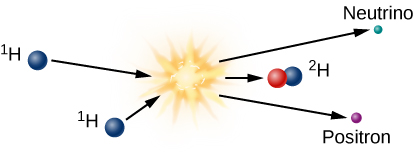
The initial step required to form one helium nucleus from four hydrogen nuclei is shown in Figure 16.6. At the high temperatures inside the Sun’s core, two protons combine to make a deuterium nucleus, which is an isotope (or version) of hydrogen that contains one proton and one neutron. In effect, one of the original protons has been converted into a neutron in the fusion reaction. Electric charge has to be conserved in nuclear reactions, and it is conserved in this one. A positron (antimatter electron) emerges from the reaction and carries away the positive charge originally associated with one of the protons.
英語のヒント
4個の水素原子核から1個のヘリウム原子核を作るための最初の段階を、図16.6に示す。太陽の中心核の高温のもとで、二つの陽子が結合して重水素原子核を作る。重水素は、陽子1個と中性子1個を含む水素の同位体、つまり別の型である。実質的には、もとの陽子の一つが核融合反応で中性子へ変わったことになる。核反応では電荷が保存されなければならず、この反応でも保存されている。陽電子、すなわち電子の反粒子が反応から飛び出し、もとは陽子の一つがもっていた正の電荷を持ち去る。
Proton-Proton Chain, Step 1.陽子・陽子連鎖反応、第1段階。
OpenStax / Rice University · CC BY 4.0
Figure 16.6 This is the first step in the process of fusing hydrogen into helium in the Sun. High temperatures are required because this reaction starts with two hydrogen nuclei, which are protons (shown in blue at left) that must overcome electrical repulsion to combine, forming a hydrogen nucleus with a proton and a neutron (shown in red). Note that hydrogen containing one proton and one neutron is given its own name: deuterium. Also produced in this reaction are a positron, which is an antielectron, and an elusive particle named the neutrino.
図16.6 太陽の中で水素をヘリウムへ融合する過程の第1段階。反応は、左に青で示した二つの水素原子核、すなわち陽子から始まる。それらが電気的な反発に打ち勝って結合し、陽子1個と、赤で示した中性子1個を含む水素原子核を作るため、高温が必要になる。陽子1個と中性子1個を含む水素には、重水素という独自の名がある。この反応では、電子の反粒子である陽電子と、ニュートリノという捉えにくい粒子も作られる。
Since it is antimatter, this positron will instantly collide with a nearby electron, and both will be annihilated, producing electromagnetic energy in the form of gamma-ray photons. This gamma ray, which has been created in the center of the Sun, finds itself in a world crammed full of fast-moving nuclei and electrons. The gamma ray collides with particles of matter and transfers its energy to one of them. The particle later emits another gamma-ray photon, but often the emitted photon has a bit less energy than the one that was absorbed.
英語のヒント
この陽電子は反物質なので、ただちに近くの電子と衝突し、両方が対消滅して、ガンマ線光子の形で電磁エネルギーを生み出す。太陽の中心で生じたこのガンマ線は、高速で動く原子核と電子でぎっしり詰まった世界の中に置かれる。ガンマ線は物質の粒子と衝突し、その一つにエネルギーを渡す。その粒子は後に別のガンマ線光子を放出するが、放出される光子は、吸収された光子よりも少しエネルギーが低いことが多い。
Such interactions happen to gamma rays again and again and again as they make their way slowly toward the outer layers of the Sun, until their energy becomes so reduced that they are no longer gamma rays but X-rays (recall what you learned in The Electromagnetic Spectrum). Later, as the photons lose still more energy through collisions in the crowded center of the Sun, they become ultraviolet photons.
英語のヒント
太陽の外層へゆっくり進む間に、ガンマ線はこのような相互作用を何度も、何度も繰り返す。ついにはエネルギーが低下し、ガンマ線ではなくX線になる。「電磁スペクトル」で学んだことを思い出そう。その後も、太陽の混み合った中心部での衝突によって、光子はさらにエネルギーを失い、紫外線の光子になる。
By the time they reach the Sun’s surface, most of the photons have given up enough energy to be ordinary light—and they are the sunlight we see coming from our star. (To be precise, each gamma-ray photon is ultimately converted into many separate lower-energy photons of sunlight.) So, the sunlight given off by the Sun today had its origin as a gamma ray produced by nuclear reactions deep in the Sun’s core. The length of time that photons require to reach the surface depends on how far a photon on average travels between collisions, and the travel time depends on what model of the complicated solar interior we accept. Estimates are somewhat uncertain but indicate that the emission of energy from the surface of the Sun can lag its production in the interior by 100,000 years to as much as 1,000,000 years.
英語のヒント
太陽の表面に達するころには、ほとんどの光子は十分にエネルギーを失い、普通の光になっている。それが、私たちの見る太陽光である。正確には、一つのガンマ線光子は最終的に、エネルギーの低い、多数の別々の太陽光の光子へ変換される。したがって、今日太陽が放出している光は、太陽の中心核の奥深くで、核反応によって生み出されたガンマ線に由来する。光子が表面へ届くのに必要な時間は、衝突と次の衝突の間に、平均してどれだけ遠くまで進むかで決まる。また、その移動時間は、複雑な太陽内部についてどのモデルを採用するかによっても変わる。見積もりにはいくらか不確かさがあるが、エネルギーが太陽内部で作られてから表面から放出されるまで、10万年から、長ければ100万年もの遅れが生じうるとされる。
In addition to the positron, the fusion of two hydrogen atoms to form deuterium results in the emission of a neutrino. Because neutrinos interact so little with ordinary matter, those produced by fusion reactions near the center of the Sun travel directly to the Sun’s surface and then out into space, in all directions. Neutrinos move at nearly the speed of light, and they escape the Sun about two seconds after they are created.
英語のヒント
二つの水素原子が融合して重水素を作ると、陽電子に加えてニュートリノも放出される。ニュートリノは通常の物質とほとんど相互作用しないため、太陽の中心付近の核融合反応で生じたものは、表面まで直接進み、そこからあらゆる方向へ宇宙空間に飛び出す。ニュートリノはほぼ光速で動き、生まれてから約2秒後には太陽を脱出する。
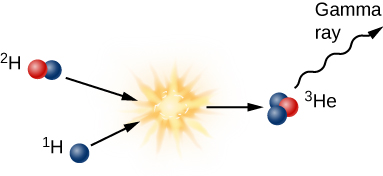
Proton-Proton Chain, Step 2.陽子・陽子連鎖反応、第2段階。
OpenStax / Rice University · CC BY 4.0
Figure 16.7 This is the second step of the proton-proton chain, the fusion reaction that converts hydrogen into helium in the Sun. This step combines one hydrogen nucleus, which is a proton (shown in blue), with the deuterium nucleus from the previous step (shown as a red and blue particle). The product of this is an isotope of helium with two protons (blue) and one neutron (red) and energy in the form of gamma-ray radiation.
図16.7 太陽で水素をヘリウムへ変える核融合反応、陽子・陽子連鎖反応の第2段階。この段階では、青で示した陽子である水素原子核1個が、前の段階でできた、赤と青の粒子で示した重水素原子核と結合する。生じるのは、青で示した陽子2個と赤で示した中性子1個をもつヘリウムの同位体、およびガンマ線の形のエネルギーである。
The second step in forming helium from hydrogen is to add another proton to the deuterium nucleus to create a helium nucleus that contains two protons and one neutron (Figure 16.7). In the process, some mass is again lost and more gamma radiation is emitted. Such a nucleus is helium because an element is defined by its number of protons; any nucleus with two protons is called helium. But this form of helium, which we call helium-3 (and write in shorthand as 3He) is not the isotope we see in the Sun’s atmosphere or on Earth. That helium has two neutrons and two protons and hence is called helium-4 (4He).
英語のヒント
水素からヘリウムを作る第2段階は、重水素原子核にもう一つ陽子を加えて、陽子2個と中性子1個を含むヘリウム原子核を作ることである(図16.7)。この過程でも質量の一部が失われ、さらにガンマ線が放出される。元素は陽子の数で定義されるので、この原子核はヘリウムである。陽子を2個もつ原子核はすべてヘリウムと呼ばれる。しかし、ヘリウム3と呼び、略して³Heと書くこの型は、太陽大気や地球で見られる同位体ではない。そちらのヘリウムは中性子2個と陽子2個をもち、そのためヘリウム4(⁴He)と呼ばれる。
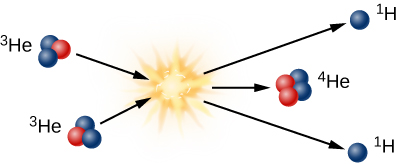
To get to helium-4 in the Sun, helium-3 must combine with another helium-3 in the third step of fusion (illustrated in Figure 16.8). Note that two energetic protons are left over from this step; each of them comes out of the reaction ready to collide with other protons and to start step 1 in the chain of reactions all over again.
英語のヒント
太陽の中でヘリウム4を作るには、核融合の第3段階で、ヘリウム3が別のヘリウム3と結合しなければならない(図16.8)。この段階では、高エネルギーの陽子が2個余って出てくる。それぞれは反応から飛び出すと、ほかの陽子と衝突し、連鎖反応の第1段階を最初から再び始められる状態にある。
Proton-Proton Chain, Step 3.陽子・陽子連鎖反応、第3段階。
OpenStax / Rice University · CC BY 4.0
Figure 16.8 This is the third step in the fusion of hydrogen into helium in the Sun. Note that the two helium-3 nuclei from the second step (see Figure 16.7) must combine before the third step becomes possible. The two protons that come out of this step have the energy to collide with other protons in the Sun and start step one again.
図16.8 太陽で水素をヘリウムへ融合する過程の第3段階。第2段階(図16.7参照)から来た二つのヘリウム3原子核が結合しなければ、この第3段階は起こらない。この段階から出てくる二つの陽子は、太陽内のほかの陽子と衝突し、再び第1段階を始めるエネルギーをもつ。