第9章クレーターに覆われた世界Cratered Worlds
9.5 Mercury9.5 水星
Learning Objectives学習の目標
By the end of this section, you will be able to:
この節を学び終えると、次のことができるようになる。
Characterize the orbit of Mercury around the Sun
水星が太陽を回る軌道の特徴を述べる。
Describe Mercury’s structure and composition
水星の構造と組成を説明する。
Explain the relationship between Mercury’s orbit and rotation
水星の公転と自転の関係を説明する。
Describe the topography and features of Mercury’s surface
水星表面の地形と特徴を説明する。
Summarize our ideas about the origin and evolution of Mercury
水星の起源と進化についての考え方をまとめる。
Mercury’s Orbit水星の軌道
The planet Mercury is similar to the Moon in many ways. Like the Moon, it has no atmosphere, and its surface is heavily cratered. As described later in this chapter, it also shares with the Moon the likelihood of a violent birth.
英語のヒント
水星は多くの点で月に似ている。月と同じく大気がなく、表面にはクレーターが密集している。この章の後半で述べるように、激しい出来事を経て生まれた可能性がある点も、月と共通している。
Mercury is the nearest planet to the Sun, and, in accordance with Kepler’s third law, it has the shortest period of revolution about the Sun (88 of our days) and the highest average orbital speed (48 kilometers per second). It is appropriately named for the fleet-footed messenger god of the Romans. Because Mercury remains close to the Sun, it can be difficult to pick out in the sky. As you might expect, it’s best seen when its eccentric orbit takes it as far from the Sun as possible.
英語のヒント
水星は太陽に最も近い惑星であり、ケプラーの第三法則に従って、太陽の周りの公転周期が最も短く、地球の88日である。また、平均公転速度も最も速く、毎秒48 kmである。その英語名Mercuryが、ローマの足の速い伝令の神にちなんでいるのは、ふさわしい。水星は太陽の近くにとどまるため、空で見つけにくいことがある。予想できるように、離心率の大きな軌道上で、太陽からできるだけ離れたところへ来るときに、最もよく見える。
The semimajor axis of Mercury’s orbit—that is, the planet’s average distance from the Sun—is 58 million kilometers, or 0.39 AU. However, because its orbit has the high eccentricity of 0.206, Mercury’s actual distance from the Sun varies from 46 million kilometers at perihelion to 70 million kilometers at aphelion (the ideas and terms that describe orbits were introduced in Orbits and Gravity).
英語のヒント
水星の軌道長半径、つまり太陽からの平均距離は、5800万km、すなわち0.39 AUである。しかし、軌道の離心率が0.206と大きいため、太陽からの実際の距離は、近日点の4600万kmから遠日点の7000万kmまで変わる。軌道を説明する考え方と用語は、「軌道と重力」で紹介した。
Composition and Structure組成と構造
Mercury’s mass is one-eighteenth that of Earth, making it the smallest terrestrial planet. Mercury is the smallest planet (except for the dwarf planets), having a diameter of 4878 kilometers, less than half that of Earth. Mercury’s density is 5.4 g/cm3, much greater than the density of the Moon, indicating that the composition of those two objects differs substantially.
英語のヒント
水星の質量は地球の18分の1で、最も小さい地球型惑星である。水星は、準惑星を除けば最小の惑星であり、直径は4878 kmと、地球の半分にも満たない。水星の密度は5.4 g/cm³で、月の密度よりかなり大きい。このことは、両天体の組成が大きく異なることを示している。
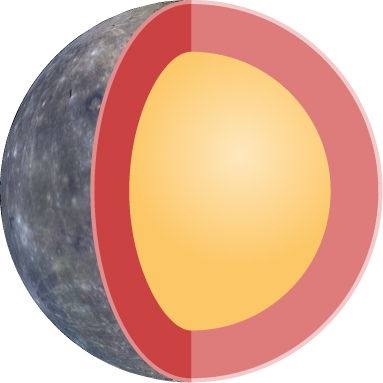
Mercury’s composition is one of the most interesting things about it and makes it unique among the planets. Mercury’s high density tells us that it must be composed largely of heavier materials such as metals. The most likely models for Mercury’s interior suggest a metallic iron-nickel core amounting to 60% of the total mass, with the rest of the planet made up primarily of silicates. The core has a diameter of 3500 kilometers and extends out to within 700 kilometers of the surface. We could think of Mercury as a metal ball the size of the Moon surrounded by a rocky crust 700 kilometers thick (Figure 9.20). Unlike the Moon, Mercury does have a weak magnetic field. The existence of this field is consistent with the presence of a large metal core, and it suggests that at least part of the core must be liquid in order to generate the observed magnetic field.Recall from the Radiation and Spectra chapter that magnetism is an effect of moving electric charges. In atoms of metals, the outer electrons are easier to dislodge and they can form a current when the metal is in liquid form and can flow.
英語のヒント
水星で最も興味深いことの一つは、その組成であり、これによって水星は惑星の中でも特異な存在になっている。水星の高い密度は、主に金属などの重い物質からできているはずだと教えてくれる。水星内部について最も有力なモデルでは、金属の鉄・ニッケル核が全質量の60%を占め、残りは主にケイ酸塩からなる。核の直径は3500 kmで、表面の700 km下まで広がっている。水星は、月ほどの大きさの金属球を、厚さ700 kmの岩石質の地殻が取り囲んだものと考えられる(図9.20)。月と異なり、水星には弱いながらも磁場がある。この磁場の存在は、大きな金属核があることと整合し、観測される磁場を生むためには、核の少なくとも一部が液体でなければならないことを示唆する。〔注:「放射とスペクトル」の章で学んだように、磁気は動く電荷の作用である。金属原子の外側の電子は、比較的容易に原子から離れる。金属が液体になって流れることができるとき、これらの電子は電流を作れる。〕
Mercury’s Internal Structure.水星の内部構造。
OpenStax / Rice University · CC BY 4.0
Figure 9.20 The interior of Mercury is dominated by a metallic core about the same size as our Moon.
図9.20 水星の内部の大部分を占めるのは、私たちの月とほぼ同じ大きさの金属核である。
Densities of Worlds天体の密度
The average density of a body equals its mass divided by its volume. For a sphere, density is:
英語のヒント
天体の平均密度は、その質量を体積で割った値に等しい。球の場合、密度は次のようになる。
Astronomers can measure both mass and radius accurately when a spacecraft flies by a body.
英語のヒント
宇宙機が天体のそばを通過すると、天文学者は、その質量と半径の両方を正確に測定できる。
Using the information in this chapter, we can calculate the approximate average density of the Moon.
この章の情報を使えば、月のおおよその平均密度を計算できる。
Solution解き方
For a sphere,
球については、
Check Your Learning理解を確かめよう
Using the information in this chapter, calculate the average density of Mercury. Show your work. Does your calculation agree with the figure we give in this chapter?
英語のヒント
この章の情報を使って、水星の平均密度を計算しよう。計算の過程を示すこと。計算結果は、この章で示した値と一致するだろうか。
Mercury’s Strange Rotation水星の奇妙な自転
Visual studies of Mercury’s indistinct surface markings were once thought to indicate that the planet kept one face to the Sun (as the Moon does to Earth). Thus, for many years, it was widely believed that Mercury’s rotation period was equal to its revolution period of 88 days, making one side perpetually hot while the other was always cold.
英語のヒント
水星のぼんやりした表面模様の目視による研究は、かつて、水星が太陽に同じ面を向け続けていることを示すと考えられていた。月が地球に対してそうしているのと同じである。そのため長年、水星の自転周期は88日の公転周期に等しく、一方の面は永久に熱く、他方は常に冷たいと広く信じられていた。
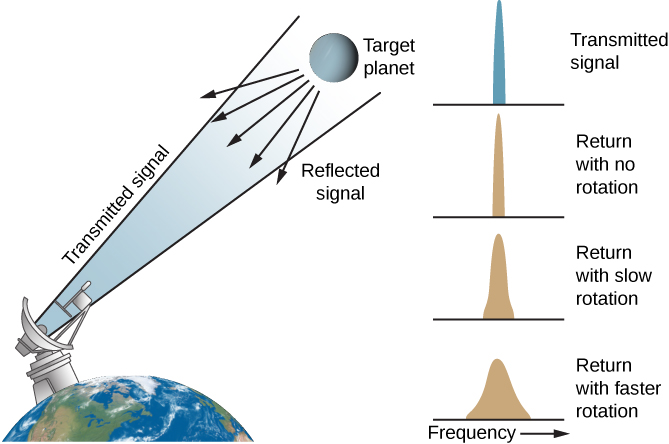
Radar observations of Mercury in the mid-1960s, however, showed conclusively that Mercury does not keep one side fixed toward the Sun. If a planet is turning, one side seems to be approaching Earth while the other is moving away from it. The resulting Doppler shift spreads or broadens the precise transmitted radar-wave frequency into a range of frequencies in the reflected signal (Figure 9.21). The degree of broadening provides an exact measurement of the rotation rate of the planet.
英語のヒント
しかし、1960年代半ばの水星のレーダー観測により、水星は太陽に同じ面を固定して向けているわけではないと、決定的に示された。惑星が自転していれば、一方の側は地球に近づき、他方の側は地球から遠ざかるように見える。その結果生じるドップラー偏移によって、送信されたレーダー波の一定の周波数は、反射信号の中では、ある幅を持つ周波数の範囲へ広がる(図9.21)。その広がりの程度から、惑星の自転の速さを正確に測定できる。
Doppler Radar Measures Rotation.ドップラーレーダーで自転を測る。
OpenStax / Rice University · CC BY 4.0
Figure 9.21 When a radar beam is reflected from a rotating planet, the motion of one side of the planet’s disk toward us and the other side away from us causes Doppler shifts in the reflected signal. The effect is to cause both a redshift and a blueshift, widening the spread of frequencies in the radio beam.
図9.21 レーダービームが自転する惑星で反射されると、惑星の円盤の一方の側が私たちへ近づき、もう一方が遠ざかる運動によって、反射信号にドップラー偏移が生じる。この作用は、赤方偏移と青方偏移の両方を生じさせ、電波ビームの周波数の広がりを大きくする。
Mercury’s period of rotation (how long it takes to turn with respect to the distant stars) is 59 days, which is just two-thirds of the planet’s period of revolution. Subsequently, astronomers found that a situation where the spin and the orbit of a planet (its year) are in a 2:3 ratio turns out to be stable. (See What a Difference a Day Makes for more on the effects of having such a long day on Mercury.)
英語のヒント
水星の自転周期、つまり遠方の恒星を基準に1回転するのにかかる時間は59日で、公転周期のちょうど3分の2である。その後、天文学者は、惑星の自転周期と公転周期、すなわち1年の長さが2対3の比になった状態は、安定することを見いだした。水星の1日がこれほど長いことの影響については、「1日の長さが生む大きな違い」を参照しよう。
Mercury, being close to the Sun, is very hot on its daylight side; but because it has no appreciable atmosphere, it gets surprisingly cold during the long nights. The temperature on the surface climbs to 700 K (430 °C) at noontime. After sunset, however, the temperature drops, reaching 100 K (–170 °C) just before dawn. (It is even colder in craters near the poles that receive no sunlight at all.) The range in temperature on Mercury is thus 600 K (or 600 °C), a greater difference than on any other planet.
英語のヒント
太陽に近い水星は、昼の側が非常に熱くなる。しかし、無視できないほどの大気を持たないため、長い夜の間には、驚くほど冷える。正午の表面温度は700 K(430℃)まで上がるが、日没後は下がり、夜明け直前には100 K(−170℃)に達する。極付近で太陽光がまったく届かないクレーターの中は、さらに冷たい。したがって、水星の温度変化の幅は600 K、または600℃であり、ほかのどの惑星よりも大きい。