第9章クレーターに覆われた世界Cratered Worlds
Using Crater Countsクレーターの数を利用する
If a world has had little erosion or internal activity, like the Moon during the past 3 billion years, it is possible to use the number of impact craters on its surface to estimate the age of that surface. By “age” here we mean the time since a major disturbance occurred on that surface (such as the volcanic eruptions that produced the lunar maria).
英語のヒント
この30億年間の月のように、侵食や内部活動の少ない世界では、表面の衝突クレーターの数を使って、その表面の年代を推定できる。ここでいう「年代」は、月の海を作った火山噴火のように、その表面に大きな変化をもたらす出来事が起きてからの時間を意味する。
We cannot directly measure the rate at which craters are being formed on Earth and the Moon, since the average interval between large crater-forming impacts is longer than the entire span of human history. Our best-known example of such a large crater, Meteor Crater in Arizona (Figure 9.18), is about 50,000 years old. However, the cratering rate can be estimated from the number of craters on the lunar maria or calculated from the number of potential “projectiles” (asteroids and comets) present in the solar system today. Both lines of reasoning lead to about the same estimations.
英語のヒント
大きなクレーターを作る衝突の平均間隔は、人類史全体の長さよりも長いため、地球と月でクレーターができる頻度を直接測定することはできない。こうした大きなクレーターの最もよく知られた例である、アリゾナ州のメテオクレーター(図9.18)は、約5万年前のものである。しかし、クレーターの形成頻度は、月の海にあるクレーターの数から推定したり、現在の太陽系に存在する潜在的な「飛来物」、すなわち小惑星や彗星の数から計算したりできる。どちらの筋道で考えても、ほぼ同じ推定結果に至る。
Meteor Crater.メテオクレーター。
Figure 9.18 This aerial photo of Meteor Crater in Arizona shows the simple form of a meteorite impact crater. The crater’s rim diameter is about 1.2 kilometers. (credit: Shane Torgerson)
図9.18 アリゾナ州のメテオクレーターのこの航空写真は、隕石衝突クレーターの単純な形を示している。クレーターの縁の直径は約1.2 kmである。(提供:シェーン・トーガーソン)
For the Moon, these calculations indicate that a crater 1 kilometer in diameter should be produced about every 200,000 years, a 10-kilometer crater every few million years, and one or two 100-kilometer craters every billion years. If the cratering rate has stayed the same, we can figure out how long it must have taken to make all the craters we see in the lunar maria. Our calculations show that it would have taken several billion years. This result is similar to the age determined for the maria from radioactive dating of returned samples—3.3 to 3.8 billion years old.
英語のヒント
月についての計算によると、直径1 kmのクレーターは約20万年に1個、10 kmのクレーターは数百万年に1個、100 kmのクレーターは10億年に1〜2個できるはずである。クレーターの形成頻度が一定だったなら、月の海に見られるすべてのクレーターを作るのに、どれくらいの時間がかかったはずかを求められる。計算では、数十億年を要したことになる。この結果は、持ち帰った試料の放射年代測定から求めた、海の33億〜38億年という年代に近い。
The fact that these two calculations agree suggests that astronomers’ original assumption was right: comets and asteroids in approximately their current numbers have been impacting planetary surfaces for billions of years. Calculations carried out for other planets (and their moons) indicate that they also have been subject to about the same number of interplanetary impacts during this time.
英語のヒント
二つの計算が一致するという事実は、天文学者の最初の仮定が正しかったことを示唆する。すなわち、現在とほぼ同じ数の彗星や小惑星が、数十億年間、惑星の表面に衝突してきたという仮定である。ほかの惑星とその衛星について行った計算も、その間に、それらがほぼ同じ数の惑星間天体の衝突を受けてきたことを示している。
We have good reason to believe, however, that earlier than 3.8 billion years ago, the impact rates must have been a great deal higher. This becomes immediately evident when comparing the numbers of craters on the lunar highlands with those on the maria. Typically, there are 10 times more craters on the highlands than on a similar area of maria. Yet the radioactive dating of highland samples showed that they are only a little older than the maria, typically 4.2 billion years rather than 3.8 billion years. If the rate of impacts had been constant throughout the Moon’s history, the highlands would have had to be at least 10 times older. They would thus have had to form 38 billion years ago—long before the universe itself began.
英語のヒント
しかし、38億年前より以前には、衝突の頻度がはるかに高かったはずだと考える、十分な理由がある。これは、月の高地と海のクレーターの数を比べれば、すぐに明らかになる。一般に、高地には、同じ面積の海の10倍のクレーターがある。ところが、高地試料の放射年代測定によると、その年代は海より少し古いだけで、通常、海の38億年に対して42億年である。月の歴史を通して衝突の頻度が一定だったとしたら、高地は少なくとも10倍古くなければならなかった。つまり、380億年前、宇宙そのものが始まるずっと前にできていなければならなかったことになる。
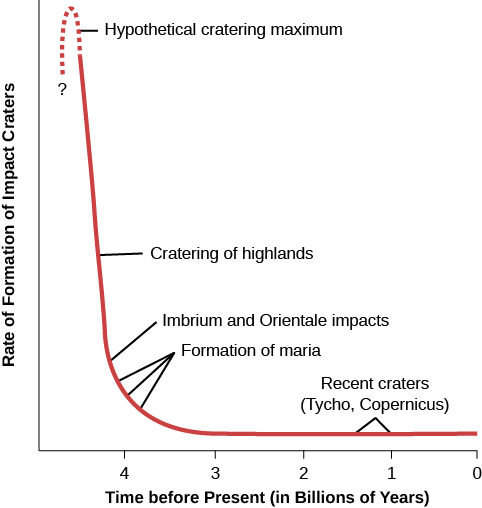
In science, when an assumption leads to an implausible conclusion, we must go back and re-examine that assumption—in this case, the constant impact rate. The contradiction is resolved if the impact rate varied over time, with a much heavier bombardment earlier than 3.8 billion years ago (Figure 9.19). This “heavy bombardment” produced most of the craters we see today in the highlands.
英語のヒント
科学では、ある仮定がもっともらしくない結論につながったなら、立ち戻って、その仮定を検討し直さなければならない。この場合は、衝突の頻度が一定だったという仮定である。衝突の頻度は時間とともに変わり、38億年前より以前には、ずっと激しい天体衝突があったとすれば、矛盾は解消する(図9.19)。この「激しい天体衝突」が、現在、高地に見られるクレーターの大部分を作ったのである。
Cratering Rates over Time.時間とともに変わるクレーター形成頻度。
OpenStax / Rice University · CC BY 4.0
Figure 9.19 The number of craters being made on the Moon’s surface has varied with time over the past 4.3 billion years.
図9.19 月面にできるクレーターの数は、この43億年間、時間とともに変化してきた。
This idea we have been exploring—that large impacts (especially during the early history of the solar system) played a major role in shaping the worlds we see—is not unique to our study of the Moon. As you read through the other chapters about the planets, you will see further indications that a number of the present-day characteristics of our system may be due to its violent past.
英語のヒント
ここまで検討してきた考え方、つまり、大きな衝突、特に太陽系の歴史の初期に起きたものが、現在見られる世界の形を作るうえで大きな役割を果たしたという考え方は、月の研究だけに限られない。惑星を扱うほかの章を読み進めると、太陽系の現在の特徴のいくつもが、その激しい過去に由来する可能性を示す、さらなる証拠に出会うだろう。
Key Concepts and Summary重要事項のまとめ
A century ago, Grove Gilbert suggested that the lunar craters were caused by impacts, but the cratering process was not well understood until more recently. High-speed impacts produce explosions and excavate craters 10 to 15 times the size of the impactor with raised rims, ejecta blankets, and often central peaks. Cratering rates have been roughly constant for the past 3 billion years but earlier were much greater. Crater counts can be used to derive approximate ages for geological features on the Moon and other worlds with solid surfaces.
英語のヒント
1世紀前、グローヴ・ギルバートは、月のクレーターが衝突によって生じたと提唱したが、クレーターの形成過程がよく理解されるようになったのは、もっと最近である。高速の衝突は爆発を起こし、衝突天体の10〜15倍の大きさのクレーターを掘る。盛り上がった縁やイジェクタブランケットができ、中央丘を伴うことも多い。クレーターの形成頻度は、この30億年間はほぼ一定だったが、それ以前ははるかに高かった。クレーターの数を使えば、月や、ほかの固体表面を持つ世界の地形のおおよその年代を求められる。