第9章クレーターに覆われた世界Cratered Worlds
The Surface of Mercury水星の表面
The first close-up look at Mercury came in 1974, when the US spacecraft Mariner 10 passed 703 kilometers from the surface of the planet and transmitted more than 2000 photographs to Earth, revealing details with a resolution down to 150 meters. Subsequently, the planet was mapped in great detail by the MESSENGER spacecraft, which was launched in 2004 and made multiple flybys of Earth, Venus, and Mercury before settling into orbit around Mercury in 2011. It ended its life in 2015, when it ran out of propellant and crashed into the surface of the planet.
英語のヒント
水星が初めて間近で見られたのは、1974年である。アメリカの探査機マリナー10号が、水星の表面から703 kmを通過し、2000枚を超える写真を地球へ送った。これによって、分解能150 mまでの細部が明らかになった。その後、水星はメッセンジャー探査機によって、非常に詳しく地図化された。メッセンジャーは2004年に打ち上げられ、地球、金星、水星のそばを複数回通過した後、2011年に水星周回軌道へ入った。2015年、推進剤が尽きて水星の表面へ衝突し、その生涯を終えた。
Mercury’s surface strongly resembles the Moon in appearance (Figure 9.22 and Figure 9.23). It is covered with thousands of craters and larger basins up to 1550 kilometers in diameter. Some of the brighter craters are rayed, like Tycho and Copernicus on the Moon, and many have central peaks. There are also scarps (cliffs) more than a kilometer high and hundreds of kilometers long, as well as ridges and plains.
英語のヒント
水星の表面は、見た目が月によく似ている(図9.22、図9.23)。何千ものクレーターと、それより大きな、直径最大1550 kmの盆地に覆われている。明るいクレーターのいくつかは、月のティコやコペルニクスのように光条を伴い、中央丘を持つものも多い。また、高さ1 km以上、長さ数百kmの断崖に加え、尾根や平原もある。
MESSENGER instruments measured the surface composition and mapped past volcanic activity. One of its most important discoveries was the verification of water ice (first detected by radar) in craters near the poles, similar to the situation on the Moon, and unexpected evidence for dark material, possibly complex organic (carbon-rich) compounds, overlying some of the water ice.
英語のヒント
メッセンジャーの観測機器は、表面の組成を測定し、過去の火山活動を地図化した。最も重要な発見の一つは、月と同じように、極付近のクレーターに水の氷があることを確かめたことだった。この氷は、最初にレーダーで検出されていた。また、一部の水の氷を覆う暗い物質の、予想外の証拠も得られた。この物質は、炭素に富む複雑な有機化合物である可能性がある。
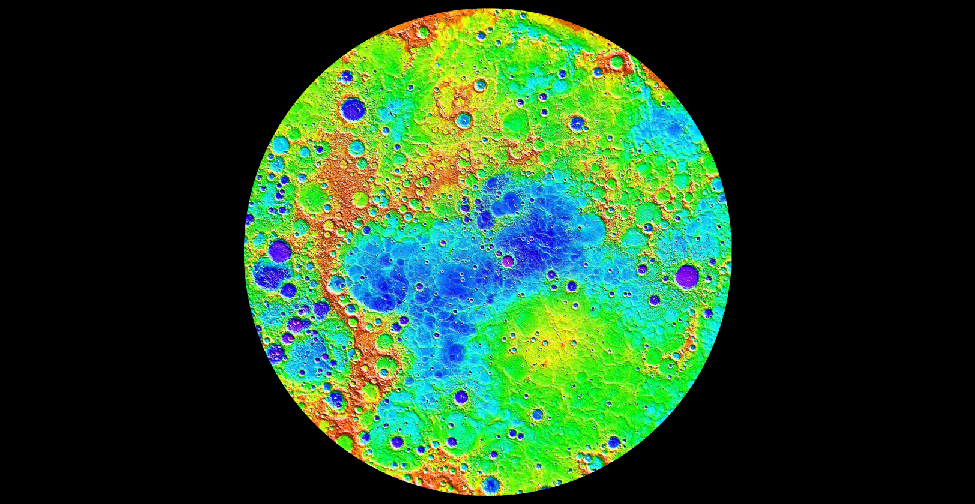
Mercury’s Topography.水星の地形。
credit: modification of work by NASA/Johns Hopkins University Applied Physics Laboratory/Carnegie Institution of Washington · NASA media use guidelines
Figure 9.22 The topography of Mercury’s northern hemisphere is mapped in great detail from MESSENGER data. The lowest regions are shown in purple and blue, and the highest regions are shown in red. The difference in elevation between the lowest and highest regions shown here is roughly 10 kilometers. The permanently shadowed low-lying craters near the north pole contain radar-bright water ice. (credit: modification of work by NASA/Johns Hopkins University Applied Physics Laboratory/Carnegie Institution of Washington)
図9.22 メッセンジャーのデータから、水星北半球の地形が非常に詳しく地図化されている。最も低い領域は紫と青、最も高い領域は赤で示す。ここに示す最低部と最高部の標高差は、約10 kmである。北極付近の、永久に影になる低いクレーターには、レーダーを強く反射する水の氷がある。(提供:NASA/ジョンズ・ホプキンス大学応用物理学研究所/ワシントン・カーネギー研究所の作品を改変)
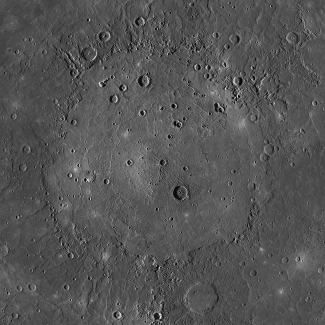
Caloris Basin.カロリス盆地。
credit: NASA/Johns Hopkins University Applied Physics Laboratory/Carnegie Institution of Washington · NASA media use guidelines
Figure 9.23 This partially flooded impact basin is the largest known structural feature on Mercury. The smooth plains in the interior of the basin have an area of almost two million square kilometers. Compare this photo with Figure 9.11, the Orientale Basin on the Moon. (credit: NASA/Johns Hopkins University Applied Physics Laboratory/Carnegie Institution of Washington)
図9.23 部分的に溶岩で埋まったこの衝突盆地は、水星で知られる最大の構造地形である。盆地内部の滑らかな平原の面積は、約200万km²に達する。この写真を、月の東の海を示す図9.11と比べよう。(提供:NASA/ジョンズ・ホプキンス大学応用物理学研究所/ワシントン・カーネギー研究所)
Most of the mercurian features have been named in honor of artists, writers, composers, and other contributors to the arts and humanities, in contrast with the scientists commemorated on the Moon. Among the named craters are Bach, Shakespeare, Tolstoy, Van Gogh, and Scott Joplin.
英語のヒント
月では科学者の功績をたたえた名前が付けられているのに対し、水星の地形の大部分は、美術家、作家、作曲家など、芸術や人文学への貢献者に敬意を表して命名されている。名前の付いたクレーターには、バッハ、シェイクスピア、トルストイ、ファン・ゴッホ、スコット・ジョプリンなどがある。
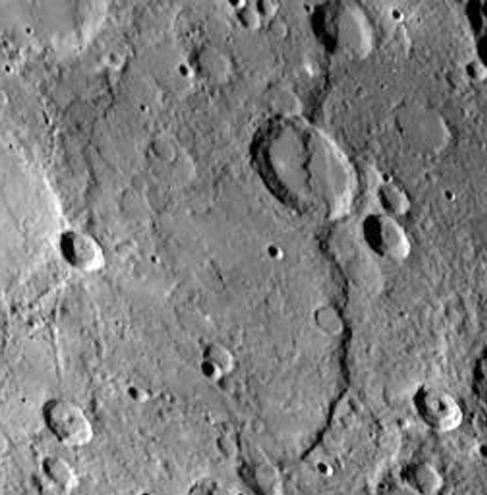
There is no evidence of plate tectonics on Mercury. However, the planet’s distinctive long scarps can sometimes be seen cutting across craters; this means the scarps must have formed later than the craters (Figure 9.24). These long, curved cliffs appear to have their origin in the slight compression of Mercury’s crust. Apparently, at some point in its history, the planet shrank, wrinkling the crust, and it must have done so after most of the craters on its surface had already formed.
英語のヒント
水星にはプレートテクトニクスの証拠がない。しかし、水星に特有の長い断崖は、ときにクレーターを横切っている。これは、断崖がクレーターより後にできたはずだということを意味する(図9.24)。長く曲がったこれらの崖は、水星の地殻がわずかに圧縮されたことで生じたようだ。どうやら水星は、その歴史のある時点で縮み、地殻にしわを寄せたらしい。それは、表面のクレーターの大部分がすでにできた後だったはずである。
If the standard cratering chronology applies to Mercury, this shrinkage must have taken place during the last 4 billion years and not during the solar system’s early period of heavy bombardment.
英語のヒント
標準的なクレーター年代学を水星にも適用できるなら、この収縮は、太陽系初期の激しい天体衝突の時代ではなく、この40億年間に起きたはずである。
Discovery Scarp on Mercury.水星のディスカバリー断崖。
credit: modification of work by NASA/JPL/Northwestern University · JPL image use policy
Figure 9.24 This long cliff, nearly 1 kilometer high and more than 100 kilometers long, cuts across several craters. Astronomers conclude that the compression that made “wrinkles” like this in the planet's surface must have taken place after the craters were formed. (credit: modification of work by NASA/JPL/Northwestern University)
図9.24 高さ約1 km、長さ100 km以上のこの崖は、いくつかのクレーターを横切る。天文学者は、水星表面にこのような「しわ」を作った圧縮は、クレーターができた後に起きたはずだと結論する。(提供:NASA/JPL/ノースウェスタン大学の作品を改変)
The Origin of Mercury水星の起源
The problem with understanding how Mercury formed is the reverse of the problem posed by the composition of the Moon. We have seen that, unlike the Moon, Mercury is composed mostly of metal. However, astronomers think that Mercury should have formed with roughly the same ratio of metal to silicate as that found on Earth or Venus. How did it lose so much of its rocky material?
英語のヒント
水星の形成を理解するうえでの問題は、月の組成が突きつける問題と逆である。見てきたように、月とは異なり、水星は主に金属でできている。しかし天文学者は、水星も、金属とケイ酸塩の比率が地球や金星とほぼ同じ状態で形成されたはずだと考えている。水星はどのようにして、これほど多くの岩石質物質を失ったのだろうか。
The most probable explanation for Mercury’s silicate loss may be similar to the explanation for the Moon’s relatively small metal core. Mercury is likely to have experienced several giant impacts very early in its youth, and one or more of these may have torn away a fraction of its mantle and crust, leaving a body dominated by its iron core. A recent alternative explanation suggests that, early on, heat from the young Sun evaporated much of the lighter, more volatile, silicates in the material that formed Mercury, leaving the planet with a majority of metals.
英語のヒント
水星がケイ酸塩を失ったことについて最も有力な説明は、月の金属核が相対的に小さいことの説明に似ているのかもしれない。水星は誕生後まもないころ、何回か巨大衝突を経験した可能性が高い。その1回以上が、マントルと地殻の一部をはぎ取り、鉄核が大部分を占める天体を残したのかもしれない。最近の別の説明では、初期に若い太陽からの熱が、水星を作る物質中の、より軽く、より揮発しやすいケイ酸塩の多くを蒸発させ、金属が大半を占める惑星を残したと考える。
Today, astronomers recognize that the early solar system was a chaotic place, with the final stages of planet formation characterized by impacts of great violence. Some objects of planetary mass have been destroyed, whereas others could have fragmented and then re-formed, perhaps more than once. Both the Moon and Mercury, with their strange compositions, bear testimony to the catastrophes that must have characterized the solar system during its youth.
英語のヒント
現在、天文学者は、初期の太陽系が混沌とした場所で、惑星形成の最終段階を特徴づけるのは、非常に激しい衝突だったと認識している。惑星ほどの質量を持つ天体の一部は破壊され、ほかのものは、砕けた後に再び形成された可能性がある。おそらく、それが何度も起きた場合もあっただろう。奇妙な組成を持つ月と水星は、どちらも、太陽系の幼年期を特徴づけたはずの激変を物語っている。