第9章クレーターに覆われた世界Cratered Worlds
9.2 The Lunar Surface9.2 月の表面
Learning Objectives学習の目標
By the end of this section, you will be able to:
この節を学び終えると、次のことができるようになる。
Differentiate between the major surface features of the Moon
月面の主な地形を区別する。
Describe the history of the lunar surface
月面の歴史を説明する。
Describe the properties of the lunar “soil”
月の「土壌」の性質を説明する。
General Appearance全体の見え方
If you look at the Moon through a telescope, you can see that it is covered by impact craters of all sizes. The most conspicuous of the Moon’s surface features—those that can be seen with the unaided eye and that make up the feature often called “the man in the Moon”—are vast splotches of darker lava flows.
英語のヒント
望遠鏡で月を見ると、あらゆる大きさの衝突クレーターに覆われていることがわかる。月面の地形で最も目立つもの、つまり肉眼でも見え、しばしば「月の中の男」と呼ばれる模様を作るものは、暗い溶岩流が広大な斑点状に広がった部分である。
Centuries ago, early lunar observers thought that the Moon had continents and oceans and that it was a possible abode of life. They called the dark areas “seas” (maria in Latin, or mare in the singular, pronounced “mah ray”). Their names, Mare Nubium (Sea of Clouds), Mare Tranquillitatis (Sea of Tranquility), and so on, are still in use today. In contrast, the “land” areas between the seas are not named. Thousands of individual craters have been named, however, mostly for great scientists and philosophers (Figure 9.6). Among the most prominent craters are those named for Plato, Copernicus, Tycho, and Kepler.
英語のヒント
何世紀も前、初期の月観測者は、月にも大陸と海洋があり、生命が住める場所かもしれないと考えた。彼らは暗い領域を「海」と呼んだ。ラテン語では複数形がmaria、単数形がmareで、後者は「マーレイ」と発音する。Mare Nubium(雲の海)、Mare Tranquillitatis(静かの海)などの名は、今も使われている。それに対し、海の間の「陸」の領域には、名前が付けられていない。しかし、個々のクレーターには何千もの名前が付いており、その大半は偉大な科学者や哲学者にちなんでいる(図9.6)。特に目立つクレーターには、プラトン、コペルニクス、ティコ、ケプラーにちなんだものがある。
We know today that the resemblance of lunar features to terrestrial ones is superficial. Even when they look somewhat similar, the origins of lunar features such as craters and mountains are very different from their terrestrial counterparts. The Moon’s relative lack of internal activity, together with the absence of air and water, makes most of its geological history unlike anything we know on Earth.
英語のヒント
現在では、月の地形と地球の地形の似方は、表面的なものにすぎないとわかっている。クレーターや山などの月の地形は、見かけが多少似ていても、地球の対応する地形とは成り立ちが大きく異なる。月は内部活動が比較的少なく、空気も水もない。そのため、地質学的歴史の大部分が、地球で知られているどのようなものとも違っている。
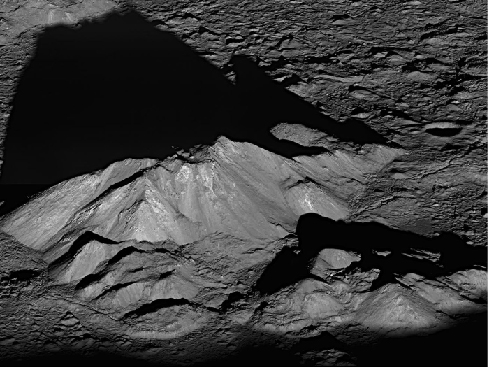
Sunrise on the Central Mountain Peaks of Tycho Crater, as Imaged by the NASA Lunar Reconnaissance Orbiter.NASAのLROが撮影した、ティコクレーター中央の山々の日の出。
credit: modification of work by NASA/Goddard/Arizona State University · NASA media use guidelines
Figure 9.6 Tycho, about 82 kilometers in diameter, is one of the youngest of the very large lunar craters. The central mountain rises 2 kilometers above the crater floor. (credit: modification of work by NASA/Goddard/Arizona State University)
図9.6 直径約82 kmのティコは、月の非常に大きなクレーターの中でも、最も新しいものの一つである。中央の山は、クレーターの底から2 kmの高さまでそびえている。(提供:NASA/ゴダード/アリゾナ州立大学の作品を改変)
Lunar History月の歴史
To trace the detailed history of the Moon or of any planet, we must be able to estimate the ages of individual rocks. Once lunar samples were brought back by the Apollo astronauts, the radioactive dating techniques that had been developed for Earth were applied to them. The solidification ages of the samples ranged from about 3.3 to 4.4 billion years old, substantially older than most of the rocks on Earth. For comparison, as we saw in the chapter on Earth, Moon, and Sky, both Earth and the Moon were formed between 4.5 and 4.6 billion years ago.
英語のヒント
月やほかの惑星の詳しい歴史をたどるには、個々の岩石の年代を推定できなければならない。アポロの宇宙飛行士が月試料を持ち帰ると、地球のために開発された放射年代測定法が、それらに適用された。試料が固まった年代は、約33億〜44億年前にわたり、地球の岩石の大部分よりもかなり古かった。比較のために述べると、「地球・月・空」の章で見たとおり、地球と月はいずれも45億〜46億年前に形成された。
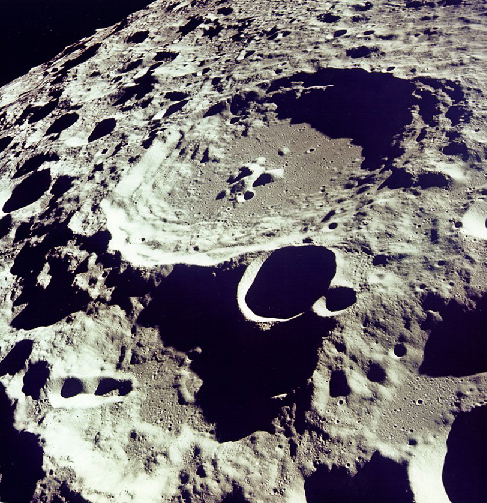
Most of the surface of the Moon (83%) consists of silicate rocks called anorthosites; these regions are known as the lunar highlands. They are made of relatively low-density rock that solidified on the cooling Moon like slag floating on the top of a smelter. Because they formed so early in lunar history (between 4.1 and 4.4 billion years ago), the highlands are also extremely heavily cratered, bearing the scars of all those billions of years of impacts by interplanetary debris (Figure 9.7).
英語のヒント
月の表面の大部分、面積にして83%は、斜長岩と呼ばれるケイ酸塩岩石でできている。こうした領域は、月の高地として知られる。高地を作る比較的密度の低い岩石は、製錬炉の上部に浮くスラグのように、冷えつつあった月の上で固まった。月の歴史の非常に初期、41億〜44億年前にできたため、高地にはクレーターがきわめて密集している。惑星間の破片が何十億年にもわたって衝突してきた傷跡を、すべてとどめているのである(図9.7)。
Lunar Highlands.月の高地。
credit: Apollo 11 Crew, NASA · NASA media use guidelines
Figure 9.7 The old, heavily cratered lunar highlands make up 83% of the Moon’s surface. (credit: Apollo 11 Crew, NASA)
図9.7 古く、クレーターが密集した月の高地は、月面の83%を占める。(提供:アポロ11号の乗組員、NASA)
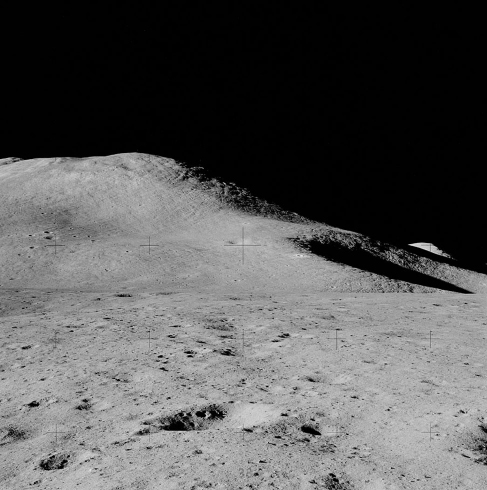
Unlike the mountains on Earth, the Moon’s highlands do not have any sharp folds in their ranges. The highlands have low, rounded profiles that resemble the oldest, most eroded mountains on Earth (Figure 9.8). Because there is no atmosphere or water on the Moon, there has been no wind, water, or ice to carve them into cliffs and sharp peaks, the way we have seen them shaped on Earth. Their smooth features are attributed to gradual erosion, mostly due to impact cratering.
英語のヒント
地球の山々と異なり、月の高地の山並みには鋭い褶曲がない。高地は低く丸みのある輪郭を持ち、地球で最も古く、最も侵食された山々に似ている(図9.8)。月には大気も水もないため、地球で見られるように、風、水、氷が山を削って崖や鋭い峰にすることはなかった。その滑らかな地形は、主に衝突クレーターができることによる、緩やかな侵食の結果と考えられている。
Lunar Mountain.月の山。
credit: NASA/Apollo Lunar Surface Journal · NASA media use guidelines
Figure 9.8 This photo of Mt. Hadley on the edge of Mare Imbrium was taken by Dave Scott, one of the Apollo 15 astronauts. Note the smooth contours of the lunar mountains, which have not been sculpted by water or ice. (credit: NASA/Apollo Lunar Surface Journal)
図9.8 雨の海の縁にあるハドレー山のこの写真は、アポロ15号の宇宙飛行士の1人、デイヴ・スコットが撮影した。水や氷によって削られていない、月の山々の滑らかな輪郭に注目しよう。(提供:NASA/Apollo Lunar Surface Journal)
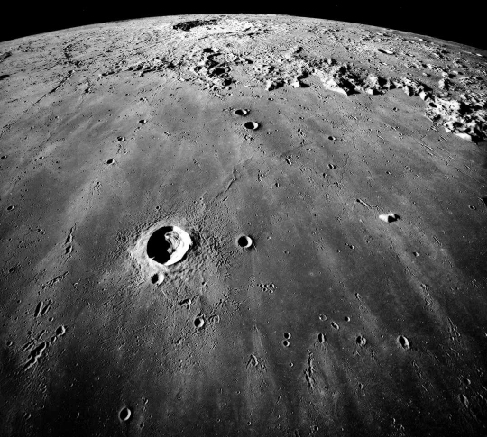
The maria are much less cratered than the highlands, and cover just 17% of the lunar surface, mostly on the side of the Moon that faces Earth (Figure 9.9).
英語のヒント
海には高地よりずっとクレーターが少なく、月面のわずか17%を覆っている。その大部分は、月の地球を向く側にある(図9.9)。
Lunar Maria.月の海。
credit: NASA, Apollo 17 · NASA media use guidelines
Figure 9.9 About 17% of the Moon’s surface consists of the maria—flat plains of basaltic lava. This view of Mare Imbrium also shows numerous secondary craters and evidence of material ejected from the large crater Copernicus on the upper horizon. Copernicus is an impact crater almost 100 kilometers in diameter that was formed long after the lava in Imbrium had already been deposited. (credit: NASA, Apollo 17)
図9.9 月面の約17%は、玄武岩質溶岩の平坦な平原である海からなる。この雨の海の眺めには、多数の二次クレーターと、上側の地平線にある大きなコペルニクスクレーターから放出された物質の証拠も写っている。コペルニクスは直径ほぼ100 kmの衝突クレーターで、雨の海に溶岩が堆積したずっと後にできた。(提供:NASA、アポロ17号)
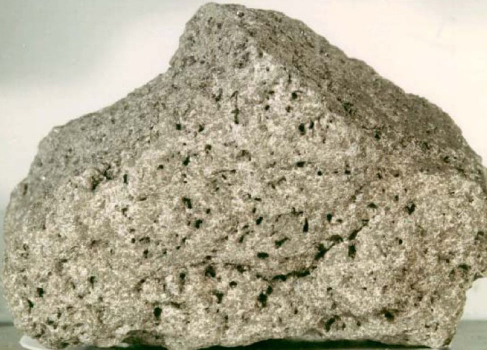
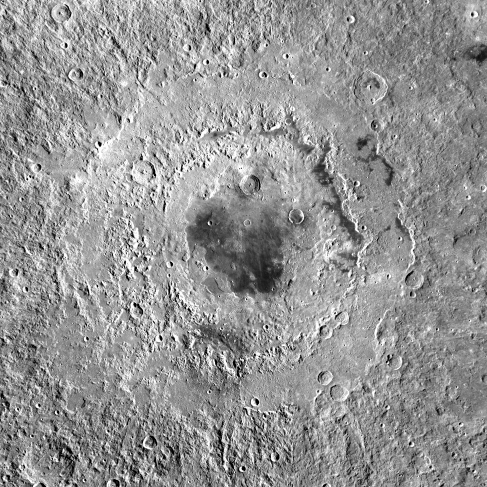
Today, we know that the maria consist mostly of dark-colored basalt (volcanic lava) laid down in volcanic eruptions billions of years ago. Eventually, these lava flows partly filled the huge depressions called impact basins, which had been produced by collisions of large chunks of material with the Moon relatively early in its history. The basalt on the Moon (Figure 9.10) is very similar in composition to the crust under the oceans of Earth or to the lavas erupted by many terrestrial volcanoes. The youngest of the lunar impact basins is Mare Orientale, shown in Figure 9.11.
英語のヒント
現在、海の大部分は、何十億年も前の火山噴火で流れ広がった、暗い色の玄武岩、すなわち火山の溶岩からなるとわかっている。これらの溶岩流は、やがて衝突盆地と呼ばれる巨大なくぼみを部分的に埋めた。衝突盆地は、月の歴史の比較的初期に、大きな物質の塊が月と衝突してできたものだった。月の玄武岩(図9.10)の組成は、地球の海底の地殻や、多くの地球の火山が噴出した溶岩とよく似ている。月の衝突盆地で最も新しいものは、図9.11に示す東の海である。
Rock from a Lunar Mare.月の海の岩石。
credit: modification of work by NASA · NASA media use guidelines
Figure 9.10 In this sample of basalt from the mare surface, you can see the holes left by gas bubbles, which are characteristic of rock formed from lava. All lunar rocks are chemically distinct from terrestrial rocks, a fact that has allowed scientists to identify a few lunar samples among the thousands of meteorites that reach Earth. (credit: modification of work by NASA)
英語のヒント
図9.10 この海の表面から得た玄武岩試料には、気泡が残した穴が見える。これは、溶岩からできた岩石の特徴である。月の岩石はすべて、地球の岩石と化学的に区別できる。この事実によって科学者は、地球に到来する何千個もの隕石の中から、いくつかの月の試料を特定できた。(提供:NASAの作品を改変)
Mare Orientale.東の海。
credit: NASA · NASA media use guidelines
Figure 9.11 The youngest of the large lunar impact basins is Orientale, formed 3.8 billion years ago. Its outer ring is about 1000 kilometers in diameter, roughly the distance between New York City and Detroit, Michigan. Unlike most of the other basins, Orientale has not been completely filled in with lava flows, so it retains its striking “bull’s-eye” appearance. It is located on the edge of the Moon as seen from Earth. (credit: NASA)
図9.11 月の大きな衝突盆地で最も新しいものは、38億年前にできた東の海である。最も外側の環の直径は約1000 kmで、ニューヨーク市とミシガン州デトロイトの間の距離ほどある。ほかの盆地の大部分と異なり、東の海は溶岩流で完全には埋まっていないため、印象的な「標的の中心」のような同心円状の姿を保っている。地球から見ると、月の縁に位置する。(提供:NASA)
Volcanic activity may have begun very early in the Moon’s history, although most evidence of the first half billion years is lost. What we do know is that the major mare volcanism, which involved the release of lava from hundreds of kilometers below the surface, ended about 3.3 billion years ago. After that, the Moon’s interior cooled, and volcanic activity was limited to a very few small areas. The primary forces altering the surface come from the outside, not the interior.
英語のヒント
火山活動は月の歴史の非常に初期から始まったのかもしれないが、最初の5億年については、証拠の大部分が失われている。確かにわかっているのは、地下数百kmから溶岩を放出した海の主要な火山活動が、約33億年前に終わったことである。その後、月の内部は冷え、火山活動は、ごく少数の小さな領域に限られた。表面を変える主な力は、内部ではなく外からもたらされる。