第9章クレーターに覆われた世界Cratered Worlds
9.3 Impact Craters9.3 衝突クレーター
Learning Objectives学習の目標
By the end of this section, you will be able to:
この節を学び終えると、次のことができるようになる。
Compare and contrast ideas about how lunar craters form
月のクレーターができる仕組みについて、各説の共通点と違いを比較する。
Explain the process of impact crater formation
衝突クレーターができる過程を説明する。
Discuss the use of crater counts to determine relative ages of lunar landforms
クレーターの数を使って月の地形の相対的な年代を求める方法を論じる。
Volcanic Versus Impact Origin of Cratersクレーターの起源――火山か衝突か
The Moon provides an important benchmark for understanding the history of our planetary system. Most solid worlds show the effects of impacts, often extending back to the era when a great deal of debris from our system’s formation process was still present. On Earth, this long history has been erased by our active geology. On the Moon, in contrast, most of the impact history is preserved. If we can understand what has happened on the Moon, we may be able to apply this knowledge to other worlds. The Moon is especially interesting because it is not just any moon, but our Moon—a nearby world that has shared the history of Earth for more than 4 billion years and preserved a record that, for Earth, has been destroyed by our active geology.
英語のヒント
月は、太陽系の歴史を理解するうえで重要な基準点になる。固体の表面を持つ世界の大半には、衝突の影響が見られる。しばしばその記録は、太陽系ができた過程の破片がまだ大量に残っていた時代にまでさかのぼる。地球では、この長い歴史は活発な地質活動によって消されてしまった。それに対し、月には衝突の歴史の大部分が保存されている。月で何が起きたかを理解できれば、その知識をほかの世界にも適用できるかもしれない。月がとりわけ興味深いのは、単なるどこかの衛星ではなく、私たちの月だからである。40億年以上にわたって地球と歴史を共有し、地球では活発な地質活動によって壊された記録を保つ、近くの世界なのである。
Until the middle of the twentieth century, scientists did not generally recognize that lunar craters were the result of impacts. Since impact craters are extremely rare on Earth, geologists did not expect them to be the major feature of lunar geology. They reasoned (perhaps unconsciously) that since the craters we have on Earth are volcanic, the lunar craters must have a similar origin.
英語のヒント
20世紀半ばまで、科学者は一般に、月のクレーターが衝突の結果だとは認識していなかった。衝突クレーターは地球ではきわめて珍しいため、地質学者は、それが月の地質の主要な特徴になるとは考えなかった。彼らは、おそらく無意識のうちに、地球にあるクレーターは火山によるものなのだから、月のクレーターにも同じような起源があるはずだ、と推論した。
One of the first geologists to propose that lunar craters were the result of impacts was Grove K. Gilbert, a scientist with the US Geological Survey in the 1890s. He pointed out that the large lunar craters—mountain-rimmed, circular features with floors generally below the level of the surrounding plains—are larger and have different shapes from known volcanic craters on Earth. Terrestrial volcanic craters are smaller and deeper and almost always occur at the tops of volcanic mountains (Figure 9.13). The only alternative to explain the Moon’s craters was an impact origin. His careful reasoning, although not accepted at the time, laid the foundations for the modern science of lunar geology.
英語のヒント
月のクレーターは衝突の結果だと最初に提唱した地質学者の1人が、1890年代にアメリカ地質調査所の科学者だったグローヴ・K・ギルバートである。彼は、月の大きなクレーターが、地球で知られている火山の火口より大きく、形も異なることを指摘した。月のクレーターは山に縁取られた円形の地形で、その底は一般に、周囲の平原より低い。地球の火山の火口は、それより小さくて深く、ほぼ必ず火山の頂上にある(図9.13)。月のクレーターを説明する、唯一の別の選択肢は、衝突による起源だった。彼の慎重な推論は、当時は受け入れられなかったが、現代の月の地質学の基礎を築いた。
Volcanic and Impact Craters.火山の火口と衝突クレーター。

OpenStax / Rice University · CC BY 4.0
Figure 9.13 Profiles of a typical terrestrial volcanic crater and a typical lunar impact crater are quite different.
図9.13 典型的な地球の火山の火口と、典型的な月の衝突クレーターは、断面の形が大きく異なる。
Gilbert concluded that the lunar craters were produced by impacts, but he didn’t understand why most of them were circular rather than oval. The reason lies in the escape velocity, the minimum speed that a body must reach to permanently break away from the gravity of another body; it is also the minimum impact speed for an unbound projectile approaching Earth or the Moon from far away, if atmospheric drag is neglected. Attracted by the gravity of the larger body, the incoming chunk strikes with at least escape velocity, which is 11 kilometers per second for Earth and 2.4 kilometers per second (5400 miles per hour) for the Moon. Without atmospheric drag, conservation of energy gives an impact speed equal to the square root of the sum of the squares of the escape speed and the projectile’s speed with respect to Earth or the Moon when still far away; that incoming speed is typically 10 kilometers per second or more.
英語のヒント
ギルバートは、月のクレーターは衝突でできたと結論したが、なぜ大部分が楕円形ではなく円形なのかは理解していなかった。その理由は、脱出速度にある。これは、ある天体が別の天体の重力から永久に離れるために達しなければならない最低速度であると同時に、大気抵抗を無視した場合に、地球や月の重力に束縛されずに遠方から近づく飛来物が衝突するときの最低速度でもある。より大きな天体の重力に引かれ、飛来する塊は、少なくとも脱出速度で衝突する。その速度は地球では毎秒11 km、月では毎秒2.4 km、すなわち時速5400マイルである。大気抵抗を無視すると、エネルギー保存より、衝突速度は、脱出速度の二乗と、地球または月から十分遠い場所で飛来物が持っていた相対速度の二乗との和の平方根になる。この遠方での相対速度は、通常、毎秒10 km以上である。
At these speeds, the energy of impact produces a violent explosion that excavates a large volume of material in a symmetrical way. Photographs of bomb and shell craters on Earth confirm that explosion craters are always essentially circular. Only following World War I did scientists recognize the similarity between impact craters and explosion craters, but, sadly, Gilbert did not live to see his impact hypothesis widely accepted.
英語のヒント
このような速度では、衝突のエネルギーが激しい爆発を起こし、大量の物質を対称的な形で掘り出す。地球上の爆弾や砲弾のクレーターの写真からも、爆発クレーターが基本的に常に円形になることが確かめられる。科学者が衝突クレーターと爆発クレーターの似ている点を認識したのは、第一次世界大戦後になって初めてだった。しかし残念ながら、ギルバートは、自分の衝突仮説が広く受け入れられるのを見るまで生きられなかった。
The Cratering Processクレーターができる過程
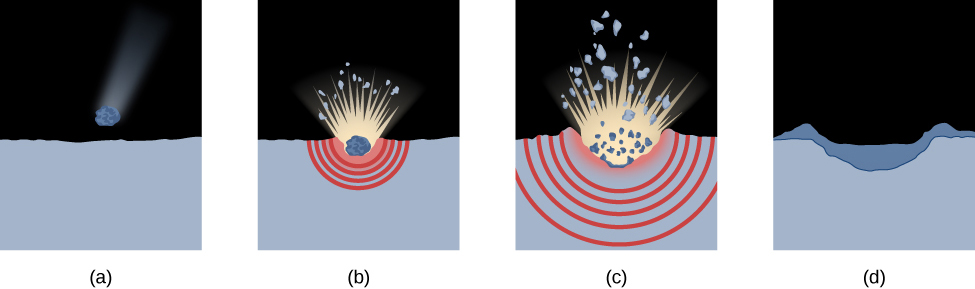
Let’s consider how an impact at these high speeds produces a crater. When such a fast projectile strikes a planet, it penetrates two or three times its own diameter before stopping. During these few seconds, its energy of motion is transferred into a shock wave (which spreads through the target body) and into heat (which vaporizes most of the projectile and some of the surrounding target). The shock wave fractures the rock of the target, while the expanding silicate vapor generates an explosion similar to that of a nuclear bomb detonated at ground level (Figure 9.14). The size of the excavated crater depends primarily on the speed of impact, but generally it is 10 to 15 times the diameter of the projectile.
英語のヒント
このような高速の衝突が、どのようにクレーターを作るかを考えよう。それほど速い飛来物が惑星にぶつかると、止まるまでに、自分の直径の2〜3倍の深さまで突き進む。この数秒の間に、その運動エネルギーは、衝突された天体内を伝わる衝撃波と、飛来物の大部分および周囲の衝突対象の一部を蒸発させる熱へ移される。衝撃波は衝突対象の岩石を割り、膨張するケイ酸塩の蒸気は、地上で起爆した核爆弾に似た爆発を生む(図9.14)。掘り出されるクレーターの大きさは、主に衝突速度に依存するが、一般には、飛来物の直径の10〜15倍になる。
Stages in the Formation of an Impact Crater.衝突クレーター形成の段階。
OpenStax / Rice University · CC BY 4.0
Figure 9.14 (a) The impact occurs. (b) The projectile vaporizes and a shock wave spreads through the lunar rock. (c) Ejecta are thrown out of the crater. (d) Most of the ejected material falls back to fill the crater, but some of it is found outside the crater in the form of an ejecta blanket.
図9.14 (a)衝突が起こる。(b)飛来物が蒸発し、衝撃波が月の岩石中を広がる。(c)クレーターから放出物が飛び出す。(d)放出された物質の大部分は戻ってクレーターを埋めるが、一部はクレーターの外にイジェクタブランケットとして存在する。
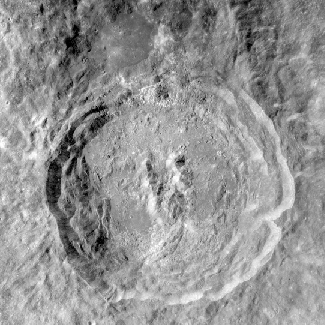
An impact explosion of the sort described above leads to a characteristic kind of crater, as shown in Figure 9.15. The central cavity is initially bowl-shaped (the word “crater” comes from the Greek word for “bowl”), but the rebound of the crust partially fills it in, producing a flat floor and sometimes creating a central peak. Around the rim, landslides create a series of terraces.
英語のヒント
上で説明した種類の衝突爆発は、図9.15に示す特徴的なクレーターを作る。中央の穴は初め、鉢の形をしている。「クレーター」という語は、「鉢」を表すギリシャ語に由来する。しかし、地殻が跳ね返ると穴の一部が埋まり、平らな底ができ、ときには中央丘も生まれる。縁の周りでは、地滑りによって何段ものテラスができる。
Typical Impact Crater.典型的な衝突クレーター。
credit: NASA/JSC/Arizona State University · NASA media use guidelines
Figure 9.15 King Crater on the far side of the Moon, a fairly recent lunar crater 75 kilometers in diameter, shows most of the features associated with large impact structures. (credit: NASA/JSC/Arizona State University)
図9.15 月の裏側にあるキングクレーターは、直径75 kmの比較的新しい月のクレーターで、大きな衝突構造に伴う特徴の大半を示している。(提供:NASA/JSC/アリゾナ州立大学)
The rim of the crater is turned up by the force of the explosion, so it rises above both the floor and the adjacent terrain. Surrounding the rim is an ejecta blanket consisting of material thrown out by the explosion. This debris falls back to create a rough, hilly region, typically about as wide as the crater diameter. Additional, higher-speed ejecta fall at greater distances from the crater, often digging small secondary craters where they strike the surface (Figure 9.9).
英語のヒント
クレーターの縁は、爆発の力で上へめくれ上がり、底と隣接する地形の両方より高くなる。その縁を取り囲むのが、爆発で飛び出した物質からなるイジェクタブランケットである。破片は落下し、一般にクレーターの直径と同程度の幅を持つ、でこぼこした丘陵地を作る。さらに速い別の放出物は、クレーターからより遠くへ落ち、しばしば表面にぶつかった場所に、小さな二次クレーターを掘る(図9.9)。
Some of these streams of ejecta can extend for hundreds or even thousands of kilometers from the crater, creating the bright crater rays that are prominent in lunar photos taken near full phase. The brightest lunar crater rays are associated with large young craters such as Kepler and Tycho.
英語のヒント
こうした放出物の筋の一部は、クレーターから数百km、ときには数千kmまで延びる。これが、満月に近い時期の月の写真で目立つ、明るい光条を作る。月で最も明るい光条は、ケプラーやティコなどの、大きく新しいクレーターに伴っている。