第9章クレーターに覆われた世界Cratered Worlds
On the Lunar Surface月面で
“The surface is fine and powdery. I can pick it up loosely with my toe. But I can see the footprints of my boots and the treads in the fine sandy particles.” —Neil Armstrong, Apollo 11 astronaut, immediately after stepping onto the Moon for the first time.
英語のヒント
「表面は細かく、粉のようです。つま先で軽くすくい上げられます。でも、その細かい砂の粒子の中に、私のブーツの足跡と、靴底の溝の跡が見えます。」――アポロ11号の宇宙飛行士ニール・アームストロング。初めて月面に降り立った直後の言葉。
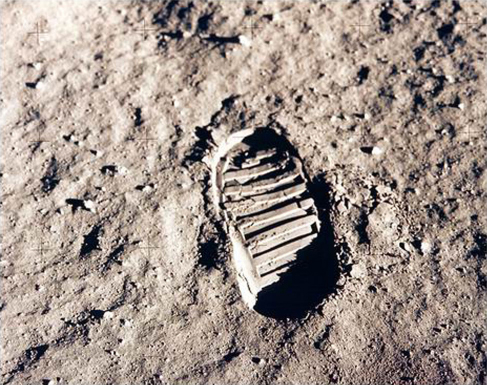
The surface of the Moon is buried under a fine-grained soil of tiny, shattered rock fragments. The dark basaltic dust of the lunar maria was kicked up by every astronaut footstep, and thus eventually worked its way into all of the astronauts’ equipment. The upper layers of the surface are porous, consisting of loosely packed dust into which their boots sank several centimeters (Figure 9.12). This lunar dust, like so much else on the Moon, is the product of impacts. Each cratering event, large or small, breaks up the rock of the lunar surface and scatters the fragments. Ultimately, billions of years of impacts have reduced much of the surface layer to particles about the size of dust or sand.
英語のヒント
月の表面は、細かく砕けた岩石の小片からなる、粒子の細かい土壌に埋もれている。月の海にある暗い玄武岩質の塵は、宇宙飛行士が一歩踏み出すたびに舞い上がり、やがて宇宙飛行士のあらゆる装備に入り込んだ。表面の上層は多孔質で、緩く積もった塵からなり、ブーツはその中へ数cm沈んだ(図9.12)。この月の塵も、月にある多くのほかのものと同様、衝突の産物である。クレーターを作る出来事は、大きくても小さくても、そのたびに月面の岩石を砕いて、破片をまき散らす。何十億年にもわたる衝突は、ついには表層の多くを、塵や砂ほどの大きさの粒子にした。
Footprint on Moon Dust.月の塵に残る足跡。
credit: NASA · NASA media use guidelines
Figure 9.12 Apollo photo of an astronaut’s boot print in the lunar soil. (credit: NASA)
図9.12 月の土壌に残る宇宙飛行士のブーツの足跡を写した、アポロの写真。(提供:NASA)
In the absence of any air, the lunar surface experiences much greater temperature extremes than the surface of Earth, even though Earth is virtually the same distance from the Sun. Near local noon, when the Sun is highest in the sky, the temperature of the dark lunar soil rises above the boiling point of water. During the long lunar night (which, like the lunar day, lasts two Earth weeksYou can see the cycle of day and night on the side of the Moon facing us in the form of the Moon’s phases. It takes about 14 days for the side of the Moon facing us to go from full moon (all lit up) to new moon (all dark). There is more on this in Chapter 4: Earth, Moon, and Sky.), the temperature drops to about 100 K (–173 °C). The extreme cooling is a result not only of the absence of air but also of the porous nature of the Moon’s dusty soil, which cools more rapidly than solid rock would.
英語のヒント
大気がまったくないため、月面は地球の表面よりはるかに極端な温度変化を経験する。地球も太陽からほぼ同じ距離にあるにもかかわらず、そうなのである。その場所で正午に近づき、太陽が空で最も高くなると、暗い月の土壌の温度は、水の沸点を超える。月の長い夜には、温度は約100 K(−173℃)まで下がる。月の夜は、月の昼と同様、地球の2週間続く。〔注:私たちを向く月の側の昼夜の周期は、月の満ち欠けとして見ることができる。この側が満月、つまり全面が照らされた状態から、新月、つまり全面が暗い状態になるまでには、約14日かかる。詳しくは第4章「地球・月・空」で扱う。〕この極端な冷却は、空気がないことだけでなく、月の塵に覆われた土壌が多孔質で、緻密な岩石の場合よりも速く冷えることによっても起こる。
Key Concepts and Summary重要事項のまとめ
The Moon, like Earth, was formed about 4.5 billion years ago. The Moon’s heavily cratered highlands are made of rocks more than 4 billion years old. The darker volcanic plains of the maria were erupted primarily between 3.3 and 3.8 billion years ago. Generally, the surface is dominated by impacts, including continuing small impacts that produce its fine-grained soil.
英語のヒント
月は地球と同じく、約45億年前にできた。クレーターの密集した月の高地は、40億年以上前の岩石からなる。より暗い海の火山平原は、主に33億〜38億年前に噴出した。全般に、月面を大きく支配するのは衝突であり、現在も続く小さな衝突が、粒子の細かい土壌を作り出している。
highlands
高地
the lighter, heavily cratered regions of the Moon, which are generally several kilometers higher than the maria
月の明るく、クレーターが密集した領域。一般に、海よりも数km高い。
mare
海
(plural: maria) Latin for “sea;” the name applied to the dark, relatively smooth features that cover 17% of the Moon’s surface
ラテン語のmare(複数形はmaria)は「海」を意味する。月面の17%を覆う、暗く比較的滑らかな地形に付けられた名称。