第18章典型元素の金属・半金属・非金属
18.11 Occurrence, Preparation, and Properties of Halogens18.11 ハロゲンの存在・製法・性質
Learning Objectives学習目標
By the end of this section, you will be able to:
この節を学び終えると、次のことができるようになる。
- Describe the preparation, properties, and uses of halogensハロゲンの製法、性質、用途を説明する。
- Describe the properties, preparation, and uses of halogen compoundsハロゲン化合物の性質、製法、用途を説明する。
The elements in group 17 are the halogens. These are the elements fluorine, chlorine, bromine, iodine, and astatine. These elements are too reactive to occur freely in nature, but their compounds are widely distributed. Chlorides are the most abundant; although fluorides, bromides, and iodides are less common, they are reasonably available. In this section, we will examine the occurrence, preparation, and properties of halogens. Next, we will examine halogen compounds with the representative metals followed by an examination of the interhalogens. This section will conclude with some applications of halogens.
17族の元素はハロゲンである。フッ素、塩素、臭素、ヨウ素、アスタチンが該当する。これらの元素は反応性が高すぎるため、自然界に単体では存在しないが、その化合物は広く分布している。塩化物が最も豊富であり、フッ化物、臭化物、ヨウ化物はそれほど多くないものの、比較的入手しやすい。この節では、ハロゲンの産出、製法、性質を調べる。続いて、典型金属とのハロゲン化合物を調べ、その後、ハロゲン間化合物を取り上げる。最後に、ハロゲンの用途のいくつかを扱う。
Occurrence and Preparation産出と製法
All of the halogens occur in seawater as halide ions. The concentration of the chloride ion is 0.54 M; that of the other halides is less than 10–4 M. Fluoride also occurs in minerals such as CaF2, Ca(PO4)3F, and Na3AlF6. Chloride also occurs in the Great Salt Lake and the Dead Sea, and in extensive salt beds that contain NaCl, KCl, or MgCl2. Part of the chlorine in your body is present as hydrochloric acid, which is a component of stomach acid. Bromine compounds occur in the Dead Sea and underground brines. Iodine compounds are found in small quantities in Chile saltpeter, underground brines, and sea kelp. Iodine is essential to the function of the thyroid gland.
英語のヒント
すべてのハロゲンは、海水中にハロゲン化物イオンとして存在する。塩化物イオンの濃度は0.54 Mであり、他のハロゲン化物の濃度は10–4 M未満である。フッ化物は、CaF2、Ca(PO4)3F、Na3AlF6などの鉱物にも存在する。塩化物は、グレートソルト湖や死海、およびNaCl、KCl、MgCl2を含む広大な岩塩層にも存在する。体内の塩素の一部は、胃酸の成分である塩酸として存在する。臭素化合物は、死海や地下の塩水に存在する。ヨウ素化合物は、チリ硝石、地下の塩水、海のコンブ類に少量見られる。ヨウ素は、甲状腺の機能に不可欠である。
The best sources of halogens (except iodine) are halide salts. It is possible to oxidize the halide ions to free diatomic halogen molecules by various methods, depending on the ease of oxidation of the halide ion. Fluoride is the most difficult to oxidize, whereas iodide is the easiest.
ハロゲン(ヨウ素を除く)の最良の供給源は、ハロゲン化物塩である。ハロゲン化物イオンの酸化されやすさに応じて、さまざまな方法で酸化し、単体の二原子ハロゲン分子にできる。フッ化物が最も酸化しにくく、ヨウ化物が最も酸化しやすい。
The major method for preparing fluorine is electrolytic oxidation. The most common electrolysis procedure is to use a molten mixture of potassium hydrogen fluoride, KHF2, and anhydrous hydrogen fluoride. Electrolysis causes HF to decompose, forming fluorine gas at the anode and hydrogen at the cathode. It is necessary to keep the two gases separated to prevent their explosive recombination to reform hydrogen fluoride.
フッ素を調製する主要な方法は、電解酸化である。最も一般的な電気分解の手順では、フッ化水素カリウムKHF2と無水フッ化水素の溶融混合物を用いる。電気分解によってHFが分解し、アノードにフッ素ガス、カソードに水素が生じる。二つの気体が爆発的に再結合してフッ化水素へ戻るのを防ぐため、両者を分離しておく必要がある。
Most commercial chlorine comes from the electrolysis of the chloride ion in aqueous solutions of sodium chloride; this is the chlor-alkali process discussed previously. Chlorine is also a product of the electrolytic production of metals such as sodium, calcium, and magnesium from their fused chlorides. It is also possible to prepare chlorine by the chemical oxidation of the chloride ion in acid solution with strong oxidizing agents such as manganese dioxide (MnO2) or sodium dichromate (Na2Cr2O7). The reaction with manganese dioxide is:
商業用塩素の大部分は、塩化ナトリウム水溶液中の塩化物イオンの電気分解によって得られる。これは、先に述べた塩素アルカリ法である。塩素は、ナトリウム、カルシウム、マグネシウムなどの金属を、それぞれの溶融塩化物から電解製造する際の生成物でもある。また、二酸化マンガンMnO2や二クロム酸ナトリウムNa2Cr2O7などの強い酸化剤を用いて、酸性溶液中の塩化物イオンを化学的に酸化して調製することもできる。二酸化マンガンとの反応は、次のとおりである。
The commercial preparation of bromine involves the oxidation of bromide ion by chlorine:
臭素の商業的調製では、塩素によって臭化物イオンを酸化する。
Chlorine is a stronger oxidizing agent than bromine. This method is important for the production of essentially all domestic bromine.
塩素は臭素より強い酸化剤である。この方法は、国内の臭素のほぼ全量を生産するうえで重要である。
Some iodine comes from the oxidation of iodine chloride, ICl, or iodic acid, HlO3. The commercial preparation of iodine utilizes the reduction of sodium iodate, NaIO3, an impurity in deposits of Chile saltpeter, with sodium hydrogen sulfite:
ヨウ素の一部は、塩化ヨウ素IClまたはヨウ素酸HlO3の酸化から得られる。商業的なヨウ素の調製では、チリ硝石の鉱床の不純物であるヨウ素酸ナトリウムNaIO3,を、亜硫酸水素ナトリウムによって還元する。
Properties of the Halogensハロゲンの性質
Fluorine is a pale yellow gas, chlorine is a greenish-yellow gas, bromine is a deep reddish-brown liquid, and iodine is a grayish-black crystalline solid. Liquid bromine has a high vapor pressure, and the reddish vapor is readily visible in Figure 18.60. Iodine crystals have a noticeable vapor pressure. When gently heated, these crystals sublime and form a beautiful deep violet vapor.
フッ素は淡黄色の気体、塩素は緑がかった黄色の気体、臭素は濃い赤褐色の液体、ヨウ素は灰黒色の結晶性固体である。液体臭素は蒸気圧が高く、図18.60では赤みを帯びた蒸気がはっきり見える。ヨウ素の結晶にも、無視できない蒸気圧がある。穏やかに加熱すると、この結晶は昇華し、美しい濃紫色の蒸気を作る。
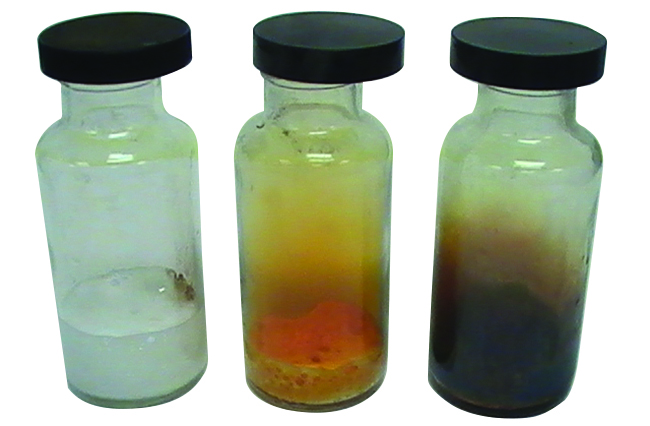
OpenStax, Rice University, Chemistry 2e. Original caption credit: (credit: Sahar Atwa) · CC BY 4.0 · Source出典

Figure 18.60図 18.60
Chlorine is a pale yellow-green gas (left), gaseous bromine is deep orange (center), and gaseous iodine is purple (right). (Fluorine is so reactive that it is too dangerous to handle.) (credit: Sahar Atwa)
塩素は淡い黄緑色の気体(左)、気体の臭素は濃いオレンジ色(中央)、気体のヨウ素は紫色(右)である。(フッ素は反応性が非常に高く、取り扱うには危険すぎる。)(クレジット:Sahar Atwa)
Bromine is only slightly soluble in water, but it is miscible in all proportions in less polar (or nonpolar) solvents such as chloroform, carbon tetrachloride, and carbon disulfide, forming solutions that vary from yellow to reddish-brown, depending on the concentration.
英語のヒント
臭素は水にはわずかしか溶けないが、クロロホルム、四塩化炭素、二硫化炭素など、極性の低い(または無極性の)溶媒とはあらゆる割合で混ざり合い、濃度に応じて黄色から赤褐色まで変化する溶液を作る。
Iodine is soluble in chloroform, carbon tetrachloride, carbon disulfide, and many hydrocarbons, giving violet solutions of I2 molecules. Iodine dissolves only slightly in water, giving brown solutions. It is quite soluble in aqueous solutions of iodides, with which it forms brown solutions. These brown solutions result because iodine molecules have empty valence d orbitals and can act as weak Lewis acids towards the iodide ion. The equation for the reversible reaction of iodine (Lewis acid) with the iodide ion (Lewis base) to form triiodide ion, is:
ヨウ素は、クロロホルム、四塩化炭素、二硫化炭素、多くの炭化水素に溶け、I2分子の紫色の溶液を作る。水にはわずかしか溶けず、褐色の溶液を作る。ヨウ化物の水溶液にはよく溶け、褐色の溶液を作る。この褐色溶液ができるのは、ヨウ素分子に空の価電子d軌道があり、ヨウ化物イオンに対して弱いルイス酸として働けるためである。ヨウ素(ルイス酸)とヨウ化物イオン(ルイス塩基)が反応して三ヨウ化物イオンを作る、可逆反応の式は次のとおりである。
The easier it is to oxidize the halide ion, the more difficult it is for the halogen to act as an oxidizing agent. Fluorine generally oxidizes an element to its highest oxidation state, whereas the heavier halogens may not. For example, when excess fluorine reacts with sulfur, SF6 forms. Chlorine gives SCl2 and bromine, S2Br2. Iodine does not react with sulfur.
ハロゲン化物イオンが酸化されやすいほど、そのハロゲンは酸化剤として働きにくくなる。フッ素は一般に、元素を最高酸化状態まで酸化するが、より重いハロゲンではそうならないことがある。たとえば、過剰のフッ素が硫黄と反応すると、SF6が生じる。塩素はSCl2を、臭素はS2Br2を生じる。ヨウ素は硫黄と反応しない。
Fluorine is the most powerful oxidizing agent of the known elements. It spontaneously oxidizes most other elements; therefore, the reverse reaction, the oxidation of fluorides, is very difficult to accomplish. Fluorine reacts directly and forms binary fluorides with all of the elements except the lighter noble gases (He, Ne, and Ar). Fluorine is such a strong oxidizing agent that many substances ignite on contact with it. Drops of water inflame in fluorine and form O2, OF2, H2O2, O3, and HF. Wood and asbestos ignite and burn in fluorine gas. Most hot metals burn vigorously in fluorine. However, it is possible to handle fluorine in copper, iron, or nickel containers because an adherent film of the fluoride salt passivates their surfaces. Fluorine is the only element that reacts directly with the noble gas xenon.
英語のヒント
フッ素は、知られている元素の中で最も強力な酸化剤である。他の元素の大部分を自発的に酸化するため、逆反応であるフッ化物の酸化を実現することは非常に難しい。フッ素は、軽い希ガス(He、Ne、Ar)を除くすべての元素と直接反応し、二元フッ化物を作る。非常に強い酸化剤であるため、多くの物質が触れただけで発火する。水滴はフッ素中で燃え上がり、O2、OF2、H2O2、O3、HFを作る。木材やアスベストは、フッ素ガス中で着火して燃える。高温の金属の大部分も、フッ素中で激しく燃える。しかし、フッ化物塩の密着した被膜が表面を不動態化するため、銅、鉄、ニッケルの容器でフッ素を扱うことができる。フッ素は、希ガスのキセノンと直接反応する唯一の元素である。
Although it is a strong oxidizing agent, chlorine is less active than fluorine. Mixing chlorine and hydrogen in the dark makes the reaction between them to be imperceptibly slow. Exposure of the mixture to light causes the two to react explosively. Chlorine is also less active towards metals than fluorine, and oxidation reactions usually require higher temperatures. Molten sodium ignites in chlorine. Chlorine attacks most nonmetals (C, N2, and O2 are notable exceptions), forming covalent molecular compounds. Chlorine generally reacts with compounds that contain only carbon and hydrogen (hydrocarbons) by adding to multiple bonds or by substitution.
英語のヒント
塩素は強い酸化剤だが、フッ素より活性が低い。暗所で塩素と水素を混合すると、両者の反応は知覚できないほど遅い。混合物を光にさらすと、両者は爆発的に反応する。金属に対しても塩素はフッ素より活性が低く、酸化反応は通常、より高い温度を必要とする。溶融ナトリウムは塩素中で発火する。塩素は非金属の大部分を侵し(C、N2、O2は注目すべき例外である)、共有結合性の分子化合物を作る。一般に塩素は、炭素と水素だけを含む化合物(炭化水素)と、多重結合への付加または置換によって反応する。
In cold water, chlorine undergoes a disproportionation reaction:
冷水中で、塩素は不均化反応を起こす。
Half the chlorine atoms oxidize to the 1+ oxidation state (hypochlorous acid), and the other half reduce to the 1− oxidation state (chloride ion). This disproportionation is incomplete, so chlorine water is an equilibrium mixture of chlorine molecules, hypochlorous acid molecules, hydronium ions, and chloride ions. When exposed to light, this solution undergoes a photochemical decomposition:
塩素原子の半分は1+の酸化状態(次亜塩素酸)へ酸化され、残る半分は1−の酸化状態(塩化物イオン)へ還元される。この不均化は完全には進まないため、塩素水は、塩素分子、次亜塩素酸分子、ヒドロニウムイオン、塩化物イオンの平衡混合物である。光にさらすと、この溶液は光化学的に分解する。
The nonmetal chlorine is more electronegative than any other element except fluorine, oxygen, and nitrogen. In general, very electronegative elements are good oxidizing agents; therefore, we would expect elemental chlorine to oxidize all of the other elements except for these three (and the nonreactive noble gases). Its oxidizing property, in fact, is responsible for its principal use. For example, phosphorus(V) chloride, an important intermediate in the preparation of insecticides and chemical weapons, is manufactured by oxidizing the phosphorus with chlorine:
非金属の塩素は、フッ素、酸素、窒素を除くどの元素よりも電気陰性度が高い。一般に、電気陰性度が非常に高い元素はよい酸化剤であるため、単体の塩素は、これら三元素(および反応性のない希ガス)を除く、他のすべての元素を酸化すると予想される。実際、主要な用途をもたらしているのは、その酸化性である。たとえば、殺虫剤や化学兵器の調製で重要な中間体である塩化リン(V)は、リンを塩素で酸化して製造される。
A great deal of chlorine is also used to oxidize, and thus to destroy, organic or biological materials in water purification and in bleaching.
浄水や漂白では、水中の有機物や生物性物質を酸化し、それによって破壊するためにも、大量の塩素が使われる。
The chemical properties of bromine are similar to those of chlorine, although bromine is the weaker oxidizing agent and its reactivity is less than that of chlorine.
臭素の化学的性質は塩素に似ているが、臭素のほうが酸化剤として弱く、反応性も低い。
Iodine is the least reactive of the halogens. It is the weakest oxidizing agent, and the iodide ion is the most easily oxidized halide ion. Iodine reacts with metals, but heating is often required. It does not oxidize other halide ions.
ヨウ素は、ハロゲンの中で最も反応性が低い。最も弱い酸化剤であり、ヨウ化物イオンは最も酸化されやすいハロゲン化物イオンである。ヨウ素は金属と反応するが、加熱を必要とすることが多い。他のハロゲン化物イオンを酸化することはない。
Compared with the other halogens, iodine reacts only slightly with water. Traces of iodine in water react with a mixture of starch and iodide ion, forming a deep blue color. This reaction is a very sensitive test for the presence of iodine in water.
他のハロゲンと比べて、ヨウ素は水とわずかしか反応しない。水中の微量のヨウ素は、デンプンとヨウ化物イオンの混合物と反応し、濃い青色を生じる。この反応は、水中のヨウ素の存在を調べる、非常に感度の高い試験である。