第18章典型元素の金属・半金属・非金属
18.6 Occurrence, Preparation, and Properties of Carbonates18.6 炭酸塩の存在・製法・性質
Learning Objectives学習目標
By the end of this section, you will be able to:
この節を学び終えると、次のことができるようになる。
- Describe the preparation, properties, and uses of some representative metal carbonates典型的な金属炭酸塩のいくつかについて、製法、性質、用途を説明する。
The chemistry of carbon is extensive; however, most of this chemistry is not relevant to this chapter. The other aspects of the chemistry of carbon will appear in the chapter covering organic chemistry. In this chapter, we will focus on the carbonate ion and related substances. The metals of groups 1 and 2, as well as zinc, cadmium, mercury, and lead(II), form ionic carbonates—compounds that contain the carbonate anions, The metals of group 1, magnesium, calcium, strontium, and barium also form hydrogen carbonates—compounds that contain the hydrogen carbonate anion, also known as the bicarbonate anion.
英語のヒント
炭素の化学は広範囲にわたるが、その大部分はこの章の対象ではない。炭素の化学の他の側面は、有機化学を扱う章に登場する。この章では、炭酸イオンと関連物質に焦点を当てる。1族と2族の金属に加え、亜鉛、カドミウム、水銀、鉛(II)は、炭酸陰イオンを含む化合物であるイオン性炭酸塩を作る。1族の金属、マグネシウム、カルシウム、ストロンチウム、バリウムは、重炭酸陰イオンとも呼ばれる炭酸水素陰イオンを含む化合物である炭酸水素塩も作る。
With the exception of magnesium carbonate, it is possible to prepare carbonates of the metals of groups 1 and 2 by the reaction of carbon dioxide with the respective oxide or hydroxide. Examples of such reactions include:
炭酸マグネシウムを除けば、1族と2族の金属の炭酸塩は、二酸化炭素と、それぞれに対応する酸化物または水酸化物との反応によって調製できる。このような反応には、次の例がある。
The carbonates of the alkaline earth metals of group 12 and lead(II) are not soluble. These carbonates precipitate upon mixing a solution of soluble alkali metal carbonate with a solution of soluble salts of these metals. Examples of net ionic equations for the reactions are:
12族のアルカリ土類金属と鉛(II)の炭酸塩は不溶性である。可溶性のアルカリ金属炭酸塩の溶液と、これらの金属の可溶性塩の溶液を混合すると、これらの炭酸塩が沈殿する。反応の正味イオン反応式の例は、次のとおりである。
Pearls and the shells of most mollusks are calcium carbonate. Tin(II) or one of the trivalent or tetravalent ions such as Al3+ or Sn4+ behave differently in this reaction as carbon dioxide and the corresponding oxide form instead of the carbonate.
英語のヒント
真珠や、大部分の軟体動物の殻は炭酸カルシウムである。スズ(II)、またはAl3+やSn4+などの三価または四価のイオンは、この反応で異なる挙動を示し、炭酸塩の代わりに、二酸化炭素と対応する酸化物を生じる。
Alkali metal hydrogen carbonates such as NaHCO3 and CsHCO3 form by saturating a solution of the hydroxides with carbon dioxide. The net ionic reaction involves hydroxide ion and carbon dioxide:
NaHCO3やCsHCO3などのアルカリ金属炭酸水素塩は、水酸化物の溶液を二酸化炭素で飽和させることによって生じる。正味のイオン反応には、水酸化物イオンと二酸化炭素が関わる。
It is possible to isolate the solids by evaporation of the water from the solution.
溶液から水を蒸発させると、固体を単離できる。
Although they are insoluble in pure water, alkaline earth carbonates dissolve readily in water containing carbon dioxide because hydrogen carbonate salts form. For example, caves and sinkholes form in limestone when CaCO3 dissolves in water containing dissolved carbon dioxide:
英語のヒント
アルカリ土類金属の炭酸塩は、純水には溶けないが、二酸化炭素を含む水には、炭酸水素塩ができるため容易に溶ける。たとえば、二酸化炭素が溶け込んだ水にCaCO3が溶解すると、石灰岩に洞窟や陥没穴ができる。
Hydrogen carbonates of the alkaline earth metals remain stable only in solution; evaporation of the solution produces the carbonate. Stalactites and stalagmites, like those shown in Figure 18.30, form in caves when drops of water containing dissolved calcium hydrogen carbonate evaporate to leave a deposit of calcium carbonate.
英語のヒント
アルカリ土類金属の炭酸水素塩は、溶液中でのみ安定に存在し、溶液を蒸発させると炭酸塩が生じる。炭酸水素カルシウムを溶かした水滴が蒸発し、炭酸カルシウムの堆積を残すと、洞窟内に図18.30のような鍾乳石や石筍ができる。
Image omitted because its reuse rights could not be verified.権利の確認ができないため画像を割愛。
Figure 18.30図 18.30
(a) Stalactites and (b) stalagmites are cave formations of calcium carbonate. (credit a: modification of work by Arvind Govindaraj; credit b: modification of work by the National Park Service.)
(a) 鍾乳石と(b) 石筍は、洞窟内で形成される炭酸カルシウムである。(クレジットa:Arvind Govindarajの作品を改変。クレジットb:米国国立公園局の作品を改変。)
The two carbonates used commercially in the largest quantities are sodium carbonate and calcium carbonate. In the United States, sodium carbonate is extracted from the mineral trona, Na3(CO3)(HCO3)(H2O)2. Following recrystallization to remove clay and other impurities, heating the recrystallized trona produces Na2CO3:
商業的に最も大量に使われる二つの炭酸塩は、炭酸ナトリウムと炭酸カルシウムである。米国では、炭酸ナトリウムは鉱物トロナNa3(CO3)(HCO3)(H2O)2から抽出される。再結晶によって粘土や他の不純物を除いた後、再結晶したトロナを加熱するとNa2CO3が生じる。
Carbonates are moderately strong bases. Aqueous solutions are basic because the carbonate ion accepts hydrogen ion from water in this reversible reaction:
炭酸塩は中程度に強い塩基である。次の可逆反応で炭酸イオンが水から水素イオンを受け取るため、水溶液は塩基性となる。
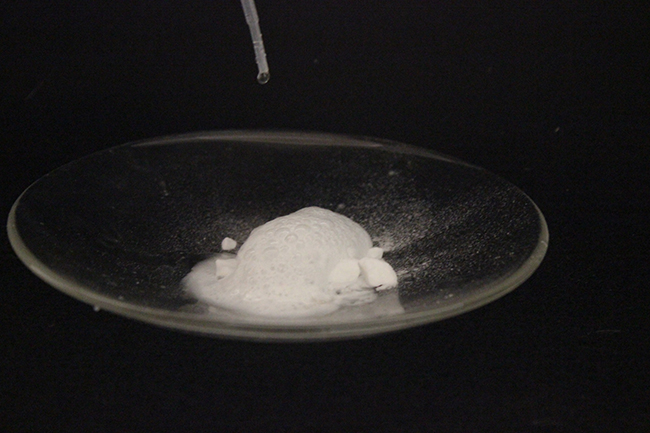
Carbonates react with acids to form salts of the metal, gaseous carbon dioxide, and water. The reaction of calcium carbonate, the active ingredient of the antacid Tums, with hydrochloric acid (stomach acid), as shown in Figure 18.31, illustrates the reaction:
炭酸塩は酸と反応して、金属の塩、気体の二酸化炭素、水を作る。図18.31に示す、制酸剤Tumsの有効成分である炭酸カルシウムと、塩酸(胃酸)との反応がその例である。
OpenStax, Rice University, Chemistry 2e. Original caption credit: (credit: Mark Ott) · CC BY 4.0 · Source出典

Figure 18.31図 18.31
The reaction of calcium carbonate with hydrochloric acid is shown. (credit: Mark Ott)
炭酸カルシウムと塩酸との反応を示している。(クレジット:Mark Ott)
Other applications of carbonates include glass making—where carbonate ions serve as a source of oxide ions—and synthesis of oxides.
炭酸塩の他の用途には、ガラスの製造と酸化物の合成がある。ガラスの製造では、炭酸イオンが酸化物イオンの供給源として働く。
Hydrogen carbonates are amphoteric because they act as both weak acids and weak bases. Hydrogen carbonate ions act as acids and react with solutions of soluble hydroxides to form a carbonate and water:
炭酸水素塩は、弱酸としても弱塩基としても働くため、両性である。炭酸水素イオンは酸として働き、可溶性水酸化物の溶液と反応して、炭酸塩と水を作る。
With acids, hydrogen carbonates form a salt, carbon dioxide, and water. Baking soda (bicarbonate of soda or sodium bicarbonate) is sodium hydrogen carbonate. Baking powder contains baking soda and a solid acid such as potassium hydrogen tartrate (cream of tartar), KHC4H4O6. As long as the powder is dry, no reaction occurs; immediately after the addition of water, the acid reacts with the hydrogen carbonate ions to form carbon dioxide:
英語のヒント
炭酸水素塩は酸と反応して、塩、二酸化炭素、水を作る。ベーキングソーダ(重曹、または重炭酸ナトリウム)は、炭酸水素ナトリウムである。ベーキングパウダーには、ベーキングソーダと、酒石酸水素カリウム(クリーム・オブ・ターター)KHC4H4O6などの固体の酸が含まれる。粉末が乾燥している限り反応は起こらないが、水を加えると直ちに、酸が炭酸水素イオンと反応して二酸化炭素を作る。
Dough will trap the carbon dioxide, causing it to expand during baking, producing the characteristic texture of baked goods.
英語のヒント
生地は二酸化炭素を閉じ込めるため、焼いている間に膨張し、焼き菓子やパンに特有の食感が生まれる。