第18章典型元素の金属・半金属・非金属
Key Concepts and Summary重要概念とまとめ
Nitrogen exhibits oxidation states ranging from 3− to 5+. Because of the stability of the N≡N triple bond, it requires a great deal of energy to make compounds from molecular nitrogen. Active metals such as the alkali metals and alkaline earth metals can reduce nitrogen to form metal nitrides. Nitrogen oxides and nitrogen hydrides are also important substances.
窒素は、3−から5+までの酸化状態を示す。N≡N三重結合が安定であるため、分子状窒素から化合物を作るには、大きなエネルギーを必要とする。アルカリ金属やアルカリ土類金属などの活性な金属は、窒素を還元して金属窒化物を作れる。窒素酸化物と窒素の水素化物も、重要な物質である。
Chemistry End of Chapter Exercises章末問題
Exercises 59–66練習問題 59–66
Exercise 59問題 59
Write the Lewis structures for each of the following:
次のそれぞれのルイス構造を書きなさい。
(a) NH2−
(a) NH2−
(b) N2F4
(b) N2F4
(c)
(c)
(d) NF3
(d) NF3
(e)
(e)
Solution解き方
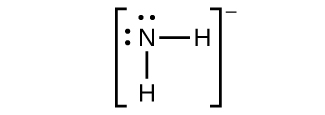
(a) NH2−:
(a) NH2−:

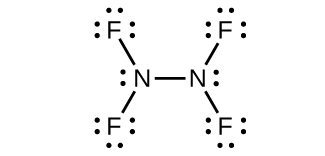
(b) N2F4:
(b) N2F4:
(c)
(c)
(d) NF3:
(d) NF3:

(e)
(e)

Exercise 60問題 60
For each of the following, indicate the hybridization of the nitrogen atom (for the central nitrogen).
次のそれぞれについて、窒素原子の混成を示しなさい(では中央の窒素について)。
(a) N2F4
(a) N2F4
(b)
(b)
(c) NF3
(c) NF3
(d)
(d)
Exercise 61問題 61
Explain how ammonia can function both as a Brønsted base and as a Lewis base.
アンモニアが、ブレンステッド塩基としてもルイス塩基としても働ける理由を説明しなさい。
Solution解き方
Ammonia acts as a Brønsted base because it readily accepts protons and as a Lewis base in that it has an electron pair to donate.
Brønsted base:
Lewis base:
Brønsted base:
Lewis base:
アンモニアは、プロトンを容易に受け取るためブレンステッド塩基として働き、供与できる電子対を持つためルイス塩基として働く。ブレンステッド塩基: ルイス塩基:
Exercise 62問題 62
Determine the oxidation state of nitrogen in each of the following. You may wish to review the chapter on chemical bonding for relevant examples.
次のそれぞれについて、窒素の酸化状態を求めなさい。関連する例を確認するため、化学結合の章を復習するとよい。
(a) NCl3
(a) NCl3
(b) ClNO
(b) ClNO
(c) N2O5
(c) N2O5
(d) N2O3
(d) N2O3
(e)
(e)
(f) N2O4
(f) N2O4
(g) N2O
(g) N2O
(h)
(h)
(i) HNO2
(i) HNO2
(j) HNO3
(j) HNO3
Exercise 63問題 63
For each of the following, draw the Lewis structure, predict the ONO bond angle, and give the hybridization of the nitrogen. You may wish to review the chapters on chemical bonding and advanced theories of covalent bonding for relevant examples.
次のそれぞれについて、ルイス構造を描き、ONO結合角を予測し、窒素の混成を示しなさい。関連する例を確認するため、化学結合と共有結合の発展的理論の章を復習するとよい。
(a) NO2
(a) NO2
(b)
(b)
(c)
(c)
Solution解き方
(a) NO2:
(a) NO2:

Nitrogen is sp2 hybridized. The molecule has a bent geometry with an ONO bond angle of approximately 120°.
(b)
窒素はsp2混成である。分子は折れ線形で、ONO結合角は約120°である。(b)

Nitrogen is sp2 hybridized. The molecule has a bent geometry with an ONO bond angle slightly less than 120°.
(c)
窒素はsp2混成である。分子は折れ線形で、ONO結合角は120°より少し小さい。(c)



Nitrogen is sp hybridized. The molecule has a linear geometry with an ONO bond angle of 180°.
窒素はsp混成である。分子は直線形で、ONO結合角は180°である。
Exercise 64問題 64
How many grams of gaseous ammonia will the reaction of 3.0 g hydrogen gas and 3.0 g of nitrogen gas produce?
3.0 gの水素ガスと3.0 gの窒素ガスとの反応によって、気体のアンモニアは何グラム生成するか。
Exercise 65問題 65
Although PF5 and AsF5 are stable, nitrogen does not form NF5 molecules. Explain this difference among members of the same group.
PF5とAsF5は安定だが、窒素はNF5分子を作らない。同じ族の元素間に見られる、この違いを説明しなさい。
Solution解き方
Nitrogen cannot form a NF5 molecule because it does not have d orbitals to bond with the additional two fluorine atoms.
窒素には、追加の二個のフッ素原子と結合するためのd軌道がないため、NF5分子を作れない。
Exercise 66問題 66
The equivalence point for the titration of a 25.00-mL sample of CsOH solution with 0.1062 M HNO3 is at 35.27 mL. What is the concentration of the CsOH solution?
25.00 mLのCsOH溶液試料を0.1062 MのHNO3で滴定すると、35.27 mLで当量点となる。CsOH溶液の濃度はいくらか。
nitrogen fixation
窒素固定
formation of nitrogen compounds from molecular nitrogen
分子状窒素から窒素化合物を形成すること。