第18章典型元素の金属・半金属・非金属
Phosphorusリン
The name phosphorus comes from the Greek words meaning light bringing. When phosphorus was first isolated, scientists noted that it glowed in the dark and burned when exposed to air. Phosphorus is the only member of its group that does not occur in the uncombined state in nature; it exists in many allotropic forms. We will consider two of those forms: white phosphorus and red phosphorus.
phosphorus(リン)という名前は、「光をもたらす」を意味するギリシャ語に由来する。リンが初めて単離されたとき、科学者は、暗闇で光り、空気にさらされると燃えることに気づいた。リンは、同じ族の中で、自然界に単体の状態では存在しない唯一の元素であり、多くの同素体の形で存在する。ここでは、そのうち白リンと赤リンの二つを取り上げる。
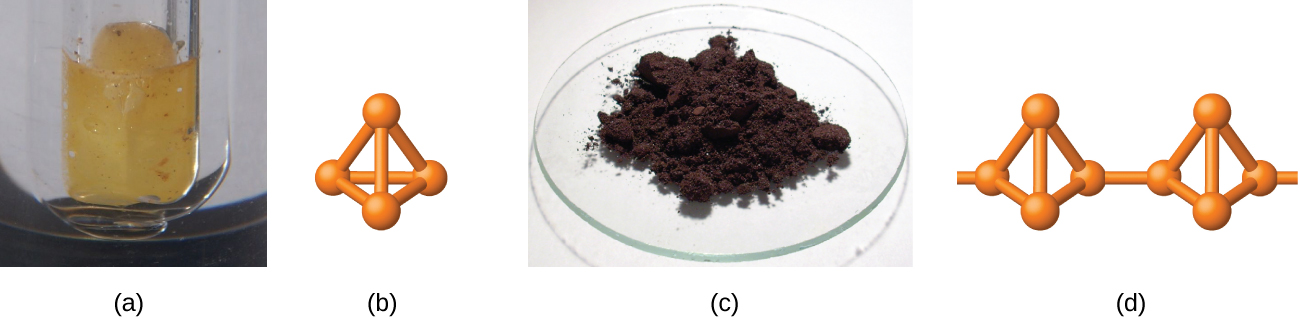
White phosphorus is a white, waxy solid that melts at 44.2 °C and boils at 280 °C. It is insoluble in water (in which it is stored—see Figure 18.24), is very soluble in carbon disulfide, and bursts into flame in air. As a solid, as a liquid, as a gas, and in solution, white phosphorus exists as P4 molecules with four phosphorus atoms at the corners of a regular tetrahedron, as illustrated in Figure 18.24. Each phosphorus atom covalently bonds to the other three atoms in the molecule by single covalent bonds. White phosphorus is the most reactive allotrope and is very toxic.
英語のヒント
OpenStax, Rice University, Chemistry 2e. Original caption credit: (credit a: modification of work from http://images-of-elements.com/phosphorus.php) · CC BY 3.0; OpenStax diagrams CC BY 4.0 · Source出典
Figure 18.24図 18.24
(a) Because white phosphorus bursts into flame in air, it is stored in water. (b) The structure of white phosphorus consists of P4 molecules arranged in a tetrahedron. (c) Red phosphorus is much less reactive than is white phosphorus. (d) The structure of red phosphorus consists of networks of P4 tetrahedra joined by P-P single bonds. (credit a: modification of work from http://images-of-elements.com/phosphorus.php)
(a) 白リンは空気中で急に炎を上げるため、水中で保存される。(b) 白リンの構造は、四面体状に配列したP4分子からなる。(c) 赤リンは白リンよりはるかに反応性が低い。(d) 赤リンの構造は、P-P単結合でつながったP4四面体の網目からなる。(クレジットa:http://images-of-elements.com/phosphorus.phpの作品を改変。)
Heating white phosphorus to 270–300 °C in the absence of air yields red phosphorus. Red phosphorus (shown in Figure 18.24) is denser, has a higher melting point (~600 °C), is much less reactive, is essentially nontoxic, and is easier and safer to handle than is white phosphorus. Its structure is highly polymeric and appears to contain three-dimensional networks of P4 tetrahedra joined by P-P single bonds. Red phosphorus is insoluble in solvents that dissolve white phosphorus. When red phosphorus is heated, P4 molecules sublime from the solid.
空気のない状態で白リンを270~300 °Cに加熱すると、赤リンが得られる。赤リン(図18.24)は、白リンより密度が高く、融点が高く(約600 °C)、反応性がはるかに低く、実質的に無毒で、扱いやすく安全である。その構造は高度に高分子化しており、P-P単結合でつながったP4四面体の三次元網目を含むと考えられる。赤リンは、白リンを溶かす溶媒には溶けない。赤リンを加熱すると、固体からP4分子が昇華する。
Sulfur硫黄
The allotropy of sulfur is far greater and more complex than that of any other element. Sulfur is the brimstone referred to in the Bible and other places, and references to sulfur occur throughout recorded history—right up to the relatively recent discovery that it is a component of the atmospheres of Venus and of Io, a moon of Jupiter. The most common and most stable allotrope of sulfur is yellow, rhombic sulfur, so named because of the shape of its crystals. Rhombic sulfur is the form to which all other allotropes revert at room temperature. Crystals of rhombic sulfur melt at 113 °C. Cooling this liquid gives long needles of monoclinic sulfur. This form is stable from 96 °C to the melting point, 119 °C. At room temperature, it gradually reverts to the rhombic form.
英語のヒント
硫黄の同素体の多様さと複雑さは、他のどの元素をもはるかに上回る。硫黄は、聖書などでbrimstoneと呼ばれる物質であり、記録された歴史を通じて言及されてきた。その歴史は、金星や木星の衛星イオの大気の成分であるという、比較的最近の発見にまで及ぶ。硫黄の最も一般的で安定な同素体は、黄色の斜方硫黄であり、その結晶の形に由来する名を持つ。室温では、他の同素体はすべて斜方硫黄に戻る。斜方硫黄の結晶は113 °Cで融解する。この液体を冷やすと、単斜硫黄の長い針状結晶が得られる。この形態は96 °Cから融点の119 °Cまで安定である。室温では、徐々に斜方晶の形に戻る。
Both rhombic sulfur and monoclinic sulfur contain S8 molecules in which atoms form eight-membered, puckered rings that resemble crowns, as illustrated in Figure 18.25. Each sulfur atom is bonded to each of its two neighbors in the ring by covalent S-S single bonds.
英語のヒント
斜方硫黄も単斜硫黄もS8分子を含み、その原子は、図18.25に示すように、王冠に似た、折れ曲がりのある八員環を作る。各硫黄原子は、環内の二つの隣接原子それぞれに、共有結合のS-S単結合で結びついている。
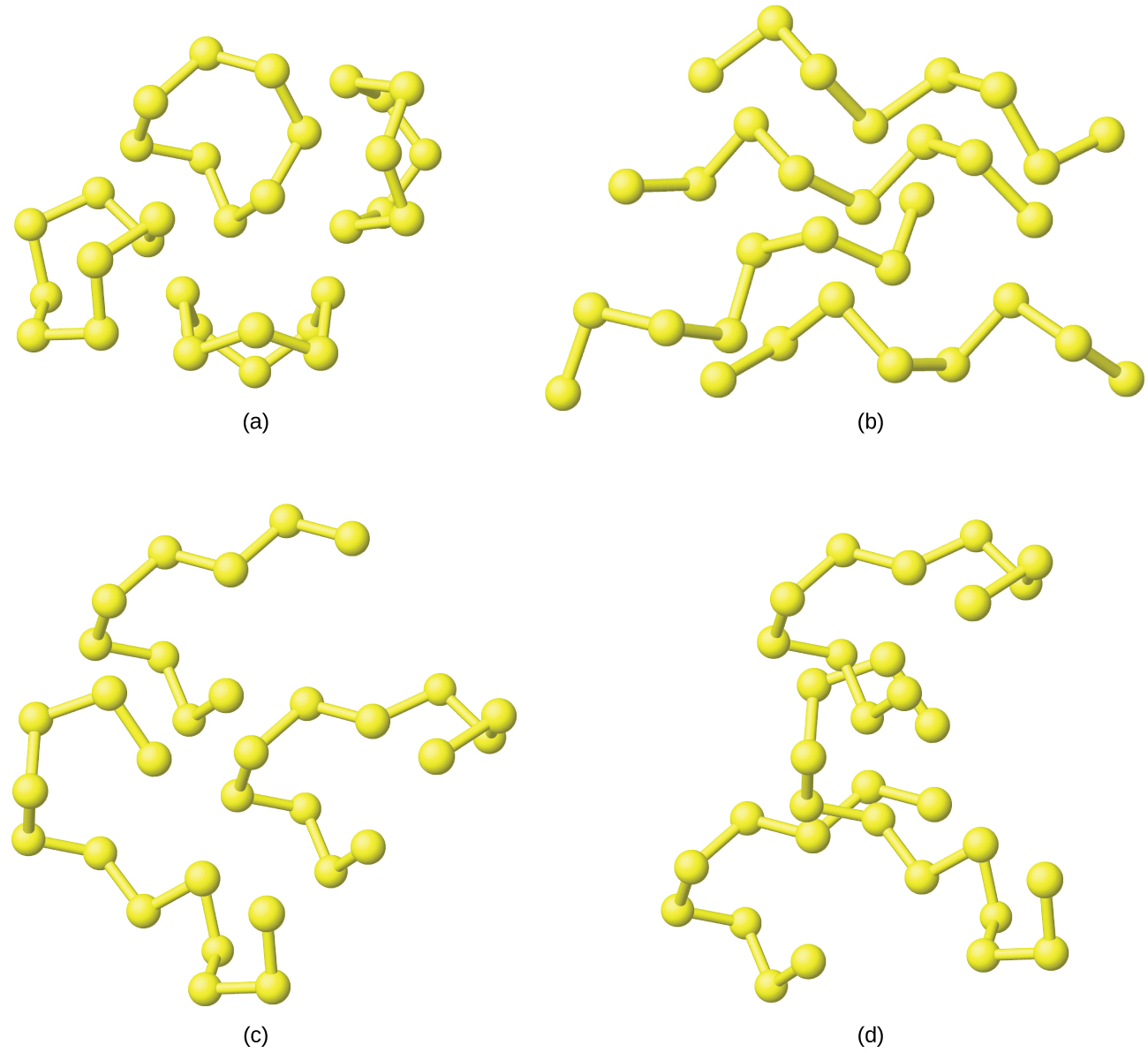

Figure 18.25図 18.25
These four sulfur allotropes show eight-membered, puckered rings. Each sulfur atom bonds to each of its two neighbors in the ring by covalent S-S single bonds. Here are (a) individual S8 rings, (b) S8 chains formed when the rings open, (c) longer chains formed by adding sulfur atoms to S8 chains, and (d) part of the very long sulfur chains formed at higher temperatures.
硫黄のこれら四つの同素体は、折れ曲がりのある八員環を示す。各硫黄原子は、環内の二つの隣接原子それぞれに、共有結合のS-S単結合で結びついている。ここに示すのは、(a) 個々のS8環、(b) 環が開いてできたS8鎖、(c) S8鎖に硫黄原子が加わってできた、より長い鎖、(d) 高温でできる非常に長い硫黄鎖の一部である。
When rhombic sulfur melts, the straw-colored liquid is quite mobile; its viscosity is low because S8 molecules are essentially spherical and offer relatively little resistance as they move past each other. As the temperature rises, S-S bonds in the rings break, and polymeric chains of sulfur atoms result. These chains combine end to end, forming still longer chains that tangle with one another. The liquid gradually darkens in color and becomes so viscous that finally (at about 230 °C) it does not pour easily. The dangling atoms at the ends of the chains of sulfur atoms are responsible for the dark red color because their electronic structure differs from those of sulfur atoms that have bonds to two adjacent sulfur atoms. This causes them to absorb light differently and results in a different visible color. Cooling the liquid rapidly produces a rubberlike amorphous mass, called plastic sulfur.
英語のヒント
斜方硫黄が融解すると、淡黄色の液体は非常に流動性が高い。S8分子はほぼ球形で、互いのそばを通り過ぎる際の抵抗が比較的小さいため、粘度は低い。温度が上がると、環のS-S結合が切れ、硫黄原子の高分子の鎖ができる。これらの鎖が端と端で結合して、さらに長い鎖を作り、互いに絡み合う。液体の色は徐々に濃くなり、粘度が非常に高くなって、最終的には(約230 °Cで)容易には注げなくなる。硫黄原子の鎖の末端で結合が満たされていない原子は、隣接する二つの硫黄原子に結合した硫黄原子とは電子構造が異なるため、暗赤色の原因となる。この違いによって光の吸収の仕方が変わり、見える色が異なる。液体を急冷すると、ゴム状の非晶質の塊が生じ、ゴム状硫黄と呼ばれる。
Sulfur boils at 445 °C and forms a vapor consisting of S2, S6, and S8 molecules; at about 1000 °C, the vapor density corresponds to the formula S2, which is a paramagnetic molecule like O2 with a similar electronic structure and a weak sulfur-sulfur double bond.
硫黄は445 °Cで沸騰し、S2、S6、S8分子からなる蒸気を作る。約1000 °Cでは、蒸気密度は式S2に対応する。この分子はO2と同様に常磁性を持ち、電子構造も似ていて、弱い硫黄・硫黄二重結合を持つ。
As seen in this discussion, an important feature of the structural behavior of the nonmetals is that the elements usually occur with eight electrons in their valence shells. If necessary, the elements form enough covalent bonds to supplement the electrons already present to possess an octet. For example, members of group 15 have five valence electrons and require only three additional electrons to fill their valence shells. These elements form three covalent bonds in their free state: triple bonds in the N2 molecule or single bonds to three different atoms in arsenic and phosphorus. The elements of group 16 require only two additional electrons. Oxygen forms a double bond in the O2 molecule, and sulfur, selenium, and tellurium form two single bonds in various rings and chains. The halogens form diatomic molecules in which each atom is involved in only one bond. This provides the electron required necessary to complete the octet on the halogen atom. The noble gases do not form covalent bonds to other noble gas atoms because they already have a filled outer shell.
英語のヒント
ここまでの説明からわかるように、非金属の構造上の挙動の重要な特徴は、通常、価電子殻に八個の電子を持つ状態で存在することである。必要に応じて、元素は十分な数の共有結合を作り、すでに存在する電子を補ってオクテットを持つ。たとえば、15族の元素は五個の価電子を持ち、価電子殻を満たすために必要な追加の電子は三個だけである。これらの元素は単体の状態で三つの共有結合を作る。N2分子では三重結合、ヒ素やリンでは三つの異なる原子に対する単結合である。16族の元素に必要な追加の電子は二個だけである。酸素はO2分子で二重結合を作り、硫黄、セレン、テルルは、さまざまな環や鎖の中で二つの単結合を作る。ハロゲンは、各原子が一つの結合だけに関わる二原子分子を作る。これにより、ハロゲン原子のオクテットを完成させるのに必要な電子が得られる。希ガスは、外殻がすでに満たされているため、他の希ガス原子と共有結合を作らない。