第18章典型元素の金属・半金属・非金属
Structures of the Nonmetals非金属の構造
The structures of the nonmetals differ dramatically from those of metals. Metals crystallize in closely packed arrays that do not contain molecules or covalent bonds. Nonmetal structures contain covalent bonds, and many nonmetals consist of individual molecules. The electrons in nonmetals are localized in covalent bonds, whereas in a metal, there is delocalization of the electrons throughout the solid.
英語のヒント
非金属の構造は、金属の構造とは大きく異なる。金属は、分子や共有結合を含まない密に詰まった配列として結晶化する。非金属の構造は共有結合を含み、多くの非金属は個々の分子からなる。非金属中の電子は共有結合に局在するが、金属では電子が固体全体に非局在化している。
The noble gases are all monatomic, whereas the other nonmetal gases—hydrogen, nitrogen, oxygen, fluorine, and chlorine—normally exist as the diatomic molecules H2, N2, O2, F2, and Cl2. The other halogens are also diatomic; Br2 is a liquid and I2 exists as a solid under normal conditions. The changes in state as one moves down the halogen family offer excellent examples of the increasing strength of intermolecular London forces with increasing molecular mass and increasing polarizability.
希ガスはすべて単原子であるが、他の非金属の気体、すなわち水素、窒素、酸素、フッ素、塩素は、通常、二原子分子H2,、N2、O2、F2、Cl2として存在する。他のハロゲンも二原子分子であり、通常の条件ではBr2は液体、I2は固体として存在する。ハロゲンの族を下るにつれて状態が変化することは、分子量と分極率の増大に伴い分子間のロンドン力が強くなることの、よい例である。
Oxygen has two allotropes: O2, dioxygen, and O3, ozone. Phosphorus has three common allotropes, commonly referred to by their colors: white, red, and black. Sulfur has several allotropes. There are also many carbon allotropes. Most people know of diamond, graphite, and charcoal, but fewer people know of the recent discovery of fullerenes, carbon nanotubes, and graphene.
酸素には二つの同素体、O2(二酸素)とO3(オゾン)がある。リンには一般的な同素体が三つあり、通常、白、赤、黒という色で呼ばれる。硫黄にはいくつもの同素体がある。炭素にも多くの同素体がある。ダイヤモンド、黒鉛、木炭は大部分の人が知っているが、フラーレン、カーボンナノチューブ、グラフェンが最近発見されたことを知る人は、それほど多くない。
Descriptions of the physical properties of three nonmetals that are characteristic of molecular solids follow.
以下では、分子性固体に特有の性質を持つ三つの非金属について、物理的性質を説明する。
Carbon炭素
Carbon occurs in the uncombined (elemental) state in many forms, such as diamond, graphite, charcoal, coke, carbon black, graphene, and fullerene.
炭素は、ダイヤモンド、黒鉛、木炭、コークス、カーボンブラック、グラフェン、フラーレンなど、多くの形で、他の元素と結合していない状態(単体)として存在する。
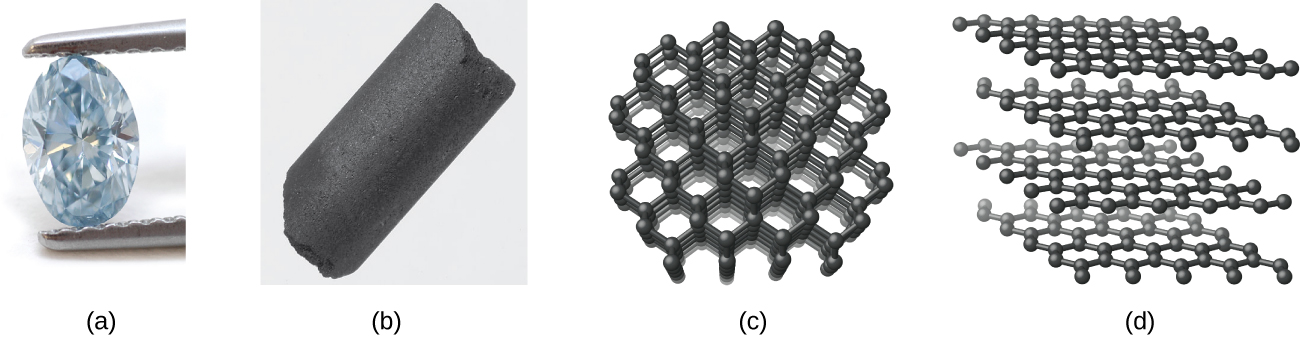
Diamond, shown in Figure 18.20, is a very hard crystalline material that is colorless and transparent when pure. Each atom forms four single bonds to four other atoms at the corners of a tetrahedron (sp3 hybridization); this makes the diamond a giant molecule. Carbon-carbon single bonds are very strong, and, because they extend throughout the crystal to form a three-dimensional network, the crystals are very hard and have high melting points (~4400 °C).
図18.20に示すダイヤモンドは、純粋な場合には無色透明な、非常に硬い結晶性物質である。各原子は、四面体の頂点にある他の四つの原子に対して、四つの単結合を作る(sp3混成)。このため、ダイヤモンドは巨大分子となる。炭素・炭素単結合は非常に強く、結晶全体にわたって三次元網目を作るため、結晶は非常に硬く、融点が高い(約4400 °C)。
OpenStax, Rice University, Chemistry 2e. Original caption credit: (credit a: modification of work by “Fancy Diamonds”/Flickr; credit b: modification of work from http://images-of-elements.com/carbon.php) Diamond: Fancy Diamonds / Leibish & Co, Fancy Intense Blue, Oval Diamond by Leibish & Co. Graphite: images-of-elements.com/carbon.php. · CC BY 2.0 and CC BY 3.0; OpenStax diagrams CC BY 4.0 · Source出典
Figure 18.20図 18.20
(a) Diamond and (b) graphite are two forms of carbon. (c) In the crystal structure of diamond, the covalent bonds form three-dimensional tetrahedrons. (d) In the crystal structure of graphite, each planar layer is composed of six-membered rings. (credit a: modification of work by “Fancy Diamonds”/Flickr; credit b: modification of work from http://images-of-elements.com/carbon.php)
(a) ダイヤモンドと(b) 黒鉛は、炭素の二つの形態である。(c) ダイヤモンドの結晶構造では、共有結合が三次元の四面体を作る。(d) 黒鉛の結晶構造では、各平面層が六員環からなる。(クレジットa:「Fancy Diamonds」/Flickrの作品を改変。クレジットb:http://images-of-elements.com/carbon.phpの作品を改変。)
Graphite, also shown in Figure 18.20, is a soft, slippery, grayish-black solid that conducts electricity. These properties relate to its structure, which consists of layers of carbon atoms, with each atom surrounded by three other carbon atoms in a trigonal planar arrangement. Each carbon atom in graphite forms three σ bonds, one to each of its nearest neighbors, by means of sp2-hybrid orbitals. The unhybridized p orbital on each carbon atom will overlap unhybridized orbitals on adjacent carbon atoms in the same layer to form π bonds. Many resonance forms are necessary to describe the electronic structure of a graphite layer; Figure 18.21 illustrates two of these forms.
英語のヒント
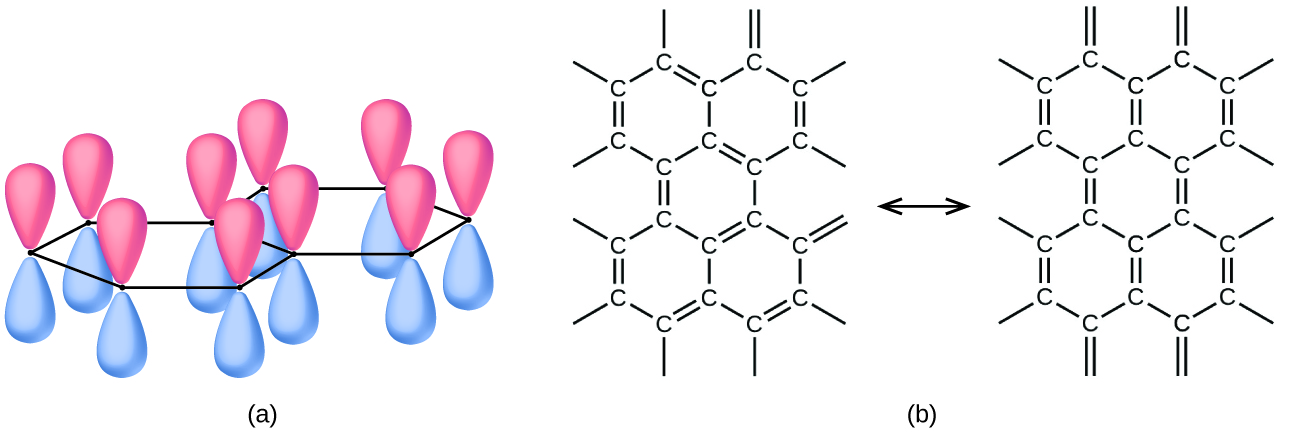
Figure 18.21図 18.21
(a) Carbon atoms in graphite have unhybridized p orbitals. Each p orbital is perpendicular to the plane of carbon atoms. (b) These are two of the many resonance forms of graphite necessary to describe its electronic structure as a resonance hybrid.
(a) 黒鉛中の炭素原子には、混成していないp軌道がある。各p軌道は炭素原子の平面に垂直である。(b) これは、黒鉛の電子構造を共鳴混成体として表すのに必要な、多くの共鳴形のうち二つである。
Atoms within a graphite layer are bonded together tightly by the σ and π bonds; however, the forces between layers are weak. London dispersion forces hold the layers together. To learn more, see the discussion of these weak forces in the chapter on liquids and solids. The weak forces between layers give graphite the soft, flaky character that makes it useful as the so-called “lead” in pencils and the slippery character that makes it useful as a lubricant. The loosely held electrons in the resonating π bonds can move throughout the solid and are responsible for the electrical conductivity of graphite.
英語のヒント
黒鉛の層内の原子は、σ結合とπ結合によって強く結びついているが、層間の力は弱い。層どうしを結びつけているのはロンドン分散力である。詳しくは、液体と固体の章で、これらの弱い力についての説明を参照しよう。層間の弱い力により、黒鉛は軟らかく剥がれやすくなり、鉛筆のいわゆる「芯」として役立つ。また、滑りやすくなり、潤滑剤として役立つ。共鳴するπ結合中の緩く束縛された電子は、固体全体を移動でき、黒鉛の電気伝導性をもたらす。
Other forms of elemental carbon include carbon black, charcoal, and coke. Carbon black is an amorphous form of carbon prepared by the incomplete combustion of natural gas, CH4. It is possible to produce charcoal and coke by heating wood and coal, respectively, at high temperatures in the absence of air.
炭素の単体の他の形態には、カーボンブラック、木炭、コークスがある。カーボンブラックは、天然ガスCH4の不完全燃焼によって調製される、炭素の非晶質の形態である。空気がない状態で木材と石炭をそれぞれ高温に加熱すると、木炭とコークスを作ることができる。
Recently, new forms of elemental carbon molecules have been identified in the soot generated by a smoky flame and in the vapor produced when graphite is heated to very high temperatures in a vacuum or in helium. One of these new forms, first isolated by Professor Richard Smalley and coworkers at Rice University, consists of icosahedral (soccer-ball-shaped) molecules that contain 60 carbon atoms, C60. This is buckminsterfullerene (often called bucky balls) after the architect Buckminster Fuller, who designed domed structures, which have a similar appearance (Figure 18.22).
英語のヒント
近年、煙を出す炎から生じるすすや、真空中またはヘリウム中で黒鉛を非常に高温に加熱して生じる蒸気の中に、炭素の単体分子の新しい形態が確認された。その一つは、ライス大学のリチャード・スモーリー教授と共同研究者によって初めて単離され、60個の炭素原子を含む二十面体(サッカーボール形)の分子C60からなる。これは、似た外観のドーム構造を設計した建築家バックミンスター・フラーにちなみ、バックミンスターフラーレン(バッキーボールともよく呼ばれる)と名づけられている(図18.22)。
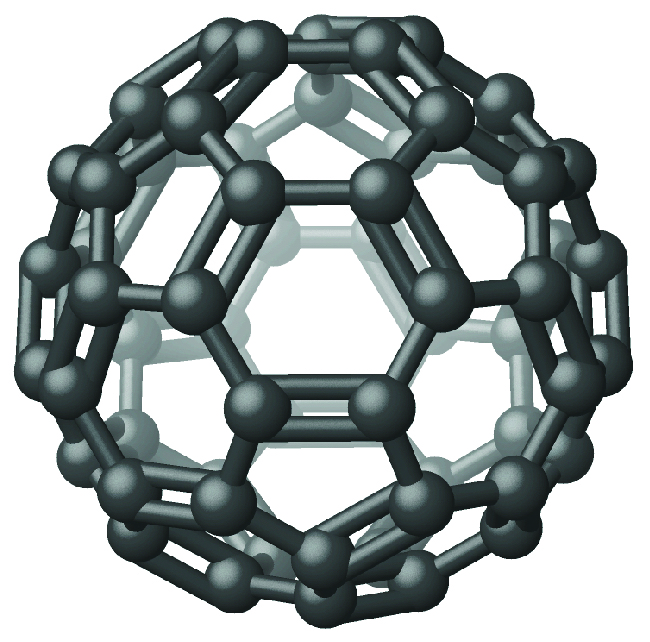


Figure 18.22図 18.22
The molecular structure of C60, buckminsterfullerene, is icosahedral.
バックミンスターフラーレンC60の分子構造は二十面体である。