第18章典型元素の金属・半金属・非金属
18.3 Structure and General Properties of the Metalloids18.3 半金属の構造と一般的性質
Learning Objectives学習目標
By the end of this section, you will be able to:
この節を学び終えると、次のことができるようになる。
- Describe the general preparation, properties, and uses of the metalloids半金属の一般的な製法、性質、用途を説明する。
- Describe the preparation, properties, and compounds of boron and siliconホウ素とケイ素の製法、性質、化合物を説明する。
A series of six elements called the metalloids separate the metals from the nonmetals in the periodic table. The metalloids are boron, silicon, germanium, arsenic, antimony, and tellurium. These elements look metallic; however, they do not conduct electricity as well as metals so they are semiconductors. They are semiconductors because their electrons are more tightly bound to their nuclei than are those of metallic conductors. Their chemical behavior falls between that of metals and nonmetals. For example, the pure metalloids form covalent crystals like the nonmetals, but like the metals, they generally do not form monatomic anions. This intermediate behavior is in part due to their intermediate electronegativity values. In this section, we will briefly discuss the chemical behavior of metalloids and deal with two of these elements—boron and silicon—in more detail.
英語のヒント
周期表では、半金属と呼ばれる六つの元素が、金属と非金属を隔てている。半金属は、ホウ素、ケイ素、ゲルマニウム、ヒ素、アンチモン、テルルである。これらの元素は金属のように見えるが、金属ほど電気をよく通さず、半導体である。半導体であるのは、その電子が金属導体の電子より原子核に強く束縛されているためである。化学的な挙動は、金属と非金属の中間にある。たとえば、純粋な半金属は非金属のように共有結合結晶を形成するが、金属と同様に、一般には単原子陰イオンを作らない。この中間的な挙動は、その電気陰性度が中間の値であることに一部由来する。この節では、半金属の化学的挙動を簡潔に説明し、そのうちホウ素とケイ素の二元素を詳しく扱う。
The metalloid boron exhibits many similarities to its neighbor carbon and its diagonal neighbor silicon. All three elements form covalent compounds. However, boron has one distinct difference in that its 2s22p1 outer electron structure gives it one less valence electron than it has valence orbitals. Although boron exhibits an oxidation state of +3 in most of its stable compounds, this electron deficiency provides boron with the ability to form other, sometimes fractional, oxidation states, which occur, for example, in the boron hydrides.
英語のヒント
半金属のホウ素は、隣の炭素や斜め隣のケイ素と多くの類似点を示す。三元素とも共有結合性の化合物を作る。しかし、ホウ素には一つの明確な違いがある。最外殻の電子構造2s22p1によって、価電子の数が価電子軌道の数より1個少ないことである。ホウ素は安定な化合物の大部分で+3の酸化状態を示すが、この電子不足のため、他の、ときには分数の酸化状態もとることができる。たとえば、水素化ホウ素にそのような酸化状態が現れる。
Silicon has the valence shell electron configuration 3s23p2, and it commonly forms tetrahedral structures in which it is sp3 hybridized with a formal oxidation state of +4. The major differences between the chemistry of carbon and silicon result from the relative strength of the carbon-carbon bond, carbon’s ability to form stable bonds to itself, and the presence of the empty 3d valence-shell orbitals in silicon. Silicon’s empty d orbitals and boron’s empty p orbital enable tetrahedral silicon compounds and trigonal planar boron compounds to act as Lewis acids. Carbon, on the other hand, has no available valence shell orbitals; tetrahedral carbon compounds cannot act as Lewis acids. Germanium is very similar to silicon in its chemical behavior.
ケイ素の価電子殻の電子配置は3s23p2であり、通常、sp3混成で、形式的な酸化状態+4の四面体構造を形成する。炭素とケイ素の化学の主な違いは、炭素・炭素結合の相対的な強さ、炭素が自身と安定な結合を作れること、およびケイ素の価電子殻に空の3d軌道が存在することに由来する。ケイ素の空のd軌道とホウ素の空のp軌道により、四面体型のケイ素化合物と平面三角形のホウ素化合物は、ルイス酸として働くことができる。一方、炭素には利用可能な価電子殻の軌道がないため、四面体型の炭素化合物はルイス酸として働けない。ゲルマニウムの化学的挙動は、ケイ素によく似ている。
Arsenic and antimony generally form compounds in which an oxidation state of +3 or +5 is exhibited; however, arsenic can form arsenides with an oxidation state of –3. These elements tarnish only slightly in dry air but readily oxidize when warmed. Antimony reacts readily with stoichiometric amounts of fluorine, chlorine, bromine, or iodine, yielding trihalides or, with excess fluorine or chlorine, forming the pentahalides SbF5 and SbCl5. Depending on the stoichiometry, it forms antimony(III) sulfide, Sb2S3, or antimony(V) sulfide, Sb2S5, when heated with sulfur. As expected, the metallic nature of the element is greater than that of arsenic, which lies immediately above it in group 15.
英語のヒント
ヒ素とアンチモンは一般に、+3または+5の酸化状態を示す化合物を形成するが、ヒ素は酸化状態–3のヒ化物も形成できる。これらの元素は乾いた空気中ではわずかに変色するだけだが、温めると容易に酸化される。アンチモンは、化学量論的な量のフッ素、塩素、臭素、ヨウ素と容易に反応して三ハロゲン化物を生じ、過剰のフッ素や塩素とは五ハロゲン化物SbF5とSbCl5を作る。硫黄と加熱すると、化学量論に応じて硫化アンチモン(III) Sb2S3または硫化アンチモン(V) Sb2S5を生じる。予想されるように、この元素の金属性は、15族のすぐ上にあるヒ素より強い。
Tellurium combines directly with most elements. The most stable tellurium compounds are the tellurides—salts of Te2− formed with active metals and lanthanides—and compounds with oxygen, fluorine, and chlorine, in which tellurium normally exhibits an oxidation state +2 or +4. Although tellurium(VI) compounds are known (for example, TeF6), there is a marked resistance to oxidation to this maximum group oxidation state.
英語のヒント
テルルは大部分の元素と直接結合する。最も安定なテルル化合物は、活性な金属やランタノイドと形成するTe2−の塩であるテルル化物、および酸素、フッ素、塩素との化合物であり、後者でテルルは通常+2または+4の酸化状態を示す。テルル(VI)化合物(たとえばTeF6)も知られているが、この族の最大酸化状態への酸化には、顕著な抵抗がある。
Structures of the Metalloids半金属の構造
Covalent bonding is the key to the crystal structures of the metalloids. In this regard, these elements resemble nonmetals in their behavior.
共有結合は、半金属の結晶構造の鍵となる。この点で、これらの元素の挙動は非金属に似ている。
Elemental silicon, germanium, arsenic, antimony, and tellurium are lustrous, metallic-looking solids. Silicon and germanium crystallize with a diamond structure. Each atom within the crystal has covalent bonds to four neighboring atoms at the corners of a regular tetrahedron. Single crystals of silicon and germanium are giant, three-dimensional molecules. There are several allotropes of arsenic with the most stable being layer like and containing puckered sheets of arsenic atoms. Each arsenic atom forms covalent bonds to three other atoms within the sheet. The crystal structure of antimony is similar to that of arsenic, both shown in Figure 18.12. The structures of arsenic and antimony are similar to the structure of graphite, covered later in this chapter. Tellurium forms crystals that contain infinite spiral chains of tellurium atoms. Each atom in the chain bonds to two other atoms.
英語のヒント
単体のケイ素、ゲルマニウム、ヒ素、アンチモン、テルルは、光沢のある金属的な外観の固体である。ケイ素とゲルマニウムはダイヤモンド構造で結晶化する。結晶内の各原子は、正四面体の頂点に位置する四つの隣接原子と共有結合している。ケイ素とゲルマニウムの単結晶は、巨大な三次元分子である。ヒ素にはいくつかの同素体があり、最も安定なものは層状で、ヒ素原子の波打ったシートを含む。各ヒ素原子は、シート内の他の三原子と共有結合を作る。アンチモンの結晶構造はヒ素と似ており、両者を図18.12に示す。ヒ素とアンチモンの構造は、本章の後半で扱う黒鉛の構造に似ている。テルルは、テルル原子の無限らせん鎖を含む結晶を作る。鎖の各原子は、他の二原子に結合している。
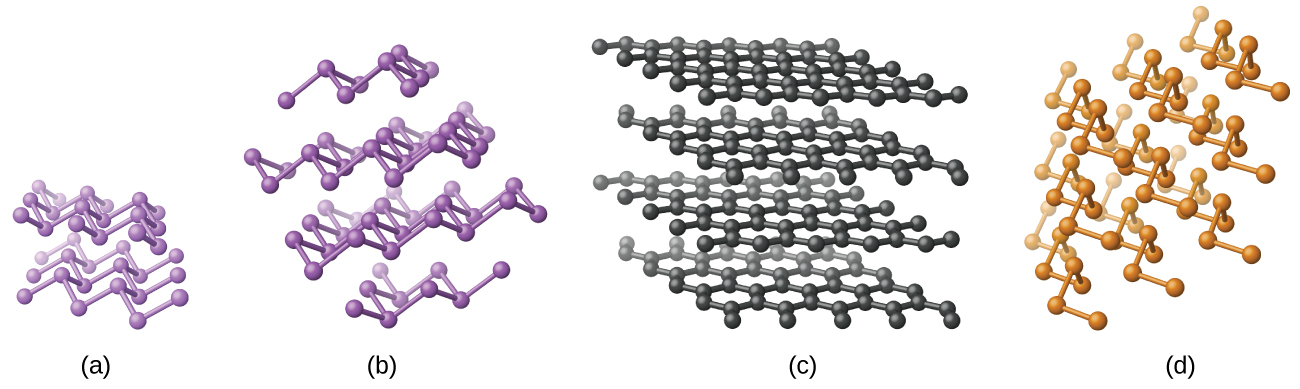
Figure 18.12図 18.12
(a) Arsenic and (b) antimony have a layered structure similar to that of (c) graphite, except that the layers are puckered rather than planar. (d) Elemental tellurium forms spiral chains.
(a)ヒ素と(b)アンチモンは(c)黒鉛に似た層状構造を持つが、層は平面ではなく波打っている。(d)単体のテルルはらせん鎖を作る。
Pure crystalline boron is transparent. The crystals consist of icosahedra, as shown in Figure 18.13, with a boron atom at each corner. In the most common form of boron, the icosahedra pack together in a manner similar to the cubic closest packing of spheres. All boron-boron bonds within each icosahedron are identical and are approximately 176 pm in length. In the different forms of boron, there are different arrangements and connections between the icosahedra.
英語のヒント
純粋な結晶性ホウ素は透明である。結晶は、図18.13に示すような、各頂点にホウ素原子を持つ二十面体から成る。ホウ素の最も一般的な形態では、二十面体は球の立方最密充填に似た様式で詰まっている。各二十面体内のホウ素・ホウ素結合はすべて同一で、長さは約176 pmである。ホウ素の形態が異なると、二十面体どうしの配列と連結も異なる。
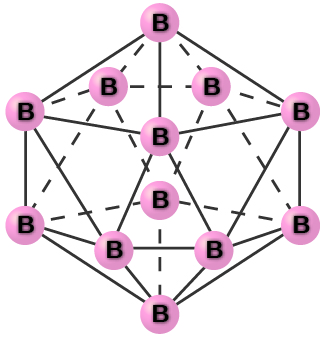


Figure 18.13図 18.13
An icosahedron is a symmetrical, solid shape with 20 faces, each of which is an equilateral triangle. The faces meet at 12 corners.
二十面体は20個の面を持つ対称的な立体で、各面は正三角形である。面は12個の頂点で出会う。
The name silicon is derived from the Latin word for flint, silex. The metalloid silicon readily forms compounds containing Si-O-Si bonds, which are of prime importance in the mineral world. This bonding capability is in contrast to the nonmetal carbon, whose ability to form carbon-carbon bonds gives it prime importance in the plant and animal worlds.
英語のヒント
siliconという名前は、火打ち石を表すラテン語silexに由来する。半金属のケイ素はSi-O-Si結合を含む化合物を容易に形成し、これらは鉱物の世界で最も重要である。この結合能力は、炭素・炭素結合を形成する能力によって動植物の世界で最も重要となる非金属の炭素と対照をなす。