第18章典型元素の金属・半金属・非金属
18.2 Occurrence and Preparation of the Representative Metals18.2 典型金属元素の存在と製法
Learning Objectives学習目標
By the end of this section, you will be able to:
この節を学び終えると、次のことができるようになる。
- Identify natural sources of representative metals典型金属元素の天然の供給源を特定する。
- Describe electrolytic and chemical reduction processes used to prepare these elements from natural sourcesこれらの元素を天然資源から製造するための、電解還元と化学還元の過程を説明する。
Because of their reactivity, we do not find most representative metals as free elements in nature. However, compounds that contain ions of most representative metals are abundant. In this section, we will consider the two common techniques used to isolate the metals from these compounds—electrolysis and chemical reduction.
典型金属元素の大部分は、反応性のため、天然では遊離元素として見つからない。しかし、典型金属元素の大部分のイオンを含む化合物は豊富に存在する。この節では、これらの化合物から金属を取り出すための二つの一般的な技術、電気分解と化学還元を考える。
These metals primarily occur in minerals, with lithium found in silicate or phosphate minerals, and sodium and potassium found in salt deposits from evaporation of ancient seas and in silicates. The alkaline earth metals occur as silicates and, with the exception of beryllium, as carbonates and sulfates. Beryllium occurs as the mineral beryl, Be3Al2Si6O18, which, with certain impurities, may be either the gemstone emerald or aquamarine. Magnesium is in seawater and, along with the heavier alkaline earth metals, occurs as silicates, carbonates, and sulfates. Aluminum occurs abundantly in many types of clay and in bauxite, an impure aluminum oxide hydroxide. The principle tin ore is the oxide cassiterite, SnO2, and the principle lead and thallium ores are the sulfides or the products of weathering of the sulfides. The remaining representative metals occur as impurities in zinc or aluminum ores.
英語のヒント
これらの金属は主に鉱物中に存在する。リチウムはケイ酸塩鉱物やリン酸塩鉱物に、ナトリウムとカリウムは古代の海の蒸発に由来する塩の鉱床やケイ酸塩に見られる。アルカリ土類金属はケイ酸塩として、またベリリウムを除いて炭酸塩や硫酸塩として存在する。ベリリウムは緑柱石Be3Al2Si6O18という鉱物として存在し、特定の不純物を含むと、宝石のエメラルドまたはアクアマリンとなることがある。マグネシウムは海水中にあり、重いアルカリ土類金属と同様に、ケイ酸塩、炭酸塩、硫酸塩としても存在する。アルミニウムは多くの種類の粘土と、不純な酸化水酸化アルミニウムであるボーキサイトに豊富に含まれる。スズの主要鉱石は酸化物の錫石SnO2であり、鉛とタリウムの主要鉱石は硫化物または硫化物の風化生成物である。他の典型金属元素は、亜鉛鉱石やアルミニウム鉱石中の不純物として存在する。
Electrolysis電気分解
Ions of metals in of groups 1 and 2, along with aluminum, are very difficult to reduce; therefore, it is necessary to prepare these elements by electrolysis, an important process discussed in the chapter on electrochemistry. Briefly, electrolysis involves using electrical energy to drive unfavorable chemical reactions to completion; it is useful in the isolation of reactive metals in their pure forms. Sodium, aluminum, and magnesium are typical examples.
1族と2族の金属イオン、およびアルミニウムは非常に還元しにくいため、電気分解でこれらの元素を製造する必要がある。電気分解は、電気化学の章で説明した重要な過程である。簡潔にいうと、電気分解は電気エネルギーを使って、不利な化学反応を完結まで進めるものであり、反応性の高い金属を純粋な形で取り出すのに役立つ。ナトリウム、アルミニウム、マグネシウムは典型例である。
The Preparation of Sodiumナトリウムの製法
The most important method for the production of sodium is the electrolysis of molten sodium chloride; the set-up is a Downs cell, shown in Figure 18.10. The reaction involved in this process is:
ナトリウムの最も重要な製造方法は、溶融塩化ナトリウムの電気分解である。その装置は図18.10に示すダウンズ電解槽である。この過程に関与する反応は次のとおりである。
The electrolysis cell contains molten sodium chloride (melting point 801 °C), to which calcium chloride has been added to lower the melting point to 600 °C (a colligative effect). The passage of a direct current through the cell causes the sodium ions to migrate to the negatively charged cathode and pick up electrons, reducing the ions to sodium metal. Chloride ions migrate to the positively charged anode, lose electrons, and undergo oxidation to chlorine gas. The overall cell reaction comes from adding the following reactions:
英語のヒント
電解セルは、溶融塩化ナトリウム(融点801 °C)を含み、そこに塩化カルシウムを加えて融点を600 °Cまで下げてある(束一的効果)。セルに直流を流すと、ナトリウムイオンが負に帯電したカソードへ移動して電子を受け取り、金属ナトリウムへ還元される。塩化物イオンは正に帯電したアノードへ移動し、電子を失って塩素ガスへ酸化される。全体の電池反応は、次の反応を加えることで得られる。
Separation of the molten sodium and chlorine prevents recombination. The liquid sodium, which is less dense than molten sodium chloride, floats to the surface and flows into a collector. The gaseous chlorine goes to storage tanks. Chlorine is also a valuable product.
溶融ナトリウムと塩素を分離することで、再結合を防ぐ。液体ナトリウムは溶融塩化ナトリウムより密度が低いため、表面に浮かび、捕集部へ流れ込む。気体の塩素は貯蔵タンクへ送られる。塩素も価値のある生成物である。
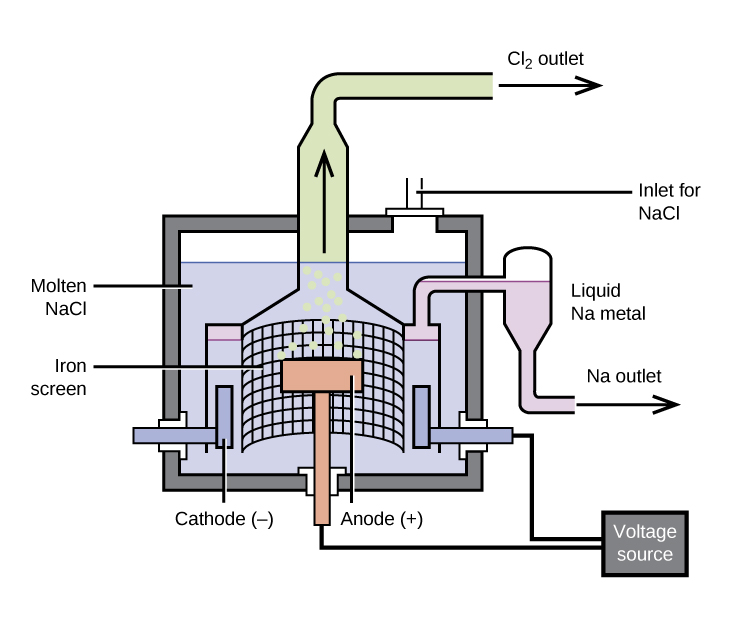
Figure 18.10図 18.10
Pure sodium metal is isolated by electrolysis of molten sodium chloride using a Downs cell. It is not possible to isolate sodium by electrolysis of aqueous solutions of sodium salts because hydrogen ions are more easily reduced than are sodium ions; as a result, hydrogen gas forms at the cathode instead of the desired sodium metal. The high temperature required to melt NaCl means that liquid sodium metal forms.
ダウンズ電解槽を使って溶融塩化ナトリウムを電気分解することで、純粋な金属ナトリウムを単離する。ナトリウム塩の水溶液の電気分解では、ナトリウムを単離できない。水素イオンのほうがナトリウムイオンより還元されやすいため、カソードでは目的の金属ナトリウムの代わりに水素ガスが発生するからである。NaClを融かすのに必要な高温のため、生成する金属ナトリウムは液体となる。
The Preparation of Aluminumアルミニウムの製法
The preparation of aluminum utilizes a process invented in 1886 by Charles M. Hall, who began to work on the problem while a student at Oberlin College in Ohio. Paul L. T. Héroult discovered the process independently a month or two later in France. In honor to the two inventors, this electrolysis cell is known as the Hall–Héroult cell. The Hall–Héroult cell is an electrolysis cell for the production of aluminum. Figure 18.11 illustrates the Hall–Héroult cell.
アルミニウムの製造には、Charles M. Hallが1886年に発明した方法を使う。彼はオハイオ州のOberlin Collegeの学生だったとき、この問題に取り組み始めた。その1、2か月後に、フランスでPaul L. T. Héroultが独立にこの方法を発見した。二人の発明者に敬意を表して、この電解セルはホール・エルー電解槽と呼ばれる。ホール・エルー電解槽は、アルミニウム製造用の電解セルである。図18.11にホール・エルー電解槽を示す。
The production of aluminum begins with the purification of bauxite, the most common source of aluminum. The reaction of bauxite, AlO(OH), with hot sodium hydroxide forms soluble sodium aluminate, while clay and other impurities remain undissolved:
英語のヒント
アルミニウムの製造は、その最も一般的な供給源であるボーキサイトの精製から始まる。ボーキサイトAlO(OH)を熱い水酸化ナトリウムと反応させると、可溶性のアルミン酸ナトリウムができ、粘土や他の不純物は溶けずに残る。
After the removal of the impurities by filtration, the addition of acid to the aluminate leads to the reprecipitation of aluminum hydroxide:
英語のヒント
ろ過によって不純物を取り除いた後、アルミン酸塩に酸を加えると、水酸化アルミニウムが再沈殿する。
The next step is to remove the precipitated aluminum hydroxide by filtration. Heating the hydroxide produces aluminum oxide, Al2O3, which dissolves in a molten mixture of cryolite, Na3AlF6, and calcium fluoride, CaF2. Electrolysis of this solution takes place in a cell like that shown in Figure 18.11. Reduction of aluminum ions to the metal occurs at the cathode, while oxygen, carbon monoxide, and carbon dioxide form at the anode.
英語のヒント
次の手順は、沈殿した水酸化アルミニウムをろ過で取り出すことである。水酸化物を加熱すると酸化アルミニウムAl2O3が生じ、これは氷晶石Na3AlF6とフッ化カルシウムCaF2の溶融混合物に溶ける。この溶液を図18.11のようなセルで電気分解する。カソードではアルミニウムイオンが金属へ還元され、アノードでは酸素、一酸化炭素、二酸化炭素が生じる。
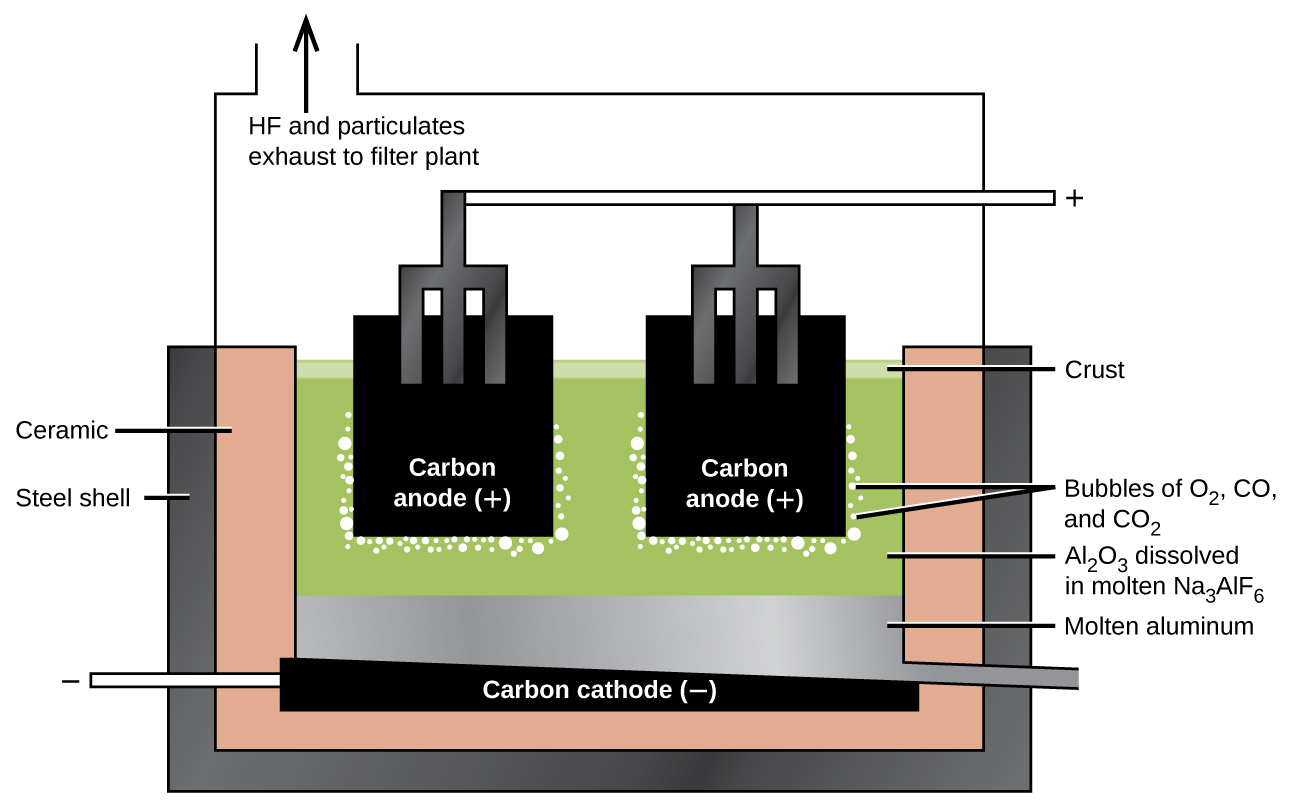


Figure 18.11図 18.11
An electrolytic cell is used for the production of aluminum. The electrolysis of a solution of cryolite and calcium fluoride results in aluminum metal at the cathode, and oxygen, carbon monoxide, and carbon dioxide at the anode.
アルミニウムの製造には電解セルを使う。氷晶石とフッ化カルシウムの溶液を電気分解すると、カソードにアルミニウム金属、アノードに酸素、一酸化炭素、二酸化炭素を生じる。