第18章典型元素の金属・半金属・非金属
Reactions反応
Elemental oxygen is a strong oxidizing agent. It reacts with most other elements and many compounds.
単体の酸素は強い酸化剤である。他の元素の大部分や、多くの化合物と反応する。
Reaction with Elements元素との反応
Oxygen reacts directly at room temperature or at elevated temperatures with all other elements except the noble gases, the halogens, and few second- and third-row transition metals of low reactivity (those with higher reduction potentials than copper). Rust is an example of the reaction of oxygen with iron. The more active metals form peroxides or superoxides. Less active metals and the nonmetals give oxides. Two examples of these reactions are:
酸素は、室温または高温で、希ガス、ハロゲン、および反応性の低い第2・第3遷移系列の少数の金属(銅より還元電位が高いもの)を除く、すべての他の元素と直接反応する。さびは、酸素と鉄との反応の一例である。より活性な金属は、過酸化物または超酸化物を作る。活性の低い金属と非金属は、酸化物を作る。これらの反応の二つの例を示す。
The oxides of halogens, at least one of the noble gases, and metals with higher reduction potentials than copper do not form by the direct action of the elements with oxygen.
ハロゲン、希ガスの少なくとも一つ、および銅より還元電位の高い金属の酸化物は、それらの単体と酸素との直接の作用では生成しない。
Reaction with Compounds化合物との反応
Elemental oxygen also reacts with some compounds. If it is possible to oxidize any of the elements in a given compound, further oxidation by oxygen can occur. For example, hydrogen sulfide, H2S, contains sulfur with an oxidation state of 2−. Because the sulfur does not exhibit its maximum oxidation state, we would expect H2S to react with oxygen. It does, yielding water and sulfur dioxide. The reaction is:
単体の酸素は、一部の化合物とも反応する。ある化合物に含まれる元素のいずれかを酸化できる場合には、酸素によるさらなる酸化が起こりうる。たとえば、硫化水素H2Sは、酸化状態が2−の硫黄を含む。硫黄は最高酸化状態を示していないため、H2Sは酸素と反応すると予想される。実際に反応し、水と二酸化硫黄を生じる。反応は次のとおりである。
It is also possible to oxidize oxides such as CO and P4O6 that contain an element with a lower oxidation state. The ease with which elemental oxygen picks up electrons is mirrored by the difficulty of removing electrons from oxygen in most oxides. Of the elements, only the very reactive fluorine can oxidize oxides to form oxygen gas.
英語のヒント
COやP4O6のように、低い酸化状態の元素を含む酸化物も、酸化できる。単体の酸素が電子を容易に受け取ることは、酸化物の大部分において酸素から電子を取り去ることが難しいことに対応している。元素の中では、非常に反応性の高いフッ素だけが、酸化物を酸化して酸素ガスを作れる。
Oxides, Peroxides, and Hydroxides酸化物、過酸化物、水酸化物
Compounds of the representative metals with oxygen fall into three categories: (1) oxides, containing oxide ions, O2−; (2) peroxides, containing peroxides ions, with oxygen-oxygen covalent single bonds and a very limited number of superoxides, containing superoxide ions, with oxygen-oxygen covalent bonds that have a bond order of In addition, there are (3) hydroxides, containing hydroxide ions, OH−. All representative metals form oxides. Some of the metals of group 2 also form peroxides, MO2, and the metals of group 1 also form peroxides, M2O2, and superoxides, MO2.
典型金属と酸素との化合物は、三つの分類に分かれる。(1) 酸化物イオンO2−を含む酸化物。(2) 酸素・酸素共有単結合を持つ過酸化物イオンを含む過酸化物、および、結合次数の酸素・酸素共有結合を持つ超酸化物イオンを含む、数が非常に限られた超酸化物。さらに、(3) 水酸化物イオンOH−を含む水酸化物がある。すべての典型金属は酸化物を作る。2族金属の一部は過酸化物MO2も作り、1族金属は過酸化物M2O2と超酸化物MO2も作る。
Oxides酸化物
It is possible to produce the oxides of most representative metals by heating the corresponding hydroxides (forming the oxide and gaseous water) or carbonates (forming the oxide and gaseous CO2). Equations for example reactions are:
典型金属の大部分の酸化物は、対応する水酸化物を加熱する(酸化物と気体の水が生じる)か、炭酸塩を加熱する(酸化物と気体のCO2が生じる)ことによって生成できる。反応式の例は、次のとおりである。
However, alkali metal salts generally are very stable and do not decompose easily when heated. Alkali metal oxides result from the oxidation-reduction reactions created by heating nitrates or hydroxides with the metals. Equations for sample reactions are:
しかし、アルカリ金属塩は一般に非常に安定で、加熱しても容易には分解しない。アルカリ金属の酸化物は、硝酸塩または水酸化物をその金属とともに加熱することで起こる、酸化還元反応によって得られる。反応式の例は、次のとおりである。
With the exception of mercury(II) oxide, it is possible to produce the oxides of the metals of groups 2–15 by burning the corresponding metal in air. The heaviest member of each group, the member for which the inert pair effect is most pronounced, forms an oxide in which the oxidation state of the metal ion is two less than the group oxidation state (inert pair effect). Thus, Tl2O, PbO, and Bi2O3 form when burning thallium, lead, and bismuth, respectively. The oxides of the lighter members of each group exhibit the group oxidation state. For example, SnO2 forms from burning tin. Mercury(II) oxide, HgO, forms slowly when mercury is warmed below 500 °C; it decomposes at higher temperatures.
英語のヒント
酸化水銀(II)を除けば、2~15族金属の酸化物は、対応する金属を空気中で燃焼させることによって生成できる。各族の最も重い元素、すなわち不活性電子対効果が最も顕著な元素は、金属イオンの酸化状態が、その族の酸化状態より二つ低い酸化物を作る(不活性電子対効果)。したがって、タリウム、鉛、ビスマスを燃焼させると、それぞれTl2O、PbO、Bi2O3が生じる。各族のより軽い元素の酸化物は、その族の酸化状態を示す。たとえば、スズを燃焼させるとSnO2が生じる。酸化水銀(II)HgOは、水銀を500 °C未満で温めるとゆっくり生じ、より高温では分解する。
Burning the members of groups 1 and 2 in air is not a suitable way to form the oxides of these elements. These metals are reactive enough to combine with nitrogen in the air, so they form mixtures of oxides and ionic nitrides. Several also form peroxides or superoxides when heated in air.
1族と2族の元素を空気中で燃焼させることは、それらの酸化物を作る適切な方法ではない。これらの金属は空気中の窒素と結合するほど反応性が高いため、酸化物とイオン性窒化物の混合物を作る。また、そのうちいくつかは、空気中で加熱すると過酸化物や超酸化物も作る。
Ionic oxides all contain the oxide ion, a very powerful hydrogen ion acceptor. With the exception of the very insoluble aluminum oxide, Al2O3, tin(IV), SnO2, and lead(IV), PbO2, the oxides of the representative metals react with acids to form salts. Some equations for these reactions are:
イオン性酸化物はすべて、非常に強力な水素イオン受容体である酸化物イオンを含む。非常に溶けにくい酸化アルミニウムAl2O3、酸化スズ(IV)SnO2、酸化鉛(IV)PbO2を除き、典型金属の酸化物は酸と反応して塩を作る。これらの反応式の例は、次のとおりである。
The oxides of the metals of groups 1 and 2 and of thallium(I) oxide react with water and form hydroxides. Examples of such reactions are:
1族と2族の金属の酸化物、および酸化タリウム(I)は、水と反応して水酸化物を作る。このような反応の例は、次のとおりである。
The oxides of the alkali metals have little industrial utility, unlike magnesium oxide, calcium oxide, and aluminum oxide. Magnesium oxide is important in making firebrick, crucibles, furnace linings, and thermal insulation—applications that require chemical and thermal stability. Calcium oxide, sometimes called quicklime or lime in the industrial market, is very reactive, and its principal uses reflect its reactivity. Pure calcium oxide emits an intense white light when heated to a high temperature (as illustrated in Figure 18.43). Blocks of calcium oxide heated by gas flames were the stage lights in theaters before electricity was available. This is the source of the phrase “in the limelight.”
英語のヒント
アルカリ金属の酸化物は、酸化マグネシウム、酸化カルシウム、酸化アルミニウムとは違い、工業的な有用性が小さい。酸化マグネシウムは、耐火れんが、るつぼ、炉の内張り、断熱材の製造に重要である。これらの用途には、化学的・熱的な安定性が求められる。工業市場で生石灰または石灰と呼ばれることもある酸化カルシウムは、非常に反応性が高く、主な用途にはその反応性が反映されている。純粋な酸化カルシウムは、高温に加熱すると強い白色光を放つ(図18.43)。電気が利用可能になる前は、ガスの炎で加熱した酸化カルシウムの塊が、劇場の舞台照明であった。これが「脚光を浴びて(in the limelight)」という表現の由来である。
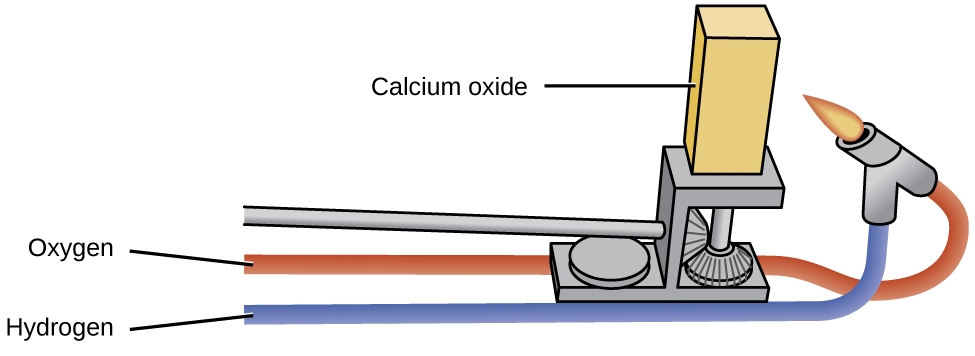

Figure 18.43図 18.43
Calcium oxide has many industrial uses. When it is heated at high temperatures, it emits an intense white light.
酸化カルシウムには、多くの工業用途がある。高温に加熱すると、強い白色光を放つ。
Calcium oxide and calcium hydroxide are inexpensive bases used extensively in chemical processing, although most of the useful products prepared from them do not contain calcium. Calcium oxide, CaO, is made by heating calcium carbonate, CaCO3, which is widely and inexpensively available as limestone or oyster shells:
酸化カルシウムと水酸化カルシウムは、化学処理に広く使われる安価な塩基であるが、それらから調製される有用な製品の大部分にはカルシウムは含まれない。酸化カルシウムCaOは、石灰岩やカキ殻として広く安価に入手できる炭酸カルシウムCaCO3を加熱して作る。
Although this decomposition reaction is reversible, it is possible to obtain a 100% yield of CaO by allowing the CO2 to escape. It is possible to prepare calcium hydroxide by the familiar acid-base reaction of a soluble metal oxide with water:
この分解反応は可逆的であるが、CO2を逃がすことで、CaOを100%の収率で得ることができる。可溶性の金属酸化物と水との、よく知られた酸塩基反応によって、水酸化カルシウムを調製できる。
Both CaO and Ca(OH)2 are useful as bases; they accept protons and neutralize acids.
CaOとCa(OH)2は、どちらも塩基として有用であり、プロトンを受け取って酸を中和する。
Alumina (Al2O3) occurs in nature as the mineral corundum, a very hard substance used as an abrasive for grinding and polishing. Corundum is important to the jewelry trade as ruby and sapphire. The color of ruby is due to the presence of a small amount of chromium; other impurities produce the wide variety of colors possible for sapphires. Artificial rubies and sapphires are now manufactured by melting aluminum oxide (melting point = 2050 °C) with small amounts of oxides to produce the desired colors and cooling the melt in such a way as to produce large crystals. Ruby lasers use synthetic ruby crystals.
英語のヒント
アルミナAl2O3は、自然界では鉱物コランダムとして存在する。コランダムは非常に硬い物質で、研削や研磨のための研磨材として使われる。宝飾品の取引では、ルビーやサファイアとして重要である。ルビーの色は、少量のクロムが存在することによる。他の不純物は、サファイアに見られる多様な色を生じさせる。現在、人工のルビーとサファイアは、目的の色を出す少量の酸化物とともに酸化アルミニウム(融点 = 2050 °C)を溶融し、大きな結晶ができるように融液を冷却して製造される。ルビーレーザーでは、合成ルビー結晶を用いる。
Zinc oxide, ZnO, was a useful white paint pigment; however, pollutants tend to discolor the compound. The compound is also important in the manufacture of automobile tires and other rubber goods, and in the preparation of medicinal ointments. For example, zinc-oxide-based sunscreens, as shown in Figure 18.44, help prevent sunburn. The zinc oxide in these sunscreens is present in the form of very small grains known as nanoparticles. Lead dioxide is a constituent of charged lead storage batteries. Lead(IV) tends to revert to the more stable lead(II) ion by gaining two electrons, so lead dioxide is a powerful oxidizing agent.
英語のヒント
酸化亜鉛ZnOは有用な白色塗料顔料であったが、汚染物質によって変色しやすい。この化合物は、自動車タイヤや他のゴム製品の製造、および薬用軟膏の調製にも重要である。たとえば、図18.44に示す酸化亜鉛を主成分とする日焼け止めは、日焼けを防ぐのに役立つ。これらの日焼け止め中の酸化亜鉛は、ナノ粒子と呼ばれる非常に小さな粒の形で存在する。二酸化鉛は、充電された鉛蓄電池の構成成分である。鉛(IV)は二個の電子を受け取って、より安定な鉛(II)イオンに戻りやすいため、二酸化鉛は強力な酸化剤である。
Image omitted because its reuse rights could not be verified.権利の確認ができないため画像を割愛。
Figure 18.44図 18.44
Zinc oxide protects exposed skin from sunburn. (credit: modification of work by "osseous"/Flickr)
酸化亜鉛は、露出した皮膚を日焼けから守る。(クレジット:「osseous」/Flickrの作品を改変。)