第18章典型元素の金属・半金属・非金属
Reactions with Elements元素との反応
When heated, hydrogen reacts with the metals of group 1 and with Ca, Sr, and Ba (the more active metals in group 2). The compounds formed are crystalline, ionic hydrides that contain the hydride anion, H−, a strong reducing agent and a strong base, which reacts vigorously with water and other acids to form hydrogen gas.
水素は、加熱すると、1族金属およびCa、Sr、Ba(2族の中でより活性な金属)と反応する。生成する化合物は、水素化物陰イオンH−を含む結晶性のイオン性水素化物である。この陰イオンは強い還元剤であり強い塩基でもあり、水や他の酸と激しく反応して水素ガスを生じる。
The reactions of hydrogen with nonmetals generally produce acidic hydrogen compounds with hydrogen in the 1+ oxidation state. The reactions become more exothermic and vigorous as the electronegativity of the nonmetal increases. Hydrogen reacts with nitrogen and sulfur only when heated, but it reacts explosively with fluorine (forming HF) and, under some conditions, with chlorine (forming HCl). A mixture of hydrogen and oxygen explodes if ignited. Because of the explosive nature of the reaction, it is necessary to exercise caution when handling hydrogen (or any other combustible gas) to avoid the formation of an explosive mixture in a confined space. Although most hydrides of the nonmetals are acidic, ammonia and phosphine (PH3) are very, very weak acids and generally function as bases. There is a summary of these reactions of hydrogen with the elements in Table 18.1.
英語のヒント
水素と非金属との反応では、一般に、水素の酸化状態が1+の、酸性の水素化合物が生じる。非金属の電気陰性度が高まるにつれ、反応はより発熱的で激しくなる。水素は窒素や硫黄とは加熱した場合にだけ反応するが、フッ素とは爆発的に反応してHFを作り、ある条件下では塩素とも爆発的に反応してHClを作る。水素と酸素の混合物は、点火すると爆発する。反応が爆発性を持つため、水素(または他の可燃性ガス)を扱う際には、閉鎖空間に爆発性混合物ができるのを避けるよう、注意を払う必要がある。非金属の水素化物の大部分は酸性だが、アンモニアとホスフィンPH3は非常に、非常に弱い酸であり、一般には塩基として働く。水素と元素とのこれらの反応を表18.1にまとめている。
Chemical Reactions of Hydrogen with Other Elements 水素と他の元素との化学反応 |
|
|---|---|
General Equation 一般式 |
Comments 備考 |
ionic hydrides with group 1 and Ca, Sr, and Ba 1族およびCa、Sr、Baとのイオン性水素化物 |
|
requires high pressure and temperature; low yield 高圧・高温を要する。収率は低い。 |
|
exothermic and potentially explosive 発熱的で、爆発する可能性がある。 |
|
requires heating; low yield 加熱を要する。収率は低い。 |
|
X = F, Cl, Br, and I; explosive with F2; low yield with I2 X = F、Cl、Br、I。F2とは爆発的。I2では収率が低い。 |
|
Reaction with Compounds化合物との反応
Hydrogen reduces the heated oxides of many metals, with the formation of the metal and water vapor. For example, passing hydrogen over heated CuO forms copper and water.
水素は、多くの金属の加熱された酸化物を還元し、金属と水蒸気を生じる。たとえば、加熱したCuOに水素を通すと、銅と水が生じる。
Hydrogen may also reduce the metal ions in some metal oxides to lower oxidation states:
水素は、一部の金属酸化物中の金属イオンを、より低い酸化状態に還元することもある。
Hydrogen Compounds水素化合物
Other than the noble gases, each of the nonmetals forms compounds with hydrogen. For brevity, we will discuss only a few hydrogen compounds of the nonmetals here.
希ガス以外の非金属は、どれも水素と化合物を作る。簡潔にするため、ここでは、非金属の水素化合物のうち少数だけを取り上げる。
Nitrogen Hydrogen Compounds窒素と水素の化合物
Ammonia, NH3, forms naturally when any nitrogen-containing organic material decomposes in the absence of air. The laboratory preparation of ammonia is by the reaction of an ammonium salt with a strong base such as sodium hydroxide. The acid-base reaction with the weakly acidic ammonium ion gives ammonia, illustrated in Figure 18.29. Ammonia also forms when ionic nitrides react with water. The nitride ion is a much stronger base than the hydroxide ion:
アンモニアNH3は、窒素を含む有機物が空気のない状態で分解すると、自然に生じる。実験室では、アンモニウム塩と水酸化ナトリウムなどの強塩基との反応によって調製する。弱い酸性を持つアンモニウムイオンとの酸塩基反応によって、図18.29に示すアンモニアが得られる。イオン性窒化物が水と反応した場合にも、アンモニアが生じる。窒化物イオンは、水酸化物イオンよりはるかに強い塩基である。
The commercial production of ammonia is by the direct combination of the elements in the Haber process:
アンモニアの商業的生産は、ハーバー法で単体どうしを直接結合させることによって行われる。
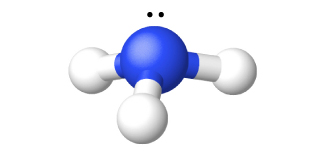
Figure 18.29図 18.29
The structure of ammonia is shown with a central nitrogen atom and three hydrogen atoms.
アンモニアの構造を、中心の窒素原子と三個の水素原子で示している。
Ammonia is a colorless gas with a sharp, pungent odor. Smelling salts utilize this powerful odor. Gaseous ammonia readily liquefies to give a colorless liquid that boils at −33 °C. Due to intermolecular hydrogen bonding, the enthalpy of vaporization of liquid ammonia is higher than that of any other liquid except water, so ammonia is useful as a refrigerant. Ammonia is quite soluble in water (658 L at STP dissolves in 1 L H2O).
英語のヒント
アンモニアは、鋭い刺激臭を持つ無色の気体である。気付け薬は、この強い臭いを利用している。気体のアンモニアは容易に液化し、−33 °Cで沸騰する無色の液体となる。分子間水素結合のため、液体アンモニアの蒸発エンタルピーは、水以外のどの液体よりも高く、冷媒として有用である。アンモニアは水によく溶ける(STPにおける658 Lが、1 LのH2Oに溶ける)。
The chemical properties of ammonia are as follows:
アンモニアの化学的性質は、次のとおりである。
- Ammonia acts as a Brønsted base, as discussed in the chapter on acid-base chemistry. The ammonium ion is similar in size to the potassium ion; compounds of the two ions exhibit many similarities in their structures and solubilities.アンモニアは、酸塩基化学の章で述べたように、ブレンステッド塩基として働く。アンモニウムイオンの大きさはカリウムイオンに似ており、この二つのイオンの化合物は、構造や溶解度に多くの類似性を示す。
- Ammonia can display acidic behavior, although it is a much weaker acid than water. Like other acids, ammonia reacts with metals, although it is so weak that high temperatures are necessary. Hydrogen and (depending on the stoichiometry) amides (salts of imides (salts of NH2−), or nitrides (salts of N3−) form.アンモニアは、水よりはるかに弱い酸ではあるが、酸性の挙動を示すこともある。他の酸と同様に、アンモニアは金属と反応するが、非常に弱い酸であるため、高温を必要とする。水素と、化学量論に応じて、アミド(の塩)、イミド(NH2−の塩)、または窒化物(N3−の塩)が生じる。
- The nitrogen atom in ammonia has its lowest possible oxidation state (3−) and thus is not susceptible to reduction. However, it can be oxidized. Ammonia burns in air, giving NO and water. Hot ammonia and the ammonium ion are active reducing agents. Of particular interest are the oxidations of ammonium ion by nitrite ion, to yield pure nitrogen and by nitrate ion to yield nitrous oxide, N2O.
英語のヒント
アンモニアの窒素原子は、可能な最低の酸化状態(3−)にあるため、還元を受けない。しかし、酸化されることはある。アンモニアは空気中で燃焼して、NOと水を生じる。高温のアンモニアとアンモニウムイオンは、活性な還元剤である。特に興味深いのは、アンモニウムイオンが亜硝酸イオンによって酸化されて純粋な窒素を生じる反応と、硝酸イオンによって酸化されて亜酸化窒素N2Oを生じる反応である。 - There are a number of compounds that we can consider derivatives of ammonia through the replacement of one or more hydrogen atoms with some other atom or group of atoms. Inorganic derivations include chloramine, NH2Cl, and hydrazine, N2H4:一個以上の水素原子を、別の原子や原子団で置き換えることにより、アンモニアの誘導体と考えられる化合物がいくつもある。無機の誘導体には、クロラミンNH2ClとヒドラジンN2H4が含まれる。
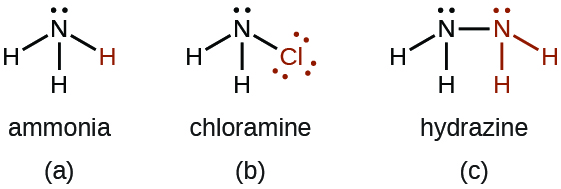


Chloramine, NH2Cl, results from the reaction of sodium hypochlorite, NaOCl, with ammonia in basic solution. In the presence of a large excess of ammonia at low temperature, the chloramine reacts further to produce hydrazine, N2H4:
クロラミンNH2Clは、塩基性溶液中で次亜塩素酸ナトリウムNaOClとアンモニアが反応することによって生じる。低温で大過剰のアンモニアが存在すると、クロラミンはさらに反応して、ヒドラジンN2H4を生じる。
Anhydrous hydrazine is relatively stable in spite of its positive free energy of formation:
無水ヒドラジンは、生成自由エネルギーが正であるにもかかわらず、比較的安定である。
Hydrazine is a fuming, colorless liquid that has some physical properties remarkably similar to those of H2O (it melts at 2 °C, boils at 113.5 °C, and has a density at 25 °C of 1.00 g/mL). It burns rapidly and completely in air with substantial evolution of heat:
英語のヒント
ヒドラジンは、発煙する無色の液体で、物理的性質の一部がH2Oに驚くほど似ている(融点は2 °C、沸点は113.5 °C、25 °Cにおける密度は1.00 g/mL)。空気中では急速かつ完全に燃焼し、大量の熱を発生する。
Like ammonia, hydrazine is both a Brønsted base and a Lewis base, although it is weaker than ammonia. It reacts with strong acids and forms two series of salts that contain the and ions, respectively. Some rockets use hydrazine as a fuel.
ヒドラジンは、アンモニアより弱いものの、アンモニアと同様に、ブレンステッド塩基でもルイス塩基でもある。強酸と反応し、イオンとイオンをそれぞれ含む、二系列の塩を作る。一部のロケットでは、ヒドラジンを燃料として用いる。