第18章典型元素の金属・半金属・非金属
Phosphorus Oxyacids and Saltsリンのオキソ酸と塩
Pure orthophosphoric acid, H3PO4 (shown in Figure 18.52), forms colorless, deliquescent crystals that melt at 42 °C. The common name of this compound is phosphoric acid, and is commercially available as a viscous 82% solution known as syrupy phosphoric acid. One use of phosphoric acid is as an additive to many soft drinks.
英語のヒント
純粋なオルトリン酸H3PO4(図18.52)は、42 °Cで融解する、無色で潮解性の結晶を作る。この化合物の一般名はリン酸であり、シロップ状リン酸として知られる、粘性の高い82%溶液として市販されている。リン酸の用途の一つは、多くの清涼飲料への添加である。
One commercial method of preparing orthophosphoric acid is to treat calcium phosphate rock with concentrated sulfuric acid:
オルトリン酸を調製する商業的方法の一つは、リン酸カルシウムを含む鉱石を濃硫酸で処理することである。
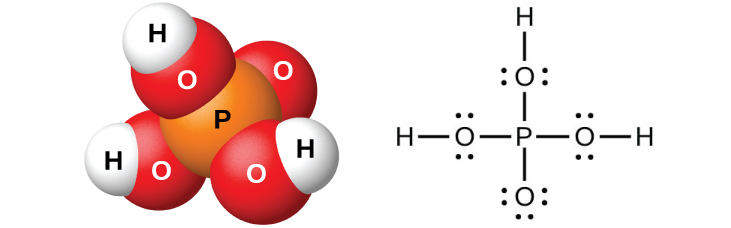
Figure 18.52図 18.52
Orthophosphoric acid, H3PO4, is colorless when pure and has this molecular (left) and Lewis structure (right).
オルトリン酸H3PO4は純粋な場合には無色であり、ここに示す分子構造(左)とルイス構造(右)を持つ。
Dilution of the products with water, followed by filtration to remove calcium sulfate, gives a dilute acid solution contaminated with calcium dihydrogen phosphate, Ca(H2PO4)2, and other compounds associated with calcium phosphate rock. It is possible to prepare pure orthophosphoric acid by dissolving P4O10 in water.
生成物を水で希釈し、続いてろ過して硫酸カルシウムを除くと、リン酸二水素カルシウムCa(H2PO4)2と、リン酸カルシウムの鉱石に伴う他の化合物が混入した、薄い酸溶液が得られる。P4O10を水に溶かすと、純粋なオルトリン酸を調製できる。
The action of water on P4O6, PCl3, PBr3, or PI3 forms phosphorous acid, H3PO3 (shown in Figure 18.53). The best method for preparing pure phosphorous acid is by hydrolyzing phosphorus trichloride:
P4O6、PCl3、PBr3、PI3に水が作用すると、亜リン酸H3PO3(図18.53)が生じる。純粋な亜リン酸を調製する最良の方法は、三塩化リンを加水分解することである。
Heating the resulting solution expels the hydrogen chloride and leads to the evaporation of water. When sufficient water evaporates, white crystals of phosphorous acid will appear upon cooling. The crystals are deliquescent, very soluble in water, and have an odor like that of garlic. The solid melts at 70.1 °C and decomposes at about 200 °C by disproportionation into phosphine and orthophosphoric acid:
英語のヒント
得られた溶液を加熱すると、塩化水素が追い出され、水が蒸発する。十分な水が蒸発した後に冷却すると、亜リン酸の白い結晶が現れる。結晶は潮解性で、水に非常によく溶け、ニンニクのような臭いを持つ。固体は70.1 °Cで融解し、約200 °Cでは、不均化によってホスフィンとオルトリン酸に分解する。
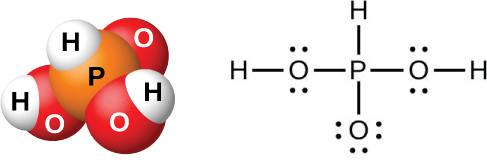
Figure 18.53図 18.53
In a molecule of phosphorous acid, H3PO3, only the two hydrogen atoms bonded to an oxygen atom are acidic.
亜リン酸H3PO3の分子では、酸素原子に結合している二個の水素原子だけが酸性を持つ。
Phosphorous acid forms only two series of salts, which contain the dihydrogen phosphite ion, or the hydrogen phosphate ion, respectively. It is not possible to replace the third atom of hydrogen because it is not very acidic, as it is not easy to ionize the P-H bond.
亜リン酸は、それぞれ亜リン酸二水素イオンまたはリン酸水素イオンを含む、二系列の塩だけを作る。第三の水素原子は、P-H結合が容易には電離せず、酸性が非常に弱いため、置き換えることができない。
Sulfur Oxyacids and Salts硫黄のオキソ酸と塩
The preparation of sulfuric acid, H2SO4 (shown in Figure 18.54), begins with the oxidation of sulfur to sulfur trioxide and then converting the trioxide to sulfuric acid. Pure sulfuric acid is a colorless, oily liquid that freezes at 10.5 °C. It fumes when heated because the acid decomposes to water and sulfur trioxide. The heating process causes the loss of more sulfur trioxide than water, until reaching a concentration of 98.33% acid. Acid of this concentration boils at 338 °C without further change in concentration (a constant boiling solution) and is commercially concentrated H2SO4. The amount of sulfuric acid used in industry exceeds that of any other manufactured compound.
硫酸H2SO4(図18.54)の調製は、まず硫黄を三酸化硫黄に酸化し、次にそれを硫酸に変えることによって行われる。純粋な硫酸は、10.5 °Cで凝固する、無色で油状の液体である。加熱すると、水と三酸化硫黄に分解するため発煙する。加熱によって、水より多くの三酸化硫黄が失われ、酸の濃度が98.33%になるまで続く。この濃度の酸は、濃度がそれ以上変わらずに338 °Cで沸騰する(定沸点溶液)。これが市販の濃H2SO4である。工業で使われる硫酸の量は、他のどの製造された化合物よりも多い。
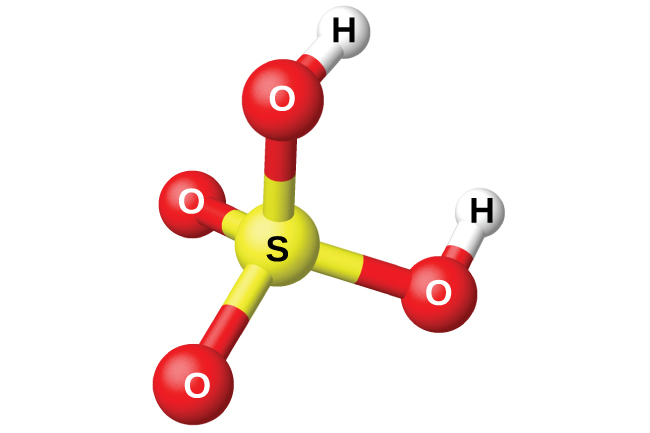


Figure 18.54図 18.54
Sulfuric acid has a tetrahedral molecular structure.
硫酸は、四面体形の分子構造を持つ。
The strong affinity of concentrated sulfuric acid for water makes it a good dehydrating agent. It is possible to dry gases and immiscible liquids that do not react with the acid by passing them through the acid.
英語のヒント
濃硫酸は水との親和性が強いため、よい脱水剤となる。酸と反応しない気体や、互いに混ざり合わない液体は、酸に通すことで乾燥できる。
Sulfuric acid is a strong diprotic acid that ionizes in two stages. In aqueous solution, the first stage is essentially complete. The secondary ionization is not nearly so complete, and is a moderately strong acid (about 25% ionized in solution of a salt: Ka = 1.2 10−2).
硫酸は、二段階で電離する強い二価酸である。水溶液中では、第一段階は実質的に完全に進む。第二段階の電離は、それほど完全には進まず、は中程度に強い酸である(塩の溶液では約25%電離する。Ka = 1.2 10−2)。
Being a diprotic acid, sulfuric acid forms both sulfates, such as Na2SO4, and hydrogen sulfates, such as NaHSO4. Most sulfates are soluble in water; however, the sulfates of barium, strontium, calcium, and lead are only slightly soluble in water.
硫酸は二価酸なので、Na2SO4などの硫酸塩と、NaHSO4などの硫酸水素塩の両方を作る。硫酸塩の大部分は水に溶けるが、バリウム、ストロンチウム、カルシウム、鉛の硫酸塩は、水にわずかしか溶けない。
Among the important sulfates are Na2SO4⋅10H2O and Epsom salts, MgSO4⋅7H2O. Because the ion is an acid, hydrogen sulfates, such as NaHSO4, exhibit acidic behavior, and this compound is the primary ingredient in some household cleansers.
重要な硫酸塩には、Na2SO4⋅10H2Oや、エプソム塩MgSO4⋅7H2Oがある。イオンは酸であるため、NaHSO4などの硫酸水素塩は酸性を示し、この化合物は一部の家庭用洗浄剤の主成分である。
Hot, concentrated sulfuric acid is an oxidizing agent. Depending on its concentration, the temperature, and the strength of the reducing agent, sulfuric acid oxidizes many compounds and, in the process, undergoes reduction to SO2, S, H2S, or S2−.
高温の濃硫酸は酸化剤である。濃度、温度、還元剤の強さに応じて、硫酸は多くの化合物を酸化し、その過程で、自身はSO2、、、S、H2S,、またはS2−へ還元される。
Sulfur dioxide dissolves in water to form a solution of sulfurous acid, as expected for the oxide of a nonmetal. Sulfurous acid is unstable, and it is not possible to isolate anhydrous H2SO3. Heating a solution of sulfurous acid expels the sulfur dioxide. Like other diprotic acids, sulfurous acid ionizes in two steps: The hydrogen sulfite ion, and the sulfite ion, form. Sulfurous acid is a moderately strong acid. Ionization is about 25% in the first stage, but it is much less in the second (Ka1 = 1.2 10−2 and Ka2 = 6.2 10−8).
非金属酸化物から予想されるように、二酸化硫黄は水に溶け、亜硫酸の溶液を作る。亜硫酸は不安定で、無水のH2SO3を単離することはできない。亜硫酸溶液を加熱すると、二酸化硫黄が追い出される。他の二価酸と同様に、亜硫酸は二段階で電離し、亜硫酸水素イオンと亜硫酸イオンが生じる。亜硫酸は中程度に強い酸である。第一段階では約25%電離するが、第二段階でははるかに少ない(Ka1 = 1.2 10−2、Ka2 = 6.2 10−8)。
In order to prepare solid sulfite and hydrogen sulfite salts, it is necessary to add a stoichiometric amount of a base to a sulfurous acid solution and then evaporate the water. These salts also form from the reaction of SO2 with oxides and hydroxides. Heating solid sodium hydrogen sulfite forms sodium sulfite, sulfur dioxide, and water:
固体の亜硫酸塩と亜硫酸水素塩を調製するには、亜硫酸溶液に化学量論量の塩基を加え、次に水を蒸発させる必要がある。これらの塩は、SO2と酸化物や水酸化物との反応によっても生じる。固体の亜硫酸水素ナトリウムを加熱すると、亜硫酸ナトリウム、二酸化硫黄、水が生じる。
Strong oxidizing agents can oxidize sulfurous acid. Oxygen in the air oxidizes it slowly to the more stable sulfuric acid:
強い酸化剤は亜硫酸を酸化できる。空気中の酸素は、亜硫酸を、より安定な硫酸へゆっくり酸化する。
Solutions of sulfites are also very susceptible to air oxidation to produce sulfates. Thus, solutions of sulfites always contain sulfates after exposure to air.
亜硫酸塩の溶液も、空気による酸化を非常に受けやすく、硫酸塩を生じる。したがって、亜硫酸塩の溶液は、空気にさらされた後には必ず硫酸塩を含む。