第18章典型元素の金属・半金属・非金属
Boron and Silicon Halidesホウ素とケイ素のハロゲン化物
Boron trihalides—BF3, BCl3, BBr3, and BI3—can be prepared by the direct reaction of the elements. These nonpolar molecules contain boron with sp2 hybridization and a trigonal planar molecular geometry. The fluoride and chloride compounds are colorless gasses, the bromide is a liquid, and the iodide is a white crystalline solid.
英語のヒント
三ハロゲン化ホウ素、BF3、BCl3、BBr3、BI3は、単体どうしの直接反応で調製できる。これらの無極性分子は、sp2混成したホウ素を含み、平面三角形の分子構造を持つ。フッ化物と塩化物は無色の気体、臭化物は液体、ヨウ化物は白色の結晶性固体である。
Except for boron trifluoride, the boron trihalides readily hydrolyze in water to form boric acid and the corresponding hydrohalic acid. Boron trichloride reacts according to the equation:
英語のヒント
三フッ化ホウ素を除き、三ハロゲン化ホウ素は水中で容易に加水分解して、ホウ酸と対応するハロゲン化水素酸を生じる。三塩化ホウ素は、次の式に従って反応する。
Boron trifluoride reacts with hydrofluoric acid, to yield a solution of fluoroboric acid, HBF4:
三フッ化ホウ素はフッ化水素酸と反応して、ホウフッ化水素酸HBF4の溶液を生じる。
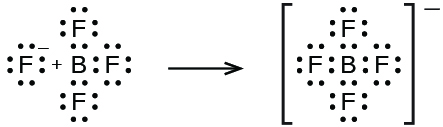
In this reaction, the BF3 molecule acts as the Lewis acid (electron pair acceptor) and accepts a pair of electrons from a fluoride ion:
この反応で、BF3分子はルイス酸(電子対受容体)として働き、フッ化物イオンから電子対を受け取る。
All the tetrahalides of silicon, SiX4, have been prepared. Silicon tetrachloride can be prepared by direct chlorination at elevated temperatures or by heating silicon dioxide with chlorine and carbon:
ケイ素の四ハロゲン化物SiX4は、すべて調製されている。四塩化ケイ素は、高温での直接塩素化、または二酸化ケイ素を塩素と炭素とともに加熱することで調製できる。
Silicon tetrachloride is a covalent tetrahedral molecule, which is a nonpolar, low-boiling (57 °C), colorless liquid.
英語のヒント
四塩化ケイ素は共有結合性の四面体分子であり、無極性で低沸点(57 °C)の無色液体である。
It is possible to prepare silicon tetrafluoride by the reaction of silicon dioxide with hydrofluoric acid:
二酸化ケイ素とフッ化水素酸の反応によって、四フッ化ケイ素を調製できる。
Hydrofluoric acid is the only common acid that will react with silicon dioxide or silicates. This reaction occurs because the silicon-fluorine bond is the only bond that silicon forms that is stronger than the silicon-oxygen bond. For this reason, it is possible to store all common acids, other than hydrofluoric acid, in glass containers.
英語のヒント
フッ化水素酸は、二酸化ケイ素やケイ酸塩と反応する唯一の一般的な酸である。この反応が起こるのは、ケイ素が形成する結合のうち、ケイ素・酸素結合より強いのがケイ素・フッ素結合だけだからである。このため、フッ化水素酸以外の一般的な酸は、すべてガラス容器に保存できる。
Except for silicon tetrafluoride, silicon halides are extremely sensitive to water. Upon exposure to water, SiCl4 reacts rapidly with hydroxide groups, replacing all four chlorine atoms to produce unstable orthosilicic acid, Si(OH)4 or H4SiO4, which slowly decomposes into SiO2.
英語のヒント
四フッ化ケイ素を除き、ケイ素のハロゲン化物は水にきわめて敏感である。水にさらされると、SiCl4はヒドロキシ基と速やかに反応し、四つの塩素原子をすべて置換して、不安定なオルトケイ酸Si(OH)4またはH4SiO4を生じる。これはゆっくりと分解してSiO2になる。
Boron and Silicon Oxides and Derivativesホウ素とケイ素の酸化物および誘導体
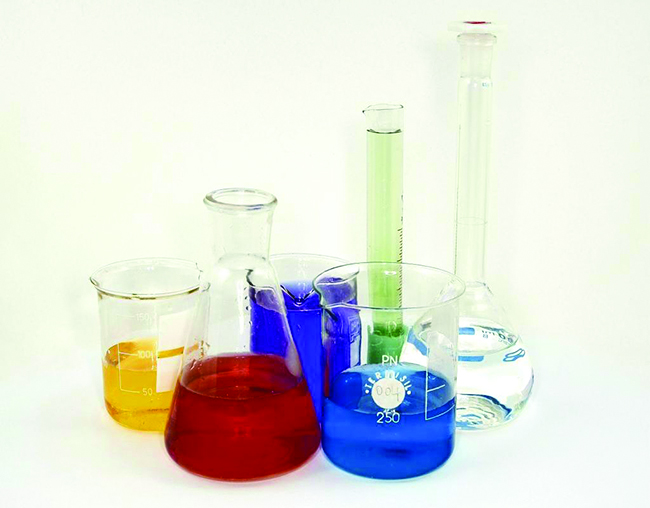
Boron burns at 700 °C in oxygen, forming boric oxide, B2O3. Boric oxide is necessary for the production of heat-resistant borosilicate glass, like that shown in Figure 18.15 and certain optical glasses. Boric oxide dissolves in hot water to form boric acid, B(OH)3:
英語のヒント
ホウ素は700 °Cで酸素中で燃焼し、酸化ホウ素B2O3を生じる。酸化ホウ素は、図18.15のような耐熱性のホウケイ酸ガラスや、ある種の光学ガラスの製造に必要である。酸化ホウ素は熱水に溶けて、ホウ酸B(OH)3を生じる。
OpenStax, Rice University, Chemistry 2e. Original caption credit: (credit: “Tweenk”/Wikimedia Commons) Source work: Lab glassware.jpg · CC BY 3.0 · Source出典
Figure 18.15図 18.15
Laboratory glassware, such as Pyrex and Kimax, is made of borosilicate glass because it does not break when heated. The inclusion of borates in the glass helps to mediate the effects of thermal expansion and contraction. This reduces the likelihood of thermal shock, which causes silicate glass to crack upon rapid heating or cooling. (credit: “Tweenk”/Wikimedia Commons)
英語のヒント
PyrexやKimaxなどの実験用ガラス器具は、加熱しても割れないため、ホウケイ酸ガラスで作られる。ガラスにホウ酸塩を含めると、熱膨張と収縮の影響が緩和される。その結果、急激な加熱や冷却でケイ酸塩ガラスに亀裂を生じさせる熱衝撃の可能性が低くなる。(出典:「Tweenk」/Wikimedia Commons)
The boron atom in B(OH)3 is sp2 hybridized and is located at the center of an equilateral triangle with oxygen atoms at the corners. In solid B(OH)3, hydrogen bonding holds these triangular units together. Boric acid, shown in Figure 18.16, is a very weak acid that does not act as a proton donor but rather as a Lewis acid, accepting an unshared pair of electrons from the Lewis base OH−:
B(OH)3のホウ素原子はsp2混成しており、頂点に酸素原子を持つ正三角形の中心に位置する。固体のB(OH)3では、水素結合がこれらの三角形単位を結び付けている。図18.16に示すホウ酸は非常に弱い酸であり、プロトン供与体としてではなくルイス酸として働き、ルイス塩基OH−から非共有電子対を受け取る。
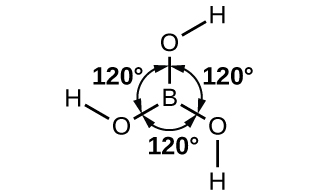
Figure 18.16図 18.16
Boric acid has a planar structure with three –OH groups spread out equally at 120° angles from each other.
ホウ酸は、三つの–OH基が互いに120°の等しい角度で広がった平面構造を持つ。
Heating boric acid to 100 °C causes molecules of water to split out between pairs of adjacent –OH groups to form metaboric acid, HBO2. At about 150 °C, additional B-O-B linkages form, connecting the BO3 groups together with shared oxygen atoms to form tetraboric acid, H2B4O7. Complete water loss, at still higher temperatures, results in boric oxide.
英語のヒント
ホウ酸を100 °Cに加熱すると、隣接する–OH基の対の間から水分子が脱離し、メタホウ酸HBO2を形成する。約150 °Cでは、さらにB-O-B結合ができ、BO3基が共有された酸素原子で結び付いて、四ホウ酸H2B4O7を形成する。さらに高温で完全に水を失うと、酸化ホウ素となる。
Borates are salts of the oxyacids of boron. Borates result from the reactions of a base with an oxyacid or from the fusion of boric acid or boric oxide with a metal oxide or hydroxide. Borate anions range from the simple trigonal planar ion to complex species containing chains and rings of three- and four-coordinated boron atoms. The structures of the anions found in CaB2O4, K[B5O6(OH)4]⋅2H2O (commonly written KB5O8⋅4H2O) and Na2[B4O5(OH)4]⋅8H2O (commonly written Na2B4O7⋅10H2O) are shown in Figure 18.17. Commercially, the most important borate is borax, Na2[B4O5(OH)4]⋅8H2O, which is an important component of some laundry detergents. Most of the supply of borax comes directly from dry lakes, such as Searles Lake in California, or is prepared from kernite, Na2B4O7⋅4H2O.
英語のヒント
ホウ酸塩は、ホウ素のオキソ酸の塩である。塩基とオキソ酸の反応、またはホウ酸や酸化ホウ素を金属酸化物や水酸化物と融解させることで得られる。ホウ酸陰イオンには、単純な平面三角形のイオンから、3配位および4配位のホウ素原子の鎖や環を含む複雑な化学種まである。CaB2O4、K[B5O6(OH)4]⋅2H2O(通常はKB5O8⋅4H2Oと書く)、Na2[B4O5(OH)4]⋅8H2O(通常はNa2B4O7⋅10H2Oと書く)に含まれる陰イオンの構造を、図18.17に示す。商業的に最も重要なホウ酸塩はホウ砂Na2[B4O5(OH)4]⋅8H2Oであり、一部の洗濯用洗剤の重要な成分である。ホウ砂の供給量の大部分は、カリフォルニアのSearles Lakeのような干上がった湖から直接得るか、ケルナイトNa2B4O7⋅4H2Oから調製する。
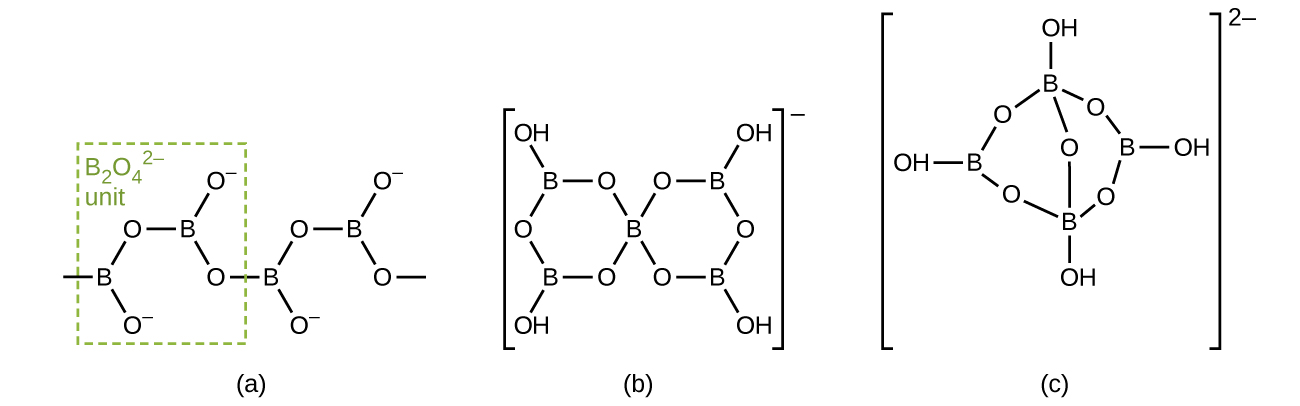


Figure 18.17図 18.17
The borate anions are (a) CaB2O4, (b) KB5O8⋅4H2O, and (c) Na2B4O7⋅10H2O. The anion in CaB2O4 is an “infinite” chain.
ホウ酸陰イオンを含むのは、(a)CaB2O4、(b)KB5O8⋅4H2O、(c)Na2B4O7⋅10H2Oである。CaB2O4中の陰イオンは「無限」の鎖である。
Silicon dioxide, silica, occurs in both crystalline and amorphous forms. The usual crystalline form of silicon dioxide is quartz, a hard, brittle, clear, colorless solid. It is useful in many ways—for architectural decorations, semiprecious jewels, and frequency control in radio transmitters. Silica takes many crystalline forms, or polymorphs, in nature. Trace amounts of Fe3+ in quartz give amethyst its characteristic purple color. The term quartz is also used for articles such as tubing and lenses that are manufactured from amorphous silica. Opal is a naturally occurring form of amorphous silica.
英語のヒント
二酸化ケイ素、すなわちシリカは、結晶質と非晶質の両方の形態で存在する。二酸化ケイ素の通常の結晶形は石英で、硬くてもろい、透明で無色の固体である。建築装飾、半貴石、無線送信機の周波数制御など、多くの用途に役立つ。シリカは天然で多くの結晶形、すなわち多形をとる。石英中の微量のFe3+は、アメシストに特徴的な紫色を与える。石英という用語は、非晶質シリカで作った管やレンズなどの物品にも使われる。オパールは、天然に存在する非晶質シリカの一形態である。
The contrast in structure and physical properties between silicon dioxide and carbon dioxide is interesting, as illustrated in Figure 18.18. Solid carbon dioxide (dry ice) contains single CO2 molecules with each of the two oxygen atoms attached to the carbon atom by double bonds. Very weak intermolecular forces hold the molecules together in the crystal. The volatility of dry ice reflect these weak forces between molecules. In contrast, silicon dioxide is a covalent network solid. In silicon dioxide, each silicon atom links to four oxygen atoms by single bonds directed toward the corners of a regular tetrahedron, and SiO4 tetrahedra share oxygen atoms. This arrangement gives a three dimensional, continuous, silicon-oxygen network. A quartz crystal is a macromolecule of silicon dioxide. The difference between these two compounds is the ability of the group 14 elements to form strong π bonds. Second-period elements, such as carbon, form very strong π bonds, which is why carbon dioxide forms small molecules with strong double bonds. Elements below the second period, such as silicon, do not form π bonds as readily as second-period elements, and when they do form, the π bonds are weaker than those formed by second-period elements. For this reason, silicon dioxide does not contain π bonds but only σ bonds.
英語のヒント
図18.18に示すように、二酸化ケイ素と二酸化炭素の構造および物理的性質の対照は興味深い。固体の二酸化炭素(ドライアイス)は個別のCO2分子を含み、各分子の二つの酸素原子はそれぞれ炭素原子と二重結合している。結晶内では、非常に弱い分子間力が分子を結び付けている。ドライアイスの揮発性は、分子間のこれらの弱い力を反映する。これに対して、二酸化ケイ素は共有結合網目固体である。各ケイ素原子は、正四面体の頂点へ向かう単結合によって四つの酸素原子とつながり、SiO4四面体は酸素原子を共有する。この配列によって、三次元に連続するケイ素・酸素の網目ができる。石英の結晶は、二酸化ケイ素の巨大分子である。この二つの化合物の違いは、14族元素が強いπ結合を作る能力にある。炭素のような第2周期元素は非常に強いπ結合を形成するため、二酸化炭素は強い二重結合を持つ小さな分子を作る。ケイ素のように第2周期より下にある元素は、第2周期元素ほど容易にはπ結合を作らず、作った場合にも、第2周期元素のπ結合より弱い。このため、二酸化ケイ素はπ結合を含まず、σ結合だけを含む。
Image omitted because its reuse rights could not be verified.権利の確認ができないため画像を割愛。
Figure 18.18図 18.18
Because carbon tends to form double and triple bonds and silicon does not, (a) carbon dioxide is a discrete molecule with two C=O double bonds and (b) silicon dioxide is an infinite network of oxygen atoms bridging between silicon atoms with each silicon atom possessing four Si-O single bonds. (credit a photo: modification of work by Erica Gerdes; credit b photo: modification of work by Didier Descouens)
英語のヒント
炭素は二重結合や三重結合を作る傾向があるが、ケイ素はそうでない。そのため、(a)二酸化炭素は二つのC=O二重結合を持つ独立した分子であり、(b)二酸化ケイ素は、酸素原子がケイ素原子間を架橋する無限の網目で、各ケイ素原子は四つのSi-O単結合を持つ。(aの写真の出典:Erica Gerdesの作品を改変。bの写真の出典:Didier Descouensの作品を改変。)
At 1600 °C, quartz melts to yield a viscous liquid. When the liquid cools, it does not crystallize readily but usually supercools and forms a glass, also called silica. The SiO4 tetrahedra in glassy silica have a random arrangement characteristic of supercooled liquids, and the glass has some very useful properties. Silica is highly transparent to both visible and ultraviolet light. For this reason, it is important in the manufacture of lamps that give radiation rich in ultraviolet light and in certain optical instruments that operate with ultraviolet light. The coefficient of expansion of silica glass is very low; therefore, rapid temperature changes do not cause it to fracture. CorningWare and other ceramic cookware contain amorphous silica.
英語のヒント
1600 °Cで石英は融けて、粘性の高い液体となる。この液体は冷却しても容易には結晶化せず、通常は過冷却され、シリカとも呼ばれるガラスを形成する。ガラス状シリカのSiO4四面体は、過冷却液体に特徴的な不規則な配列を持ち、このガラスには非常に有用な性質がある。シリカは可視光にも紫外光にも非常に透明である。このため、紫外光に富む放射を出すランプや、紫外光で動作するある種の光学機器の製造で重要である。シリカガラスの膨張係数は非常に小さいため、急激な温度変化でも破断しない。CorningWareなどのセラミック製調理器具は、非晶質シリカを含む。
Silicates are salts containing anions composed of silicon and oxygen. In nearly all silicates, sp3-hybridized silicon atoms occur at the centers of tetrahedra with oxygen at the corners. There is a variation in the silicon-to-oxygen ratio that occurs because silicon-oxygen tetrahedra may exist as discrete, independent units or may share oxygen atoms at corners in a variety of ways. In addition, the presence of a variety of cations gives rise to the large number of silicate minerals.
ケイ酸塩は、ケイ素と酸素から成る陰イオンを含む塩である。ほぼすべてのケイ酸塩では、sp3混成したケイ素原子が、頂点に酸素を持つ四面体の中心に位置する。ケイ素・酸素四面体が、個別の独立した単位として存在したり、さまざまな仕方で頂点の酸素原子を共有したりするため、ケイ素と酸素の比には変化がある。さらに、さまざまな陽イオンが存在することにより、多数のケイ酸塩鉱物が生じる。
Many ceramics are composed of silicates. By including small amounts of other compounds, it is possible to modify the physical properties of the silicate materials to produce ceramics with useful characteristics.
多くのセラミックはケイ酸塩でできている。少量の他の化合物を含めることで、ケイ酸塩材料の物理的性質を変え、有用な特性を持つセラミックを作ることができる。