第18章典型元素の金属・半金属・非金属
Occurrence, Preparation, and Compounds of Boron and Siliconホウ素とケイ素の存在・製法・化合物
Boron constitutes less than 0.001% by weight of the earth’s crust. In nature, it only occurs in compounds with oxygen. Boron is widely distributed in volcanic regions as boric acid, B(OH)3, and in dry lake regions, including the desert areas of California, as borates and salts of boron oxyacids, such as borax, Na2B4O7⋅10H2O.
英語のヒント
ホウ素は地殻の質量の0.001%未満を占める。天然では酸素との化合物としてのみ存在する。火山地域にはホウ酸B(OH)3として広く分布し、カリフォルニアの砂漠地域を含む干上がった湖の地域には、ホウ砂Na2B4O7⋅10H2Oなどのホウ酸塩やホウ素のオキソ酸の塩として存在する。
Elemental boron is chemically inert at room temperature, reacting with only fluorine and oxygen to form boron trifluoride, BF3, and boric oxide, B2O3, respectively. At higher temperatures, boron reacts with all nonmetals, except tellurium and the noble gases, and with nearly all metals; it oxidizes to B2O3 when heated with concentrated nitric or sulfuric acid. Boron does not react with nonoxidizing acids. Many boron compounds react readily with water to give boric acid, B(OH)3 (sometimes written as H3BO3).
単体のホウ素は室温では化学的に不活性であり、フッ素および酸素とのみ反応し、それぞれ三フッ化ホウ素BF3と酸化ホウ素B2O3を作る。高温では、テルルと希ガスを除くすべての非金属、およびほぼすべての金属と反応する。濃硝酸や濃硫酸と加熱すると、酸化されてB2O3となる。ホウ素は、酸化性でない酸とは反応しない。多くのホウ素化合物は水と容易に反応し、ホウ酸B(OH)3(H3BO3と書くこともある)を生じる。
Reduction of boric oxide with magnesium powder forms boron (95–98.5% pure) as a brown, amorphous powder:
英語のヒント
酸化ホウ素をマグネシウム粉末で還元すると、ホウ素(純度95~98.5%)が褐色の非晶質粉末として得られる。
An amorphous substance is a material that appears to be a solid, but does not have a long-range order like a true solid. Treatment with hydrochloric acid removes the magnesium oxide. Further purification of the boron begins with conversion of the impure boron into boron trichloride. The next step is to heat a mixture of boron trichloride and hydrogen:
英語のヒント
非晶質物質は、固体のように見えるが、真の固体のような長距離秩序を持たない物質である。塩酸で処理すると酸化マグネシウムを除去できる。ホウ素をさらに精製するには、まず不純なホウ素を三塩化ホウ素に変える。次に、三塩化ホウ素と水素の混合物を加熱する。
Silicon makes up nearly one-fourth of the mass of the earth’s crust—second in abundance only to oxygen. The crust is composed almost entirely of minerals in which the silicon atoms are at the center of the silicon-oxygen tetrahedron, which connect in a variety of ways to produce, among other things, chains, layers, and three-dimensional frameworks. These minerals constitute the bulk of most common rocks, soil, and clays. In addition, materials such as bricks, ceramics, and glasses contain silicon compounds.
英語のヒント
ケイ素は地殻の質量のほぼ4分の1を占め、存在量は酸素に次いで2番目である。地殻はほぼ完全に、ケイ素原子がケイ素・酸素四面体の中心に位置する鉱物で構成されている。これらの四面体はさまざまな仕方でつながり、鎖、層、三次元骨格などを作る。これらの鉱物は、一般的な岩石、土壌、粘土の大部分を構成する。また、れんが、セラミック、ガラスなどの材料もケイ素化合物を含む。
It is possible to produce silicon by the high-temperature reduction of silicon dioxide with strong reducing agents, such as carbon and magnesium:
二酸化ケイ素を炭素やマグネシウムなどの強い還元剤で高温還元すると、ケイ素を製造できる。
Extremely pure silicon is necessary for the manufacture of semiconductor electronic devices. This process begins with the conversion of impure silicon into silicon tetrahalides, or silane (SiH4), followed by decomposition at high temperatures. Zone refining, illustrated in Figure 18.14, completes the purification. In this method, a rod of silicon is heated at one end by a heat source that produces a thin cross-section of molten silicon. Slowly lowering the rod through the heat source moves the molten zone from one end of the rod to other. As this thin, molten region moves, impurities in the silicon dissolve in the liquid silicon and move with the molten region. Ultimately, the impurities move to one end of the rod, which is then cut off.
英語のヒント
半導体電子機器の製造には、きわめて純粋なケイ素が必要である。この工程では、まず不純なケイ素を四ハロゲン化ケイ素、またはシラン(SiH4)に変え、続いて高温で分解する。図18.14に示す帯域精製で精製を完了する。この方法では、ケイ素の棒の一端を熱源で加熱し、棒の断面に沿った薄い溶融ケイ素の領域を作る。棒を熱源の中でゆっくり下げると、溶融帯が棒の一端から他端へ移動する。この薄い溶融領域が移動するにつれ、ケイ素中の不純物が液体ケイ素に溶け、溶融領域とともに移動する。最終的に不純物は棒の一端へ集まり、その端を切り落とす。
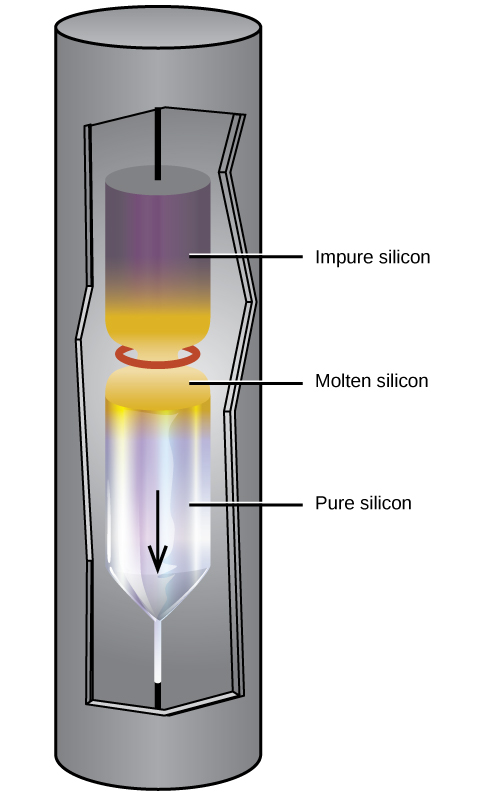

Figure 18.14図 18.14
A zone-refining apparatus used to purify silicon.
ケイ素を精製するための帯域精製装置。
This highly purified silicon, containing no more than one part impurity per million parts of silicon, is the most important element in the computer industry. Pure silicon is necessary in semiconductor electronic devices such as transistors, computer chips, and solar cells.
この高純度に精製したケイ素は、ケイ素100万部あたり不純物が1部以下であり、コンピューター産業で最も重要な元素である。トランジスター、コンピューターチップ、太陽電池などの半導体電子機器には、純粋なケイ素が必要である。
Like some metals, passivation of silicon occurs due the formation of a very thin film of oxide (primarily silicon dioxide, SiO2). Silicon dioxide is soluble in hot aqueous base; thus, strong bases destroy the passivation. Removal of the passivation layer allows the base to dissolve the silicon, forming hydrogen gas and silicate anions. For example:
一部の金属と同様、ケイ素も、非常に薄い酸化物(主に二酸化ケイ素SiO2)の膜が形成されることで不動態化する。二酸化ケイ素は熱い塩基性水溶液に溶けるため、強塩基は不動態化を破壊する。不動態層を除去すると、塩基がケイ素を溶かせるようになり、水素ガスとケイ酸陰イオンを形成する。たとえば、
Silicon reacts with halogens at high temperatures, forming volatile tetrahalides, such as SiF4.
ケイ素は高温でハロゲンと反応し、SiF4などの揮発性の四ハロゲン化物を作る。
Unlike carbon, silicon does not readily form double or triple bonds. Silicon compounds of the general formula SiX4, where X is a highly electronegative group, can act as Lewis acids to form six-coordinate silicon. For example, silicon tetrafluoride, SiF4, reacts with sodium fluoride to yield Na2[SiF6], which contains the octahedral ion in which silicon is sp3d2 hybridized:
英語のヒント
炭素と異なり、ケイ素は二重結合や三重結合を容易には形成しない。一般式SiX4(Xは電気陰性度の高い基)を持つケイ素化合物は、ルイス酸として働き、6配位のケイ素を形成できる。たとえば、四フッ化ケイ素SiF4はフッ化ナトリウムと反応してNa2[SiF6]を生じる。これは八面体型のイオンを含み、その中のケイ素はsp3d2混成している。
Antimony reacts readily with stoichiometric amounts of fluorine, chlorine, bromine, or iodine, yielding trihalides or, with excess fluorine or chlorine, forming the pentahalides SbF5 and SbCl5. Depending on the stoichiometry, it forms antimony(III) sulfide, Sb2S3, or antimony(V) sulfide when heated with sulfur. As expected, the metallic nature of the element is greater than that of arsenic, which lies immediately above it in group 15.
アンチモンは、化学量論的な量のフッ素、塩素、臭素、ヨウ素と容易に反応して三ハロゲン化物を生じ、過剰のフッ素や塩素とは五ハロゲン化物SbF5とSbCl5を作る。硫黄と加熱すると、化学量論に応じて硫化アンチモン(III) Sb2S3または硫化アンチモン(V)を生じる。予想されるように、この元素の金属性は、15族のすぐ上にあるヒ素より強い。