第18章典型元素の金属・半金属・非金属
18.5 Occurrence, Preparation, and Compounds of Hydrogen18.5 水素の存在・製法・化合物
Learning Objectives学習目標
By the end of this section, you will be able to:
この節を学び終えると、次のことができるようになる。
- Describe the properties, preparation, and compounds of hydrogen水素の性質、製法、化合物を説明する。
Hydrogen is the most abundant element in the universe. The sun and other stars are composed largely of hydrogen. Astronomers estimate that 90% of the atoms in the universe are hydrogen atoms. Hydrogen is a component of more compounds than any other element. Water is the most abundant compound of hydrogen found on earth. Hydrogen is an important part of petroleum, many minerals, cellulose and starch, sugar, fats, oils, alcohols, acids, and thousands of other substances.
水素は、宇宙で最も豊富な元素である。太陽や他の恒星は、主に水素からできている。天文学者は、宇宙の原子の90%が水素原子であると推定している。水素は、他のどの元素よりも多くの化合物の成分となる。地球上で見られる水素の化合物で最も豊富なものは水である。水素は、石油、多くの鉱物、セルロース、デンプン、糖、脂肪、油、アルコール、酸、その他何千もの物質の重要な構成要素である。
At ordinary temperatures, hydrogen is a colorless, odorless, tasteless, and nonpoisonous gas consisting of the diatomic molecule H2. Hydrogen is composed of three isotopes, and unlike other elements, these isotopes have different names and chemical symbols: protium, 1H, deuterium, 2H (or “D”), and tritium 3H (or “T”). In a naturally occurring sample of hydrogen, there is one atom of deuterium for every 7000 H atoms and one atom of radioactive tritium for every 1018 H atoms. The chemical properties of the different isotopes are very similar because they have identical electron structures, but they differ in some physical properties because of their differing atomic masses. Elemental deuterium and tritium have lower vapor pressure than ordinary hydrogen. Consequently, when liquid hydrogen evaporates, the heavier isotopes are concentrated in the last portions to evaporate. Electrolysis of heavy water, D2O, yields deuterium. Most tritium originates from nuclear reactions.
英語のヒント
常温では、水素は二原子分子H2からなる、無色、無臭、無味、無毒の気体である。水素には三つの同位体があり、他の元素と違って、それぞれ異なる名前と化学記号を持つ。軽水素1H、重水素2H(または「D」)、三重水素3H(または「T」)である。天然の水素試料には、H原子7000個につき重水素原子が一個、H原子1018個につき放射性の三重水素原子が一個存在する。各同位体は電子構造が同じなので化学的性質は非常によく似ているが、原子質量が異なるため、物理的性質の一部は異なる。単体の重水素と三重水素の蒸気圧は、通常の水素より低い。したがって、液体水素が蒸発すると、重い同位体は最後に蒸発する部分に濃縮される。重水D2Oを電気分解すると、重水素が得られる。三重水素の大部分は、核反応によって生じる。
Preparation of Hydrogen水素の製法
Elemental hydrogen must be prepared from compounds by breaking chemical bonds. The most common methods of preparing hydrogen follow.
水素の単体は、化学結合を切ることによって、化合物から調製しなければならない。以下に、水素を調製する最も一般的な方法を示す。
From Steam and Carbon or Hydrocarbons水蒸気と炭素または炭化水素から
Water is the cheapest and most abundant source of hydrogen. Passing steam over coke (an impure form of elemental carbon) at 1000 °C produces a mixture of carbon monoxide and hydrogen known as water gas:
水は、水素の最も安価で豊富な供給源である。1000 °Cでコークス(不純な炭素の単体)に水蒸気を通すと、水性ガスとして知られる、一酸化炭素と水素の混合物が生じる。
Water gas is as an industrial fuel. It is possible to produce additional hydrogen by mixing the water gas with steam in the presence of a catalyst to convert the CO to CO2. This reaction is the water gas shift reaction.
水性ガスは工業用燃料である。触媒の存在下で水性ガスに水蒸気を混ぜ、COをCO2に変えると、追加の水素を生成できる。この反応が水性ガスシフト反応である。
It is also possible to prepare a mixture of hydrogen and carbon monoxide by passing hydrocarbons from natural gas or petroleum and steam over a nickel-based catalyst. Propane is an example of a hydrocarbon reactant:
天然ガスや石油から得た炭化水素と水蒸気をニッケル系触媒に通すことによっても、水素と一酸化炭素の混合物を調製できる。炭化水素の反応物の一例はプロパンである。
Electrolysis電気分解
Hydrogen forms when direct current electricity passes through water containing an electrolyte such as H2SO4, as illustrated in Figure 18.26. Bubbles of hydrogen form at the cathode, and oxygen evolves at the anode. The net reaction is:
図18.26に示すように、H2SO4などの電解質を含む水に直流電流を流すと、水素が生じる。カソードでは水素の気泡ができ、アノードでは酸素が発生する。正味の反応は次のとおりである。
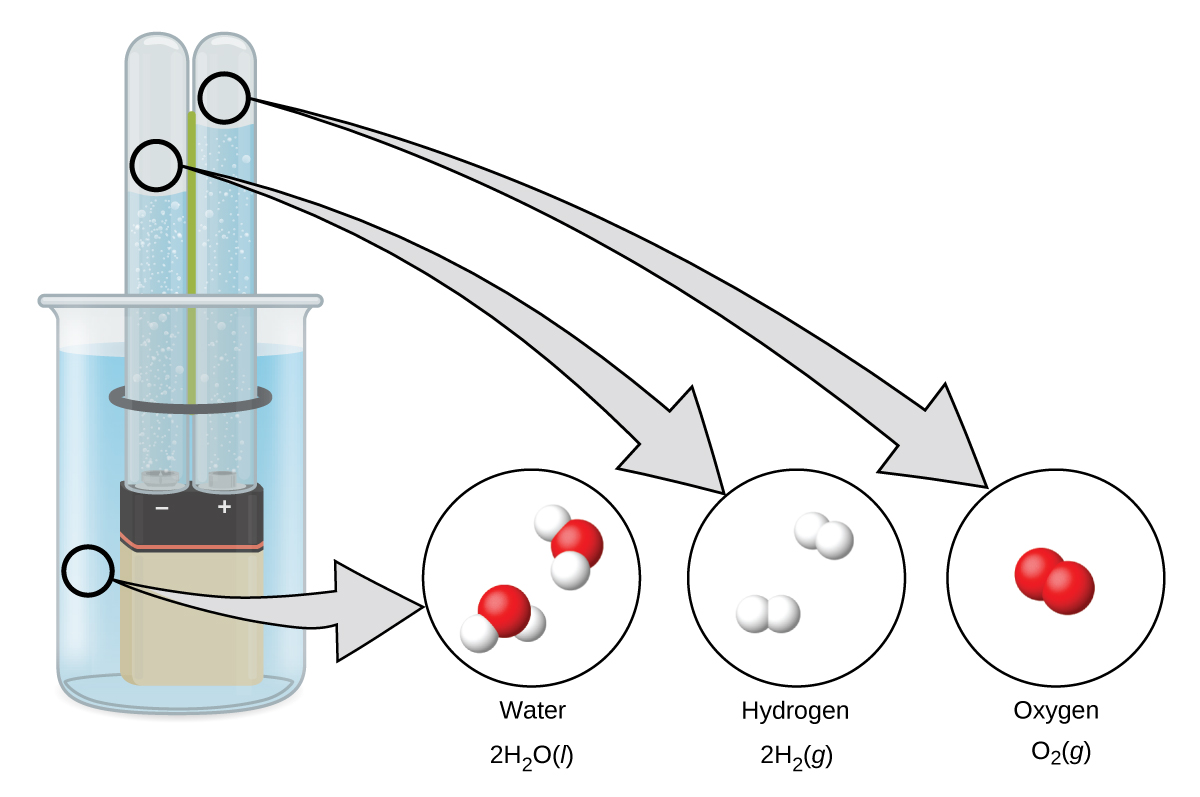

Figure 18.26図 18.26
The electrolysis of water produces hydrogen and oxygen. Because there are twice as many hydrogen atoms as oxygen atoms and both elements are diatomic, there is twice the volume of hydrogen produced at the cathode as there is oxygen produced at the anode.
水の電気分解によって、水素と酸素が生じる。水素原子の数は酸素原子の二倍で、どちらの元素も二原子分子であるため、カソードで生じる水素の体積は、アノードで生じる酸素の体積の二倍となる。
Reaction of Metals with Acids金属と酸との反応
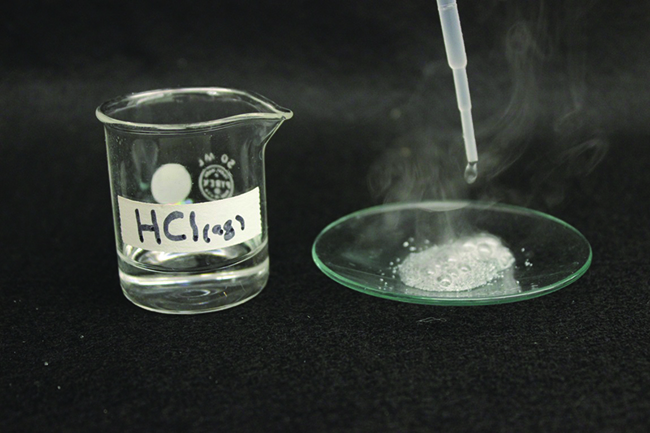
This is the most convenient laboratory method of producing hydrogen. Metals with lower reduction potentials reduce the hydrogen ion in dilute acids to produce hydrogen gas and metal salts. For example, as shown in Figure 18.27, iron in dilute hydrochloric acid produces hydrogen gas and iron(II) chloride:
これは、実験室で水素を生成する最も便利な方法である。還元電位の低い金属は、希酸中の水素イオンを還元し、水素ガスと金属塩を生じる。たとえば、図18.27に示すように、希塩酸中の鉄は、水素ガスと塩化鉄(II)を生じる。
OpenStax, Rice University, Chemistry 2e. Original caption credit: (credit: Mark Ott) · CC BY 4.0 · Source出典

Figure 18.27図 18.27
The reaction of iron with an acid produces hydrogen. Here, iron reacts with hydrochloric acid. (credit: Mark Ott)
鉄と酸の反応によって水素が生じる。ここでは、鉄が塩酸と反応している。(クレジット:Mark Ott)
Reaction of Ionic Metal Hydrides with Waterイオン性金属水素化物と水との反応
It is possible to produce hydrogen from the reaction of hydrides of the active metals, which contain the very strongly basic H− anion, with water:
非常に強い塩基性を持つH−陰イオンを含む、活性な金属の水素化物を水と反応させると、水素を生成できる。
Metal hydrides are expensive but convenient sources of hydrogen, especially where space and weight are important factors. They are important in the inflation of life jackets, life rafts, and military balloons.
英語のヒント
金属水素化物は高価だが、特に空間や重量が重要な要因となる場合には、便利な水素の供給源である。救命胴衣、救命いかだ、軍用気球を膨らませるのに重要である。
Reactions反応
Under normal conditions, hydrogen is relatively inactive chemically, but when heated, it enters into many chemical reactions.
通常の条件では、水素は化学的に比較的不活性であるが、加熱すると多くの化学反応に関与する。
Two thirds of the world’s hydrogen production is devoted to the manufacture of ammonia, which is a fertilizer and used in the manufacture of nitric acid. Large quantities of hydrogen are also important in the process of hydrogenation, discussed in the chapter on organic chemistry.
英語のヒント
世界の水素生産量の三分の二は、アンモニアの製造に使われる。アンモニアは肥料であり、硝酸の製造にも用いられる。また、有機化学の章で扱う水素化の過程でも、大量の水素が重要な役割を果たす。
It is possible to use hydrogen as a nonpolluting fuel. The reaction of hydrogen with oxygen is a very exothermic reaction, releasing 286 kJ of energy per mole of water formed. Hydrogen burns without explosion under controlled conditions. The oxygen-hydrogen torch, because of the high heat of combustion of hydrogen, can achieve temperatures up to 2800 °C. The hot flame of this torch is useful in cutting thick sheets of many metals. Liquid hydrogen is also an important rocket fuel (Figure 18.28).
水素は、汚染を生じない燃料として利用できる。水素と酸素の反応は非常に発熱的であり、水が1モル生成するごとに286 kJのエネルギーを放出する。制御された条件では、水素は爆発せずに燃焼する。水素の燃焼熱が高いため、酸水素トーチは2800 °Cまでの温度に達することができる。このトーチの高温の炎は、多くの金属の厚い板を切断するのに役立つ。液体水素は、重要なロケット燃料でもある(図18.28)。
Image omitted because its reuse rights could not be verified.権利の確認ができないため画像を割愛。
Figure 18.28図 18.28
Before the fleet’s retirement in 2011, liquid hydrogen and liquid oxygen were used in the three main engines of a space shuttle. Two compartments in the large tank held these liquids until the shuttle was launched. (credit: “reynermedia”/Flickr)
英語のヒント
スペースシャトルが2011年に全機退役するまで、三基の主エンジンには液体水素と液体酸素が用いられていた。大型タンクの二つの区画には、シャトルが打ち上げられるまで、これらの液体が蓄えられていた。(クレジット:「reynermedia」/Flickr)
An uncombined hydrogen atom consists of a nucleus and one valence electron in the 1s orbital. The n = 1 valence shell has a capacity for two electrons, and hydrogen can rightfully occupy two locations in the periodic table. It is possible to consider hydrogen a group 1 element because hydrogen can lose an electron to form the cation, H+. It is also possible to consider hydrogen to be a group 17 element because it needs only one electron to fill its valence orbital to form a hydride ion, H−, or it can share an electron to form a single, covalent bond. In reality, hydrogen is a unique element that almost deserves its own location in the periodic table.
英語のヒント
他の原子と結合していない水素原子は、原子核と1s軌道の一個の価電子からなる。n = 1の価電子殻には二個の電子を収容でき、水素は周期表の二つの位置のどちらを占めても理にかなっている。水素は電子を失って陽イオンH+を作れるので、1族元素と考えることができる。また、価電子軌道を満たして水素化物イオンH−を作るのに必要な電子は一個だけであり、電子を共有して共有結合の単結合を作ることもできるため、17族元素と考えることもできる。実際には、水素は独特の元素であり、周期表に独自の位置を設ける価値があるとさえいえる。