第18章典型元素の金属・半金属・非金属
18.10 Occurrence, Preparation, and Properties of Sulfur18.10 硫黄の存在・製法・性質
Learning Objectives学習目標
By the end of this section, you will be able to:
この節を学び終えると、次のことができるようになる。
- Describe the properties, preparation, and uses of sulfur硫黄の性質、製法、用途を説明する。
Sulfur exists in nature as elemental deposits as well as sulfides of iron, zinc, lead, and copper, and sulfates of sodium, calcium, barium, and magnesium. Hydrogen sulfide is often a component of natural gas and occurs in many volcanic gases, like those shown in Figure 18.58. Sulfur is a constituent of many proteins and is essential for life.
硫黄は、自然界に単体の鉱床として存在するほか、鉄、亜鉛、鉛、銅の硫化物や、ナトリウム、カルシウム、バリウム、マグネシウムの硫酸塩としても存在する。硫化水素は天然ガスの成分であることが多く、図18.58のような多くの火山ガスにも含まれる。硫黄は多くのタンパク質の構成成分であり、生命に不可欠である。
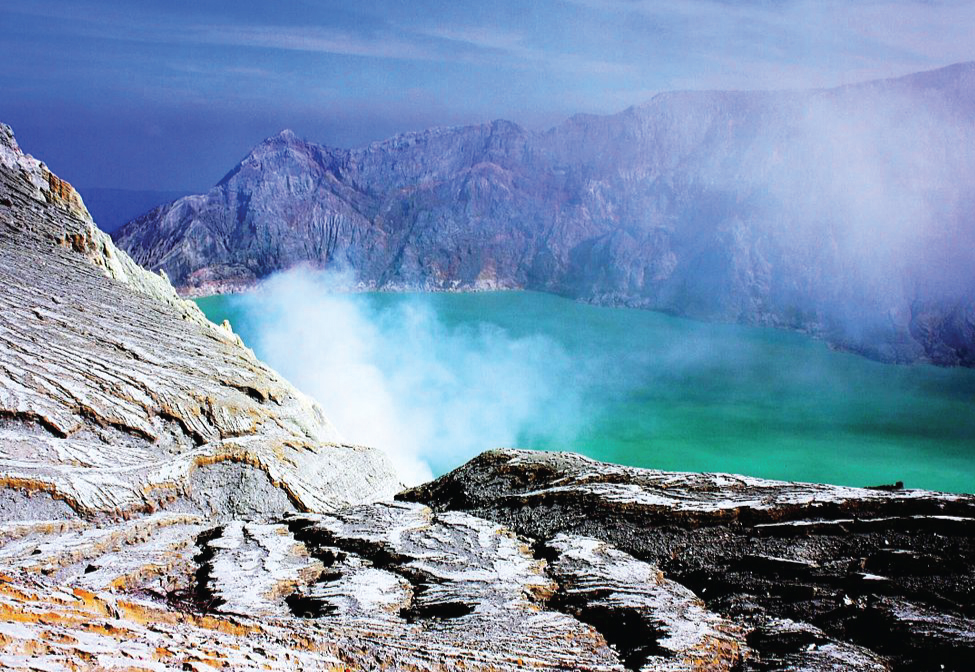
OpenStax, Rice University, Chemistry 2e. Original caption credit: (credit: Daniel Julie/Wikimedia Commons) Source work: DSC00316 Java East Kawah Ijen Volcano Caldeira and acide Lake and Sulfured (6224356958).jpg · CC BY 2.0 · Source出典
Figure 18.58図 18.58
Volcanic gases contain hydrogen sulfide. (credit: Daniel Julie/Wikimedia Commons)
火山ガスには硫化水素が含まれる。(クレジット:Daniel Julie/Wikimedia Commons)
The Frasch process, illustrated in Figure 18.59, is important in the mining of free sulfur from enormous underground deposits in Texas and Louisiana. Superheated water (170 °C and 10 atm pressure) is forced down the outermost of three concentric pipes to the underground deposit. The hot water melts the sulfur. The innermost pipe conducts compressed air into the liquid sulfur. The air forces the liquid sulfur, mixed with air, to flow up through the outlet pipe. Transferring the mixture to large settling vats allows the solid sulfur to separate upon cooling. This sulfur is 99.5% to 99.9% pure and requires no purification for most uses.
英語のヒント
図18.59に示すフラッシュ法は、テキサス州とルイジアナ州の巨大な地下鉱床から、単体の硫黄を採掘する際に重要である。三本の同心管の最外管から、過熱水(170 °C、圧力10 atm)を地下鉱床へ圧入する。熱水が硫黄を溶融させる。最内管は、圧縮空気を液体硫黄へ導く。空気の圧力によって、空気と混ざった液体硫黄が排出管を通って上へ流れる。この混合物を大きな沈降槽へ移すと、冷却に伴って固体硫黄が分離する。この硫黄の純度は99.5~99.9%であり、大部分の用途では精製を必要としない。
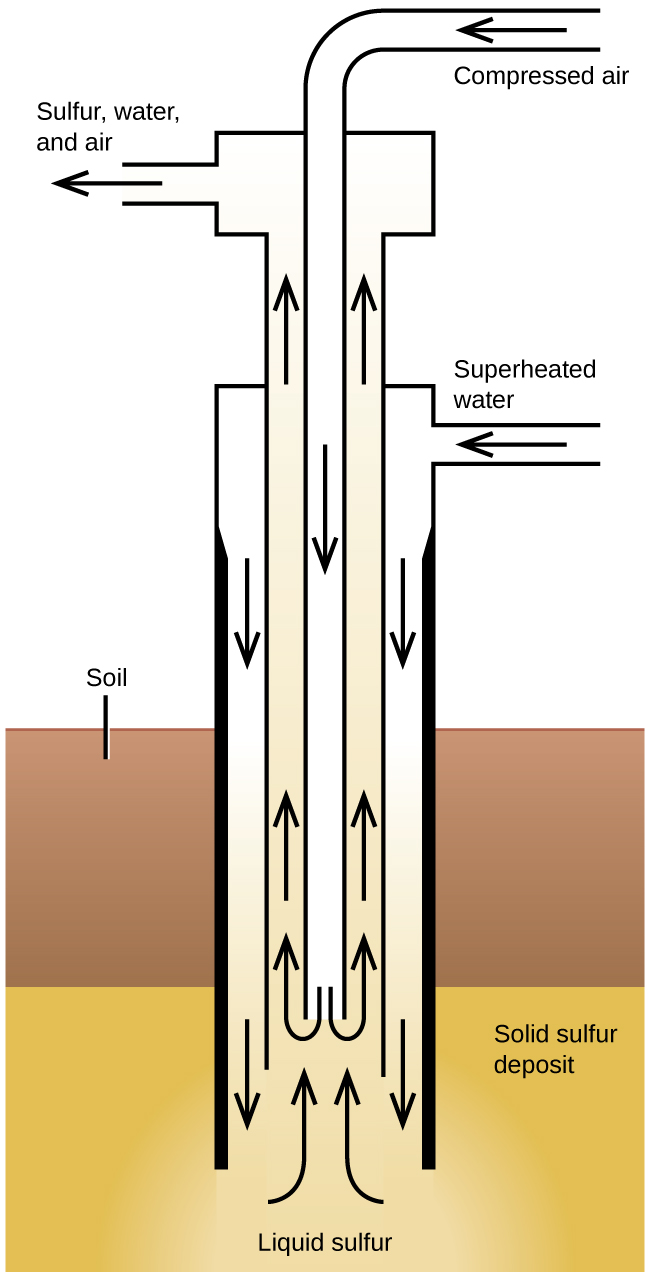


Figure 18.59図 18.59
The Frasch process is used to mine sulfur from underground deposits.
フラッシュ法は、地下鉱床から硫黄を採掘するために用いられる。
Larger amounts of sulfur also come from hydrogen sulfide recovered during the purification of natural gas.
天然ガスの精製中に回収される硫化水素からも、より多量の硫黄が得られる。
Sulfur exists in several allotropic forms. The stable form at room temperature contains eight-membered rings, and so the true formula is S8. However, chemists commonly use S to simplify the coefficients in chemical equations; we will follow this practice in this book.
硫黄はいくつかの同素体として存在する。室温で安定な形態は八員環を含むため、真の化学式はS8である。しかし、化学者は化学反応式の係数を簡単にするため、一般にSを用いる。この本でも、その慣習に従う。
Like oxygen, which is also a member of group 16, sulfur exhibits a distinctly nonmetallic behavior. It oxidizes metals, giving a variety of binary sulfides in which sulfur exhibits a negative oxidation state (2−). Elemental sulfur oxidizes less electronegative nonmetals, and more electronegative nonmetals, such as oxygen and the halogens, will oxidize it. Other strong oxidizing agents also oxidize sulfur. For example, concentrated nitric acid oxidizes sulfur to the sulfate ion, with the concurrent formation of nitrogen(IV) oxide:
英語のヒント
同じ16族の元素である酸素と同様に、硫黄は明らかな非金属の挙動を示す。金属を酸化し、硫黄が負の酸化状態(2−)をとる、さまざまな二元硫化物を生じる。単体の硫黄は、自身より電気陰性度の低い非金属を酸化し、酸素やハロゲンなど、自身より電気陰性度の高い非金属によって酸化される。他の強い酸化剤も硫黄を酸化する。たとえば、濃硝酸は硫黄を硫酸イオンに酸化し、同時に酸化窒素(IV)を生じる。
The chemistry of sulfur with an oxidation state of 2− is similar to that of oxygen. Unlike oxygen, however, sulfur forms many compounds in which it exhibits positive oxidation states.
酸化状態が2−の硫黄の化学は、酸素の化学に似ている。しかし、酸素とは異なり、硫黄は正の酸化状態を示す化合物を多く作る。
Key Concepts and Summary重要概念とまとめ
Sulfur (group 16) reacts with almost all metals and readily forms the sulfide ion, S2−, in which it has as oxidation state of 2−. Sulfur reacts with most nonmetals.
硫黄(16族)はほぼすべての金属と反応し、酸化状態が2−の硫化物イオンS2−を容易に作る。硫黄は非金属の大部分とも反応する。
Chemistry End of Chapter Exercises章末問題
Exercises 90–99練習問題 90–99
Exercise 90問題 90
Explain why hydrogen sulfide is a gas at room temperature, whereas water, which has a lower molecular mass, is a liquid.
硫化水素が室温で気体であるのに対し、分子質量の小さい水が液体である理由を説明しなさい。
Exercise 91問題 91
Give the hybridization and oxidation state for sulfur in SO2, in SO3, and in H2SO4.
SO2、SO3、H2SO4における、硫黄の混成と酸化状態を示しなさい。
Solution解き方
SO2, sp2 4+; SO3, sp2, 6+; H2SO4, sp3, 6+
SO2, sp2 4+; SO3, sp2, 6+; H2SO4, sp3, 6+
Exercise 92問題 92
Which is the stronger acid, NaHSO3 or NaHSO4?
NaHSO3とNaHSO4では、どちらが強い酸か。
Exercise 93問題 93
Determine the oxidation state of sulfur in SF6, SO2F2, and KHS.
SF6、SO2F2、KHSにおける硫黄の酸化状態を求めなさい。
Solution解き方
SF6: S = 6+; SO2F2: S = 6+; KHS: S = 2−
SF6: S = 6+; SO2F2: S = 6+; KHS: S = 2−
Exercise 94問題 94
Which is a stronger acid, sulfurous acid or sulfuric acid? Why?
亜硫酸と硫酸では、どちらが強い酸か。なぜか。
Exercise 95問題 95
Oxygen forms double bonds in O2, but sulfur forms single bonds in S8. Why?
酸素はO2で二重結合を作るが、硫黄はS8で単結合を作る。なぜか。
Solution解き方
Sulfur is able to form double bonds only at high temperatures (substantially endothermic conditions), which is not the case for oxygen.
硫黄が二重結合を作れるのは高温(大きく吸熱的な条件)だけであるが、酸素ではそうではない。
Exercise 96問題 96
Give the Lewis structure of each of the following:
次のそれぞれのルイス構造を示しなさい。
(a) SF4
(a) SF4
(b) K2SO4
(b) K2SO4
(c) SO2Cl2
(c) SO2Cl2
(d) H2SO3
(d) H2SO3
(e) SO3
(e) SO3
Exercise 97問題 97
Write two balanced chemical equations in which sulfuric acid acts as an oxidizing agent.
硫酸が酸化剤として働く、係数を整えた化学反応式を二つ書きなさい。
Solution解き方
There are many possible answers including: and
答えは多く考えられ、とも含まれる。
Exercise 98問題 98
Explain why sulfuric acid, H2SO4, which is a covalent molecule, dissolves in water and produces a solution that contains ions.
共有結合性分子である硫酸H2SO4が、水に溶けて、イオンを含む溶液を作る理由を説明しなさい。
Exercise 99問題 99
How many grams of Epsom salts (MgSO4⋅7H2O) will form from 5.0 kg of magnesium?
5.0 kgのマグネシウムから、何グラムのエプソム塩MgSO4⋅7H2Oができるか。
Solution解き方
5.1 104 g
5.1 104 g
Frasch process
フラッシュ法
important in the mining of free sulfur from enormous underground deposits
巨大な地下鉱床から、単体の硫黄を採掘する際に重要な方法。