第18章典型元素の金属・半金属・非金属
Key Concepts and Summary重要概念とまとめ
The elements boron, silicon, germanium, arsenic, antimony, and tellurium separate the metals from the nonmetals in the periodic table. These elements, called metalloids or sometimes semimetals, exhibit properties characteristic of both metals and nonmetals. The structures of these elements are similar in many ways to those of nonmetals, but the elements are electrical semiconductors.
英語のヒント
ホウ素、ケイ素、ゲルマニウム、ヒ素、アンチモン、テルルは、周期表で金属と非金属を隔てる元素である。metalloid、またはsemimetalとも呼ばれるこれらの半金属は、金属と非金属の両方に特徴的な性質を示す。構造は多くの点で非金属に似ているが、電気的には半導体である。
Chemistry End of Chapter Exercises章末問題
Exercises 28–43練習問題 28–43
Exercise 28問題 28
Give the hybridization of the metalloid and the molecular geometry for each of the following compounds or ions. You may wish to review the chapters on chemical bonding and advanced covalent bonding for relevant examples.
次の各化合物またはイオンについて、半金属の混成と分子の幾何学的構造を示しなさい。関連する例について、化学結合と共有結合の詳しい扱いの章を復習してもよい。
(a) GeH4
(a) GeH4
(b) SbF3
(b) SbF3
(c) Te(OH)6
(c) Te(OH)6
(d) H2Te
(d) H2Te
(e) GeF2
(e) GeF2
(f) TeCl4
(f) TeCl4
(g)
(g)
(h) SbCl5
(h) SbCl5
(i) TeF6
(i) TeF6
Exercise 29問題 29
Write a Lewis structure for each of the following molecules or ions. You may wish to review the chapter on chemical bonding.
次の各分子またはイオンのルイス構造を書きなさい。化学結合の章を復習してもよい。
(a) H3BPH3
(a) H3BPH3
(b)
(b)
(c) BBr3
(c) BBr3
(d) B(CH3)3
(d) B(CH3)3
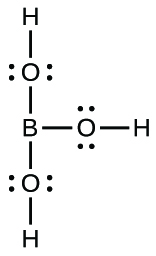
(e) B(OH)3
(e) B(OH)3
Solution解き方
(a) H3BPH3:
(a) H3BPH3:
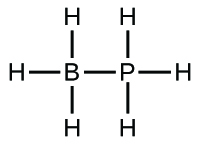
(b)
(b)
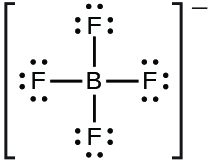
(c) BBr3:
(c) BBr3:
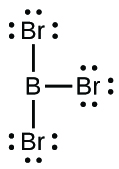
(d) B(CH3)3:
(d) B(CH3)3:
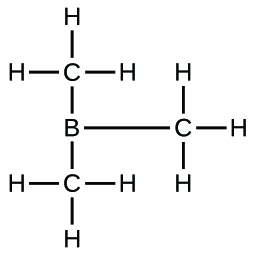
(e) B(OH)3:
(e) B(OH)3:


Exercise 30問題 30
Describe the hybridization of boron and the molecular structure about the boron in each of the following:
次の各物質について、ホウ素の混成と、ホウ素の周囲の分子構造を説明しなさい。
(a) H3BPH3
(a) H3BPH3
(b)
(b)
(c) BBr3
(c) BBr3
(d) B(CH3)3
(d) B(CH3)3
(e) B(OH)3
(e) B(OH)3
Exercise 31問題 31
Using only the periodic table, write the complete electron configuration for silicon, including any empty orbitals in the valence shell. You may wish to review the chapter on electronic structure.
周期表だけを使い、価電子殻の空の軌道も含め、ケイ素の完全な電子配置を書きなさい。電子構造の章を復習してもよい。
Solution解き方
1s22s22p63s23p23d0.
1s22s22p63s23p23d0。
Exercise 32問題 32
Write a Lewis structure for each of the following molecules and ions:
次の各分子およびイオンのルイス構造を書きなさい。
(a) (CH3)3SiH
(a) (CH3)3SiH
(b)
(b)
(c) Si2H6
(c) Si2H6
(d) Si(OH)4
(d) Si(OH)4
(e)
(e)
Exercise 33問題 33
Describe the hybridization of silicon and the molecular structure of the following molecules and ions:
次の分子およびイオンについて、ケイ素の混成と分子構造を説明しなさい。
(a) (CH3)3SiH
(a) (CH3)3SiH
(b)
(b)
(c) Si2H6
(c) Si2H6
(d) Si(OH)4
(d) Si(OH)4
(e)
(e)
Solution解き方
(a) (CH3)3SiH: sp3 bonding about Si; the structure is tetrahedral; (b) sp3 bonding about Si; the structure is tetrahedral; (c) Si2H6: sp3 bonding about each Si; the structure is linear along the Si-Si bond; (d) Si(OH)4: sp3 bonding about Si; the structure is tetrahedral; (e) sp3d2 bonding about Si; the structure is octahedral
(a) (CH3)3SiH:Siの周囲はsp3混成結合で、構造は四面体型。(b) :Siの周囲はsp3混成結合で、構造は四面体型。(c) Si2H6:各Siの周囲はsp3混成結合で、構造はSi-Si結合に沿って直線状。(d) Si(OH)4:Siの周囲はsp3混成結合で、構造は四面体型。(e) :Siの周囲はsp3d2混成結合で、構造は八面体型。
Exercise 34問題 34
Describe the hybridization and the bonding of a silicon atom in elemental silicon.
単体のケイ素におけるケイ素原子の混成と結合を説明しなさい。
Exercise 35問題 35
Classify each of the following molecules as polar or nonpolar. You may wish to review the chapter on chemical bonding.
次の各分子を、極性または無極性に分類しなさい。化学結合の章を復習してもよい。
(a) SiH4
(a) SiH4
(b) Si2H6
(b) Si2H6
(c) SiCl3H
(c) SiCl3H
(d) SiF4
(d) SiF4
(e) SiCl2F2
(e) SiCl2F2
Solution解き方
(a) nonpolar; (b) nonpolar; (c) polar; (d) nonpolar; (e) polar
(a) 無極性。(b) 無極性。(c) 極性。(d) 無極性。(e) 極性。
Exercise 36問題 36
Silicon reacts with sulfur at elevated temperatures. If 0.0923 g of silicon reacts with sulfur to give 0.3030 g of silicon sulfide, determine the empirical formula of silicon sulfide.
ケイ素は高温で硫黄と反応する。0.0923 gのケイ素が硫黄と反応して0.3030 gの硫化ケイ素を生じた場合、硫化ケイ素の組成式を求めなさい。
Exercise 37問題 37
Name each of the following compounds:
次の各化合物の名称を示しなさい。
(a) TeO2
(a) TeO2
(b) Sb2S3
(b) Sb2S3
(c) GeF4
(c) GeF4
(d) SiH4
(d) SiH4
(e) GeH4
(e) GeH4
Solution解き方
(a) tellurium dioxide or tellurium(IV) oxide; (b) antimony(III) sulfide; (c) germanium(IV) fluoride; (d) silane or silicon(IV) hydride; (e) germanium(IV) hydride
(a) 二酸化テルル、または酸化テルル(IV)。(b) 硫化アンチモン(III)。(c) フッ化ゲルマニウム(IV)。(d) シラン、または水素化ケイ素(IV)。(e) 水素化ゲルマニウム(IV)。
Exercise 38問題 38
Write a balanced equation for the reaction of elemental boron with each of the following (most of these reactions require high temperature):
単体のホウ素と次の各物質との反応について、係数を合わせた式を書きなさい(これらの反応の大部分は高温を必要とする)。
(a) F2
(a) F2
(b) O2
(b) O2
(c) S
(c) S
(d) Se
(d) Se
(e) Br2
(e) Br2
Exercise 39問題 39
Why is boron limited to a maximum coordination number of four in its compounds?
化合物中のホウ素の最大配位数が4に限られるのはなぜか。
Solution解き方
Boron has only s and p orbitals available, which can accommodate a maximum of four electron pairs. Unlike silicon, no d orbitals are available in boron.
ホウ素で利用できるのはs軌道とp軌道だけであり、これらに収容できる電子対は最大で四つである。ケイ素とは異なり、ホウ素には利用できるd軌道がない。
Exercise 40問題 40
Write a formula for each of the following compounds:
次の各化合物の化学式を書きなさい。
(a) silicon dioxide
(a) 二酸化ケイ素
(b) silicon tetraiodide
(b) 四ヨウ化ケイ素
(c) silane
(c) シラン
(d) silicon carbide
(d) 炭化ケイ素
(e) magnesium silicide
(e) ケイ化マグネシウム
Exercise 41問題 41
From the data given in Appendix G, determine the standard enthalpy change and the standard free energy change for each of the following reactions:
付録Gのデータから、次の各反応の標準エンタルピー変化と標準自由エネルギー変化を求めなさい。
(a)
(a)
(b)
(b)
(c)
(c)
Solution解き方
(a) ΔH° = 87 kJ; ΔG° = 44 kJ; (b) ΔH° = −109.9 kJ; ΔG° = −154.7 kJ; (c) ΔH° = −510 kJ; ΔG° = −601.5 kJ
(a) ΔH° = 87 kJ、ΔG° = 44 kJ。(b) ΔH° = −109.9 kJ、ΔG° = −154.7 kJ。(c) ΔH° = −510 kJ、ΔG° = −601.5 kJ。
Exercise 42問題 42
A hydride of silicon prepared by the reaction of Mg2Si with acid exerted a pressure of 306 torr at 26 °C in a bulb with a volume of 57.0 mL. If the mass of the hydride was 0.0861 g, what is its molecular mass? What is the molecular formula for the hydride?
Mg2Siと酸との反応で調製したケイ素の水素化物が、体積57.0 mLの球状容器内で、26 °Cにおいて306 torrの圧力を示した。水素化物の質量が0.0861 gであった場合、その分子量はいくらか。この水素化物の分子式は何か。
Exercise 43問題 43
Suppose you discovered a diamond completely encased in a silicate rock. How would you chemically free the diamond without harming it?
英語のヒント
ケイ酸塩の岩石の中に完全に包み込まれたダイヤモンドを発見したとする。ダイヤモンドを傷めずに、化学的にどのように取り出すか。
Solution解き方
A mild solution of hydrofluoric acid would dissolve the silicate and would not harm the diamond.
薄いフッ化水素酸の溶液なら、ケイ酸塩を溶かし、ダイヤモンドを傷めないだろう。
amorphous
非晶質
solid material such as a glass that does not have a regular repeating component to its three-dimensional structure; a solid but not a crystal
ガラスのように、三次元構造に規則的な繰り返しの構成要素を持たない固体物質。固体ではあるが結晶ではない。
borate
ホウ酸塩
compound containing boron-oxygen bonds, typically with clusters or chains as a part of the chemical structure
ホウ素・酸素結合を含む化合物。通常、化学構造の一部にクラスターや鎖を持つ。
polymorph
多形
variation in crystalline structure that results in different physical properties for the resulting compound
結晶構造の違いにより、その化合物の物理的性質が異なること。
silicate
ケイ酸塩
compound containing silicon-oxygen bonds, with silicate tetrahedra connected in rings, sheets, or three-dimensional networks, depending on the other elements involved in the formation of the compounds
ケイ素・酸素結合を含む化合物。化合物の形成に関わる他の元素に応じて、ケイ酸四面体が環、シート、または三次元網目としてつながる。