第18章典型元素の金属・半金属・非金属
18.1 Periodicity18.1 周期性
Learning Objectives学習目標
By the end of this section, you will be able to:
この節を学び終えると、次のことができるようになる。
- Classify elements元素を分類する。
- Make predictions about the periodicity properties of the representative elements典型元素の周期的な性質について予測する。
We begin this section by examining the behaviors of representative metals in relation to their positions in the periodic table. The primary focus of this section will be the application of periodicity to the representative metals.
この節ではまず、典型金属元素の挙動を周期表内の位置との関係で調べる。この節の主な焦点は、典型金属元素への周期性の適用である。
It is possible to divide elements into groups according to their electron configurations. The representative elements are elements where the s and p orbitals are filling. The transition elements are elements where the d orbitals (groups 3–11 on the periodic table) are filling, and the inner transition metals are the elements where the f orbitals are filling. The d orbitals fill with the elements in group 11; therefore, the elements in group 12 qualify as representative elements because the last electron enters an s orbital. Metals among the representative elements are the representative metals. Metallic character results from an element’s ability to lose its outer valence electrons and results in high thermal and electrical conductivity, among other physical and chemical properties. There are 20 nonradioactive representative metals in groups 1, 2, 3, 12, 13, 14, and 15 of the periodic table (the elements shaded in yellow in Figure 18.2). The radioactive elements copernicium, flerovium, polonium, and livermorium are also metals but are beyond the scope of this chapter.
英語のヒント
元素は、電子配置に従ってグループに分けることができる。典型元素はs軌道とp軌道が満たされていく元素である。遷移元素はd軌道(周期表の3~11族)が満たされていく元素で、内部遷移金属はf軌道が満たされていく元素である。d軌道は11族の元素で満たされるため、12族の元素では最後の電子がs軌道に入り、典型元素に該当する。典型元素のうち金属であるものが、典型金属元素である。金属性は、元素が最外殻の価電子を失う能力に由来し、さまざまな物理的・化学的性質の中でも、高い熱伝導性や電気伝導性をもたらす。周期表の1、2、3、12、13、14、15族には、放射性でない典型金属元素が20種類ある(図18.2で黄色に塗られた元素)。放射性元素のコペルニシウム、フレロビウム、ポロニウム、リバモリウムも金属だが、本章の範囲外である。
In addition to the representative metals, some of the representative elements are metalloids. A metalloid is an element that has properties that are between those of metals and nonmetals; these elements are typically semiconductors.
典型金属元素に加え、典型元素の中には半金属もある。半金属は、金属と非金属の中間の性質を持つ元素であり、これらの元素は通常、半導体である。
The remaining representative elements are nonmetals. Unlike metals, which typically form cations and ionic compounds (containing ionic bonds), nonmetals tend to form anions or molecular compounds. In general, the combination of a metal and a nonmetal produces a salt. A salt is an ionic compound consisting of cations and anions.
英語のヒント
残りの典型元素は非金属である。通常、陽イオンとイオン化合物(イオン結合を含む)を形成する金属とは異なり、非金属は陰イオンまたは分子性化合物を形成する傾向がある。一般に、金属と非金属を組み合わせると塩が生じる。塩は、陽イオンと陰イオンから成るイオン化合物である。
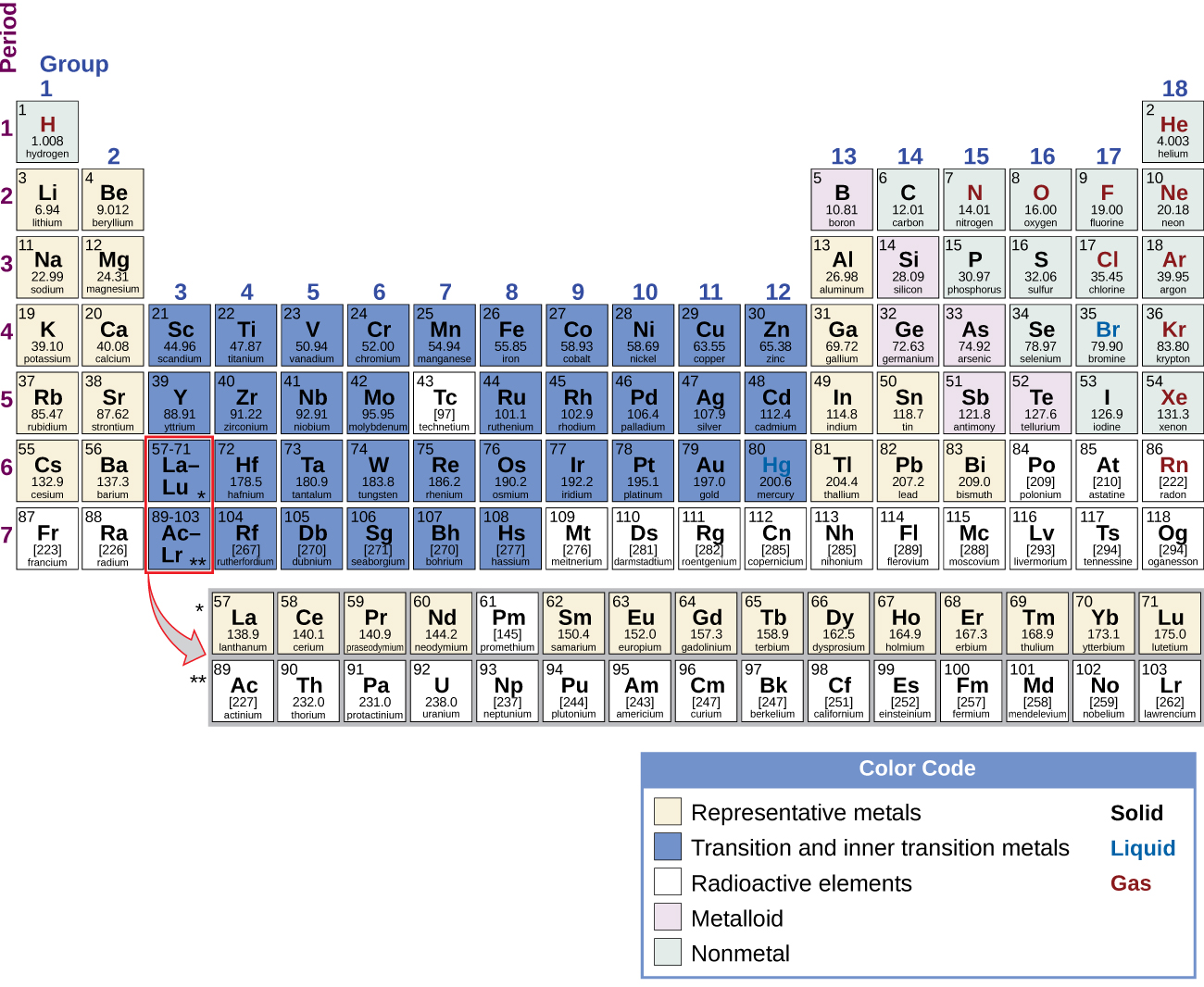
Figure 18.2図 18.2
The location of the representative metals is shown in the periodic table. Nonmetals are shown in green, metalloids in purple, and the transition metals and inner transition metals in blue.
周期表中の典型金属元素の位置を示す。非金属は緑色、半金属は紫色、遷移金属と内部遷移金属は青色で示されている。
Most of the representative metals do not occur naturally in an uncombined state because they readily react with water and oxygen in the air. However, it is possible to isolate elemental beryllium, magnesium, zinc, cadmium, mercury, aluminum, tin, and lead from their naturally occurring minerals and use them because they react very slowly with air. Part of the reason why these elements react slowly is that these elements react with air to form a protective coating. The formation of this protective coating is passivation. The coating is a nonreactive film of oxide or some other compound. Elemental magnesium, aluminum, zinc, and tin are important in the fabrication of many familiar items, including wire, cookware, foil, and many household and personal objects. Although beryllium, cadmium, mercury, and lead are readily available, there are limitations in their use because of their toxicity.
英語のヒント
典型金属元素の大部分は、水や空気中の酸素と容易に反応するため、化合していない状態では天然に存在しない。しかし、ベリリウム、マグネシウム、亜鉛、カドミウム、水銀、アルミニウム、スズ、鉛は空気と非常にゆっくり反応するので、天然の鉱物から単体として取り出して使うことができる。これらの元素の反応が遅い理由の一つは、空気と反応して保護被膜を形成することである。この保護被膜の形成を不動態化という。被膜は、酸化物などの化合物の反応性の低い薄膜である。単体のマグネシウム、アルミニウム、亜鉛、スズは、針金、調理器具、箔、および多くの家庭用品や身の回りの物品など、なじみのある多くのものの製造で重要である。ベリリウム、カドミウム、水銀、鉛は容易に入手できるが、毒性のため用途には制限がある。
Group 1: The Alkali Metals1族:アルカリ金属
The alkali metals lithium, sodium, potassium, rubidium, cesium, and francium constitute group 1 of the periodic table. Although hydrogen is in group 1 (and also in group 17), it is a nonmetal and deserves separate consideration later in this chapter. The name alkali metal is in reference to the fact that these metals and their oxides react with water to form very basic (alkaline) solutions.
英語のヒント
アルカリ金属のリチウム、ナトリウム、カリウム、ルビジウム、セシウム、フランシウムは、周期表の1族を構成する。水素も1族(および17族)にあるが、非金属であり、本章の後半で別に扱うのが適切である。アルカリ金属という名前は、これらの金属とその酸化物が水と反応して、強い塩基性(アルカリ性)の溶液を作ることに由来する。
The properties of the alkali metals are similar to each other as expected for elements in the same family. The alkali metals have the largest atomic radii and the lowest first ionization energy in their periods. This combination makes it very easy to remove the single electron in the outermost (valence) shell of each. The easy loss of this valence electron means that these metals readily form stable cations with a charge of 1+. Their reactivity increases with increasing atomic number due to the ease of losing the lone valence electron (decreasing ionization energy). Since oxidation is so easy, the reverse, reduction, is difficult, which explains why it is hard to isolate the elements. The solid alkali metals are very soft; lithium, shown in Figure 18.3, has the lowest density of any metal (0.5 g/cm3).
英語のヒント
同じ族の元素に予想されるように、アルカリ金属の性質は互いに似ている。アルカリ金属は、その周期で最大の原子半径と最も低い第一イオン化エネルギーを持つ。この組合せにより、それぞれの最外殻(価電子殻)の1個の電子を非常に容易に取り除ける。この価電子が失われやすいため、これらの金属は1+の電荷を持つ安定な陽イオンを容易に形成する。単独の価電子を失いやすくなること(イオン化エネルギーの低下)によって、反応性は原子番号の増加とともに高まる。酸化が非常に容易であるため、逆の還元は難しく、これが単体を取り出しにくい理由である。固体のアルカリ金属は非常に軟らかい。図18.3に示すリチウムは、すべての金属の中で最も密度が低い(0.5 g/cm3)。
The alkali metals all react vigorously with water to form hydrogen gas and a basic solution of the metal hydroxide. This means they are easier to oxidize than is hydrogen. As an example, the reaction of lithium with water is:
英語のヒント
アルカリ金属はすべて水と激しく反応し、水素ガスと金属水酸化物の塩基性溶液を作る。これは、水素よりも酸化されやすいことを意味する。一例として、リチウムと水の反応は次のとおりである。
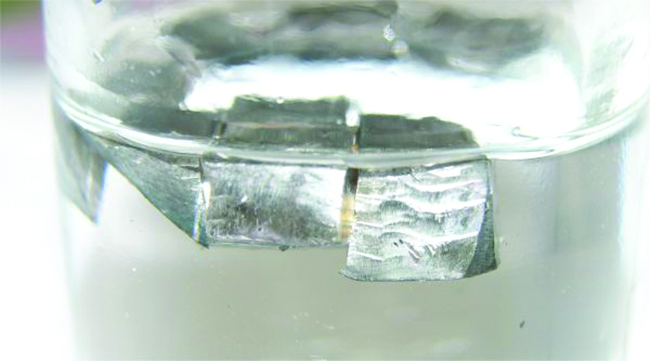
Figure 18.3図 18.3
Lithium floats in paraffin oil because its density is less than the density of paraffin oil.
リチウムの密度はパラフィン油の密度より低いため、パラフィン油に浮く。
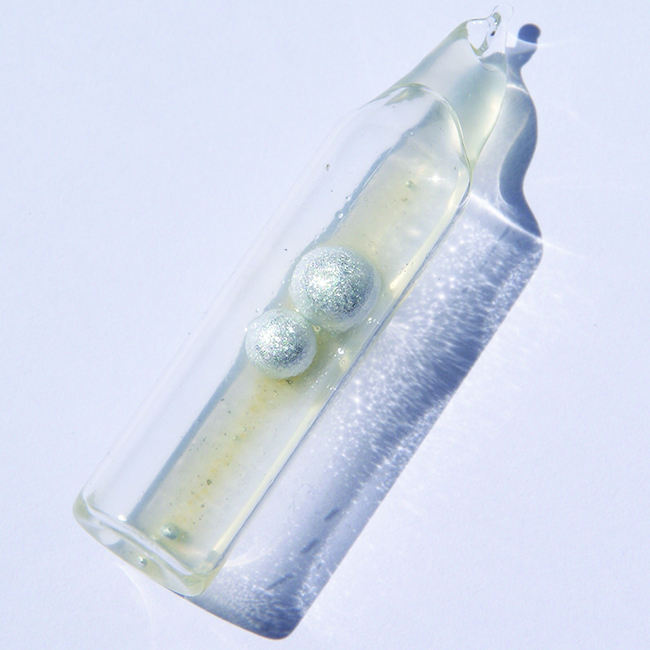
Alkali metals react directly with all the nonmetals (except the noble gases) to yield binary ionic compounds containing 1+ metal ions. These metals are so reactive that it is necessary to avoid contact with both moisture and oxygen in the air. Therefore, they are stored in sealed containers under mineral oil, as shown in Figure 18.4, to prevent contact with air and moisture. The pure metals never exist free (uncombined) in nature due to their high reactivity. In addition, this high reactivity makes it necessary to prepare the metals by electrolysis of alkali metal compounds.
英語のヒント
アルカリ金属は、希ガスを除くすべての非金属と直接反応し、1+の金属イオンを含む二元イオン化合物を作る。これらの金属は反応性が高いため、空気中の湿気と酸素の両方との接触を避ける必要がある。したがって、空気や湿気との接触を防ぐため、図18.4のように、密閉容器内で鉱油の下に保存する。反応性が高いので、純粋な金属が天然に遊離した(化合していない)状態で存在することはない。また、この高い反応性のため、アルカリ金属化合物の電気分解によって金属を製造する必要がある。
OpenStax, Rice University, Chemistry 2e. Original caption credit: (credit: http://images-of-elements.com/potassium.php) · CC BY 3.0 · Source出典
Figure 18.4図 18.4
To prevent contact with air and water, potassium for laboratory use comes as sticks or beads stored under kerosene or mineral oil, or in sealed containers. (credit: http://images-of-elements.com/potassium.php)
英語のヒント
空気や水との接触を防ぐため、実験室用のカリウムは、灯油や鉱油の下、または密閉容器内に保存された棒状や粒状の形で供給される。(出典:http://images-of-elements.com/potassium.php)
Unlike many other metals, the reactivity and softness of the alkali metals make these metals unsuitable for structural applications. However, there are applications where the reactivity of the alkali metals is an advantage. For example, the production of metals such as titanium and zirconium relies, in part, on the ability of sodium to reduce compounds of these metals. The manufacture of many organic compounds, including certain dyes, drugs, and perfumes, utilizes reduction by lithium or sodium.
英語のヒント
多くの他の金属とは異なり、アルカリ金属は反応性が高く軟らかいため、構造材料の用途には適さない。しかし、その反応性が利点になる用途もある。たとえば、チタンやジルコニウムなどの金属の製造は、ナトリウムがそれらの金属の化合物を還元できることに、部分的に依存している。ある種の染料、医薬品、香料を含む多くの有機化合物の製造では、リチウムまたはナトリウムによる還元を利用する。
Sodium and its compounds impart a bright yellow color to a flame, as seen in Figure 18.5. Passing an electrical discharge through sodium vapor also produces this color. In both cases, this is an example of an emission spectrum as discussed in the chapter on electronic structure. Streetlights sometime employ sodium vapor lights because the sodium vapor penetrates fog better than most other light. This is because the fog does not scatter yellow light as much as it scatters white light. The other alkali metals and their salts also impart color to a flame. Lithium creates a bright, crimson color, whereas the others create a pale, violet color.
英語のヒント
図18.5に見られるように、ナトリウムとその化合物は炎に明るい黄色を与える。ナトリウム蒸気に放電を通しても、この色が生じる。どちらも、電子構造の章で説明した発光スペクトルの例である。ナトリウム蒸気は他の大部分の光より霧をよく透過するため、街灯にはナトリウム蒸気灯が使われることがある。これは、霧による黄色光の散乱が、白色光の散乱ほど大きくないからである。他のアルカリ金属とその塩も、炎に色を与える。リチウムは鮮やかな深紅色を、他のものは淡い紫色を生じる。
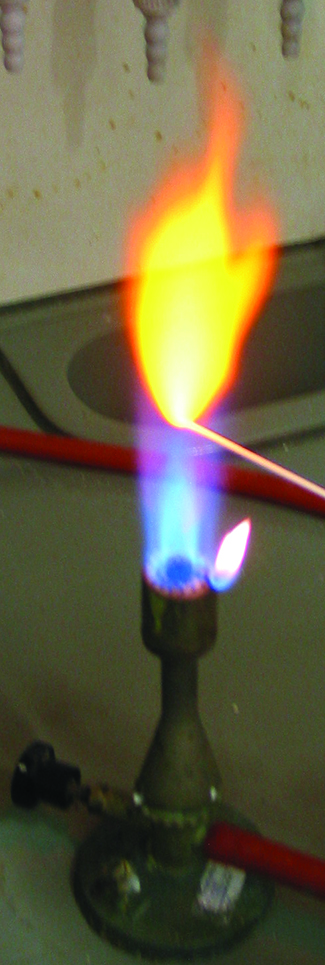


Figure 18.5図 18.5
Dipping a wire into a solution of a sodium salt and then heating the wire causes emission of a bright yellow light, characteristic of sodium.
針金をナトリウム塩の溶液に浸してから加熱すると、ナトリウムに特徴的な明るい黄色の光が放出される。