第18章典型元素の金属・半金属・非金属
Group 2: The Alkaline Earth Metals2族:アルカリ土類金属
The alkaline earth metals (beryllium, magnesium, calcium, strontium, barium, and radium) constitute group 2 of the periodic table. The name alkaline metal comes from the fact that the oxides of the heavier members of the group react with water to form alkaline solutions. The nuclear charge increases when going from group 1 to group 2. Because of this charge increase, the atoms of the alkaline earth metals are smaller and have higher first ionization energies than the alkali metals within the same period. The higher ionization energy makes the alkaline earth metals less reactive than the alkali metals; however, they are still very reactive elements. Their reactivity increases, as expected, with increasing size and decreasing ionization energy. In chemical reactions, these metals readily lose both valence electrons to form compounds in which they exhibit an oxidation state of 2+. Due to their high reactivity, it is common to produce the alkaline earth metals, like the alkali metals, by electrolysis. Even though the ionization energies are low, the two metals with the highest ionization energies (beryllium and magnesium) do form compounds that exhibit some covalent characters. Like the alkali metals, the heavier alkaline earth metals impart color to a flame. As in the case of the alkali metals, this is part of the emission spectrum of these elements. Calcium and strontium produce shades of red, whereas barium produces a green color.
英語のヒント
アルカリ土類金属(ベリリウム、マグネシウム、カルシウム、ストロンチウム、バリウム、ラジウム)は、周期表の2族を構成する。アルカリ金属という名前は、この族の重い元素の酸化物が水と反応してアルカリ性溶液を作ることに由来する。1族から2族へ移ると核電荷が増加する。この電荷の増加により、アルカリ土類金属の原子は、同じ周期のアルカリ金属より小さく、第一イオン化エネルギーは高い。イオン化エネルギーが高いため、アルカリ土類金属の反応性はアルカリ金属より低いが、それでも非常に反応性の高い元素である。予想どおり、原子の大きさが増し、イオン化エネルギーが低下するにつれて、反応性は高まる。化学反応では、これらの金属は二つの価電子をともに容易に失い、2+の酸化状態を示す化合物を形成する。反応性が高いため、アルカリ金属と同様、アルカリ土類金属も通常は電気分解で製造する。イオン化エネルギーは低いものの、その中で最もイオン化エネルギーが高い二つの金属(ベリリウムとマグネシウム)は、ある程度の共有結合性を示す化合物を確かに形成する。アルカリ金属と同様に、重いアルカリ土類金属は炎に色を与える。これは、アルカリ金属の場合と同じく、これらの元素の発光スペクトルの一部である。カルシウムとストロンチウムは色合いの異なる赤色を、バリウムは緑色を生じる。
Magnesium is a silver-white metal that is malleable and ductile at high temperatures. Passivation decreases the reactivity of magnesium metal. Upon exposure to air, a tightly adhering layer of magnesium oxycarbonate forms on the surface of the metal and inhibits further reaction. (The carbonate comes from the reaction of carbon dioxide in the atmosphere.) Magnesium is the lightest of the widely used structural metals, which is why most magnesium production is for lightweight alloys.
英語のヒント
マグネシウムは銀白色の金属で、高温では展性と延性を持つ。不動態化によって金属マグネシウムの反応性は低下する。空気にさらされると、金属表面に密着した酸化炭酸マグネシウムの層ができ、それ以上の反応を妨げる。(炭酸塩は、大気中の二酸化炭素との反応に由来する。)マグネシウムは広く使われる構造用金属の中で最も軽く、そのためマグネシウムの生産量の大部分は軽量合金に向けられる。
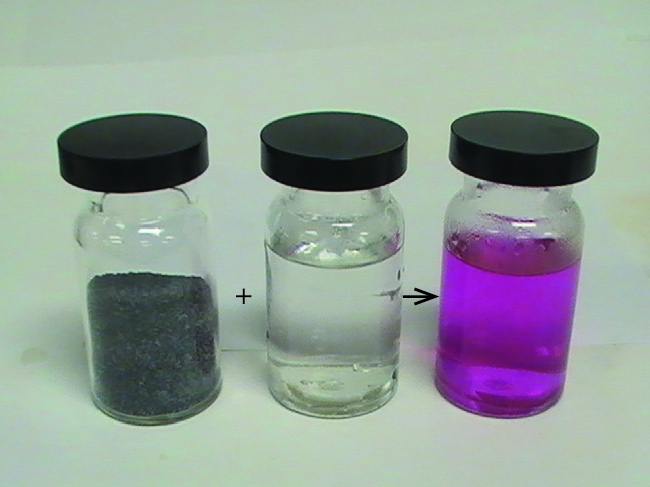
Magnesium (shown in Figure 18.6), calcium, strontium, and barium react with water and air. At room temperature, barium shows the most vigorous reaction. The products of the reaction with water are hydrogen and the metal hydroxide. The formation of hydrogen gas indicates that the heavier alkaline earth metals are better reducing agents (more easily oxidized) than is hydrogen. As expected, these metals react with both acids and nonmetals to form ionic compounds. Unlike most salts of the alkali metals, many of the common salts of the alkaline earth metals are insoluble in water because of the high lattice energies of these compounds, containing a divalent metal ion.
英語のヒント
マグネシウム(図18.6)、カルシウム、ストロンチウム、バリウムは、水や空気と反応する。室温では、バリウムが最も激しく反応する。水との反応の生成物は、水素と金属水酸化物である。水素ガスが生成することは、重いアルカリ土類金属が水素より強い還元剤(より酸化されやすい)であることを示す。予想どおり、これらの金属は酸とも非金属とも反応して、イオン化合物を作る。アルカリ金属の大部分の塩とは異なり、アルカリ土類金属の一般的な塩の多くは、2価の金属イオンを含む化合物の格子エネルギーが高いため、水に溶けない。
OpenStax, Rice University, Chemistry 2e. Original caption credit: (credit: modification of work by Sahar Atwa) · CC BY 4.0 · Source出典
Figure 18.6図 18.6
Magnesium metal (left jar) reacts slowly with hot water (center jar) to yield Mg2+ and OH- and a basic solution (right jar after adding phenolphthalein indicator). (credit: modification of work by Sahar Atwa)
金属マグネシウム(左の瓶)は熱水(中央の瓶)とゆっくり反応してMg2+とOH-を生じ、塩基性溶液になる(フェノールフタレイン指示薬を加えた後の右の瓶)。(出典:Sahar Atwaの作品を改変)
The potent reducing power of hot magnesium is useful in preparing some metals from their oxides. Indeed, magnesium’s affinity for oxygen is so great that burning magnesium reacts with carbon dioxide, producing elemental carbon:
英語のヒント
熱いマグネシウムの強い還元力は、ある種の金属をその酸化物から製造するのに役立つ。実際、マグネシウムの酸素への親和性は非常に大きく、燃焼中のマグネシウムは二酸化炭素と反応して、単体の炭素を生じる。
For this reason, a CO2 fire extinguisher will not extinguish a magnesium fire. Additionally, the brilliant white light emitted by burning magnesium makes it useful in flares and fireworks.
英語のヒント
このため、CO2消火器ではマグネシウム火災を消火できない。また、燃焼するマグネシウムが放出する鮮烈な白色光は、照明弾や花火に利用される。
Group 1212族
The elements in group 12 are transition elements; however, the last electron added is not a d electron, but an s electron. Since the last electron added is an s electron, these elements qualify as representative metals, or post-transition metals. The group 12 elements behave more like the alkaline earth metals than transition metals. Group 12 contains the four elements zinc, cadmium, mercury, and copernicium. Each of these elements has two electrons in its outer shell (ns2). When atoms of these metals form cations with a charge of 2+, where the two outer electrons are lost, they have pseudo-noble gas electron configurations. Mercury is sometimes an exception because it also exhibits an oxidation state of 1+ in compounds that contain a diatomic ion. In their elemental forms and in compounds, cadmium and mercury are both toxic.
英語のヒント
12族の元素は遷移元素だが、最後に加わる電子はd電子ではなくs電子である。最後の電子がs電子であるため、これらの元素は典型金属元素、または後遷移金属に該当する。12族元素の挙動は、遷移金属よりもアルカリ土類金属に似ている。12族には亜鉛、カドミウム、水銀、コペルニシウムの四元素がある。それぞれの最外殻には二つの電子(ns2)がある。これらの金属原子が外側の二つの電子を失って2+の陽イオンを形成すると、擬希ガス電子配置になる。水銀は、二原子から成るイオンを含む化合物で1+の酸化状態も示すため、例外になることがある。カドミウムと水銀は、単体でも化合物でも有毒である。
Zinc is the most reactive in group 12, and mercury is the least reactive. (This is the reverse of the reactivity trend of the metals of groups 1 and 2, in which reactivity increases down a group. The increase in reactivity with increasing atomic number only occurs for the metals in groups 1 and 2.) The decreasing reactivity is due to the formation of ions with a pseudo-noble gas configuration and to other factors that are beyond the scope of this discussion. The chemical behaviors of zinc and cadmium are quite similar to each other but differ from that of mercury.
12族では亜鉛が最も反応性が高く、水銀が最も低い。(これは、族を下るにつれて反応性が高まる1族・2族金属の傾向と逆である。原子番号の増加につれて反応性が高まるのは、1族と2族の金属だけである。)反応性の低下は、擬希ガス電子配置を持つイオンが形成されることと、この説明の範囲外の他の要因による。亜鉛とカドミウムの化学的挙動は互いによく似ているが、水銀の挙動とは異なる。
Zinc and cadmium have lower reduction potentials than hydrogen, and, like the alkali metals and alkaline earth metals, they will produce hydrogen gas when they react with acids. The reaction of zinc with hydrochloric acid, shown in Figure 18.7, is:
亜鉛とカドミウムの還元電位は水素より低く、アルカリ金属やアルカリ土類金属と同様、酸と反応すると水素ガスを生じる。図18.7に示す亜鉛と塩酸の反応は次のとおりである。
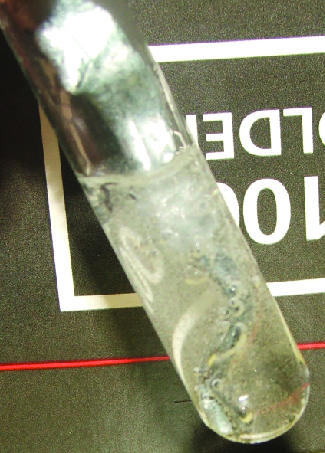


Figure 18.7図 18.7
Zinc is an active metal. It dissolves in hydrochloric acid, forming a solution of colorless Zn2+ ions, Cl– ions, and hydrogen gas.
亜鉛は活性な金属である。塩酸に溶け、無色のZn2+イオンとCl–イオンを含む溶液、および水素ガスを生成する。
Zinc is a silvery metal that quickly tarnishes to a blue-gray appearance. This change in color is due to an adherent coating of a basic carbonate, Zn2(OH)2CO3, which passivates the metal to inhibit further corrosion. Dry cell and alkaline batteries contain a zinc anode. Brass (Cu and Zn) and some bronze (Cu, Sn, and sometimes Zn) are important zinc alloys. About half of zinc production serves to protect iron and other metals from corrosion. This protection may take the form of a sacrificial anode (also known as a galvanic anode, which is a means of providing cathodic protection for various metals) or as a thin coating on the protected metal. Galvanized steel is steel with a protective coating of zinc.
英語のヒント
亜鉛は銀色の金属で、すぐに表面が変色して青灰色の外観になる。この色の変化は、密着した塩基性炭酸塩Zn2(OH)2CO3の被膜によるもので、被膜が金属を不動態化して、それ以上の腐食を抑える。乾電池とアルカリ電池は亜鉛アノードを含む。黄銅(CuとZn)および一部の青銅(Cu、Sn、ときにZn)は重要な亜鉛合金である。亜鉛の生産量の約半分は、鉄などの金属を腐食から保護するために使われる。この保護は、犠牲アノード(ガルバニアノードとも呼ばれ、さまざまな金属をカソード防食する手段)として、または保護する金属上の薄い被膜として行われる。亜鉛めっき鋼は、亜鉛の保護被膜を持つ鋼である。
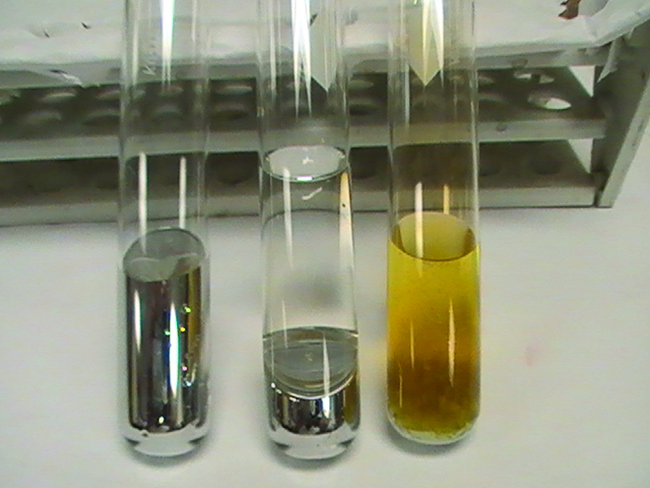
Mercury is very different from zinc and cadmium. Mercury is the only metal that is liquid at 25 °C. Many metals dissolve in mercury, forming solutions called amalgams (see the feature on Amalgams), which are alloys of mercury with one or more other metals. Mercury, shown in Figure 18.8, is a nonreactive element that is more difficult to oxidize than hydrogen. Thus, it does not displace hydrogen from acids; however, it will react with strong oxidizing acids, such as nitric acid:
英語のヒント
水銀は亜鉛やカドミウムと大きく異なる。水銀は25 °Cで液体である唯一の金属である。多くの金属は水銀に溶け、アマルガムという溶液を作る(「アマルガム」の特集を参照)。これは、水銀と一つ以上の他の金属との合金である。図18.8に示す水銀は反応性の低い元素で、水素より酸化されにくい。したがって、酸から水素を置き換えて放出させることはない。しかし、硝酸などの強い酸化力を持つ酸とは反応する。
The clear NO initially formed quickly undergoes further oxidation to the reddish brown NO2.
初めに生成する無色のNOは、すぐにさらに酸化されて赤褐色のNO2になる。
OpenStax, Rice University, Chemistry 2e. Original caption credit: (credit: Sahar Atwa) · CC BY 4.0 · Source出典

Figure 18.8図 18.8
From left to right: Hg(l), Hg + concentrated HCl, Hg + concentrated HNO3. (credit: Sahar Atwa)
左から右へ、Hg(l)、Hg + 濃HCl、Hg + 濃HNO3。(出典:Sahar Atwa)
Most mercury compounds decompose when heated. Most mercury compounds contain mercury with a 2+-oxidation state. When there is a large excess of mercury, it is possible to form compounds containing the ion. All mercury compounds are toxic, and it is necessary to exercise great care in their synthesis.
水銀化合物の大部分は加熱すると分解する。水銀化合物の大部分は、2+の酸化状態の水銀を含む。水銀が大過剰に存在すると、イオンを含む化合物を作ることができる。水銀化合物はすべて有毒であり、合成には細心の注意が必要である。