第18章典型元素の金属・半金属・非金属
18.7 Occurrence, Preparation, and Properties of Nitrogen18.7 窒素の存在・製法・性質
Learning Objectives学習目標
By the end of this section, you will be able to:
この節を学び終えると、次のことができるようになる。
- Describe the properties, preparation, and uses of nitrogen窒素の性質、製法、用途を説明する。
Most pure nitrogen comes from the fractional distillation of liquid air. The atmosphere consists of 78% nitrogen by volume. This means there are more than 20 million tons of nitrogen over every square mile of the earth’s surface. Nitrogen is a component of proteins and of the genetic material (DNA/RNA) of all plants and animals.
純粋な窒素の大部分は、液体空気の分留によって得られる。大気の78%は、体積比で窒素である。つまり、地表の1平方マイルごとに、その上空には2000万トンを超える窒素がある。窒素は、すべての動植物のタンパク質と遺伝物質(DNA/RNA)の構成要素である。
Under ordinary conditions, nitrogen is a colorless, odorless, and tasteless gas. It boils at 77 K and freezes at 63 K. Liquid nitrogen is a useful coolant because it is inexpensive and has a low boiling point. Nitrogen is very unreactive because of the very strong triple bond between the nitrogen atoms. The only common reactions at room temperature occur with lithium to form Li3N, with certain transition metal complexes, and with hydrogen or oxygen in nitrogen-fixing bacteria. The general lack of reactivity of nitrogen makes the remarkable ability of some bacteria to synthesize nitrogen compounds using atmospheric nitrogen gas as the source one of the most exciting chemical events on our planet. This process is one type of nitrogen fixation. In this case, nitrogen fixation is the process where organisms convert atmospheric nitrogen into biologically useful chemicals. Nitrogen fixation also occurs when lightning passes through air, causing molecular nitrogen to react with oxygen to form nitrogen oxides, which are then carried down to the soil.
英語のヒント
通常の条件では、窒素は無色、無臭、無味の気体である。77 Kで沸騰し、63 Kで凝固する。液体窒素は安価で沸点が低いため、有用な冷却剤である。窒素原子間の三重結合が非常に強いため、窒素は非常に反応しにくい。室温で起こる一般的な反応は、リチウムと反応してLi3Nを作る反応、特定の遷移金属錯体との反応、および窒素固定細菌の中での水素または酸素との反応だけである。窒素が全般的に反応性に乏しいため、大気中の窒素ガスを供給源として窒素化合物を合成する一部の細菌の驚くべき能力は、地球上で最も興味深い化学的出来事の一つといえる。この過程は、窒素固定の一種である。この場合の窒素固定とは、生物が大気中の窒素を、生物に有用な化学物質へ変える過程である。窒素固定は、雷が空気中を通る際にも起こる。これによって分子状窒素が酸素と反応し、窒素酸化物を作り、それが土壌へ運ばれる。
Large volumes of atmospheric nitrogen are necessary for making ammonia—the principal starting material used for preparation of large quantities of other nitrogen-containing compounds. Most other uses for elemental nitrogen depend on its inactivity. It is helpful when a chemical process requires an inert atmosphere. Canned foods and luncheon meats cannot oxidize in a pure nitrogen atmosphere, so they retain a better flavor and color, and spoil less rapidly, when sealed in nitrogen instead of air. This technology allows fresh produce to be available year-round, regardless of growing season.
英語のヒント
大量の他の含窒素化合物を調製するための主要な出発物質であるアンモニアを作るには、大量の大気中の窒素が必要となる。単体の窒素のその他の用途の大部分は、その不活性を利用している。化学的過程に不活性雰囲気が必要な場合に役立つ。缶詰食品やランチョンミートは、純粋な窒素雰囲気では酸化されないので、空気ではなく窒素中に密封すると、風味と色がよりよく保たれ、傷む速さも遅くなる。この技術により、生育期にかかわらず、生鮮農産物を一年中入手できる。
There are compounds with nitrogen in all of its oxidation states from 3− to 5+. Much of the chemistry of nitrogen involves oxidation-reduction reactions. Some active metals (such as alkali metals and alkaline earth metals) can reduce nitrogen to form metal nitrides. In the remainder of this section, we will examine nitrogen-oxygen chemistry.
窒素には、3−から5+までのすべての酸化状態の化合物がある。窒素の化学の多くは、酸化還元反応を伴う。一部の活性な金属(アルカリ金属やアルカリ土類金属など)は、窒素を還元して金属窒化物を作れる。この節の残りでは、窒素と酸素の化学を調べる。
There are well-characterized nitrogen oxides in which nitrogen exhibits each of its positive oxidation numbers from 1+ to 5+. When ammonium nitrate is carefully heated, nitrous oxide (dinitrogen oxide) and water vapor form. Stronger heating generates nitrogen gas, oxygen gas, and water vapor. No one should ever attempt this reaction—it can be very explosive. In 1947, there was a major ammonium nitrate explosion in Texas City, Texas, and, in 2013, there was another major explosion in West, Texas. In the last 100 years, there were nearly 30 similar disasters worldwide, resulting in the loss of numerous lives. In this oxidation-reduction reaction, the nitrogen in the nitrate ion oxidizes the nitrogen in the ammonium ion. Nitrous oxide, shown in Figure 18.33, is a colorless gas possessing a mild, pleasing odor and a sweet taste. It finds application as an anesthetic for minor operations, especially in dentistry, under the name “laughing gas.”
英語のヒント
窒素が1+から5+までの各正の酸化数を示す、性質がよく明らかにされた窒素酸化物がある。硝酸アンモニウムを注意深く加熱すると、亜酸化窒素(一酸化二窒素)と水蒸気が生じる。さらに強く加熱すると、窒素ガス、酸素ガス、水蒸気が生じる。この反応は非常に激しく爆発する可能性があるため、誰も決して試みてはならない。1947年にはテキサス州テキサスシティで硝酸アンモニウムの大爆発が起こり、2013年には同州ウエストでも別の大爆発が起こった。過去100年間に、世界では同様の災害が30件近く起こり、多くの命が失われた。この酸化還元反応では、硝酸イオン中の窒素が、アンモニウムイオン中の窒素を酸化する。図18.33に示す亜酸化窒素は、穏やかで心地よい臭いと甘い味を持つ、無色の気体である。「笑気ガス」という名前で、小規模な手術、特に歯科で麻酔薬として使われる。

Figure 18.33図 18.33
Nitrous oxide, N2O, is an anesthetic that has these molecular (left) and resonance (right) structures.
亜酸化窒素N2Oは、ここに示す分子構造(左)と共鳴構造(右)を持つ麻酔薬である。
Low yields of nitric oxide, NO, form when heating nitrogen and oxygen together. NO also forms when lightning passes through air during thunderstorms. Burning ammonia is the commercial method of preparing nitric oxide. In the laboratory, the reduction of nitric acid is the best method for preparing nitric oxide. When copper reacts with dilute nitric acid, nitric oxide is the principal reduction product:
窒素と酸素を一緒に加熱すると、低い収率で一酸化窒素NOが生じる。NOは、雷雨の際に雷が空気中を通るときにも生じる。工業的な一酸化窒素の製法は、アンモニアを燃焼させることである。実験室では、硝酸の還元が、一酸化窒素を調製する最良の方法である。銅が希硝酸と反応すると、一酸化窒素が主要な還元生成物となる。
Gaseous nitric oxide is the most thermally stable of the nitrogen oxides and is the simplest known thermally stable molecule with an unpaired electron. It is one of the air pollutants generated by internal combustion engines, resulting from the reaction of atmospheric nitrogen and oxygen during the combustion process.
英語のヒント
気体の一酸化窒素は、窒素酸化物の中で最も熱的に安定であり、不対電子を持つ、知られている中で最も単純な熱的に安定な分子である。内燃機関が生成する大気汚染物質の一つであり、燃焼過程で大気中の窒素と酸素が反応することによって生じる。
At room temperature, nitric oxide is a colorless gas consisting of diatomic molecules. As is often the case with molecules that contain an unpaired electron, two molecules combine to form a dimer by pairing their unpaired electrons to form a bond. Liquid and solid NO both contain N2O2 dimers, like that shown in Figure 18.34. Most substances with unpaired electrons exhibit color by absorbing visible light; however, NO is colorless because the absorption of light is not in the visible region of the spectrum.
英語のヒント
室温では、一酸化窒素は二原子分子からなる無色の気体である。不対電子を含む分子によく見られるように、二つの分子が、それぞれの不対電子を対にして結合を作り、二量体となる。液体と固体のNOは、どちらも図18.34のようなN2O2二量体を含む。不対電子を持つ物質の大部分は、可視光を吸収して色を示すが、NOは光の吸収がスペクトルの可視領域にないため、無色である。
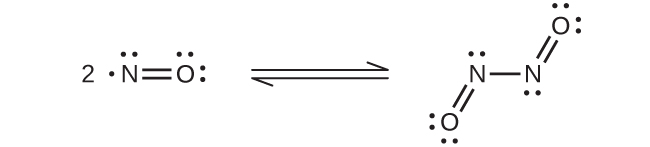
Figure 18.34図 18.34
This shows the equilibrium between NO and N2O2. The molecule, N2O2, absorbs light.
NOとN2O2との平衡を示している。N2O2分子は光を吸収する。
Cooling a mixture of equal parts nitric oxide and nitrogen dioxide to −21 °C produces dinitrogen trioxide, a blue liquid consisting of N2O3 molecules (shown in Figure 18.35). Dinitrogen trioxide exists only in the liquid and solid states. When heated, it reverts to a mixture of NO and NO2.
一酸化窒素と二酸化窒素を等量ずつ混合し、−21 °Cに冷やすと、N2O3分子(図18.35)からなる青色の液体、三酸化二窒素が生じる。三酸化二窒素は、液体と固体の状態でしか存在しない。加熱すると、NOとNO2の混合物に戻る。
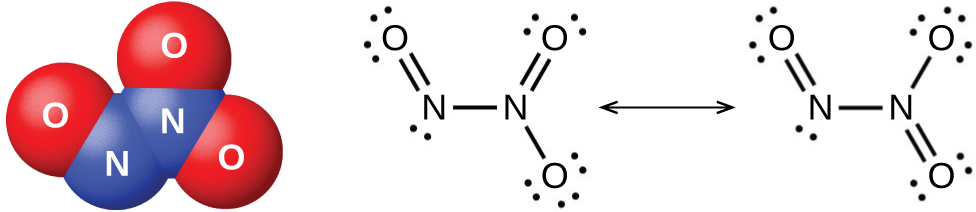
Figure 18.35図 18.35
Dinitrogen trioxide, N2O3, only exists in liquid or solid states and has these molecular (left) and resonance (right) structures.
三酸化二窒素N2O3は液体または固体の状態でしか存在せず、ここに示す分子構造(左)と共鳴構造(右)を持つ。
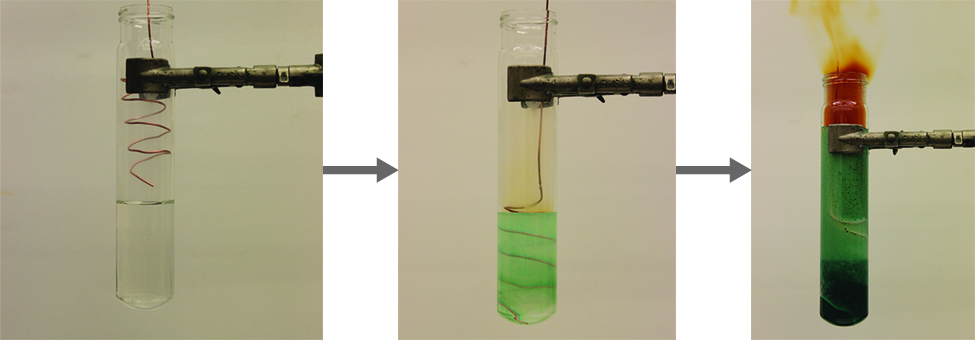
It is possible to prepare nitrogen dioxide in the laboratory by heating the nitrate of a heavy metal, or by the reduction of concentrated nitric acid with copper metal, as shown in Figure 18.36. Commercially, it is possible to prepare nitrogen dioxide by oxidizing nitric oxide with air.
実験室では、重金属の硝酸塩を加熱するか、図18.36に示すように、金属銅で濃硝酸を還元することによって、二酸化窒素を調製できる。工業的には、一酸化窒素を空気で酸化することによって、二酸化窒素を調製できる。
OpenStax, Rice University, Chemistry 2e. Original caption credit: (credit: modification of work by Mark Ott) · CC BY 4.0 · Source出典
Figure 18.36図 18.36
The reaction of copper metal with concentrated HNO3 produces a solution of Cu(NO3)2 and brown fumes of NO2. (credit: modification of work by Mark Ott)
金属銅と濃HNO3との反応によって、Cu(NO3)2の溶液と、NO2の褐色の煙が生じる。(クレジット:Mark Ottの作品を改変。)
The nitrogen dioxide molecule (illustrated in Figure 18.37) contains an unpaired electron, which is responsible for its color and paramagnetism. It is also responsible for the dimerization of NO2. At low pressures or at high temperatures, nitrogen dioxide has a deep brown color that is due to the presence of the NO2 molecule. At low temperatures, the color almost entirely disappears as dinitrogen tetraoxide, N2O4, forms. At room temperature, an equilibrium exists:
二酸化窒素分子(図18.37)は不対電子を含み、これが色と常磁性の原因となる。また、NO2の二量体化の原因でもある。低圧または高温では、二酸化窒素はNO2分子の存在によって濃い褐色を示す。低温では、四酸化二窒素N2O4ができるにつれて、色はほとんど完全に消える。室温では、次の平衡が存在する。
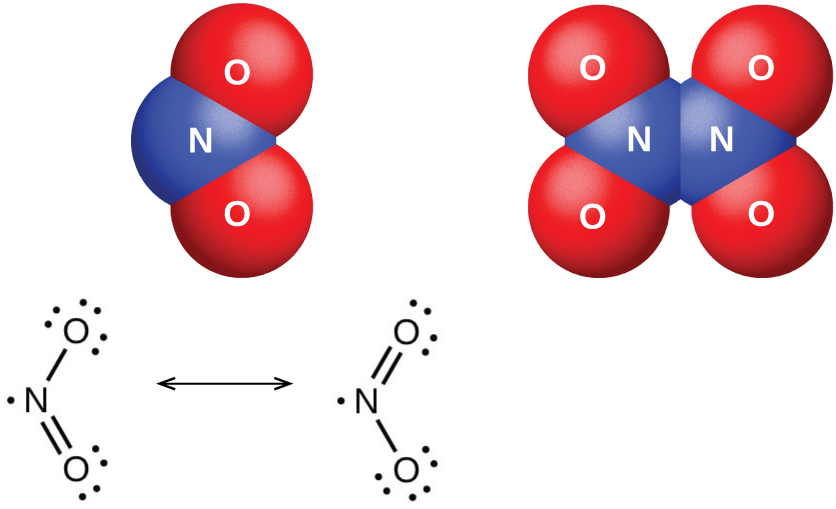
Figure 18.37図 18.37
The molecular and resonance structures for nitrogen dioxide (NO2, left) and dinitrogen tetraoxide (N2O4, right) are shown.
二酸化窒素(NO2、左)と四酸化二窒素(N2O4、右)の分子構造と共鳴構造を示している。
Dinitrogen pentaoxide, N2O5 (illustrated in Figure 18.38), is a white solid that is formed by the dehydration of nitric acid by phosphorus(V) oxide (tetraphosphorus decoxide):
五酸化二窒素N2O5(図18.38)は白色の固体であり、酸化リン(V)(十酸化四リン)によって硝酸を脱水すると生じる。
It is unstable above room temperature, decomposing to N2O4 and O2.
室温より高い温度では不安定で、N2O4とO2に分解する。
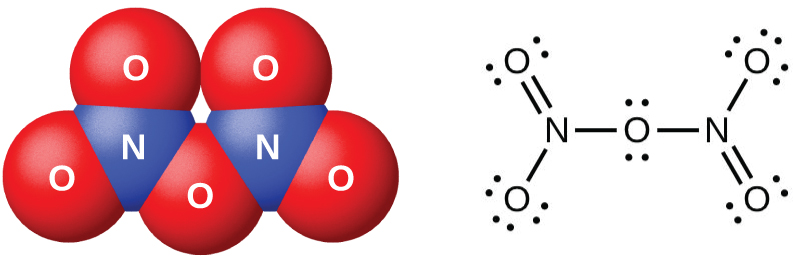


Figure 18.38図 18.38
This image shows the molecular structure and one resonance structure of a molecule of dinitrogen pentaoxide, N2O5.
この画像は、五酸化二窒素N2O5.の分子構造と、一つの共鳴構造を示している。
The oxides of nitrogen(III), nitrogen(IV), and nitrogen(V) react with water and form nitrogen-containing oxyacids. Nitrogen(III) oxide, N2O3, is the anhydride of nitrous acid; HNO2 forms when N2O3 reacts with water. There are no stable oxyacids containing nitrogen with an oxidation state of 4+; therefore, nitrogen(IV) oxide, NO2, disproportionates in one of two ways when it reacts with water. In cold water, a mixture of HNO2 and HNO3 forms. At higher temperatures, HNO3 and NO will form. Nitrogen(V) oxide, N2O5, is the anhydride of nitric acid; HNO3 is produced when N2O5 reacts with water:
窒素(III)、窒素(IV)、窒素(V)の酸化物は、水と反応して、窒素を含むオキソ酸を作る。酸化窒素(III)N2O3は亜硝酸の無水物であり、N2O3が水と反応するとHNO2が生じる。4+の酸化状態の窒素を含む安定なオキソ酸はないため、酸化窒素(IV)NO2は、水と反応すると二通りのいずれかで不均化する。冷水中では、HNO2とHNO3の混合物が生じる。より高い温度では、HNO3とNOが生じる。酸化窒素(V)N2O5は硝酸の無水物であり、N2O5が水と反応するとHNO3が生成する。
The nitrogen oxides exhibit extensive oxidation-reduction behavior. Nitrous oxide resembles oxygen in its behavior when heated with combustible substances. N2O is a strong oxidizing agent that decomposes when heated to form nitrogen and oxygen. Because one-third of the gas liberated is oxygen, nitrous oxide supports combustion better than air (one-fifth oxygen). A glowing splinter bursts into flame when thrust into a bottle of this gas. Nitric oxide acts both as an oxidizing agent and as a reducing agent. For example:
英語のヒント
窒素酸化物は、多様な酸化還元の挙動を示す。可燃性物質とともに加熱したとき、亜酸化窒素の挙動は酸素に似ている。N2Oは強い酸化剤であり、加熱すると分解して窒素と酸素を作る。放出される気体の三分の一が酸素であるため、亜酸化窒素は空気(五分の一が酸素)よりよく燃焼を支える。この気体を入れた瓶に赤くくすぶる木片を差し込むと、急に炎を上げる。一酸化窒素は、酸化剤としても還元剤としても働く。たとえば、
Nitrogen dioxide (or dinitrogen tetraoxide) is a good oxidizing agent. For example:
二酸化窒素(または四酸化二窒素)は、よい酸化剤である。たとえば、