第18章典型元素の金属・半金属・非金属
Halogen Oxyacids and Their Saltsハロゲンのオキソ酸とその塩
The compounds HXO, HXO2, HXO3, and HXO4, where X represents Cl, Br, or I, are the hypohalous, halous, halic, and perhalic acids, respectively. The strengths of these acids increase from the hypohalous acids, which are very weak acids, to the perhalic acids, which are very strong. Table 18.2 lists the known acids, and, where known, their pKa values are given in parentheses.
XがCl、Br、Iを表すとき、化合物HXO、HXO2、HXO3、HXO4は、それぞれ次ハロゲン酸、亜ハロゲン酸、ハロゲン酸、過ハロゲン酸である。これらの酸の強さは、非常に弱い次ハロゲン酸から、非常に強い過ハロゲン酸へと増す。表18.2は、知られている酸を挙げ、pKa値がわかっている場合には括弧内に示している。
Oxyacids of the Halogens ハロゲンのオキソ酸 |
||||
|---|---|---|---|---|
Name 名称 |
Fluorine フッ素 |
Chlorine 塩素 |
Bromine 臭素 |
Iodine ヨウ素 |
hypohalous 次ハロゲン酸 |
HOF |
HOCl (7.5) |
HOBr (8.7) |
HOI (11) |
halous 亜ハロゲン酸 |
HClO2 (2.0) |
|||
halic ハロゲン酸 |
HClO3 |
HBrO3 |
HIO3 (0.8) |
|
perhalic 過ハロゲン酸 |
HClO4 |
HBrO4 |
HIO4 (1.6) |
|
paraperhalic パラ過ハロゲン酸 |
H5IO6 (1.6) |
|||
The only known oxyacid of fluorine is the very unstable hypofluorous acid, HOF, which is prepared by the reaction of gaseous fluorine with ice:
知られているフッ素のオキソ酸は、非常に不安定な次亜フッ素酸HOFだけであり、気体のフッ素と氷との反応によって調製される。
The compound is very unstable and decomposes above −40 °C. This compound does not ionize in water, and there are no known salts. It is uncertain whether the name hypofluorous acid is even appropriate for HOF; a more appropriate name might be hydrogen hypofluorite.
この化合物は非常に不安定で、−40 °Cを超えると分解する。水中では電離せず、塩も知られていない。HOFに次亜フッ素酸という名前が適切なのかさえ不確かであり、次亜フッ素酸水素という名前のほうが適切かもしれない。
The reactions of chlorine and bromine with water are analogous to that of fluorine with ice, but these reactions do not go to completion, and mixtures of the halogen and the respective hypohalous and hydrohalic acids result. Other than HOF, the hypohalous acids only exist in solution. The hypohalous acids are all very weak acids; however, HOCl is a stronger acid than HOBr, which, in turn, is stronger than HOI.
英語のヒント
塩素と臭素の水との反応は、フッ素と氷との反応に似ているが、反応は完結せず、ハロゲンと、それぞれに対応する次ハロゲン酸およびハロゲン化水素酸の混合物が得られる。HOFを除き、次ハロゲン酸は溶液中にしか存在しない。次ハロゲン酸はすべて非常に弱い酸であるが、HOClはHOBrより強く、HOBrはさらにHOIより強い。
The addition of base to solutions of the hypohalous acids produces solutions of salts containing the basic hypohalite ions, OX−. It is possible to isolate these salts as solids. All of the hypohalites are unstable with respect to disproportionation in solution, but the reaction is slow for hypochlorite. Hypobromite and hypoiodite disproportionate rapidly, even in the cold:
次ハロゲン酸の溶液に塩基を加えると、塩基性の次ハロゲン酸イオンOX−を含む塩の溶液が生じる。これらの塩は、固体として単離できる。次ハロゲン酸塩はすべて、溶液中の不均化に対して不安定だが、次亜塩素酸塩では反応は遅い。次亜臭素酸塩と次亜ヨウ素酸塩は、低温でも速やかに不均化する。
Sodium hypochlorite is an inexpensive bleach (Clorox) and germicide. The commercial preparation involves the electrolysis of cold, dilute, aqueous sodium chloride solutions under conditions where the resulting chlorine and hydroxide ion can react. The net reaction is:
英語のヒント
次亜塩素酸ナトリウムは、安価な漂白剤(Clorox)であり殺菌剤である。商業的な調製では、生じた塩素と水酸化物イオンが反応できる条件で、低温の希薄な塩化ナトリウム水溶液を電気分解する。正味の反応は次のとおりである。
The only definitely known halous acid is chlorous acid, HClO2, obtained by the reaction of barium chlorite with dilute sulfuric acid:
確実に知られている亜ハロゲン酸は、亜塩素酸HClO2だけであり、亜塩素酸バリウムと希硫酸との反応によって得られる。
Filtering the insoluble barium sulfate leaves a solution of HClO2. Chlorous acid is not stable; it slowly decomposes in solution to yield chlorine dioxide, hydrochloric acid, and water. Chlorous acid reacts with bases to give salts containing the chlorite ion (shown in Figure 18.55). Sodium chlorite finds an extensive application in the bleaching of paper because it is a strong oxidizing agent and does not damage the paper.
不溶性の硫酸バリウムをろ過すると、HClO2溶液が残る。亜塩素酸は安定ではなく、溶液中でゆっくり分解して、二酸化塩素、塩酸、水を生じる。亜塩素酸は塩基と反応し、亜塩素酸イオン(図18.55)を含む塩を作る。亜塩素酸ナトリウムは、強い酸化剤でありながら紙を傷めないため、紙の漂白に広く用いられる。
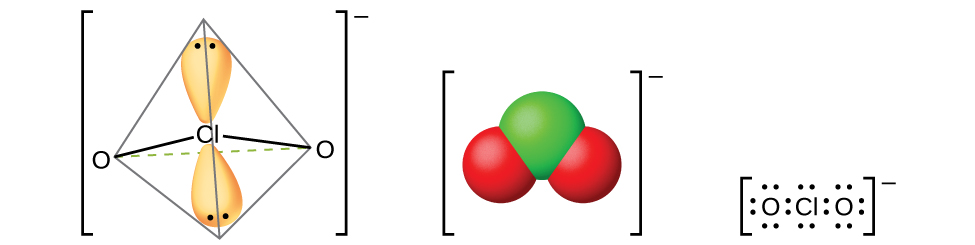
Figure 18.55図 18.55
Chlorite ions, are produced when chlorous acid reacts with bases.
亜塩素酸が塩基と反応すると、亜塩素酸イオンが生じる。
Chloric acid, HClO3, and bromic acid, HBrO3, are stable only in solution. The reaction of iodine with concentrated nitric acid produces stable white iodic acid, HIO3:
塩素酸HClO3と臭素酸HBrO3は、溶液中でしか安定ではない。ヨウ素と濃硝酸との反応によって、安定な白色のヨウ素酸HIO3が生じる。
It is possible to obtain the lighter halic acids from their barium salts by reaction with dilute sulfuric acid. The reaction is analogous to that used to prepare chlorous acid. All of the halic acids are strong acids and very active oxidizing agents. The acids react with bases to form salts containing chlorate ions (shown in Figure 18.56). Another preparative method is the electrochemical oxidation of a hot solution of a metal halide to form the appropriate metal chlorates. Sodium chlorate is a weed killer; potassium chlorate is used as an oxidizing agent.
より軽いハロゲン酸は、バリウム塩と希硫酸との反応によって得られる。この反応は、亜塩素酸の調製に使うものと類似している。ハロゲン酸はすべて強酸であり、非常に活性な酸化剤である。これらの酸は塩基と反応し、塩素酸イオン(図18.56)を含む塩を作る。別の製法は、金属ハロゲン化物の高温溶液を電気化学的に酸化し、対応する金属塩素酸塩を作ることである。塩素酸ナトリウムは除草剤であり、塩素酸カリウムは酸化剤として用いられる。
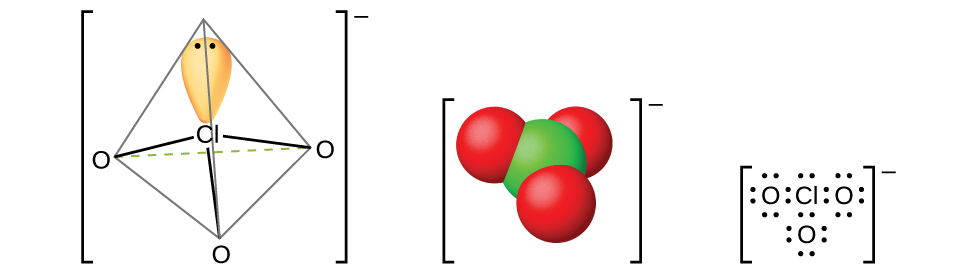
Figure 18.56図 18.56
Chlorate ions, are produced when halic acids react with bases.
ハロゲン酸が塩基と反応すると、塩素酸イオンが生じる。
Perchloric acid, HClO4, forms when treating a perchlorate, such as potassium perchlorate, with sulfuric acid under reduced pressure. The HClO4 can be distilled from the mixture:
過塩素酸HClO4は、過塩素酸カリウムなどの過塩素酸塩を、減圧下で硫酸処理すると生じる。混合物からHClO4を蒸留できる。
Dilute aqueous solutions of perchloric acid are quite stable thermally, but concentrations above 60% are unstable and dangerous. Perchloric acid and its salts are powerful oxidizing agents, as the very electronegative chlorine is more stable in a lower oxidation state than 7+. Serious explosions have occurred when heating concentrated solutions with easily oxidized substances. However, its reactions as an oxidizing agent are slow when perchloric acid is cold and dilute. The acid is among the strongest of all acids. Most salts containing the perchlorate ion (shown in Figure 18.57) are soluble. It is possible to prepare them from reactions of bases with perchloric acid and, commercially, by the electrolysis of hot solutions of their chlorides.
過塩素酸の希薄な水溶液は、熱的にかなり安定だが、60%を超える濃度では不安定で危険である。電気陰性度が非常に高い塩素は、7+より低い酸化状態のほうが安定であるため、過塩素酸とその塩は強力な酸化剤である。濃厚な溶液を酸化されやすい物質とともに加熱して、重大な爆発が起きたことがある。しかし、過塩素酸が低温で希薄なときには、酸化剤としての反応は遅い。この酸は、あらゆる酸の中でも最も強いものの一つである。過塩素酸イオン(図18.57)を含む塩の大部分は可溶性である。塩基と過塩素酸との反応により、また、工業的には対応する塩化物の高温溶液を電気分解することによって、調製できる。
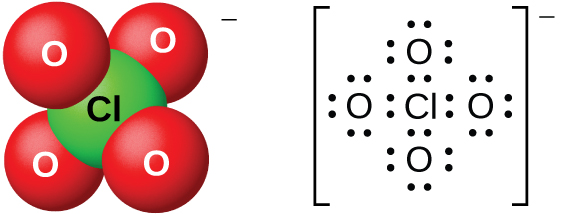


Figure 18.57図 18.57
Perchlorate ions, can be produced when perchloric acid reacts with a base or by electrolysis of hot solutions of their chlorides.
過塩素酸イオンは、過塩素酸と塩基との反応、または対応する塩化物の高温溶液の電気分解によって生成できる。
Perbromate salts are difficult to prepare, and the best syntheses currently involve the oxidation of bromates in basic solution with fluorine gas followed by acidification. There are few, if any, commercial uses of this acid or its salts.
英語のヒント
過臭素酸塩は調製が難しく、現在の最良の合成法では、塩基性溶液中で臭素酸塩をフッ素ガスによって酸化し、続いて酸性にする。この酸やその塩の商業的な用途は、あるとしてもごくわずかである。
There are several different acids containing iodine in the 7+-oxidation state; they include metaperiodic acid, HIO4, and paraperiodic acid, H5IO6. These acids are strong oxidizing agents and react with bases to form the appropriate salts.
7+の酸化状態のヨウ素を含む酸は、いくつか異なるものがある。メタ過ヨウ素酸HIO4や、パラ過ヨウ素酸H5IO6が含まれる。これらの酸は強い酸化剤であり、塩基と反応して対応する塩を作る。