第18章典型元素の金属・半金属・非金属
Nonmetal Oxygen Compounds非金属と酸素の化合物
Most nonmetals react with oxygen to form nonmetal oxides. Depending on the available oxidation states for the element, a variety of oxides might form. Fluorine will combine with oxygen to form fluorides such as OF2, where the oxygen has a 2+-oxidation state.
非金属の大部分は酸素と反応し、非金属酸化物を作る。その元素がとりうる酸化状態に応じて、さまざまな酸化物ができる可能性がある。フッ素は酸素と結合し、OF2などのフッ化物を作り、その中では酸素の酸化状態は2+である。
Sulfur Oxygen Compounds硫黄と酸素の化合物
The two common oxides of sulfur are sulfur dioxide, SO2, and sulfur trioxide, SO3. The odor of burning sulfur comes from sulfur dioxide. Sulfur dioxide, shown in Figure 18.47, occurs in volcanic gases and in the atmosphere near industrial plants that burn fuel containing sulfur compounds.
硫黄の一般的な二つの酸化物は、二酸化硫黄SO2と三酸化硫黄SO3である。硫黄が燃えるときの臭いは、二酸化硫黄による。図18.47に示す二酸化硫黄は、火山ガスや、硫黄化合物を含む燃料を燃やす工場付近の大気中に存在する。

Figure 18.47図 18.47
This image shows the molecular structure (left) and resonance forms (right) of sulfur dioxide.
この画像は、二酸化硫黄の分子構造(左)と共鳴形(右)を示している。
Commercial production of sulfur dioxide is from either burning sulfur or roasting sulfide ores such as ZnS, FeS2, and Cu2S in air. (Roasting, which forms the metal oxide, is the first step in the separation of many metals from their ores.) A convenient method for preparing sulfur dioxide in the laboratory is by the action of a strong acid on either sulfite salts containing the ion or hydrogen sulfite salts containing Sulfurous acid, H2SO3, forms first, but quickly decomposes into sulfur dioxide and water. Sulfur dioxide also forms when many reducing agents react with hot, concentrated sulfuric acid. Sulfur trioxide forms slowly when heating sulfur dioxide and oxygen together, and the reaction is exothermic:
英語のヒント
二酸化硫黄の商業的生産は、硫黄を燃焼させるか、ZnS、FeS2、Cu2Sなどの硫化鉱を空気中で焙焼することによって行われる。(金属酸化物を作る焙焼は、多くの金属を鉱石から分離する際の最初の段階である。)実験室で二酸化硫黄を調製する便利な方法は、イオンを含む亜硫酸塩、またはを含む亜硫酸水素塩に、強酸を作用させることである。最初に亜硫酸H2SO3が生じるが、すぐに二酸化硫黄と水に分解する。多くの還元剤が高温の濃硫酸と反応した場合にも、二酸化硫黄が生じる。二酸化硫黄と酸素を一緒に加熱すると、三酸化硫黄がゆっくり生じ、この反応は発熱的である。
Sulfur dioxide is a gas at room temperature, and the SO2 molecule is bent. Sulfur trioxide melts at 17 °C and boils at 43 °C. In the vapor state, its molecules are single SO3 units (shown in Figure 18.48), but in the solid state, SO3 exists in several polymeric forms.
二酸化硫黄は室温で気体であり、SO2分子は折れ線形である。三酸化硫黄は17 °Cで融解し、43 °Cで沸騰する。蒸気の状態では、その分子は個々のSO3単位(図18.48)であるが、固体の状態では、SO3はいくつかの高分子の形で存在する。
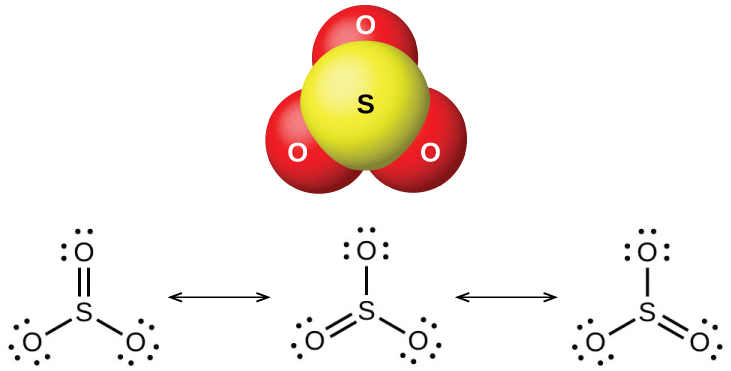
Figure 18.48図 18.48
This image shows the structure (top) of sulfur trioxide in the gas phase and its resonance forms (bottom).
この画像は、気相の三酸化硫黄の構造(上)と、その共鳴形(下)を示している。
The sulfur oxides react as Lewis acids with many oxides and hydroxides in Lewis acid-base reactions, with the formation of sulfites or hydrogen sulfites, and sulfates or hydrogen sulfates, respectively.
硫黄酸化物は、多くの酸化物や水酸化物とのルイス酸塩基反応で、ルイス酸として反応し、それぞれ、亜硫酸塩または亜硫酸水素塩、および硫酸塩または硫酸水素塩を形成する。
Halogen Oxygen Compoundsハロゲンと酸素の化合物
The halogens do not react directly with oxygen, but it is possible to prepare binary oxygen-halogen compounds by the reactions of the halogens with oxygen-containing compounds. Oxygen compounds with chlorine, bromine, and iodine are oxides because oxygen is the more electronegative element in these compounds. On the other hand, fluorine compounds with oxygen are fluorides because fluorine is the more electronegative element.
ハロゲンは酸素と直接反応しないが、ハロゲンと酸素を含む化合物との反応によって、酸素とハロゲンの二元化合物を調製できる。塩素、臭素、ヨウ素と酸素との化合物は、酸素のほうが電気陰性度の高い元素であるため、酸化物となる。一方、フッ素と酸素との化合物は、フッ素のほうが電気陰性度の高い元素であるため、フッ化物となる。
As a class, the oxides are extremely reactive and unstable, and their chemistry has little practical importance. Dichlorine oxide, formally called dichlorine monoxide, and chlorine dioxide, both shown in Figure 18.49, are the only commercially important compounds. They are important as bleaching agents (for use with pulp and flour) and for water treatment.
英語のヒント
この酸化物群は、全般に極めて反応性が高く不安定であり、その化学には実用上の重要性はほとんどない。正式には一酸化二塩素と呼ばれる酸化二塩素と、二酸化塩素だけが、商業的に重要な化合物である。どちらも図18.49に示している。これらは、漂白剤(パルプや小麦粉用)として、また水処理に重要である。
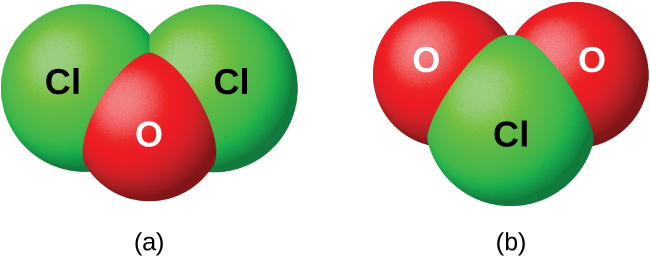
Figure 18.49図 18.49
This image shows the structures of the (a) Cl2O and (b) ClO2 molecules.
この画像は、(a) Cl2O分子と(b) ClO2分子の構造を示している。
Nonmetal Oxyacids and Their Salts非金属のオキソ酸とその塩
Nonmetal oxides form acids when allowed to react with water; these are acid anhydrides. The resulting oxyanions can form salts with various metal ions.
非金属酸化物は水と反応すると酸を作り、酸無水物である。生じたオキソ陰イオンは、さまざまな金属イオンと塩を作ることができる。
Nitrogen Oxyacids and Salts窒素のオキソ酸と塩
Nitrogen pentaoxide, N2O5, and NO2 react with water to form nitric acid, HNO3. Alchemists, as early as the eighth century, knew nitric acid (shown in Figure 18.50) as aqua fortis (meaning "strong water"). The acid was useful in the separation of gold from silver because it dissolves silver but not gold. Traces of nitric acid occur in the atmosphere after thunderstorms, and its salts are widely distributed in nature. There are tremendous deposits of Chile saltpeter, NaNO3, in the desert region near the boundary of Chile and Peru. Bengal saltpeter, KNO3, occurs in India and in other countries of the Far East.
英語のヒント
五酸化二窒素N2O5とNO2は、水と反応して硝酸HNO3を作る。錬金術師は、早くも8世紀には、硝酸(図18.50)をaqua fortis(「強い水」の意味)として知っていた。硝酸は銀を溶かすが金を溶かさないため、銀から金を分離するのに役立った。雷雨の後の大気中には微量の硝酸が存在し、その塩は自然界に広く分布している。チリとペルーの国境付近の砂漠地域には、チリ硝石NaNO3の巨大な鉱床がある。ベンガル硝石KNO3は、インドや極東の他の国々に存在する。
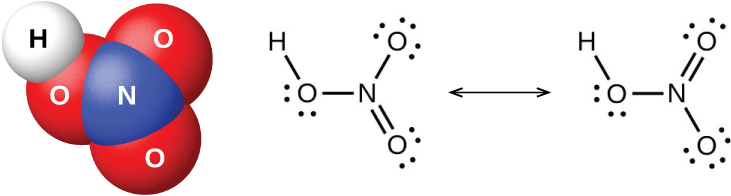
Figure 18.50図 18.50
This image shows the molecular structure (left) of nitric acid, HNO3 and its resonance forms (right).
この画像は、硝酸HNO3の分子構造(左)と共鳴形(右)を示している。
In the laboratory, it is possible to produce nitric acid by heating a nitrate salt (such as sodium or potassium nitrate) with concentrated sulfuric acid:
実験室では、硝酸塩(硝酸ナトリウムや硝酸カリウムなど)を濃硫酸とともに加熱することで、硝酸を生成できる。
The Ostwald process is the commercial method for producing nitric acid. This process involves the oxidation of ammonia to nitric oxide, NO; oxidation of nitric oxide to nitrogen dioxide, NO2; and further oxidation and hydration of nitrogen dioxide to form nitric acid:
オストワルト法は、硝酸を生産する商業的な方法である。この過程では、アンモニアを一酸化窒素NOへ酸化し、一酸化窒素を二酸化窒素NO2へ酸化し、さらに二酸化窒素を酸化・水和して硝酸を作る。
Or
または
Pure nitric acid is a colorless liquid. However, it is often yellow or brown in color because NO2 forms as the acid decomposes. Nitric acid is stable in aqueous solution; solutions containing 68% of the acid are commercially available concentrated nitric acid. It is both a strong oxidizing agent and a strong acid.
純粋な硝酸は無色の液体である。しかし、酸の分解に伴ってNO2が生じるため、黄色や褐色であることが多い。硝酸は水溶液中で安定であり、酸を68%含む溶液が、市販の濃硝酸である。強い酸化剤でも、強酸でもある。
The action of nitric acid on a metal rarely produces H2 (by reduction of H+) in more than small amounts. Instead, the reduction of nitrogen occurs. The products formed depend on the concentration of the acid, the activity of the metal, and the temperature. Normally, a mixture of nitrates, nitrogen oxides, and various reduction products form. Less active metals such as copper, silver, and lead reduce concentrated nitric acid primarily to nitrogen dioxide. The reaction of dilute nitric acid with copper produces NO. In each case, the nitrate salts of the metals crystallize upon evaporation of the resultant solutions.
金属への硝酸の作用で、H+の還元によるH2が少量を超えて生成することはまれである。代わりに、窒素が還元される。生成物は、酸の濃度、金属の活性、温度によって決まる。通常は、硝酸塩、窒素酸化物、さまざまな還元生成物の混合物が生じる。銅、銀、鉛などの活性の低い金属は、濃硝酸を主として二酸化窒素に還元する。希硝酸と銅との反応では、NOが生じる。いずれの場合も、得られた溶液を蒸発させると、金属の硝酸塩が結晶化する。
Nonmetallic elements, such as sulfur, carbon, iodine, and phosphorus, undergo oxidation by concentrated nitric acid to their oxides or oxyacids, with the formation of NO2:
硫黄、炭素、ヨウ素、リンなどの非金属元素は、濃硝酸によって酸化物またはオキソ酸へ酸化され、NO2が生じる。
Nitric acid oxidizes many compounds; for example, concentrated nitric acid readily oxidizes hydrochloric acid to chlorine and chlorine dioxide. A mixture of one part concentrated nitric acid and three parts concentrated hydrochloric acid (called aqua regia, which means royal water) reacts vigorously with metals. This mixture is particularly useful in dissolving gold, platinum, and other metals that are more difficult to oxidize than hydrogen. A simplified equation to represent the action of aqua regia on gold is:
英語のヒント
硝酸は多くの化合物を酸化する。たとえば、濃硝酸は塩酸を容易に酸化して、塩素と二酸化塩素にする。濃硝酸1部と濃塩酸3部の混合物(「王の水」を意味するaqua regia、すなわち王水と呼ばれる)は、金属と激しく反応する。この混合物は、金、白金、その他の水素より酸化しにくい金属を溶かすのに特に有用である。王水が金に作用する様子を表す簡略化した反応式は、次のとおりである。
Nitrates, salts of nitric acid, form when metals, oxides, hydroxides, or carbonates react with nitric acid. Most nitrates are soluble in water; indeed, one of the significant uses of nitric acid is to prepare soluble metal nitrates.
硝酸の塩である硝酸塩は、金属、酸化物、水酸化物、または炭酸塩が硝酸と反応すると生じる。硝酸塩の大部分は水に溶ける。実際、硝酸の重要な用途の一つは、可溶性の金属硝酸塩を調製することである。
Nitric acid finds extensive use in the laboratory and in chemical industries as a strong acid and strong oxidizing agent. It is important in the manufacture of explosives, dyes, plastics, and drugs. Salts of nitric acid (nitrates) are valuable as fertilizers. Gunpowder is a mixture of potassium nitrate, sulfur, and charcoal.
硝酸は、強酸および強い酸化剤として、実験室や化学工業で広く使われる。爆薬、染料、プラスチック、医薬品の製造に重要である。硝酸の塩(硝酸塩)は、肥料として価値がある。火薬は、硝酸カリウム、硫黄、木炭の混合物である。
The reaction of N2O3 with water gives a pale blue solution of nitrous acid, HNO2. However, HNO2 (shown in Figure 18.51) is easier to prepare by the addition of an acid to a solution of nitrite; nitrous acid is a weak acid, so the nitrite ion is basic in aqueous solution:
N2O3と水との反応によって、亜硝酸HNO2の淡青色の溶液が得られる。しかし、HNO2(図18.51)は、亜硝酸塩溶液に酸を加えるほうが簡単に調製できる。亜硝酸は弱酸なので、亜硝酸イオンは水溶液中で塩基性を示す。
Nitrous acid is very unstable and exists only in solution. It disproportionates slowly at room temperature (rapidly when heated) into nitric acid and nitric oxide. Nitrous acid is an active oxidizing agent with strong reducing agents, and strong oxidizing agents oxidize it to nitric acid.
亜硝酸は非常に不安定で、溶液中にしか存在しない。室温ではゆっくりと(加熱すると速やかに)不均化し、硝酸と一酸化窒素になる。亜硝酸は、強い還元剤に対しては活性な酸化剤として働き、強い酸化剤によっては硝酸へ酸化される。
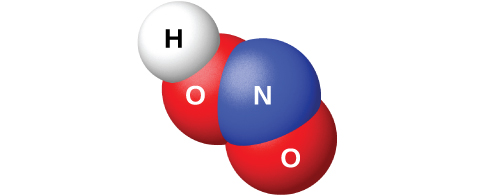


Figure 18.51図 18.51
This image shows the molecular structure of a molecule of nitrous acid, HNO2.
この画像は、亜硝酸HNO2の分子構造を示している。
Sodium nitrite, NaNO2, is an additive to meats such as hot dogs and cold cuts. The nitrite ion has two functions. It limits the growth of bacteria that can cause food poisoning, and it prolongs the meat’s retention of its red color. The addition of sodium nitrite to meat products is controversial because nitrous acid reacts with certain organic compounds to form a class of compounds known as nitrosamines. Nitrosamines produce cancer in laboratory animals. This has prompted the FDA to limit the amount of NaNO2 in foods.
英語のヒント
亜硝酸ナトリウムNaNO2は、ホットドッグやコールドカットなどの食肉に添加される。亜硝酸イオンには二つの働きがある。食中毒を起こしうる細菌の増殖を抑え、肉の赤い色が保たれる期間を延ばす。亜硝酸は特定の有機化合物と反応して、ニトロソアミンとして知られる化合物群を形成するため、食肉製品への亜硝酸ナトリウムの添加には議論がある。ニトロソアミンは、実験動物にがんを生じさせる。このため、FDAは食品中のNaNO2の量を制限するようになった。
The nitrites are much more stable than the acid, but nitrites, like nitrates, can explode. Nitrites, like nitrates, are also soluble in water (AgNO2 is only slightly soluble).
亜硝酸塩は酸よりはるかに安定だが、硝酸塩と同様に爆発することがある。また、亜硝酸塩は硝酸塩と同様に水に溶ける(AgNO2はわずかしか溶けない)。