第18章典型元素の金属・半金属・非金属
18.8 Occurrence, Preparation, and Properties of Phosphorus18.8 リンの存在・製法・性質
Learning Objectives学習目標
By the end of this section, you will be able to:
この節を学び終えると、次のことができるようになる。
- Describe the properties, preparation, and uses of phosphorusリンの性質、製法、用途を説明する。
The industrial preparation of phosphorus is by heating calcium phosphate, obtained from phosphate rock, with sand and coke:
リンの工業的な調製は、リン鉱石から得たリン酸カルシウムを、砂およびコークスとともに加熱することによって行われる。
The phosphorus distills out of the furnace and is condensed into a solid or burned to form P4O10. The preparation of many other phosphorus compounds begins with P4O10. The acids and phosphates are useful as fertilizers and in the chemical industry. Other uses are in the manufacture of special alloys such as ferrophosphorus and phosphor bronze. Phosphorus is important in making pesticides, matches, and some plastics. Phosphorus is an active nonmetal. In compounds, phosphorus usually occurs in oxidation states of 3−, 3+, and 5+. Phosphorus exhibits oxidation numbers that are unusual for a group 15 element in compounds that contain phosphorus-phosphorus bonds; examples include diphosphorus tetrahydride, H2P-PH2, and tetraphosphorus trisulfide, P4S3, illustrated in Figure 18.39.
英語のヒント
リンは炉から留出し、凝縮させて固体にするか、燃焼させてP4O10にする。多くの他のリン化合物の調製は、P4O10から始まる。酸とリン酸塩は、肥料や化学工業で有用である。他の用途として、フェロリンやリン青銅などの特殊合金の製造がある。リンは、農薬、マッチ、一部のプラスチックの製造に重要である。リンは活性な非金属である。化合物中では、通常、3−、3+、5+の酸化状態をとる。リン・リン結合を含む化合物では、15族元素としては珍しい酸化数を示す。例として、四水素化二リンH2P-PH2と、図18.39に示す三硫化四リンP4S3がある。
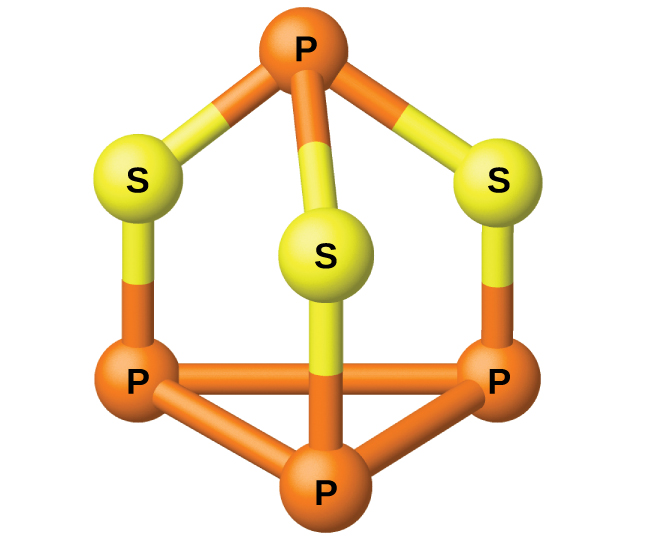
Figure 18.39図 18.39
P4S3 is a component of the heads of strike-anywhere matches.
英語のヒント
P4S3は、どこで擦っても着火するマッチの頭部の成分である。
Phosphorus Oxygen Compoundsリンと酸素の化合物
Phosphorus forms two common oxides, phosphorus(III) oxide (or tetraphosphorus hexaoxide), P4O6, and phosphorus(V) oxide (or tetraphosphorus decaoxide), P4O10, both shown in Figure 18.40. Phosphorus(III) oxide is a white crystalline solid with a garlic-like odor. Its vapor is very poisonous. It oxidizes slowly in air and inflames when heated to 70 °C, forming P4O10. Phosphorus(III) oxide dissolves slowly in cold water to form phosphorous acid, H3PO3.
リンは二つの一般的な酸化物、酸化リン(III)(六酸化四リン)P4O6と、酸化リン(V)(十酸化四リン)P4O10を作る。どちらも図18.40に示している。酸化リン(III)は、ニンニクのような臭いを持つ白い結晶性固体である。その蒸気は非常に有毒である。空気中でゆっくり酸化し、70 °Cに加熱すると発火してP4O10を作る。酸化リン(III)は冷水にゆっくり溶け、亜リン酸H3PO3を作る。
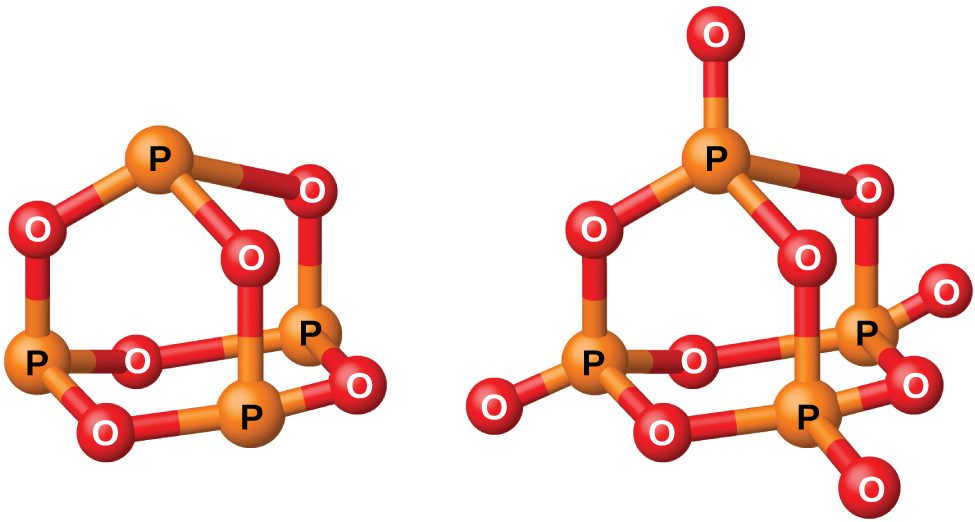
Figure 18.40図 18.40
This image shows the molecular structures of P4O6 (left) and P4O10 (right).
この画像は、P4O6(左)とP4O10(右)の分子構造を示している。
Phosphorus(V) oxide, P4O10, is a white powder that is prepared by burning phosphorus in excess oxygen. Its enthalpy of formation is very high (−2984 kJ), and it is quite stable and a very poor oxidizing agent. Dropping P4O10 into water produces a hissing sound, heat, and orthophosphoric acid:
酸化リン(V)P4O10は、過剰の酸素中でリンを燃焼させて調製する白い粉末である。生成エンタルピーは非常に高く(−2984 kJ)、かなり安定で、酸化剤としては非常に弱い。P4O10を水に落とすと、シューという音、熱、オルトリン酸が生じる。
Because of its great affinity for water, phosphorus(V) oxide is an excellent drying agent for gases and solvents, and for removing water from many compounds.
英語のヒント
酸化リン(V)は水との親和性が非常に高いため、気体や溶媒の乾燥、および多くの化合物からの水の除去に優れた乾燥剤である。
Phosphorus Halogen Compoundsリンとハロゲンの化合物
Phosphorus will react directly with the halogens, forming trihalides, PX3, and pentahalides, PX5. The trihalides are much more stable than the corresponding nitrogen trihalides; nitrogen pentahalides do not form because of nitrogen’s inability to form more than four bonds.
英語のヒント
リンはハロゲンと直接反応し、三ハロゲン化物PX3と五ハロゲン化物PX5を作る。三ハロゲン化物は、対応する窒素の三ハロゲン化物よりはるかに安定である。窒素は四つを超える結合を作れないため、窒素の五ハロゲン化物は形成されない。
The chlorides PCl3 and PCl5, both shown in Figure 18.41, are the most important halides of phosphorus. Phosphorus trichloride is a colorless liquid that is prepared by passing chlorine over molten phosphorus. Phosphorus pentachloride is an off-white solid that is prepared by oxidizing the trichloride with excess chlorine. The pentachloride sublimes when warmed and forms an equilibrium with the trichloride and chlorine when heated.
英語のヒント
図18.41に示す二つの塩化物PCl3とPCl5は、リンの最も重要なハロゲン化物である。三塩化リンは、溶融したリンに塩素を通して調製する、無色の液体である。五塩化リンは、三塩化物を過剰の塩素で酸化して調製する、ややくすんだ白色の固体である。五塩化物は温めると昇華し、加熱すると三塩化物および塩素との平衡を作る。
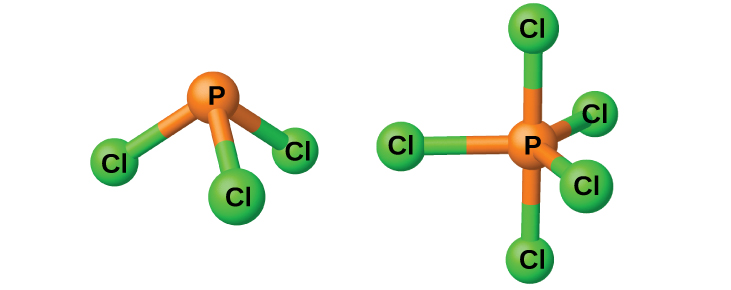
Figure 18.41図 18.41
This image shows the molecular structure of PCl3 (left) and PCl5 (right) in the gas phase.
この画像は、気相のPCl3(左)とPCl5(右)の分子構造を示している。
Like most other nonmetal halides, both phosphorus chlorides react with an excess of water and yield hydrogen chloride and an oxyacid: PCl3 yields phosphorous acid H3PO3 and PCl5 yields phosphoric acid, H3PO4.
他の非金属ハロゲン化物の大部分と同様に、リンの両塩化物は過剰の水と反応し、塩化水素とオキソ酸を生じる。PCl3は亜リン酸H3PO3を、PCl5はリン酸H3PO4を生じる。
The pentahalides of phosphorus are Lewis acids because of the empty valence d orbitals of phosphorus. These compounds readily react with halide ions (Lewis bases) to give the anion Whereas phosphorus pentafluoride is a molecular compound in all states, X-ray studies show that solid phosphorus pentachloride is an ionic compound, as are phosphorus pentabromide, [Br−], and phosphorus pentaiodide, [I−].
リンの五ハロゲン化物は、リンの空の価電子d軌道のため、ルイス酸となる。これらの化合物はハロゲン化物イオン(ルイス塩基)と容易に反応し、陰イオンを生じる。五フッ化リンはすべての状態で分子性化合物であるが、X線による研究から、固体の五塩化リンはイオン性化合物であることがわかる。五臭化リン[Br−]と五ヨウ化リン[I−]も同様である。
Key Concepts and Summary重要概念とまとめ
Phosphorus (group 15) commonly exhibits oxidation states of 3− with active metals and of 3+ and 5+ with more electronegative nonmetals. The halogens and oxygen will oxidize phosphorus. The oxides are phosphorus(V) oxide, P4O10, and phosphorus(III) oxide, P4O6. The two common methods for preparing orthophosphoric acid, H3PO4, are either the reaction of a phosphate with sulfuric acid or the reaction of water with phosphorus(V) oxide. Orthophosphoric acid is a triprotic acid that forms three types of salts.
リン(15族)は一般に、活性な金属との間では3−、より電気陰性度の高い非金属との間では3+と5+の酸化状態を示す。ハロゲンと酸素はリンを酸化する。酸化物には、酸化リン(V)P4O10と酸化リン(III)P4O6がある。オルトリン酸H3PO4を調製する二つの一般的な方法は、リン酸塩と硫酸との反応、および水と酸化リン(V)との反応である。オルトリン酸は三価酸であり、三種類の塩を作る。
Chemistry End of Chapter Exercises章末問題
Exercises 67–78練習問題 67–78
Exercise 67問題 67
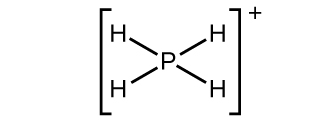
Write the Lewis structure for each of the following. You may wish to review the chapter on chemical bonding and molecular geometry.
次のそれぞれのルイス構造を書きなさい。化学結合と分子の形の章を復習するとよい。
(a) PH3
(a) PH3
(b)
(b)
(c) P2H4
(c) P2H4
(d)
(d)
(e) PF5
(e) PF5
Solution解き方
(a)
(a)

(b)
(b)
(c)
(c)
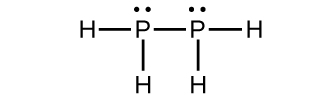
(d)
(d)
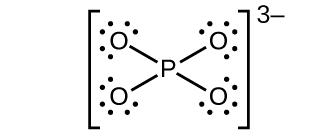
(e)
(e)
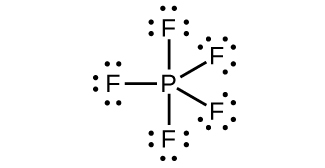
Exercise 68問題 68
Describe the molecular structure of each of the following molecules or ions listed. You may wish to review the chapter on chemical bonding and molecular geometry.
次に挙げる各分子またはイオンの分子構造を説明しなさい。化学結合と分子の形の章を復習するとよい。
(a) PH3
(a) PH3
(b)
(b)
(c) P2H4
(c) P2H4
(d)
(d)
Exercise 69問題 69
Complete and balance each of the following chemical equations. (In some cases, there may be more than one correct answer.)
次の各化学反応式を完成させ、係数を整えなさい。(正しい答えが一つとは限らない場合もある。)
(a)
(a)
(b)
(b)
(c)
(c)
(d)
(d)
(e)
(e)
(f)
(f)
Solution解き方
(a) (b) (c) (d) or (e) or (f)
(a) (b) (c) (d) または (e) または (f)
Exercise 70問題 70
Describe the hybridization of phosphorus in each of the following compounds: P4O10, P4O6, PH4I (an ionic compound), PBr3, H3PO4, H3PO3, PH3, and P2H4. You may wish to review the chapter on advanced theories of covalent bonding.
次の各化合物におけるリンの混成を説明しなさい。P4O10、P4O6、PH4I(イオン性化合物)、PBr3、H3PO4、H3PO3、PH3、P2H4。共有結合の発展的理論の章を復習するとよい。
Exercise 71問題 71
What volume of 0.200 M NaOH is necessary to neutralize the solution produced by dissolving 2.00 g of PCl3 is an excess of water? Note that when H3PO3 is titrated under these conditions, only one proton of the acid molecule reacts.
2.00 gのPCl3を過剰の水に溶かして得られる溶液を中和するには、0.200 MのNaOHがどれだけの体積必要か。この条件でH3PO3を滴定すると、酸分子のプロトンは一個だけ反応することに注意しなさい。
Solution解き方
291 mL
291 mL
Exercise 72問題 72
How much POCl3 can form from 25.0 g of PCl5 and the appropriate amount of H2O?
25.0 gのPCl5と適切な量のH2Oから、どれだけのPOCl3を作ることができるか。
Exercise 73問題 73
How many tons of Ca3(PO4)2 are necessary to prepare 5.0 tons of phosphorus if the yield is 90%?
収率が90%のとき、5.0トンのリンを調製するには、何トンのCa3(PO4)2が必要か。
Solution解き方
28 tons
28トン
Exercise 74問題 74
Write equations showing the stepwise ionization of phosphorous acid.
亜リン酸の段階的な電離を示す式を書きなさい。
Exercise 75問題 75
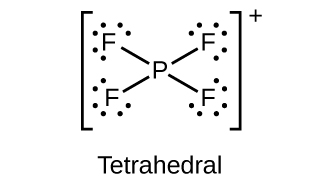
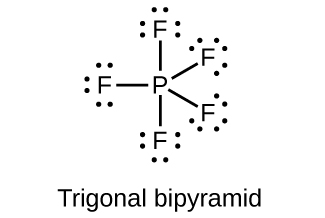
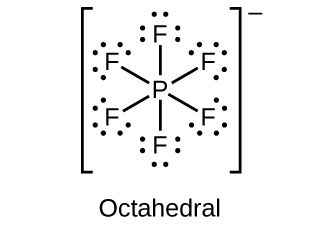
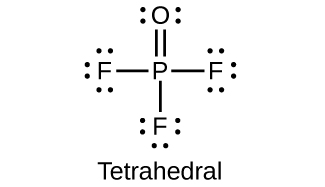
Draw the Lewis structures and describe the geometry for the following:
次について、ルイス構造を描き、形を説明しなさい。
(a)
(a)
(b) PF5
(b) PF5
(c)
(c)
(d) POF3
(d) POF3


Exercise 76問題 76
Why does phosphorous acid form only two series of salts, even though the molecule contains three hydrogen atoms?
亜リン酸の分子は三個の水素原子を含むのに、二系列の塩しか作らないのはなぜか。
Exercise 77問題 77
Assign an oxidation state to phosphorus in each of the following:
次のそれぞれについて、リンの酸化状態を割り当てなさい。
(a) NaH2PO3
(a) NaH2PO3
(b) PF5
(b) PF5
(c) P4O6
(c) P4O6
(d) K3PO4
(d) K3PO4
(e) Na3P
(e) Na3P
(f) Na4P2O7
(f) Na4P2O7
Solution解き方
(a) P = 3+; (b) P = 5+; (c) P = 3+; (d) P = 5+; (e) P = 3−; (f) P = 5+
(a) P = 3+。(b) P = 5+。(c) P = 3+。(d) P = 5+。(e) P = 3−。(f) P = 5+。
Exercise 78問題 78
Phosphoric acid, one of the acids used in some cola drinks, is produced by the reaction of phosphorus(V) oxide, an acidic oxide, with water. Phosphorus(V) oxide is prepared by the combustion of phosphorus.
一部のコーラ飲料に使われる酸の一つであるリン酸は、酸性酸化物である酸化リン(V)と水との反応によって生成される。酸化リン(V)は、リンの燃焼によって調製される。
(a) Write the empirical formula of phosphorus(V) oxide.
(a) 酸化リン(V)の組成式を書きなさい。
(b) What is the molecular formula of phosphorus(V) oxide if the molar mass is about 280.
(b) モル質量が約280である場合、酸化リン(V)の分子式は何か。
(c) Write balanced equations for the production of phosphorus(V) oxide and phosphoric acid.
(c) 酸化リン(V)とリン酸の生成について、係数を整えた反応式を書きなさい。
(d) Determine the mass of phosphorus required to make 1.00 104 kg of phosphoric acid, assuming a yield of 98.85%.
(d) 収率を98.85%と仮定して、1.00 104 kgのリン酸を作るために必要なリンの質量を求めなさい。