第18章典型元素の金属・半金属・非金属
Group 1414族
The metallic members of group 14 are tin, lead, and flerovium. Carbon is a typical nonmetal. The remaining elements of the group, silicon and germanium, are examples of semimetals or metalloids. Tin and lead form the stable divalent cations, Sn2+ and Pb2+, with oxidation states two below the group oxidation state of 4+. The stability of this oxidation state is a consequence of the inert pair effect. Tin and lead also form covalent compounds with a formal 4+-oxidation state. For example, SnCl4 and PbCl4 are low-boiling covalent liquids.
英語のヒント
14族の金属元素は、スズ、鉛、フレロビウムである。炭素は典型的な非金属である。この族の残りの元素、ケイ素とゲルマニウムは、半金属の例である。スズと鉛は、その族の酸化状態4+より2小さい酸化状態を持つ、安定な2価陽イオンSn2+とPb2+を形成する。この酸化状態の安定性は、不活性電子対効果の結果である。スズと鉛は、形式的な酸化状態4+を持つ共有結合性の化合物も形成する。たとえば、SnCl4とPbCl4は、低沸点の共有結合性液体である。
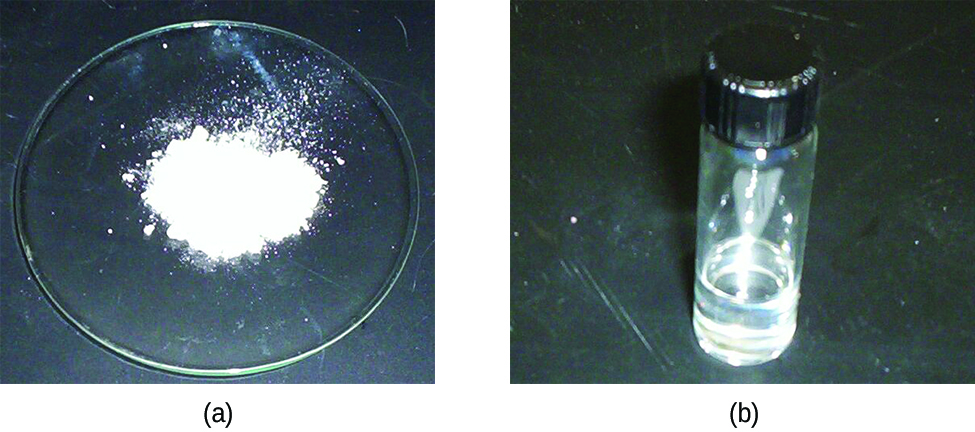

Figure 18.9図 18.9
(a) Tin(II) chloride is an ionic solid; (b) tin(IV) chloride is a covalent liquid.
(a) 塩化スズ(II)はイオン性固体である。(b) 塩化スズ(IV)は共有結合性液体である。
Tin reacts readily with nonmetals and acids to form tin(II) compounds (indicating that it is more easily oxidized than hydrogen) and with nonmetals to form either tin(II) or tin(IV) compounds (shown in Figure 18.9), depending on the stoichiometry and reaction conditions. Lead is less reactive. It is only slightly easier to oxidize than hydrogen, and oxidation normally requires a hot concentrated acid.
スズは、非金属や酸と容易に反応してスズ(II)化合物を作る(水素より酸化されやすいことを示す)。また、非金属とは、化学量論と反応条件に応じて、スズ(II)またはスズ(IV)の化合物を作る(図18.9)。鉛は反応性が低い。水素よりわずかに酸化されやすいだけで、酸化には通常、熱い濃酸が必要である。
Many of these elements exist as allotropes. Allotropes are two or more forms of the same element in the same physical state with different chemical and physical properties. There are two common allotropes of tin. These allotropes are grey (brittle) tin and white tin. As with other allotropes, the difference between these forms of tin is in the arrangement of the atoms. White tin is stable above 13.2 °C and is malleable like other metals. At low temperatures, gray tin is the more stable form. Gray tin is brittle and tends to break down to a powder. Consequently, articles made of tin will disintegrate in cold weather, particularly if the cold spell is lengthy. The change progresses slowly from the spot of origin, and the gray tin that is first formed catalyzes further change. In a way, this effect is similar to the spread of an infection in a plant or animal body, leading people to call this process tin disease or tin pest.
英語のヒント
これらの元素の多くは、同素体として存在する。同素体は、同じ物理的状態にある同じ元素の二つ以上の形態で、化学的・物理的性質が異なる。スズには一般的な同素体が二つあり、灰色スズ(もろい)と白色スズである。他の同素体と同様、これらのスズの形態の違いは原子の配列にある。白色スズは13.2 °Cを超えると安定で、他の金属と同様に展性を持つ。低温では、灰色スズのほうが安定な形態である。灰色スズはもろく、粉末に崩れやすい。その結果、スズ製の物品は寒い天候で、特に寒い期間が長い場合に崩壊する。変化は発生点からゆっくり進行し、最初に形成された灰色スズが、その後の変化を触媒する。ある意味で、この効果は植物や動物の体内で感染が広がるのに似ており、そのため人々はこの過程をスズ病、またはスズペストと呼ぶ。
The principal use of tin is in the coating of steel to form tin plate-sheet iron, which constitutes the tin in tin cans. Important tin alloys are bronze (Cu and Sn) and solder (Sn and Pb). Lead is important in the lead storage batteries in automobiles.
英語のヒント
スズの主な用途は、鋼を被覆して、缶に使われるスズめっき鉄板を作ることである。重要なスズ合金には、青銅(CuとSn)とはんだ(SnとPb)がある。鉛は、自動車の鉛蓄電池で重要である。
Group 1515族
Bismuth, the heaviest member of group 15, is a less reactive metal than the other representative metals. It readily gives up three of its five valence electrons to active nonmetals to form the tri-positive ion, Bi3+. It forms compounds with the group oxidation state of 5+ only when treated with strong oxidizing agents. The stability of the 3+-oxidation state is another example of the inert pair effect.
英語のヒント
15族で最も重い元素であるビスマスは、他の典型金属元素より反応性の低い金属である。5個の価電子のうち3個を、活性な非金属に容易に与え、3価の陽イオンBi3+を作る。強い酸化剤で処理したときだけ、その族の酸化状態5+を持つ化合物を形成する。3+の酸化状態の安定性は、不活性電子対効果のもう一つの例である。
Key Concepts and Summary重要概念とまとめ
This section focuses on the periodicity of the representative elements. These are the elements where the electrons are entering the s and p orbitals. The representative elements occur in groups 1, 2, and 12–18. These elements are representative metals, metalloids, and nonmetals. The alkali metals (group 1) are very reactive, readily form ions with a charge of 1+ to form ionic compounds that are usually soluble in water, and react vigorously with water to form hydrogen gas and a basic solution of the metal hydroxide. The outermost electrons of the alkaline earth metals (group 2) are more difficult to remove than the outer electron of the alkali metals, leading to the group 2 metals being less reactive than those in group 1. These elements easily form compounds in which the metals exhibit an oxidation state of 2+. Zinc, cadmium, and mercury (group 12) commonly exhibit the group oxidation state of 2+ (although mercury also exhibits an oxidation state of 1+ in compounds that contain Aluminum, gallium, indium, and thallium (group 13) are easier to oxidize than is hydrogen. Aluminum, gallium, and indium occur with an oxidation state 3+ (however, thallium also commonly occurs as the Tl+ ion). Tin and lead form stable divalent cations and covalent compounds in which the metals exhibit the 4+-oxidation state.
この節では典型元素の周期性に焦点を当てた。これらは電子がs軌道とp軌道に入っていく元素で、1族、2族、12~18族に位置する。典型元素には、典型金属元素、半金属、非金属がある。アルカリ金属(1族)は非常に反応性が高く、容易に1+のイオンを作り、通常は水に溶けるイオン化合物を形成する。また、水と激しく反応して、水素ガスと金属水酸化物の塩基性溶液を作る。アルカリ土類金属(2族)の最外殻電子は、アルカリ金属の最外殻電子より取り除きにくいため、2族金属の反応性は1族より低い。これらの元素は、金属が2+の酸化状態を示す化合物を容易に形成する。亜鉛、カドミウム、水銀(12族)は通常、その族の酸化状態2+を示す(水銀はを含む化合物では1+の酸化状態も示す)。アルミニウム、ガリウム、インジウム、タリウム(13族)は、水素より酸化されやすい。アルミニウム、ガリウム、インジウムは3+の酸化状態で存在する(ただし、タリウムはTl+イオンとしてもよく存在する)。スズと鉛は、安定な2価陽イオンと、金属が4+の酸化状態を示す共有結合性化合物を形成する。