第14章冷戦期の紛争Cold War Conflicts
Introductionはじめに
Mao Zedong.毛沢東
Figure 14.1 This 1967 artist’s rendering of Mao Zedong greeting a cheering Chinese public during the Cultural Revolution shows loyal party members following him and holding the Little Red Book that contained his most popular sayings. (credit: modification of work “[1967-11] 1967 Oil Painting of Mao Zedong reviewing the Red Guards” by China Pictorial 1967/Wikimedia Commons, Public Domain)
図14.1 文化大革命中の毛沢東が歓声を上げる中国の民衆に応える姿を描いた、1967年の絵画。忠実な党員たちが、毛の代表的な言葉を集めた『毛主席語録』(小さな赤い本)を持って後に続いている。(出典:China Pictorial 1967「[1967-11] 1967 Oil Painting of Mao Zedong reviewing the Red Guards」を改変/Wikimedia Commons、パブリックドメイン)
In the period following World War II, leaders like Joseph Stalin and Nikita Khrushchev of the Soviet Union and Mao Zedong of China (Figure 14.1) believed communism would light the way to a bright new future for humankind. The United States, the United Kingdom, and other Western countries regarded communism as a threat to freedom, instead placing their faith in capitalism and democracy to improve human life. The ideological differences between these two groups of countries, and the global-scale struggle between the Soviet Union and the United States for social, economic, technological, and military supremacy, divided the world into mutually hostile spheres in the half-century following the war. Their antagonism played out in a real but bloodless conflict known as the Cold War.
英語のヒント
第二次世界大戦後、ソ連のヨシフ・スターリンやニキータ・フルシチョフ、中国の毛沢東(図14.1)らの指導者は、共産主義が人類の明るい未来への道を照らすと信じた。アメリカ、イギリスなどの西側諸国は共産主義を自由への脅威と捉え、人々の暮らしを良くするものとして、資本主義と民主主義に期待を寄せた。この二つの陣営の思想的な隔たり、そして社会・経済・技術・軍事の優位を争う米ソの世界規模の対立によって、戦後の半世紀、世界は互いに敵対する勢力圏に分かれた。この対抗関係は、「冷戦」と呼ばれる、実在しながら流血を伴わない紛争として展開した。
Timeline: Cold War Conflicts.年表:冷戦期の紛争
Figure 14.2 (credit “1947: Civil War breaks out in Greece”: modification of work “1946-Greece-pro-royal-poster” by www.booksjournal.gr/Wikimedia Commons, Public Domain; credit “1948: Israel founded”: modification of work “Declaration of State of Israel 1948” by Israel Ministry of Foreign Affairs/Wikimedia Commons, Public Domain; credit “June 1948”: modification of work “Berliners watching a C-54 land at Berlin Tempelhof Airport, 1948” by Henry Reis/U.S. Air Force/Wikimedia Commons, Public Domain; credit “1957”: modification of work “A replica of Sputnik 1” by NSSDC/Wikimedia Commons, Public Domain; credit “1962”: modification of work “Cuba Missiles Crisis U-2 photo” by The John F. Kennedy Presidential Library and Museum /Wikimedia Commons, Public Domain; credit “1978”: modification of work “Deng Xiaoping and Jimmy Carter at the arrival ceremony for the Vice Premier of China” by U.S. National Archives and Records Administration/Wikimedia Commons, Public Domain)
図14.2 (出典:「1947年:ギリシャ内戦勃発」はwww.booksjournal.gr「1946-Greece-pro-royal-poster」を改変/Wikimedia Commons、パブリックドメイン。「1948年:イスラエル建国」はイスラエル外務省「Declaration of State of Israel 1948」を改変/Wikimedia Commons、パブリックドメイン。「1948年6月」はHenry Reis/米空軍「Berliners watching a C-54 land at Berlin Tempelhof Airport, 1948」を改変/Wikimedia Commons、パブリックドメイン。「1957年」はNSSDC「A replica of Sputnik 1」を改変/Wikimedia Commons、パブリックドメイン。「1962年」はジョン・F・ケネディ大統領図書館・博物館「Cuba Missiles Crisis U-2 photo」を改変/Wikimedia Commons、パブリックドメイン。「1978年」は米国国立公文書記録管理局「Deng Xiaoping and Jimmy Carter at the arrival ceremony for the Vice Premier of China」を改変/Wikimedia Commons、パブリックドメイン)
Locator Map: Cold War Conflicts.位置図:冷戦期の紛争
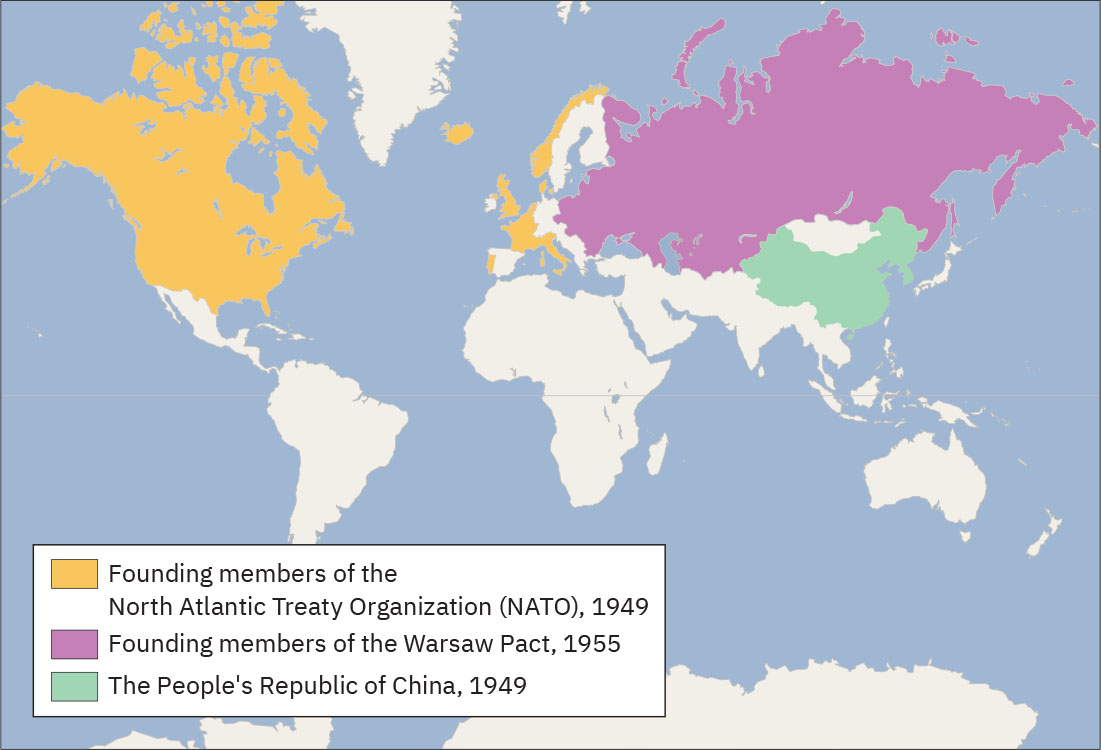
(credit: modification of work “World map blank shorelines” by Maciej Jaros/Wikimedia Commons, Public Domain) · Public Domain
Figure 14.3 (credit: modification of work “World map blank shorelines” by Maciej Jaros/Wikimedia Commons, Public Domain)
図14.3 (出典:Maciej Jaros/Wikimedia Commons「World map blank shorelines」を改変、パブリックドメイン)