第14章冷戦期の紛争Cold War Conflicts
Tensions in Latin Americaラテンアメリカの緊張
In the 1930s and 1940s, the United States had exercised a “Good Neighbor Policy” toward other nations of the Western Hemisphere, refraining from intervening in their affairs. The desire to contain communist expansion, however, led Washington to take a much more interventionist approach in Latin America and the Caribbean in the 1950s and 1960s. In 1944, an uprising in Guatemala ousted the military dictator Jorge Ubico, who had held power since 1931. Philosophy professor Juan José Arévalo became the country’s first democratically elected president in 1945. He was succeeded in office in 1951 by Jacobo Árbenz, who began a program of land reform in the desperately poor country. Árbenz also legalized the Guatemalan Party of Labor, a communist labor union. In the eyes of the United States, Guatemala seemed to be drifting toward communism (Figure 14.16).
英語のヒント
1930〜1940年代、アメリカは西半球の他国に「善隣政策」を取り、内政への介入を控えていた。しかし共産主義拡大を封じ込めたいという考えから、1950〜1960年代にはラテンアメリカとカリブ海で、はるかに介入的な姿勢を取った。1944年、グアテマラで蜂起が起こり、1931年以来の軍事独裁者ホルヘ・ウビコが追放された。哲学教授フアン・ホセ・アレバロが1945年、初の民主的に選出された大統領となった。1951年に継いだハコボ・アルベンスは、深刻な貧困にある国で土地改革を始めた。また、共産主義の労働組合であるグアテマラ労働党を合法化した。アメリカには、グアテマラが共産主義へ流れているように見えた(図14.16)。
Land and Freedom.土地と自由
Figure 14.16 A 1952 poster promises Guatemalan peasants “land and freedom” along with the agrarian reforms promoted by Jacobo Árbenz. Árbenz’s plans led U.S. officials to fear he would align Guatemala with the Eastern Bloc. (credit: “Reforma Agraria de Guatemala” by Fotos antiguas de Guatemala/Wikimedia Commons, Public Domain)
図14.16 ハコボ・アルベンスが進める農地改革とともに、グアテマラの農民へ「土地と自由」を約束する1952年のポスター。アメリカ当局は、彼の計画によってグアテマラが東側陣営と連携することを恐れた。(出典:Fotos antiguas de Guatemala「Reforma Agraria de Guatemala」/Wikimedia Commons、パブリックドメイン)
This view of the matter was encouraged by the United Fruit Company, a U.S. company that owned plantations throughout Central America, where it grew bananas for the American market. As the single largest landowner in Guatemala, United Fruit was resistant to any forces that might limit its access to land. Thus, Árbenz’s land redistribution plans threatened its interests, and his support for the Guatemalan Party of Labor also promised to undermine the company’s control over its employees.
英語のヒント
こうした見方を後押ししたのがユナイテッド・フルーツ社だった。中米各地に農園を所有し、アメリカ市場向けにバナナを栽培するアメリカ企業である。グアテマラ最大の単一の地主として、同社は土地の利用を制限しかねない勢力に抵抗した。アルベンスの土地再分配計画は同社の利益を脅かし、グアテマラ労働党への支持も、同社の従業員支配を弱めかねないものだった。
United Fruit convinced first the Truman administration and then the Eisenhower administration to remove Árbenz from power. Eisenhower was a strong anti-communist, as were his secretary of state John Foster Dulles and the head of the CIA Allen Dulles, John’s brother. The Dulles brothers were also closely connected to the United Fruit Company. In 1954, forces led by Colonel Carlos Castillo Armas but armed and trained by the CIA removed Árbenz from power. Upon taking office, Armas instituted a military dictatorship, outlawed the political opposition, and began to attack the power of the unions.
英語のヒント
ユナイテッド・フルーツ社は、まずトルーマン政権、次いでアイゼンハワー政権を説得し、アルベンスを失脚させようとした。アイゼンハワーは強硬な反共主義者で、国務長官ジョン・フォスター・ダレスと、その弟でCIA長官のアレン・ダレスも同様だった。ダレス兄弟は同社とも深く結びついていた。1954年、カルロス・カスティージョ・アルマス大佐が率い、CIAが武器と訓練を与えた部隊が、アルベンスを権力から追った。政権に就いたアルマスは軍事独裁を敷き、反対勢力を非合法化し、労働組合の力を攻撃し始めた。
It is unlikely that Árbenz sought to place Guatemala within the Eastern Bloc. Soviet influence was active elsewhere in Latin America, however. In 1952, Fulgencio Batista seized power in Cuba in a military coup. Batista, who was financially supported by the U.S. government, held tight control over the island nation and used secret police to silence his opponents, often by means of torture and murder. He wielded his political power to protect the interests of wealthy Cubans and large landowners, among whom were many U.S. executives who controlled Cuba’s sugar industry.
英語のヒント
アルベンスがグアテマラを東側陣営へ入れようとした可能性は低い。しかしラテンアメリカの別の場所では、ソ連の影響が働いていた。1952年、フルヘンシオ・バティスタが軍事クーデターでキューバの権力を握った。アメリカ政府から資金支援を受けるバティスタは島国を厳しく支配し、秘密警察を使って、しばしば拷問や殺害によって反対者を黙らせた。政治権力は裕福なキューバ人と大地主の利益を守るために振るわれた。その中には、キューバの砂糖産業を支配するアメリカ人経営者が多数含まれていた。
Opposition to Batista was led by a young lawyer and activist named Fidel Castro and his brother Raul. When Fidel Castro failed to remove Batista from power legally by challenging the constitutionality of Batista’s seizure of power, he and his brother began to organize members of Cuba’s disgruntled working class. The revolution against Batista began on July 26, 1953, with unsuccessful attacks on military bases in Santiago and Bayamo that culminated in the capture of the Castro brothers. Released from prison two years later, they retreated to Mexico where they joined other Cuban exiles and a young Argentine named Ernesto “Che” Guevara to train and plot their return to Cuba.
英語のヒント
バティスタへの反対を率いたのは、若い弁護士で活動家のフィデル・カストロと弟ラウルだった。フィデルは、バティスタの権力掌握の合憲性を争って合法的に失脚させようとしたが失敗し、弟とともに不満を抱く労働者を組織し始めた。革命は1953年7月26日、サンティアゴとバヤモの軍事基地への攻撃で始まった。しかし攻撃は失敗し、兄弟は捕らえられた。2年後に釈放されるとメキシコへ逃れ、他のキューバ人亡命者や若いアルゼンチン人エルネスト・「チェ」・ゲバラと合流し、訓練を重ねて帰国計画を練った。
In 1956, Fidel Castro and his followers returned to Cuba and led the 26th of July Movement (named for their first failed attempt to topple Batista’s government) in attacks on the Cuban government. After two years of fighting, Castro’s rebels were successful, and on December 31, 1958, Fulgencio Batista fled to the Dominican Republic. On January 2, 1959, the military commander guarding Havana ordered his soldiers to lay down their weapons, and the revolutionaries entered the capital in triumph (Figure 14.17).
英語のヒント
1956年、フィデル・カストロと支持者たちはキューバへ戻り、最初の失敗した政権打倒の試みにちなむ「7月26日運動」を率いて政府を攻撃した。2年間の戦闘の末、反乱勢力は勝利し、1958年12月31日、バティスタはドミニカ共和国へ逃れた。1959年1月2日、ハバナを守る軍司令官が武装解除を命じ、革命派は勝利のうちに首都へ入った(図14.17)。
Cuban Revolutionaries.キューバの革命家たち
Figure 14.17 Cuban revolutionaries occupy the foyer of the Hilton Hotel in Havana, Cuba, shortly after their victory in 1959. Fresh from the fight, they still carry their weapons. (credit: modification of work “Cuban rebel soldiers in the Habana Hilton foyer, January 1959” by The Guardian/Wikimedia Commons, Public Domain)
図14.17 1959年の勝利直後、キューバのハバナ・ヒルトン・ホテルの玄関ホールを占拠する革命派。戦いを終えたばかりで、まだ武器を持っている。(出典:The Guardian「Cuban rebel soldiers in the Habana Hilton foyer, January 1959」を改変/Wikimedia Commons、パブリックドメイン)
At first the United States recognized Cuba’s new government. Fidel Castro was interviewed on the popular American television program The Ed Sullivan Show a few days after his forces proved victorious, and Castro himself visited the United States to request aid in developing his country. In an address before the United Nations, he placed Cuba in the non-aligned camp; when asked, he insisted he was not a communist.
英語のヒント
アメリカは当初、キューバの新政府を承認した。勝利から数日後、フィデル・カストロは人気テレビ番組『エド・サリヴァン・ショー』のインタビューを受け、自らアメリカを訪れて国家開発への援助も求めた。国連演説ではキューバを非同盟の立場に置き、質問されると自分は共産主義者ではないと言い張った。
Despite these protestations, Castro worried the U.S. government. He began a program of land reform and forbade foreign ownership of land. He appointed communists, including Che Guevara, to important government positions. In August 1960, he began to nationalize foreign companies in Cuba, including many owned by U.S. citizens. Many wealthy and middle-class Cubans left the country; a large number relocated to the United States, only about ninety miles away. The United States, now convinced of Castro’s communist leanings, imposed economic sanctions on Cuba. If the island were allowed to become communist, Washington feared, communism would spread elsewhere in Latin America. Denied U.S. assistance, Castro turned to the Soviet Union for help.
英語のヒント
それでもアメリカ政府はカストロを懸念した。彼は土地改革を始め、外国人の土地所有を禁じ、チェ・ゲバラら共産主義者を政府の要職に就けた。1960年8月には、アメリカ人所有の多数の企業を含む外国企業の国有化を始めた。多くの富裕層や中間層が国外へ去り、約90マイルしか離れていないアメリカへ多数が移住した。カストロの共産主義への傾斜を確信したアメリカは、経済制裁を科した。島が共産主義化すればラテンアメリカの他の地域にも広がると恐れたのである。アメリカの援助を拒まれたカストロは、ソ連へ助けを求めた。
The United States was reluctant to take aggressive action against Cuba for fear of moving Castro closer to the Soviets. However, the CIA trained Cuban exiles in Florida who had formed the Democratic Revolutionary Front. Their goal was to launch an invasion of Cuba that, they believed, would spark a popular uprising and the overthrow of the Castro government. By assisting the Democratic Revolutionary Front, the United States hoped to achieve the goal of defeating Castro without committing American troops.
英語のヒント
アメリカは、カストロをソ連へさらに近づけることを恐れ、キューバへの強硬な行動には消極的だった。しかしCIAは、民主革命戦線を結成したキューバ人亡命者をフロリダで訓練した。彼らはキューバへ侵攻し、民衆蜂起とカストロ政権の転覆を引き起こそうとした。アメリカはこの組織を助けることで、自軍を投入せずにカストロを倒す目標を達成したかった。
On the night of April 17, 1961, the long-awaited Bay of Pigs invasion began, named for the spot where the invaders were to come ashore. It ended in disaster. Although they quickly overcame a local militia force, the invaders could not hold out against the Cuban Army, anticipated air support from the United States failed to materialize, and the invaders surrendered three days later. The United States was humiliated, and far from weakening Castro, its aggressive actions may actually have increased support for the revolution and strengthened nationalistic fervor among the Cuban people. The failed invasion also led Castro to seek protection from the Soviet Union.
英語のヒント
1961年4月17日夜、上陸予定地にちなむピッグス湾侵攻が、長い準備の末に始まった。しかし結果は惨敗だった。侵攻部隊は地元の民兵を素早く破ったものの、キューバ軍には持ちこたえられず、期待したアメリカの航空支援も実現しなかった。3日後に降伏した。アメリカは面目を失った。攻撃的な行動はカストロを弱めるどころか、革命への支持とキューバ人の民族主義的熱情を強めた可能性がある。侵攻の失敗は、カストロにソ連の保護を求めさせることにもなった。
Cuba had been of little interest to the Soviets until now. But by protecting it from U.S. threats, the Soviet Union stood to gain increased status in the region while also thwarting its Cold War rival. Indeed, failure to protect Cuba, Khrushchev feared, would send a message to other revolutionaries in Latin America that the Soviets were unable to protect them from U.S. aggression too. Accordingly, in 1962, the Soviet Union armed Cuba with nuclear missiles, and the construction of missile launch facilities on the island began that summer.
英語のヒント
それまでソ連はキューバにあまり関心を持っていなかった。しかしアメリカの脅威から守れば、冷戦の競争相手を妨げると同時に、この地域での地位を高められた。フルシチョフは、キューバを守れなければ、ソ連はラテンアメリカの他の革命家もアメリカの侵略から守れないという合図になると恐れた。こうして1962年、ソ連はキューバに核ミサイルを配備し、同年夏には発射施設の建設が始まった。
Photographs taken by a U-2 surveillance plane alerted the U.S. government to the presence of the missiles, aimed at the United States. After convening the National Security Council in October 1962, President Kennedy weighed his options. Although the U.S. military suggested an invasion of Cuba, he feared that would lead the Soviets to attack Berlin in retaliation. He could not allow the Soviet action to go unchallenged, however; to do so would make the United States—and Kennedy personally—seem weak.
英語のヒント
U-2偵察機の写真によって、アメリカ政府は、自国へ向けられたミサイルの存在を知った。1962年10月、ケネディ大統領は国家安全保障会議を招集し、対応策を比較検討した。軍はキューバ侵攻を提案したが、ケネディはソ連が報復としてベルリンを攻撃することを恐れた。それでもソ連の行動を黙認するわけにはいかなかった。そうすればアメリカもケネディ本人も弱く見えるからだった。
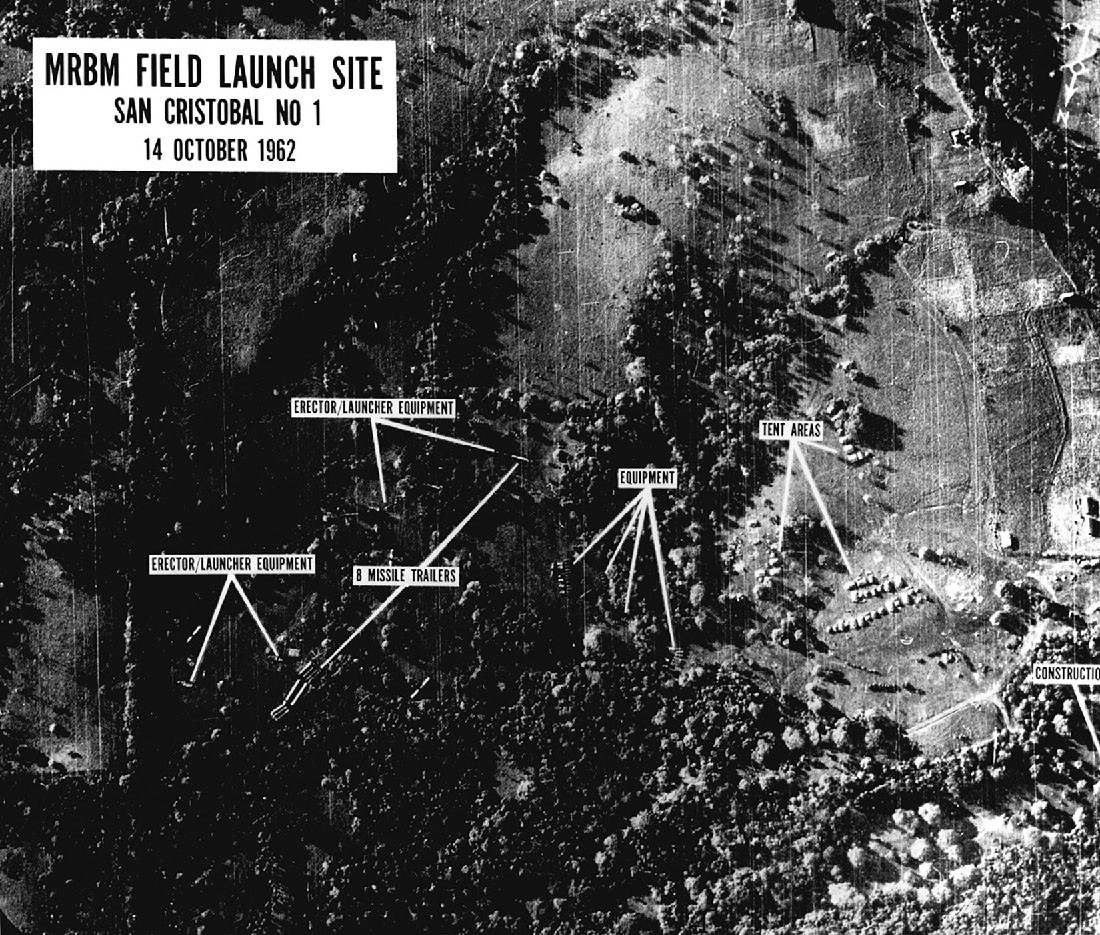
On October 22, Kennedy ordered the navy to form a blockade around Cuba to intercept Soviet ships delivering additional missiles. He informed the world of this “quarantine,” avoiding the word “blockade” because under international law a blockade could be considered an act of war. U.S. forces around the world were placed on high alert, and U.S. planes flew low over Cuba in preparation for a potential invasion, the only option for removing the missiles if the Soviets did not back down. On the island below, Soviet technicians continued the missiles’ installation (Figure 14.18).
英語のヒント
10月22日、ケネディは海軍に、追加のミサイルを運ぶソ連船を阻止するためキューバを封鎖するよう命じた。国際法上「封鎖」は戦争行為とみなされうるため、その語を避けて「隔離」と呼び、世界へ発表した。世界各地のアメリカ軍は厳戒態勢となり、航空機は侵攻に備えてキューバ上空を低空飛行した。ソ連が譲歩しなければ、ミサイルを撤去する選択肢は侵攻しかないとされた。その下の島では、ソ連の技術者が配備作業を続けていた(図14.18)。
Soviet Missiles in Cuba.キューバのソ連ミサイル
(credit: “Cuba Missiles Crisis U-2 photo” by The John F. Kennedy Presidential Library and Museum /Wikimedia Commons, Public Domain) · Public Domain
Figure 14.18 A photograph taken by a U.S. U-2 spy plane in 1962 clearly reveals evidence of the means to assemble Soviet missiles in Cuba. (credit: “Cuba Missiles Crisis U-2 photo” by The John F. Kennedy Presidential Library and Museum /Wikimedia Commons, Public Domain)
図14.18 1962年にアメリカのU-2偵察機が撮影した写真は、キューバでソ連のミサイルを組み立てる設備の証拠を明瞭に示した。(出典:ジョン・F・ケネディ大統領図書館・博物館「Cuba Missiles Crisis U-2 photo」/Wikimedia Commons、パブリックドメイン)
The world held its breath. For ten days people pondered the possibility of nuclear war as the incident, which came to be known as the Cuban Missile Crisis, dragged on. Both Kennedy and Khrushchev refused to retreat. A number of incidents occurred that might each have begun a nuclear conflict. A U-2 spy plane flying over Cuba to monitor the missile installation was shot down and its pilot killed, but Kennedy refrained from acting. Another U-2 mistakenly flew over the Soviet Union’s east coast, causing Soviet fighters to take off to intercept it, which in turn led U.S. fighters to take flight. The U.S. Navy dropped a depth charge on a Soviet submarine. The submarine had been maintaining radio silence and was unaware of the events taking place on the surface. Believing a war had started, two of the three officers on board wanted to launch a nuclear warhead, but the third officer, whose consent was needed, refused to allow them to do so.
英語のヒント
世界は息をのんだ。キューバ・ミサイル危機と呼ばれるこの事件が続く10日間、人々は核戦争の可能性を思いめぐらした。ケネディもフルシチョフも退こうとしなかった。その間、どれも核戦争の引き金になりかねない事件がいくつも起きた。配備状況を監視するためキューバ上空を飛ぶU-2が撃墜され、操縦士が死亡したが、ケネディは行動を控えた。別のU-2は誤ってソ連東岸の上空へ入り、ソ連の迎撃機が発進すると、アメリカの戦闘機も飛び立った。アメリカ海軍はソ連潜水艦へ爆雷を投下した。無線封止中の潜水艦は海上の情勢を知らなかった。戦争が始まったと考えた3人の将校のうち2人は核弾頭の発射を望んだが、同意が必要な3人目が許可しなかった。
Earlier that year, the United States had placed missiles in Turkey. Khrushchev was angered, but now he offered Kennedy a way out of the Cuban stalemate: if the missiles in Turkey were removed, those in Cuba would be too. Kennedy accepted the offer. The dismantling of the Cuban missiles began, and on November 2, 1962, Kennedy informed the world of Soviet compliance. On November 20, the blockade ended; in April 1963, the United States removed its missiles from Turkey, though over the protests of the Turkish government.
英語のヒント
同年初め、アメリカはトルコにミサイルを配備していた。これに怒ったフルシチョフは、今度はキューバでの膠着を抜ける方法をケネディに示した。トルコのミサイルを撤去すれば、キューバのミサイルも撤去するという提案だった。ケネディは受け入れた。キューバのミサイルの解体が始まり、1962年11月2日、ケネディはソ連が約束を履行していると世界へ伝えた。11月20日に封鎖は終わり、1963年4月、アメリカはトルコ政府の抗議にもかかわらず、トルコからミサイルを撤去した。
Following the standoff, a direct telephone hotline was established between Washington and Moscow to enable instant communications between the leaders of the two rival nations. The dangers of nuclear war did not necessarily diminish, however. Thwarted in their attempt to place nuclear missiles in Cuba, the Soviets focused on the development of intercontinental ballistic missiles, which could strike the United States from Europe. The United States also continued to develop its weaponry.
英語のヒント
対決の後、ワシントンとモスクワの間に直通電話のホットラインが設けられ、両国の指導者が即座に連絡できるようになった。しかし核戦争の危険が必ずしも減ったわけではない。キューバへの核ミサイル配備を阻まれたソ連は、ヨーロッパからアメリカを攻撃できる大陸間弾道ミサイルの開発に集中した。アメリカも兵器開発を続けた。
In China, Mao Zedong had criticized the Soviets for being insufficiently supportive of socialist revolution around the world. So Khrushchev’s willingness to back down when confronted by the United States and to seemingly abandon Cuba gave credence to Mao’s claims. It also improved Mao’s position within the Chinese Communist Party. He had found himself locked in a struggle with other CCP members, who favored closer relations with the Soviet Union because of the economic and technological expertise it could provide. The humiliation of the Soviets now weakened the position of those members, such as Liu Shaoqi and Deng Xiaoping. Conversely, Khrushchev’s power was seriously damaged by the Cuban Missile Crisis, and two years later he was forced from office.
英語のヒント
中国では毛沢東が、ソ連は世界各地の社会主義革命への支援が不十分だと批判していた。そのため、アメリカとの対決でフルシチョフが引き下がり、キューバを見捨てたように見えたことは、毛の主張を裏づけるように映った。中国共産党内での毛の立場も強まった。毛は、ソ連の経済・技術の専門知識を得るため接近を支持する党員たちと対立していた。ソ連の屈辱は、劉少奇や鄧小平らの立場を弱めた。反対にフルシチョフの権力は危機によって大きく損なわれ、2年後に失脚した。
Although the United States achieved its goal of removing Soviet missiles from Cuba, Castro’s government nevertheless remained in power. Communist parties were also strong in other parts of Latin America. In 1961, Rafael Trujillo, the anti-communist dictator of the Dominican Republic, was assassinated and replaced by the liberal reformer Juan Bosch, who was himself overthrown by the Dominican army in 1963. On April 24, 1965, liberal Dominican army officers rose up in revolt in an attempt to return Bosch to power. Four days later, twenty-two thousand U.S. troops invaded in order to prevent a communist takeover, as President Lyndon Johnson claimed. They placed a conservative government in power.
英語のヒント
アメリカはキューバからソ連のミサイルを撤去させる目標を達成したが、カストロ政権は存続した。ラテンアメリカの他の地域でも共産党は強い勢力を持っていた。1961年、ドミニカ共和国の反共独裁者ラファエル・トルヒーヨが暗殺され、リベラルな改革派フアン・ボッシュに代わったが、ボッシュも1963年に軍に倒された。1965年4月24日、リベラルな将校たちがボッシュ復帰を目指して反乱を起こした。4日後、リンドン・ジョンソン大統領が共産主義者の権力掌握を防ぐためと説明する中、2万2,000人のアメリカ兵が侵攻し、保守的な政府を据えた。
In Chile, Salvador Allende, the candidate of a socialist-communist coalition party called Popular Unity, was elected president in three consecutive presidential elections in 1958, 1964, and 1970. The CIA worked with the Chilean army to engineer a coup, and in September 1973, Allende and thousands of his supporters were killed. The leader of the coup General Agosto Pinochet became Chile’s president and ruled as a dictator until 1990. The CIA also trained and funded the right-wing Contras to fight against the Sandinista National Liberation Front, which came to power in Nicaragua after overthrowing the dictatorial president Anastasio Somoza Debayle. The Sandinistas received support from the Soviet Union and Cuba.
英語のヒント
チリでは、社会主義者と共産主義者の連合「人民連合」の候補サルバドール・アジェンデが、1958年、1964年、1970年の3回連続の大統領選挙で当選した。CIAはチリ軍と協力してクーデターを画策し、1973年9月、アジェンデと数千人の支持者が殺された。クーデター指導者アゴスト・ピノチェト将軍が大統領となり、1990年まで独裁者として統治した。CIAはまた、ニカラグアで独裁大統領アナスタシオ・ソモサ・デバイレを倒して政権を握ったサンディニスタ民族解放戦線と戦わせるため、右派のコントラを訓練し、資金を与えた。サンディニスタはソ連とキューバの支援を受けた。