第14章冷戦期の紛争Cold War Conflicts
Southeast Asia東南アジア
The lessons of Korea also strengthened the U.S. commitment to oppose the spread of communism in Vietnam. Following the end of World War II, France wished to reclaim control of Vietnam, which had been its colony before being seized by Japan in 1940. However, the Vietnamese nationalist group the Viet Minh, led by Ho Chi Minh, wished to seize the opportunity of Japan’s surrender to proclaim their country’s independence. The Viet Minh had fought the Japanese during World War II and had often assisted the U.S. military. Ho Chi Minh fully expected that the United States would support them.
英語のヒント
朝鮮での教訓は、ベトナムでの共産主義の拡大に反対するアメリカの姿勢も強めた。第二次世界大戦が終わると、フランスは、1940年に日本に奪われるまで自国の植民地だったベトナムの支配を取り戻そうとした。しかし、ホー・チ・ミン率いる民族主義組織ベトミンは、日本の降伏を機に独立を宣言しようとした。ベトミンは第二次世界大戦中に日本軍と戦い、アメリカ軍をしばしば助けていた。ホー・チ・ミンは、アメリカが自分たちを支援するものと十分に期待していた。
Members of the U.S. military who had worked with Ho liked and respected him. However, while he was primarily a nationalist and no one questioned his patriotism, he was also a communist. Wanting to stand firm against what it saw as Soviet-directed communist expansion, the United States also wished to support its ally France, whose help it believed it needed to prevent the spread of communism in Europe. Thus, as the First Indochina War raged between French troops and the supporters of Ho Chi Minh, the United States assumed most of France’s financial burden for the war. China and the Soviet Union gave assistance to Ho’s forces.
英語のヒント
ホー・チ・ミンと協力したアメリカ軍人たちは、彼に好意と敬意を抱いていた。しかし、彼は何よりも民族主義者であり、その愛国心を疑う者はいなかったものの、共産主義者でもあった。ソ連が指揮するとみなした共産主義の拡大に断固として対抗したいアメリカには、同盟国フランスを支援したいという事情もあった。ヨーロッパで共産主義の拡大を防ぐためには、フランスの協力が必要だと考えたからである。こうしてフランス軍とホー・チ・ミンの支持者の間で第一次インドシナ戦争が激しくなると、アメリカはフランスの戦費の大部分を負担した。中国とソ連はホーの部隊を援助した。
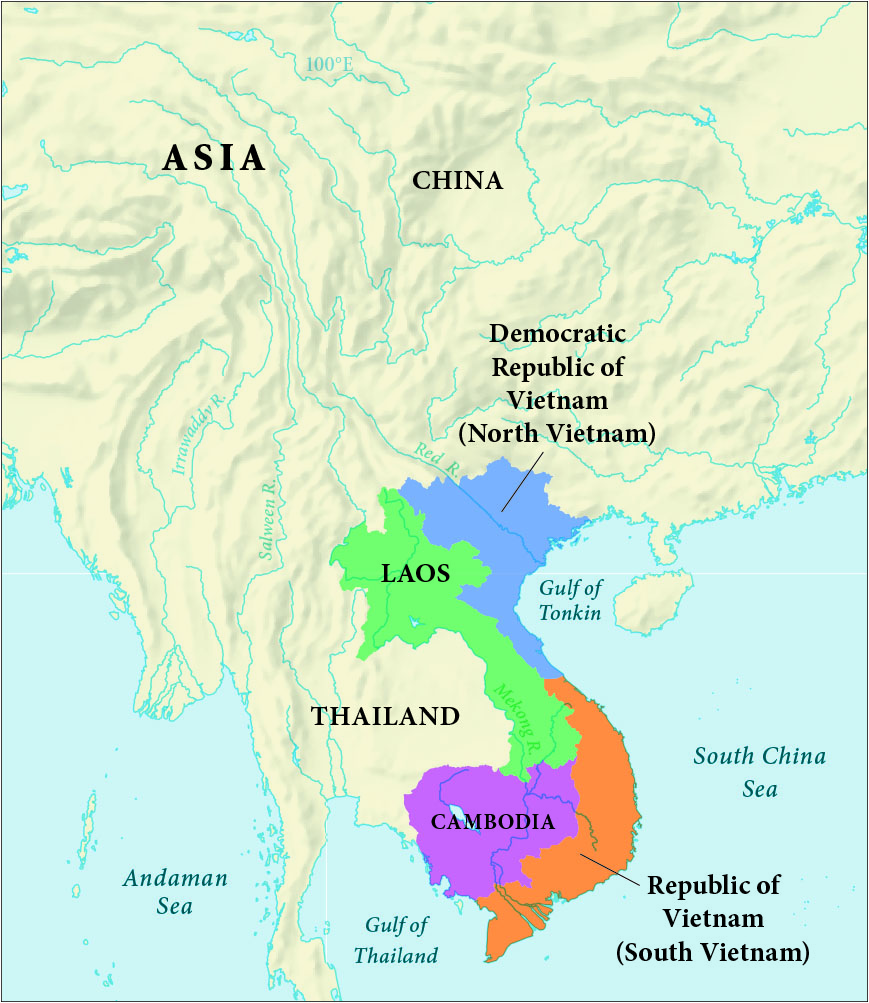
Following its defeat in 1954 at the Battle of Dien Bien Phu, France granted independence to Vietnam, Laos, and Cambodia. According to the Geneva Accords, the peace treaty ending the war, Vietnam was divided along the seventeenth parallel of latitude with the assumption that, following national elections in 1956, it would be reunified (Figure 14.10). Ho Chi Minh governed the North and was expected to be the popular candidate in both North and South. The South was governed by a figurehead, the emperor Bao Dai, and his prime minister, Ngo Dinh Diem. Vietnamese names are written with the family name first. The given name comes last. Ngo Dinh Diem is usually referred to by historians by his given name Diem instead of his surname Ngo in order to differentiate him from his brothers Ngo Dinh Thuc and Ngo Dinh Nhu, who also played an important political role in Vietnam. Diem, a strong anti-communist, came from a family of wealthy Roman Catholics in a country where most people were poor and Buddhist. Before the elections, approximately one million Vietnamese Catholics from the North moved to the South, fleeing communist rule and bolstering support for Diem, who was backed by the United States. But he remained unpopular with the majority of Vietnamese people.
英語のヒント
1954年のディエンビエンフーの戦いで敗れた後、フランスはベトナム、ラオス、カンボジアに独立を認めた。戦争を終わらせる和平合意であるジュネーヴ協定により、ベトナムは北緯17度線に沿って分割され、1956年の全国選挙を経て再統一することとされた(図14.10)。北はホー・チ・ミンが統治し、彼は南北の双方で人気の高い候補になると予想された。南を治めたのは、名目的な元首である皇帝バオ・ダイと、首相ゴ・ディン・ジエムだった。ジエムは強硬な反共主義者で、多くの人々が貧しく仏教を信仰する国にあって、裕福なカトリックの家庭に育った。選挙に先立ち、北から約100万人のカトリック信徒が共産主義支配を逃れて南へ移り、アメリカに支援されるジエムの支持基盤を強めた。それでも彼は、ベトナム人の多数からは支持されなかった。原注:ベトナム人の名は姓を先に、個人名を最後に書く。歴史家は、同じく重要な政治的役割を果たした兄弟ゴ・ディン・トゥック、ゴ・ディン・ヌーと区別するため、ゴ・ディン・ジエムを姓の「ゴ」ではなく、個人名の「ジエム」で呼ぶことが多い。
The Geneva Accords.ジュネーヴ協定
(attribution: Copyright Rice University, OpenStax, under CC BY 4.0 license) · CC BY 4.0
Figure 14.10 As a result of the 1954 Geneva Accords, the French colony of Indochina was divided into separate nations: Laos, Cambodia, the Democratic Republic of Vietnam (North Vietnam), and the Republic of Vietnam (South Vietnam). North and South Vietnam were to be reunified following national elections. (attribution: Copyright Rice University, OpenStax, under CC BY 4.0 license)
図14.10 1954年のジュネーヴ協定の結果、フランス植民地インドシナは、ラオス、カンボジア、ベトナム民主共和国(北ベトナム)、ベトナム共和国(南ベトナム)に分かれた。南北ベトナムは全国選挙を経て再統一される予定だった。(帰属表示:著作権 Rice University、OpenStax、CC BY 4.0)
Ngo Dinh Diem had no intention of relinquishing power, however; he argued that South Vietnam had not signed the Geneva Accords and so was not bound by them. The United States, as a SEATO member and knowing that Ho Chi Minh would easily win the majority of the vote in both North and South, supported Diem’s position. In 1955, well before any elections could take place, a referendum was held in South Vietnam instead. The rigged results revealed that Diem was favored by more than 98 percent of voters, and he proclaimed himself president. In reality, he was a ruthless politician who allowed no opposition and used the military to attack South Vietnamese Buddhists and students who protested his rule. Influenced by his brother Ngo Dinh Thuc, the archbishop of the city of Hue, Diem forbade the flying of the Buddhist flag. His regime also redistributed land taken from Buddhist peasants to Catholic ones and dispensed more aid to Catholics. In 1963, Buddhist monks in South Vietnam engaged in several acts of self-immolation, setting themselves on fire in public places to draw attention to the abuses of Diem’s brutal and corrupt regime. When foreign journalists questioned why the monks felt the need to engage in such dramatic protest, Diem’s sister-in-law and South Vietnam’s unofficial First Lady, Madame Nhu, compared the suicides to “barbecues.”
英語のヒント
しかしゴ・ディン・ジエムに権力を手放す意思はなかった。南ベトナムはジュネーヴ協定に署名しておらず、拘束されないと主張した。SEATO加盟国のアメリカは、ホー・チ・ミンが南北双方で容易に過半数を得ると知っていたため、ジエムの立場を支持した。全国選挙を実施できる時期より早い1955年、代わりに南で国民投票が行われた。不正に操作された結果は98%超の支持を示し、ジエムは大統領就任を宣言した。実際のジエムは反対を許さない冷酷な政治家で、統治に抗議する南ベトナムの仏教徒や学生を軍に攻撃させた。フエ大司教の兄ゴ・ディン・トゥックの影響で仏教旗の掲揚を禁じ、仏教徒農民から奪った土地をカトリック信徒へ再配分し、援助もカトリック側へ多く与えた。1963年、南ベトナムの僧侶たちは、残酷で腐敗したジエム政権の虐待に目を向けさせるため、公共の場で自らに火をつける焼身抗議を相次いで行った。外国人記者が、なぜそこまで劇的な抗議が必要だったのかと問うと、ジエムの弟の妻で、非公式のファーストレディだったマダム・ヌーは、その自殺を「バーベキュー」にたとえた。
The Second Indochina War, sometimes simply called the Vietnam War, began in 1959 when the North Vietnamese Communist Party, seeking to unify the country under communist rule, called for a “people’s war” against the government of South Vietnam. North Vietnam received support from both China and the Soviet Union. Also helping the North was a group of South Vietnamese communists, many of whom had relocated to North Vietnam following the Geneva Accords. These men and women officially formed the National Liberation Front (NLF) in North Vietnam in 1960. Popularly known as the Viet Cong, the NLF returned to the South to organize peasants and begin an insurgency against the government of South Vietnam and the United States. U.S. president John F. Kennedy responded by continuing to do what his predecessors had done: he sent money and advisers to the South Vietnamese government but refused to commit ground troops.
英語のヒント
第二次インドシナ戦争、単にベトナム戦争とも呼ばれる戦争は、北ベトナムの共産党が、共産主義支配による統一を目指し、南の政府に対する「人民戦争」を呼びかけた1959年に始まった。北ベトナムは中国とソ連の双方から支援を受けた。南ベトナムの共産主義者の集団も北を助けた。その多くはジュネーヴ協定後に北へ移住していた男女で、1960年に北ベトナムで民族解放戦線(NLF)を正式に結成した。一般にベトコンと呼ばれるNLFは南へ戻り、農民を組織して南ベトナム政府とアメリカへの反乱を始めた。アメリカ大統領ジョン・F・ケネディは、歴代大統領の対応を引き継ぎ、南政府へ資金と顧問を送ったが、地上戦闘部隊の投入は拒否した。