第14章冷戦期の紛争Cold War Conflicts
Indiaインド
Like Indonesia, India sought to plot its own path and remain free of the entangling alliances of the Cold War, and it was also one of the initiators of the Non-Aligned Movement. In 1947, the United Kingdom granted India its independence. Anti-British protests had rocked India throughout 1946, and, exhausted from fighting World War II, Britain could no longer afford to maintain control over its colony. In addition, although the United Kingdom had sufficient troops there, the majority were Indian, and it was uncertain where their loyalties lay. Indeed, in 1946 Indians in the British Navy had mutinied throughout the country. Finally, the United Kingdom’s greatest ally and creditor, the United States, pressured the nation to grant India its independence, as the United States had given independence to the Philippines following the war.
英語のヒント
インドもインドネシアと同じく、独自の道を選び、冷戦の拘束的な同盟関係から距離を置こうとした。非同盟運動の提唱国の一つでもあった。1947年、イギリスはインドに独立を認めた。1946年を通じて反英抗議がインドを揺さぶり、第二次世界大戦で疲弊したイギリスには、もはや植民地支配を維持する余裕がなかった。兵力自体は十分でも、大半はインド人で、誰に忠誠を向けるか不確かだった。実際、1946年にはイギリス海軍のインド人が各地で反乱を起こしていた。さらに、イギリス最大の同盟国で債権国でもあるアメリカは、自らが戦後フィリピンを独立させたように、インドを独立させるよう圧力をかけた。
The announcement that the British would be withdrawing sparked waves of religious violence throughout the nation. Much of it was caused by a dispute over what an independent India would consist of. Hindus in the Indian National Congress called for the maintenance of a single, unified India. Muslims, however, feared that the Hindu majority would dominate the government to their detriment, and many were reluctant to agree to such a situation. A compromise was reached, and at midnight on August 15, 1947, when India achieved its independence, the region of Pakistan, home to a Muslim majority, became an independent nation as well.
英語のヒント
イギリス撤退の発表は、各地で宗教的暴力の波を引き起こした。その多くは、独立インドをどの範囲で構成するかという争いから生じた。インド国民会議のヒンドゥー教徒は単一の統一インドの維持を求めた。しかしムスリムは、多数派のヒンドゥー教徒が政府を支配して自分たちを不利にすると恐れ、多くが同意をためらった。妥協が成立し、インドが独立した1947年8月15日午前0時、ムスリムが多数を占めるパキスタンの地域も独立国となった。
India’s geographic location, bordering both the Soviet Union and China, made it of great interest to the West. The United Kingdom continued to trade with India, supply it with weapons, and train its military officers. India’s first prime minister, Jawaharlal Nehru, wished to maintain his distance from the United States, however. He was sympathetic to socialism and had visited the Soviet Union. He recognized the People’s Republic of China and opposed the U.S. refusal to allow the PRC to hold China’s seat on the UN Security Council. He was also suspicious of U.S. intentions toward India, given the government’s treatment of its own citizens of color. Nevertheless, Nehru accepted aid from the United States in the 1950s, just as he did from the Soviet Union.
英語のヒント
ソ連と中国の双方に接するインドの地理的位置は、西側にとって大きな関心事だった。イギリスはインドとの貿易、武器供給、将校の訓練を続けた。しかし初代首相ジャワハルラル・ネルーは、アメリカとは距離を保ちたかった。ネルーは社会主義に共感し、ソ連を訪問した経験があった。中華人民共和国を承認し、中国の国連安保理議席を人民共和国に認めないアメリカの立場にも反対した。アメリカ政府による自国の有色人種への扱いから、インドに対する意図も疑っていた。それでも1950年代には、ソ連からと同様に、アメリカからも援助を受け入れた。
In 1950, India’s relationship with China changed when China established border posts in Tibet to demarcate its territory, including land India claimed. India and China sought to maintain an amicable relationship and even signed a treaty affirming the Five Principles of Peaceful Coexistence in 1954. But when Tibet’s leader, the Fourteenth Dalai Lama, sought protection in India after fleeing Tibet during an anti-Chinese uprising in 1959, India’s support for him angered China. In 1962, a confrontation along the disputed border with Tibet led to war between the two countries. The United States aided India, and while the Soviet Union officially remained neutral, it also continued to provide funds and technology to India. This decision deepened a divide that was already growing between the USSR and China.
英語のヒント
1950年、中国がインドも領有を主張する土地を含め、チベットに境界拠点を設けて領域を画定すると、インドとの関係は変化した。両国は友好関係を保とうとし、1954年には平和共存五原則を確認する条約に調印した。しかし1959年、反中蜂起の中でチベットを逃れた指導者ダライ・ラマ14世がインドに保護を求め、インドが支援すると、中国は怒った。1962年、チベットとの係争国境での対立が両国の戦争に発展した。アメリカはインドを援助し、ソ連も公式には中立を保ちながら、インドへの資金・技術提供を続けた。この判断は、すでに広がっていた中ソ間の溝をさらに深めた。
Egypt and the Middle Eastエジプトと中東
Before World War II, the United States had demonstrated relatively little concern for the Middle East, which fell largely under British control. Following the war, however, problems in the region, some of which stemmed from British policies and actions, threatened to move Arab and Iranian leaders closer to the Soviet Union. This possibility alarmed the United States and led to attempts to forge relationships with Middle Eastern governments. The nations that proved of greatest interest were Iran, Egypt, and the newly formed state of Israel.
英語のヒント
第二次世界大戦以前、主にイギリスの支配下にあった中東に、アメリカは比較的関心を示していなかった。しかし戦後、この地域の問題、とりわけイギリスの政策や行動から生じた問題が、アラブ諸国やイランの指導者をソ連へ近づけかねなくなった。この可能性を警戒したアメリカは、中東の政府と関係を築こうとした。最も関心を集めたのは、イラン、エジプト、そして新たに建国されたイスラエルだった。
Iran first became a place of concern to the United States immediately following World War II, when the Soviet Union proved reluctant to end its occupation of the country. Following the war, the United Kingdom had resumed its activities in the region, which largely consisted of drilling for oil. In 1951, Mohammad Mossadegh, an Iranian nationalist, became the country’s prime minister and moved to nationalize the oil fields belonging to British companies. This action led to protests by the United Kingdom and by pro-Western Iranian elites who supported British interests. In 1952, Iran’s monarch, the pro-Western shah Mohammad Reza Pahlavi, removed Mossadegh from power. He was forced to reinstate him, however, following massive popular protests.
英語のヒント
アメリカが初めてイランを懸念したのは、第二次世界大戦直後、ソ連が占領を終えることに消極的だったときである。戦後、イギリスはこの地域で、主に石油採掘を中心とする活動を再開した。1951年、イランの民族主義者モハンマド・モサッデグが首相に就くと、イギリス企業の油田の国有化に動いた。イギリスと、イギリスの利益を支持する親西側のイランの有力者たちは反対した。1952年、親西側の国王モハンマド・レザー・パフラヴィーはモサッデグを失脚させた。しかし大規模な民衆の抗議を受け、復職させざるをえなかった。
Mossadegh’s actions convinced both the United Kingdom and the United States that he favored communism and might ally Iran with the Soviet Union, with which it shared a border. Although it is unlikely he intended to make Iran a satellite state of the Soviet Union, British arguments that this was the case convinced the United States to take action. In August 1953, a coup plotted by the CIA and Iran’s military, which supported the Shah, removed Mossadegh from power again. He was arrested and imprisoned.
英語のヒント
モサッデグの行動により、イギリスとアメリカは、彼が共産主義を好み、国境を接するソ連とイランを同盟させるかもしれないと確信した。彼がイランをソ連の衛星国にするつもりだったとは考えにくいが、そうなるというイギリスの主張がアメリカを行動へ動かした。1953年8月、CIAと国王を支持するイラン軍が企てたクーデターにより、モサッデグは再び失脚した。逮捕され、投獄された。
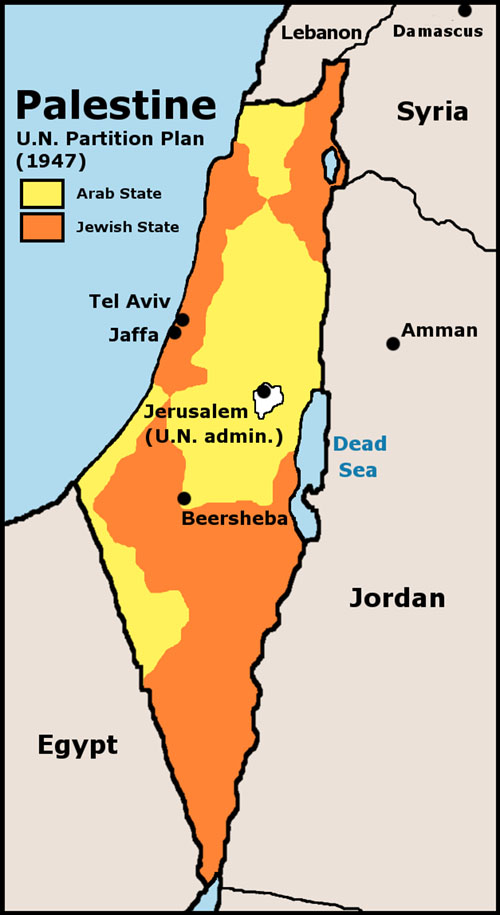
British actions laid the groundwork for another conflict in the Middle East following World War II. In 1917, Britain’s foreign secretary Arthur James Balfour had declared that Britain would support the establishment of a Jewish homeland in Palestine. Throughout the 1930s, Jewish people from Europe had streamed to the region, and as their numbers increased, so did violence between them and Arabs, who demanded an end to Jewish immigration and the creation of an independent Arab state. Following the end of World War II, as Jewish survivors of the Holocaust sought refuge in Palestine, the British government requested that the United Nations resolve the issue. In 1947, the United Nations Special Committee on Palestine visited the region and recommended that it be divided into a Jewish state and an Arab state (Figure 14.13). The city of Jerusalem, sacred to both groups, was to be placed under an “international trusteeship.” In November 1947, the UN General Assembly adopted the committee’s suggestion with the passage of Resolution 181.
英語のヒント
イギリスの行動は、戦後の中東のもう一つの紛争にも下地を作っていた。1917年、イギリス外相アーサー・ジェームズ・バルフォアは、パレスチナにユダヤ人の民族的郷土を設けることを支持すると宣言した。1930年代を通じてヨーロッパからユダヤ人が流入し、人数が増えるにつれ、移住の停止と独立アラブ国家の建設を求めるアラブ人との暴力も増えた。第二次世界大戦後、ホロコーストの生存者がパレスチナに避難先を求めると、イギリス政府は国連に解決を要請した。1947年、国連パレスチナ特別委員会が現地を訪れ、ユダヤ国家とアラブ国家への分割を勧告した(図14.13)。両者にとって聖地であるエルサレムは「国際信託統治」の下に置くこととされた。同年11月、国連総会は決議181を採択し、この提案を承認した。
UN Partition Plan for Palestine.国連のパレスチナ分割案
(credit: “UN 1947 partition plan for Palestine” by U.S. Central Intelligence Agency/Wikimedia Commons, Public Domain) · Public Domain
Figure 14.13 The UN’s 1947 plan to partition Palestine divided it into Jewish and Arab sectors. Jewish people would control most of the coast and the southern part of the country. The Arab sectors were divided from one another by large areas of Jewish settlement. (credit: “UN 1947 partition plan for Palestine” by U.S. Central Intelligence Agency/Wikimedia Commons, Public Domain)
図14.13 1947年の国連分割案は、パレスチナをユダヤ人とアラブ人の地域に分けた。海岸の大半と南部はユダヤ人が管理する予定だった。アラブ人の各地域の間には、広いユダヤ人入植地域が置かれた。(出典:米国中央情報局「UN 1947 partition plan for Palestine」/Wikimedia Commons、パブリックドメイン)
The UN resolution led to civil war in Palestine. The British withdrew from the region in May, leaving Jewish people and Palestinian Arabs, assisted by Arabs from elsewhere in the Middle East who had organized themselves as the Arab Liberation Army, to battle it out. About 250,000 Palestinian Arabs fled Jewish-controlled areas. On May 14, 1948, as the last British forces left the region, David Ben-Gurion, the leader of the Jewish settlement in Palestine, announced the founding of the nation of Israel (Figure 14.14).
英語のヒント
国連決議はパレスチナでの内戦につながった。イギリスは5月に撤退し、ユダヤ人とパレスチナのアラブ人が戦うに任せた。アラブ人には、中東の他の地域から集まりアラブ解放軍を組織した人々が加勢した。約25万人のパレスチナ・アラブ人がユダヤ人支配地域から逃れた。1948年5月14日、最後のイギリス軍が去る中、パレスチナのユダヤ人共同体の指導者ダヴィド・ベン=グリオンは、イスラエル建国を宣言した(図14.14)。
The Founding of Israel.イスラエルの建国
Figure 14.14 In the city of Tel-Aviv, David Ben-Gurion proclaims the foundation of the state of Israel in 1948. (credit: “Declaration of State of Israel 1948” by Israel Ministry of Foreign Affairs/Wikimedia Commons, Public Domain)
図14.14 1948年、テルアビブでイスラエル建国を宣言するダヴィド・ベン=グリオン。(出典:イスラエル外務省「Declaration of State of Israel 1948」/Wikimedia Commons、パブリックドメイン)
Both the United States and the Soviet Union officially recognized the new state. Israel’s Arab neighbors did not, and they proclaimed that Arabs within Israel had a right to self-determination. On the evening of May 14, an air attack on the Israeli city of Tel-Aviv began, and the next day forces from Egypt, Syria, Iraq, Lebanon, and Transjordan (now called Jordan) invaded the country. The First Arab-Israeli War lasted ten months, with Israel emerging victorious in March 1949. Not only had it defended its existence, but it had also gained control of much of the territory the 1947 UN committee had recommended reserving for Arab settlement. Hundreds of thousands of Arabs left Palestine—now part of Israel—for neighboring countries.
英語のヒント
アメリカとソ連はともに新国家を正式承認した。周辺のアラブ諸国は承認せず、イスラエル内のアラブ人には自決の権利があると主張した。5月14日夜、テルアビブへの空襲が始まり、翌日、エジプト、シリア、イラク、レバノン、トランスヨルダン(現在のヨルダン)の軍が侵攻した。第一次中東戦争は10か月続き、1949年3月にイスラエルが勝利した。自国の存続を守っただけでなく、1947年の国連委員会がアラブ人のために確保するよう勧告した領土の多くも支配下に置いた。何十万人ものアラブ人が、今やイスラエルの一部となったパレスチナを離れて周辺国へ移った。
The better-armed Arab nations’ loss to Israel came as a shock to many in the Arab world. In Egypt, the Free Officers Movement, a group of mostly junior officers from middle-class backgrounds, criticized their government for its failure. One officer, Gamal Abdel Nasser, blamed the defeat on government corruption and quickly rose to prominence. Like others in the movement, Nasser was a nationalist who wished to end the United Kingdom’s influence over its former protectorate of Egypt. On July 23, 1952, he led a group of army officers in a coup that deposed Egypt’s luxury-loving King Farouk and assumed control of the nation (Figure 14.15).
英語のヒント
より充実した武装を持つアラブ諸国がイスラエルに敗れたことは、アラブ世界の多くの人々に衝撃を与えた。エジプトでは、主に中間層出身の若手将校からなる自由将校団が政府の失敗を批判した。ガマール・アブドゥル=ナーセルは、敗因を政府の腐敗に求め、急速に存在感を高めた。他の団員と同様に、ナーセルは、かつてイギリスの保護国だったエジプトへのイギリスの影響を終わらせたい民族主義者だった。1952年7月23日、将校たちを率いてクーデターを起こし、贅沢を好む国王ファールークを退位させて国家を掌握した(図14.15)。
The Free Officers Movement.自由将校団
Figure 14.15 Gamal Abdel Nasser, second from the right in the car, rides through the streets of Cairo with other members of the Free Officers Movement following their overthrow of Egypt’s king in 1952. (credit: “1953 Egypt revolution celebrations” by Bibliotheca Alexandrina/Wikimedia Commons, Public Domain)
図14.15 1952年の国王打倒後、自由将校団の仲間とともにカイロの通りを車で進むガマール・アブドゥル=ナーセル(車内右から2人目)。(出典:Bibliotheca Alexandrina「1953 Egypt revolution celebrations」/Wikimedia Commons、パブリックドメイン)
Among Farouk’s flaws had been his reliance on an informal cabinet composed largely of non-Egyptians, one of whom had sold defective rifles to the Egyptian military during the war with Israel. Although they were not the reason for Egypt’s loss, they became a symbol of the weak, corrupt nature of Farouk’s government. The rebellious officers instituted a constitution that made Egypt a secular state and embarked on a program of land reform. Egypt’s new leaders also acted to end British influence in their nation; in separate agreements, the United Kingdom agreed to give up its rule in Sudan and evacuate its forces from the Suez Canal zone by 1956, years before required by an existing treaty.
英語のヒント
ファールークの問題の一つは、主に非エジプト人からなる非公式の側近内閣への依存だった。その一人はイスラエルとの戦争中、欠陥のある小銃をエジプト軍へ売っていた。小銃が敗北の原因だったわけではないが、弱く腐敗した政権の象徴となった。反乱を起こした将校たちは、エジプトを世俗国家とする憲法を設け、土地改革に着手した。イギリスの影響を終わらせるためにも動いた。個別の合意により、イギリスはスーダンの支配を放棄し、従来の条約が定める期限より何年も早い1956年までに、スエズ運河地帯から軍を撤退させることに同意した。
As well as weakening British power in the Middle East, Nasser, who became prime minister of Egypt in 1954, wished to make his country the leader of the Arab world, a position also sought by Iraq. In 1955, the United Kingdom signed the Baghdad Pact, which created the Central Treaty Organization (CENTO) and joined Iraq, Iran, Turkey, and Pakistan in a military alliance that seemed to thwart both of Nasser’s goals. Nasser perceived this as a signal that the West wished to promote Iraq instead of Egypt as the leader of the Arab nations.
英語のヒント
1954年に首相となったナーセルは、中東のイギリスの力を弱めるだけでなく、エジプトをアラブ世界の指導国にしたかった。イラクも同じ地位を求めていた。1955年、イギリスはバグダード条約に署名した。この条約は中央条約機構(CENTO)を作り、イラク、イラン、トルコ、パキスタンを軍事同盟へ結びつけ、ナーセルの二つの目標を妨げるように見えた。ナーセルは、西側がアラブ諸国の指導国としてエジプトではなくイラクを推そうとしているという合図だと受け取った。
Seeking to erode both Israeli and Western interests, Nasser sponsored cross-border attacks on Israel by Palestinian Arab guerrilla fighters, refugees from Israel living in Egypt, and gave support to Algerian rebels attempting to throw off French rule. The United States had sought friendly relations with Nasser, partly to prevent him from turning to the Soviet Union and partly to gain supremacy over the United Kingdom in the region. However, when he refused to promise that U.S. weapons would not be used to attack Israel, the United States refused to arm Egypt and, in July 1956, withdrew its promise of aid to build the Aswan Dam across the Nile. Accordingly, Nasser turned to the Eastern Bloc. Czechoslovakia supplied the arms, and the Soviet Union later funded the construction of the dam.
英語のヒント
イスラエルと西側の利益を損なおうと、ナーセルは、エジプトに住むイスラエルからの難民であるパレスチナ・アラブ人ゲリラの越境攻撃を支援し、フランス支配から逃れようとするアルジェリアの反乱勢力も助けた。アメリカは、ナーセルがソ連へ接近するのを防ぎ、同時にこの地域でイギリスより優位に立とうと、友好関係を求めていた。しかしナーセルが、アメリカ製武器をイスラエル攻撃に使わないという約束を拒むと、アメリカは武器供与を断った。1956年7月には、ナイル川のアスワン・ダム建設への援助約束も撤回した。そこでナーセルは東側へ頼った。チェコスロヴァキアが武器を供給し、後にソ連がダム建設に資金を出した。
On July 26, 1956, Nasser, who had been elected president of Egypt the month before, nationalized the Suez Canal and immediately closed it to Israeli shipping. On October 29, Israel invaded Egypt, and on November 5, Britain and France did as well, touching off the Suez Crisis. The United Nations passed a resolution calling for a cease-fire, and both the United States and the Soviet Union demanded an immediate end to the invasion. The Soviet Union threatened to send troops to Egypt and to attack London. U.S. president Dwight Eisenhower, anxious not to give the Soviets an excuse to intervene, threatened to impose economic sanctions on France, Israel, and the United Kingdom if they did not comply. All three withdrew, but Israel did so with the guarantee that it would be allowed to use the Straits of Tiran to send shipping through the canal. A UN peacekeeping force was left in Egypt’s Sinai Peninsula to guard the border with Israel.
英語のヒント
1956年7月26日、前月に大統領へ選出されたナーセルはスエズ運河を国有化し、直ちにイスラエルの船舶に対して閉鎖した。10月29日にイスラエルがエジプトへ侵攻し、11月5日にはイギリスとフランスも加わってスエズ危機となった。国連は停戦を求める決議を採択し、アメリカとソ連も即時の侵攻停止を要求した。ソ連はエジプトへの派兵とロンドン攻撃を警告した。ソ連に介入の口実を与えたくないアメリカ大統領アイゼンハワーは、フランス、イスラエル、イギリスが従わなければ経済制裁を科すと警告した。3か国は撤退したが、イスラエルはティラン海峡を使って運河へ船舶を通せるという保証を得てから撤退した。エジプトのシナイ半島には、イスラエルとの境界を警戒する国連平和維持部隊が残った。
The Suez Crisis changed the U.S. role in the Middle East. After having had little involvement in the area, the United States now realized that Soviet involvement there was possible. Wishing to prevent this, in 1957 Eisenhower proclaimed the Eisenhower Doctrine, by which the United States would use its military strength to defend Middle Eastern governments in danger of being overthrown by the forces of “International Communism.” The United States also extended financial and military aid to the governments of friendly countries such as Lebanon.
英語のヒント
スエズ危機は、中東におけるアメリカの役割を変えた。それまで関与の少なかったアメリカは、今やソ連が介入しかねないと認識した。これを防ぐため、1957年、アイゼンハワーはアイゼンハワー・ドクトリンを宣言した。「国際共産主義」勢力によって倒される危険のある中東の政府を、アメリカの軍事力で守るという方針だった。レバノンなどの友好国政府には、資金・軍事援助も提供した。