第14章冷戦期の紛争Cold War Conflicts
The Two Koreas二つの朝鮮
On August 15, 1945, the nation of Korea, which had been occupied by Japan during World War II and had been a Japanese colony for many years before that, was divided in half at the thirty-eighth parallel of latitude. The United States assumed responsibility for disarming the southern part of the Korean peninsula, and the Soviet Union took on the task of disarming the northern half. At the Moscow Conference held in December 1945, the United Kingdom, the United States, and the Soviet Union agreed that they and China would jointly govern Korea for a period of five years, after which it would be reunified and given its independence. The Korean people’s opposition to the division of their nation and its subjection to foreign rule was ignored.
英語のヒント
第二次世界大戦中に日本が占領し、それ以前も長年日本の植民地だった朝鮮は、1945年8月15日、北緯38度線で南北に分割された。アメリカが朝鮮半島南部の武装解除を担当し、ソ連が北部を担当した。1945年12月のモスクワ会談で、イギリス、アメリカ、ソ連は、中国を加えた4か国が5年間共同で朝鮮を統治し、その後、再統一して独立を与えることに合意した。国土の分割と外国支配に反対する朝鮮の人々の意向は無視された。
Not long after the Moscow Conference, talks between the United States and the Soviet Union on how best to reunify Korea broke down. The two sides were too far apart ideologically, so in 1947 the United States handed the problem of Korean reunification over to the United Nations (UN). The UN General Assembly called for elections to be held in Korea, and a Temporary Commission on Korea was formed.
英語のヒント
モスクワ会談から間もなく、朝鮮再統一の方法をめぐる米ソ協議は決裂した。両国の思想的な隔たりが大きすぎたため、1947年、アメリカは再統一問題を国際連合(国連)に委ねた。国連総会は朝鮮での選挙実施を求め、国連朝鮮臨時委員会が設けられた。
In the years since the original division of the nation, however, North Korea’s Communist Party, supported by the Soviet Union, had grown in power and now proved unwilling to relinquish it. North Korea therefore refused to participate in the election. Given this opposition, in May 1948 elections to a Constitutional Assembly were held only in South Korea. A constitution was drafted, and the authoritarian anti-communist Syngman Rhee was elected president in July. In August, Rhee proclaimed the establishment of the Republic of Korea (ROK). Ten days later elections were held in North Korea, and a separate government for the new Democratic People’s Republic of Korea was established with communist Kim Il-sung as its leader.
英語のヒント
しかし最初の分割から数年の間に、ソ連に支援された北朝鮮の共産党は権力を強め、今やそれを手放そうとはしなかった。このため北朝鮮は選挙への参加を拒んだ。この反対を受け、1948年5月の制憲議会選挙は南朝鮮のみで実施された。憲法が起草され、7月には権威主義的で反共の李承晩が大統領に選ばれた。8月、李は大韓民国(ROK)の成立を宣言した。その10日後、北朝鮮でも選挙が行われ、共産主義者の金日成を指導者とする新しい朝鮮民主主義人民共和国の政府が、別個に成立した。
With the country now seemingly permanently divided and troops wanted elsewhere, the Soviet Union withdrew its forces from Korea, and the United States moved most of its troops out as well. Without the forces of the two superpowers, which had each wished to avoid provoking the other, border clashes occurred between North and South Korean troops from 1948 to 1950. North Korean forces hoped to encourage uprisings by communists in the South, and South Korean forces fought to keep Northern troops out to prevent the overthrow of the South’s government.
英語のヒント
分断が恒久化したように見え、他の場所でも兵力が必要だったため、ソ連は朝鮮から撤兵し、アメリカも大部分の部隊を引き揚げた。相手を刺激することを避けていた両超大国の部隊が去ると、1948年から1950年にかけて、南北の軍の間で国境衝突が起こった。北朝鮮軍は南の共産主義者による蜂起を促そうとし、南朝鮮軍は自国政府の転覆を防ぐため、北の部隊の侵入を阻止しようとした。
On June 25, 1950, the Korean People’s Army (KPA) of North Korea invaded South Korea, confident of welcome. The ROK troops were unable to halt their advance, and within two days Seoul, the capital of South Korea, had fallen. The United States was taken by surprise. South Korea was not considered of vital importance to U.S. security. However, Japan was, and President Truman, in keeping with the domino theory, believed a stable non-communist Korea was necessary to protect Japan. Unwilling to see another Asian country fall to communism, he also feared U.S. reluctance to respond would send a signal to the Soviet Union that it was free to act aggressively in Europe, the area of greatest U.S. interest. Accordingly, Truman approached the United Nations asking for a condemnation of North Korea’s actions and requesting the assistance of member nations in South Korea’s defense.
英語のヒント
1950年6月25日、北朝鮮の朝鮮人民軍(KPA)は、歓迎されると確信して南へ侵攻した。韓国軍は進撃を止められず、2日以内に首都ソウルは陥落した。アメリカにとっては不意打ちだった。韓国はアメリカの安全保障に不可欠とは考えられていなかった。しかし日本は重要だった。トルーマン大統領はドミノ理論に沿って、日本を守るには安定した非共産主義の朝鮮が必要だと考えた。また、アジアのもう一つの国が共産主義化することを望まず、対応をためらえば、アメリカが最も重視するヨーロッパでソ連が自由に攻撃的な行動を取れるという合図になると恐れた。そこで国連に働きかけ、北朝鮮への非難と、韓国防衛への加盟国の援助を求めた。
The UN Security Council responded quickly. It condemned North Korea’s invasion of South Korea, and after a brief debate, on June 27 it issued Resolution 83, calling on the UN’s members to resist North Korean aggression. The Security Council’s actions could have been prevented by a veto of one its five permanent members: China, France, the Soviet Union, the United Kingdom, and the United States. However, since the Nationalists’ loss in the Chinese civil war, the United States had insisted that China’s seat on the council belonged to Taiwan, not to the People’s Republic of China, and the Soviet Union had boycotted the council’s meetings in protest. It was thus unable to stop the resolution from passing.
英語のヒント
国連安全保障理事会は素早く対応した。北朝鮮の韓国侵攻を非難し、短い討議の後、6月27日に決議83を採択して、加盟国に北朝鮮の侵略への抵抗を求めた。中国、フランス、ソ連、イギリス、アメリカの5常任理事国のうち一国でも拒否権を行使すれば、この行動は阻止できた。しかし、中国内戦で国民党が敗れて以降、アメリカは中国の議席は中華人民共和国ではなく台湾のものだと主張していた。ソ連はこれに抗議して理事会を欠席していたため、決議成立を阻止できなかった。
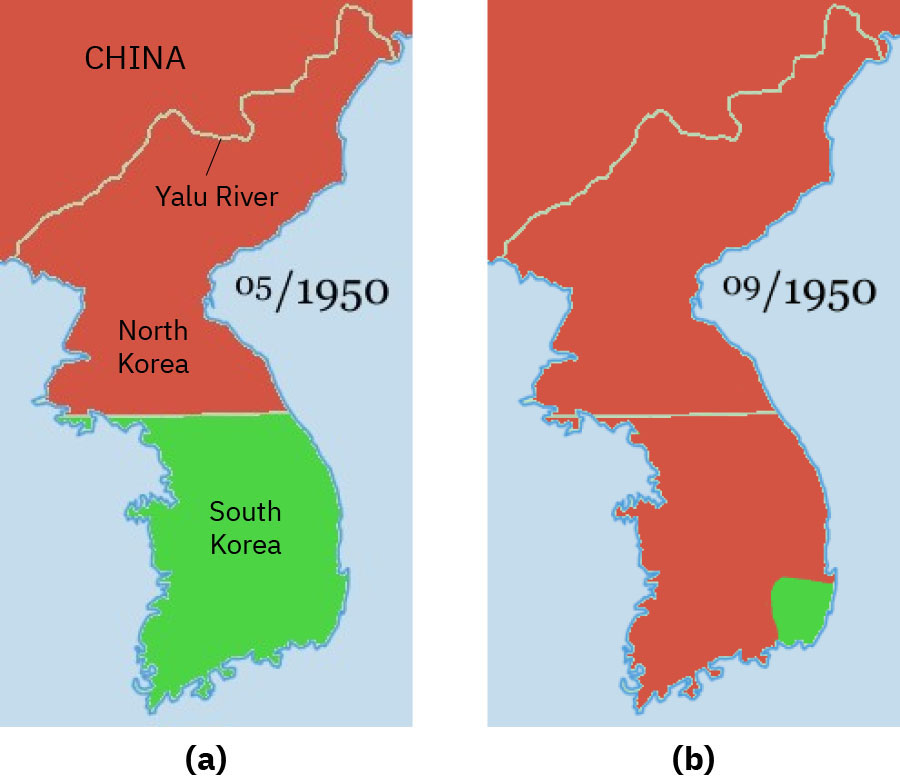
The United States suspected the invasion of South Korea had been a ploy by the Soviets to test the U.S. response to an act of armed communist aggression. But Stalin had in fact warned Kim against it. Unwilling to start a war with the United States in Asia, he advised Kim to seek assistance not from Moscow but from Mao, whose CCP forces North Korea had aided in the Chinese civil war. Thus, while the United States immediately dispatched air and naval forces to Korea, the Soviet Union sent nothing. Initially Kim did not need assistance, though, and North Korean troops swiftly overran nearly the entire Korean peninsula, with ROK, UN, and U.S. forces clinging to the area around the port of Pusan in the south (Figure 14.9).
英語のヒント
アメリカは、韓国への侵攻が、共産主義勢力の武力侵略に対するアメリカの反応を試すソ連の策略ではないかと疑った。しかし実際には、スターリンは金日成に侵攻を思いとどまるよう警告していた。アジアでアメリカと戦争を始めることを望まず、援助を求める相手はモスクワではなく、中国内戦で北朝鮮が共産党軍を助けた毛沢東にするよう助言した。そのため、アメリカが直ちに空海軍を朝鮮へ派遣する一方、ソ連は何も送らなかった。ただ、当初の金日成は援助を必要としていなかった。北朝鮮軍は半島のほぼ全域をたちまち制圧し、韓国軍、国連軍、アメリカ軍は南部の港、釜山周辺にかろうじて踏みとどまっていた(図14.9)。
The Korean War Begins.朝鮮戦争の始まり
(credit a: modification of work “Map of Korean war in May 1950” by Wikimedia/Wikimedia Commons, CC0 1.0; credit b: modification of work “Map of Korean war in September 1950” by Wikimedia/Wikimedia Commons, CC0 1.0) · CC0 1.0
Figure 14.9 (a) The map on the left shows the division of the Korean peninsula between North and South in May 1950, the month before the Korean War began. (b) By September the North Korean army had forced South Korean, UN, and U.S. troops to retreat to the far southeastern part of the peninsula. (credit a: modification of work “Map of Korean war in May 1950” by Wikimedia/Wikimedia Commons, CC0 1.0; credit b: modification of work “Map of Korean war in September 1950” by Wikimedia/Wikimedia Commons, CC0 1.0)
図14.9 (a)左の地図は朝鮮戦争開始の前月、1950年5月の半島の南北分断を示す。(b)9月までに北朝鮮軍は、韓国軍、国連軍、アメリカ軍を半島南東端へ後退させた。(出典a:Wikimedia「Map of Korean war in May 1950」を改変/Wikimedia Commons、CC0 1.0。出典b:Wikimedia「Map of Korean war in September 1950」を改変/Wikimedia Commons、CC0 1.0)
The situation was reversed in September 1950 when U.S. troops led by General Douglas MacArthur landed behind KPA lines at Incheon. Seoul was swiftly retaken, and Rhee returned to power. With his original objective met, MacArthur was given a new goal: to reunify Korea under Rhee’s control if possible—and if the attempt did not lead to Chinese or Soviet intervention. Despite a warning by China that its forces would enter the war should the thirty-eighth parallel be crossed, MacArthur’s forces, with permission from the UN, did just that, chasing KPA troops northward toward the Yalu River, North Korea’s border with China.
英語のヒント
1950年9月、ダグラス・マッカーサー将軍率いるアメリカ軍が、朝鮮人民軍の背後に当たる仁川へ上陸し、情勢は逆転した。ソウルは速やかに奪還され、李承晩は政権へ戻った。当初の目標を達成したマッカーサーは、新たに、可能であれば李承晩の支配下で朝鮮を統一するという目標を与えられた。ただし、中国やソ連の介入を招かないことが条件だった。中国は38度線を越えれば参戦すると警告したが、マッカーサーの部隊は国連の許可を得て、まさにその一線を越えた。北朝鮮軍を追って、中国との国境である鴨緑江へ向け北進したのである。
Although not all prominent members of the Chinese Communist Party approved of committing troops to a war in Korea, Mao favored sending aid to Kim. Chinese forces had been gathering with the intention of invading Taiwan and defeating the Nationalist government there, but when the United States moved its Seventh Fleet into the straits between Taiwan and the Chinese mainland, China’s opportunity was lost. Its forces that might otherwise have gone to Taiwan now entered the fray in Korea, crossing the Yalu River on October 19, 1950. By December, Chinese and North Korean forces had sent UN and U.S. troops into retreat, back across the thirty-eighth parallel into South Korea. A cease-fire proposed by the UN was rejected by the Chinese forces, and fighting raged through the harsh Korean winter.
英語のヒント
中国共産党の有力者全員が朝鮮への派兵に賛成したわけではなかったが、毛沢東は金日成への援助を支持した。中国軍は台湾へ侵攻して国民党政府を倒すため集結していたものの、アメリカが第7艦隊を台湾と中国大陸の間の海峡へ送ったことで、その機会を失った。さもなければ台湾へ向かったかもしれない部隊は、今度は朝鮮の戦いに加わり、1950年10月19日に鴨緑江を渡った。12月までに中国軍と北朝鮮軍は国連軍とアメリカ軍を後退させ、38度線を越えて韓国へ押し戻した。中国軍は国連の停戦提案を拒否し、厳しい朝鮮の冬の間も激戦が続いた。
By July 1951, the war had turned into a deadly stalemate near where it began, along the thirty-eighth parallel. Both sides, exhausted, began to discuss peace on July 10. Negotiations dragged on for two years as the two sides fought to gain as much territory as possible before a cease-fire was finally proclaimed. On July 27, 1953, the Korean Armistice Agreement was signed. To prevent the recurrence of hostilities, a Korean Demilitarized Zone was established, roughly along the thirty-eighth parallel, to be patrolled by North and South Korean forces, and U.S. troops remained in South Korea as a deterrent to future North Korean aggression.
英語のヒント
1951年7月までに、戦争は始まった場所に近い38度線沿いで、多くの命を奪う膠着状態となった。疲弊した双方は7月10日に和平協議を始めた。交渉は2年にわたり、その間も最終的な停戦までにできるだけ多くの領土を確保しようと戦闘が続いた。1953年7月27日、朝鮮休戦協定が調印された。戦闘の再発を防ぐため、おおむね38度線に沿って非武装地帯が設けられ、南北の部隊が警戒に当たった。アメリカ軍は、将来の北朝鮮の侵攻への抑止力として韓国に残った。
Like many of the proxy wars of the Cold War, in which the troops of nations allied with the United States and the Soviet Union faced off against one another rather than risk direct conflict between the superpowers, the Korean War was futile. Approximately three million people died in the three-year conflict, most of them Korean civilians who either were caught in the crossfire or became victims of starvation and disease, and all Korea’s cities lay in ruins. No territory was gained by either side, and no political transformation occurred in either the North or the South. The country remained divided, with North Korea adopting an isolationist policy that left it cut off from the West.
英語のヒント
冷戦期の多くの代理戦争と同じく、朝鮮戦争は実りのないものだった。代理戦争とは、超大国同士の直接衝突を避けるため、アメリカやソ連と同盟する国々の軍が対峙する戦争である。3年間の戦闘で約300万人が死亡した。その大半は交戦に巻き込まれたり、飢えや病気の犠牲となったりした朝鮮の民間人で、朝鮮の都市はすべて廃墟となった。どちらの陣営も領土を獲得せず、南北いずれでも政治体制の転換は起こらなかった。分断は続き、北朝鮮は西側との関係を断つ孤立主義的な政策を採用した。
China also suffered as a result of the Korean War. Now regarded by the United States and Western Europe as an aggressor nation, it too found itself isolated and dependent on the Soviet Union for assistance. In the United States, the outbreak of the war had pushed President Truman to adopt the policy recommended by the State Department in NSC-68, a document that, among other things, called for increased spending on defense. Although Truman had initially been reluctant to do so, the need to confront the Chinese forces on the Korean peninsula led him to more than triple U.S. defense spending. Korea had convinced the country of the need to always possess the capability to do battle with communist forces.
英語のヒント
中国も朝鮮戦争の結果として損害を受けた。アメリカと西ヨーロッパに侵略国とみなされ、孤立してソ連の援助に依存するようになった。アメリカでは戦争の勃発が、国務省の文書NSC-68で勧告された政策をトルーマン大統領に採用させるきっかけとなった。この文書は、とりわけ国防費の増額を求めていた。トルーマンは当初ためらったが、朝鮮半島で中国軍と対峙する必要から、国防費を3倍以上に増やした。朝鮮戦争は、共産主義勢力と戦える能力を常に備える必要性を、アメリカに確信させた。
China’s actions in Korea also bolstered U.S. resolve both to protect the Nationalist government in Taiwan and to act decisively to stop the spread of communism in Asia. In 1954, the United States joined Britain, France, Thailand, Pakistan, the Philippines, Australia, and New Zealand to form the Southeast Asia Treaty Organization (SEATO) to prevent the expansion of communism in Southeast Asia. The organization had no capacity to mobilize troops, however, and focused largely on trying to improve standards of living in the region, in the hope of making communism less attractive.
英語のヒント
朝鮮での中国の行動は、台湾の国民党政府を守り、アジアでの共産主義拡大を断固として阻止するというアメリカの決意も強めた。1954年、アメリカはイギリス、フランス、タイ、パキスタン、フィリピン、オーストラリア、ニュージーランドとともに、東南アジアでの共産主義の拡大を防ぐため、東南アジア条約機構(SEATO)を結成した。しかし、この組織は部隊を動員する能力を持たず、共産主義の魅力を弱めようと、主に地域の生活水準の向上に取り組んだ。
Alarmed by the creation of SEATO, in September 1958 the PRC began to bombard Jinmen (Quemoy), Mazu (Matsu), and Dachen, islands off the coast of China that Taiwan claimed as territory belonging to the Nationalists, in what was called the First Taiwan Strait Crisis. Although the United States had no wish to engage in war with the PRC, the attacks on the islands led it to sign a Mutual Defense Treaty with Taiwan, assuring the nation of U.S. support in the event of war with China. In 1958, the PRC once again bombarded Jinmen and Mazu, sparking the Second Taiwan Strait Crisis. When the United States began to supply the Nationalist troops stationed on the islands, the bombardment ended. The situation was not fully resolved until the 1970s, when the United States and the PRC had established more peaceful relations with one another.
英語のヒント
SEATOの成立に危機感を抱いた中華人民共和国は、1958年9月、中国沿岸の金門、馬祖、大陳への砲撃を始めた。これらは台湾側が国民党に属する領土と主張する島々だった。この出来事は第一次台湾海峡危機と呼ばれる。アメリカは中華人民共和国との戦争を望まなかったが、島々への攻撃を受けて台湾と相互防衛条約を結び、中国と戦争になった場合の支援を約束した。1958年、中華人民共和国は金門と馬祖を再び砲撃し、第二次台湾海峡危機を引き起こした。アメリカが島々の国民党軍に補給を始めると、砲撃は終わった。この情勢が完全に落ち着くのは、アメリカと中華人民共和国の関係がより平和的になった1970年代のことだった。