第14章冷戦期の紛争Cold War Conflicts
14.3 The Non-Aligned Movement14.3 非同盟運動
Learning Objectives学習の目標
By the end of this section, you will be able to:
この節を読み終えると、次のことができるようになる。
Describe the relationship between Yugoslavia and the Soviet Union
ユーゴスラヴィアとソ連の関係を説明する
Discuss the goals of the Non-Aligned Movement
非同盟運動の目標を論じる
Explain how Indonesia, India, and Egypt attempted to avoid joining either the Western or the Eastern Bloc
インドネシア、インド、エジプトが東西いずれの陣営への参加もどう避けようとしたかを説明する
Identify the causes of the Israeli-Arab conflict in the Middle East
中東におけるイスラエルとアラブの対立の原因を明らかにする
As the Soviet Union and the United States struggled for supremacy, they sought to attract the support of the world’s nations by offering financial aid, military support, and technical advice. Many countries were willing to align with one side or the other for a variety of reasons, sometimes ideological but often not. Some nations, however, resisted being drawn into either camp.
英語のヒント
ソ連とアメリカは優位を争うなかで、資金援助、軍事支援、技術的助言を提供し、世界各国の支持を引きつけようとした。多くの国はさまざまな理由で一方の陣営と連携しようとした。その理由は思想上のものもあったが、そうでない場合も多かった。しかし、どちらの陣営にも取り込まれることを拒む国々もあった。
Yugoslaviaユーゴスラヴィア
In the aftermath of World War II, the nations of Europe speedily aligned themselves with either the Western or the Eastern Bloc, with one exception: Yugoslavia. In 1942, communist partisans who had fought the Axis powers on behalf of the People’s Liberation Front formed a government, the Anti-Fascist Council for the National Liberation of Yugoslavia (AVNOJ). When Italian forces evacuated Yugoslavia in 1943, AVNOJ assumed control of the territory and established the state of Democratic Federal Yugoslavia. The partisans’ leader, Josip Broz Tito, was named prime minister. In 1945, Yugoslavia’s monarchy was abolished, and Tito was recognized as the leader of the country. This result was confirmed by a nationwide election held shortly thereafter.
英語のヒント
第二次世界大戦後、ヨーロッパ諸国は、ユーゴスラヴィアを唯一の例外として、速やかに西側か東側の陣営に加わった。1942年、人民解放戦線のために枢軸国と戦った共産主義のパルチザンは、ユーゴスラヴィア人民解放反ファシスト会議(AVNOJ)という政府を組織した。1943年にイタリア軍がユーゴスラヴィアから撤退すると、AVNOJは領域を支配し、民主連邦ユーゴスラヴィアを成立させた。パルチザン指導者ヨシップ・ブロズ・チトーが首相となった。1945年には王政が廃止され、チトーが国家の指導者と認められた。この結果は、直後の全国選挙でも確認された。
Yugoslavia was a communist state from the beginning and was one of the founders of the Cominform, the Information Bureau of the Communist and Workers’ Parties, in 1947. Cominform’s purpose was to give direction to the communist governments of Europe after World War II so that they might coordinate their efforts to oppose anti-communist activity in the rest of Europe. The Soviet Union would be at the fore, providing guidance for the others.
英語のヒント
ユーゴスラヴィアは当初から共産主義国であり、1947年にはコミンフォルム、すなわち共産党・労働者党情報局の設立国の一つとなった。コミンフォルムの目的は、第二次世界大戦後のヨーロッパの共産主義政権に方針を示し、ヨーロッパの他の地域の反共活動へ協調して対抗できるようにすることだった。ソ連が先頭に立ち、他国を指導することになっていた。
Tito and Stalin clashed early on, however. Tito wished to incorporate within Yugoslavia the countries of Bulgaria and Albania, as well as parts of Greece, Italy, and Austria. Stalin opposed Yugoslavia’s claims, believing them to be unreasonable and likely to cause trouble with Western Europe. Yugoslavia also aided the Greek communists in their civil war, which Stalin opposed as well, again believing the West would be angered by it. Tito, for his part, refused to accept a secondary position for Yugoslavia. Unlike the other members of the Eastern Bloc, Yugoslavia had liberated itself from the Axis without Soviet assistance. Thus, Tito believed it should be treated by the Soviet Union as an equal, not as a satellite state to which it gave orders.
英語のヒント
しかしチトーとスターリンは早い段階で対立した。チトーは、ブルガリア、アルバニア、さらにギリシャ、イタリア、オーストリアの一部をユーゴスラヴィアに取り込みたかった。スターリンは、その要求を無理なものと考え、西ヨーロッパとの問題を招くとして反対した。ユーゴスラヴィアはギリシャ内戦で共産主義者を援助したが、スターリンはこれにも、西側を怒らせるとして反対した。チトーの側は、ユーゴスラヴィアが従属的な地位に置かれることを拒んだ。他の東側諸国と違い、ユーゴスラヴィアはソ連の援助なしに自力で枢軸国から解放された。したがってチトーは、ソ連に命令される衛星国としてではなく、対等の国として扱われるべきだと考えた。
In 1948 Cominform expelled Yugoslavia. For assistance Tito turned to the United States, which helped Yugoslavia survive despite its inability to trade with its Eastern Bloc neighbors. Tito, however, was equally concerned about becoming a puppet of the United States, and during the 1950s and 1960s, Yugoslavia became economically self-sufficient and traded with members of both the Western and Eastern Blocs. In 1960, Tito spoke before the General Assembly of the United Nations and called upon “non-bloc countries” to unite to achieve common goals of decolonization, disarmament, bans on nuclear testing, and equality of economic development.
英語のヒント
1948年、コミンフォルムはユーゴスラヴィアを除名した。チトーはアメリカへ援助を求め、アメリカの支援によって、近隣の東側諸国と貿易できなくても生き延びた。しかしチトーは、アメリカの操り人形になることも同じように警戒した。1950〜1960年代、ユーゴスラヴィアは経済的自立を進め、東西両陣営の国々と貿易した。1960年、チトーは国連総会で演説し、「陣営に属さない国々」に対し、脱植民地化、軍縮、核実験禁止、経済発展の平等という共通の目標へ向けて団結するよう呼びかけた。
The Bandung Conference and Indonesiaバンドン会議とインドネシア
Among European nations, Yugoslavia’s refusal to become a member of either the Western or the Eastern Bloc made it an exception. But a desire to plot a middle path between the superpowers was common in former colonies or protectorates of European powers, especially in South Asia, Africa, and the Middle East.
英語のヒント
ヨーロッパの国々の中では、東西いずれの陣営にも加わらないユーゴスラヴィアは例外だった。しかし、超大国の間で中間の道を進もうという願いは、かつてヨーロッパ列強の植民地や保護国だった国々、とくに南アジア、アフリカ、中東では広く見られた。
In April 1955 representatives from twenty-nine such countries in Asia and Africa gathered at a conference in Bandung, Indonesia. Their goal was to be able to rely on one another as they strove to industrialize and avoid the need to turn to Europe, the United States, or the Soviet Union for assistance. This aim formed the basis for the Non-Aligned Movement, an attempt by newly independent nations to stay out of the orbit of either the Western or the Eastern Bloc.
英語のヒント
1955年4月、アジアとアフリカのこうした29か国の代表が、インドネシアのバンドンで会議を開いた。工業化を進める際に互いを頼り、ヨーロッパ、アメリカ、ソ連に援助を求めずにすむようにすることが目標だった。この目標は、新たに独立した国々が東西いずれの陣営の勢力圏にも入らずにいようとする、非同盟運動の基礎となった。
Indonesia assumed a leading role in the Non-Aligned Movement. An anti-Dutch independence campaign had developed there before World War II, and in August 1945 two of its leaders, Mohammad Hatta and Kusno Sosrodihardjo, known as Sukarno, proclaimed independence for Indonesia, a status that became official in 1949. Sukarno, on becoming president, stressed that the nation wished to remain neutral in foreign affairs.
英語のヒント
インドネシアは非同盟運動の中心的役割を担った。第二次世界大戦以前から反オランダ独立運動があり、1945年8月、指導者のモハマッド・ハッタと、スカルノとして知られるクスノ・ソスロディハルジョが独立を宣言した。独立は1949年に正式なものとなった。大統領に就いたスカルノは、外交で中立を保ちたいと強調した。
Both the United States and the Soviet Union desired Indonesia as an ally. It was a country with a large population, oil deposits, and a strategically advantageous geographical position. Both sides believed Indonesia’s future path—communist or democratic—would greatly influence the other nations of Asia. Accordingly, both courted Sukarno, and Sukarno accepted aid from both. In his eyes, so long as he did not allow either superpower to determine Indonesia’s affairs, his country was neutral.
英語のヒント
アメリカとソ連はともに、インドネシアを同盟国にしたかった。人口が多く、石油を産出し、地理的にも戦略上有利な位置を占めたからである。両国は、共産主義へ進むか民主主義へ進むかというインドネシアの選択が、アジアの他国を大きく左右すると考えた。そこで双方がスカルノに接近し、スカルノも双方から援助を受けた。いずれの超大国にも国内のことを決めさせなければ、自国は中立だというのが彼の考えだった。
In 1956, Sukarno visited China and was impressed by what Mao Zedong had been able to achieve. Believing Mao’s ability to centralize power lay at the heart of China’s success, upon his return to Indonesia, Sukarno established a National Council made up of representatives of larger social groups, such as peasants and workers, to reach decisions by consensus rather than by voting. In the new “Guided Democracy” he established in 1959, the consensus of the nation would be expressed through the president instead of the legislature. To shore up his autocratic authority, Sukarno turned to both the Indonesian Communist Party and the conservative armed forces. His goal was the creation of an Indonesian state based on what he called NASAKOM, an acronym standing for nationalism, religion, and communism.
英語のヒント
1956年、スカルノは中国を訪れ、毛沢東の成果に感銘を受けた。権力を中央へ集中する毛の力こそ中国の成功の中心にあると考え、帰国すると国民評議会を設置した。農民や労働者などの大きな社会集団の代表によって構成し、投票ではなく合意によって決定する機関である。1959年に打ち出した新しい「指導される民主主義」では、国民の合意を議会ではなく大統領を通じて表すこととされた。独裁的な権威を支えるため、スカルノはインドネシア共産党と保守的な軍部の双方を頼った。目標は、民族主義、宗教、共産主義の頭文字を組み合わせた「ナサコム」に基づくインドネシア国家の建設だった。
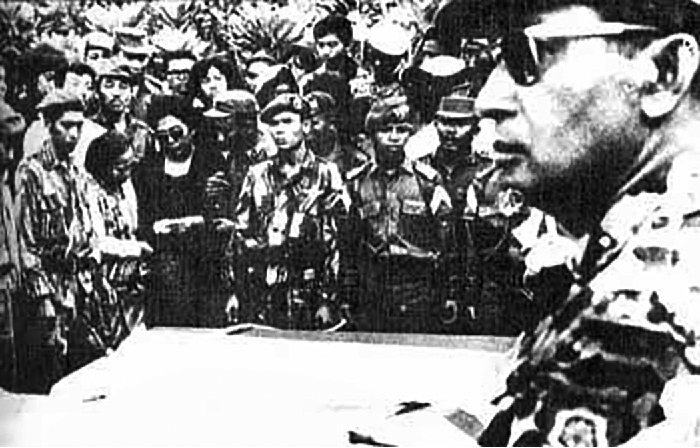
By 1964 Sukarno had abandoned all pretense of neutrality and sought alliances with communist countries while encouraging anti–United States sentiment in Indonesia. In 1965, Suharto, a general in the Indonesian military, claimed that Indonesian communists had sought to subvert the government by plotting to kill Sukarno. Suharto’s subsequent destruction of Indonesia’s communists, carried out with the aid of the CIA, may have cost the lives of some one million people (Figure 14.12). In 1967, Suharto removed Sukarno from office and assumed dictatorial powers.
英語のヒント
1964年までにスカルノは中立の建前をすべて捨て、国内の反米感情をあおりながら共産主義国との同盟を求めた。1965年、軍の将軍スハルトは、インドネシアの共産主義者がスカルノ殺害を企て、政府を転覆させようとしたと主張した。その後スハルトはCIAの援助を受けて共産主義者を破壊し、約100万人が犠牲になった可能性がある(図14.12)。1967年にはスカルノを失脚させ、独裁権力を握った。
Suharto.スハルト
(credit: “Suharto at funeral” by Department of Information of the Republic of Indonesia/Wikimedia Commons, Public Domain) · Public Domain
Figure 14.12 Major-General Suharto (right) attends a funeral for generals he claimed were killed in a communist coup. He used the supposed coup as an excuse to kill Indonesian communists. (credit: “Suharto at funeral” by Department of Information of the Republic of Indonesia/Wikimedia Commons, Public Domain)
図14.12 共産主義者のクーデターで殺されたとスハルトが主張した将軍たちの葬儀に参列する、スハルト少将(右)。彼はこのクーデターとされる事件を口実に、インドネシアの共産主義者を殺害した。(出典:インドネシア共和国情報省「Suharto at funeral」/Wikimedia Commons、パブリックドメイン)