第14章冷戦期の紛争Cold War Conflicts
Western and Eastern Blocs西側陣営と東側陣営
The tensions between the United States and the Soviet Union that had built up slowly through the later 1940s came to a head in 1948. Believing a strong Germany was vital to Europe’s economic recovery and a necessary bulwark against the spread of communism, the United States, Britain, and France planned to reunify the three zones of Germany they had occupied since the end of World War II. United, these zones would dwarf the Soviet zone in size, population, and wealth and, by sharing a single currency, play a major role in Europe’s postwar economy.
英語のヒント
1940年代後半にゆっくりと高まってきた米ソ間の緊張は、1948年に頂点に達した。アメリカ、イギリス、フランスは、強いドイツがヨーロッパの経済復興に欠かせず、共産主義の拡大への防壁にもなると考え、第二次世界大戦の終結以来それぞれが占領していたドイツの3地区を統合する計画を立てた。統合すれば、これらの地区は面積、人口、富でソ連占領地区をはるかに上回り、共通通貨を用いることによって、戦後ヨーロッパ経済で大きな役割を果たすはずだった。
The Soviet Union hoped to keep Germany disunited and weak and thus objected. In March 1948, it withdrew from the Allied Control Council that coordinated Allied actions in Germany. In June, the United Kingdom and the United States introduced a new currency, the Deutschemark, into their zones as well as into the western portions of Berlin they controlled, in order to dispense Marshall Plan funds. Infuriated, the Soviet Union cut off all ground routes into West Berlin. No food or fuel could enter the city by road, railroad, or canal. The Soviets planned to starve the Western Allies out, forcing them to abandon their sections of Berlin and thus their toehold within the Soviet zone.
英語のヒント
ソ連はドイツを分裂した弱い状態にとどめたかったため、反対した。1948年3月、ドイツにおける連合国の活動を調整する連合国管理理事会から脱退した。6月には、イギリスとアメリカがマーシャル・プランの資金を配分するため、新通貨ドイツ・マルクを、自国の占領地区と管理下にあるベルリン西部へ導入した。激怒したソ連は、西ベルリンに通じるすべての地上交通路を遮断した。食糧も燃料も、道路・鉄道・運河を通して市内へ運べなくなった。ソ連は物資を絶って西側連合国を撤退させ、ベルリンの担当地区と、ソ連占領地区内に確保した足場を放棄させようとした。
Realizing that air was their only way around the blockade, the United Kingdom and the United States swiftly formulated plans to supply the besieged city by plane. For nearly a year, they carried out the Berlin Airlift, an extensive operation that at one point had a British or U.S. plane taking off from Berlin’s Tempelhof Airport every forty-five seconds (Figure 14.5). Recognizing they could not defeat the resolve of the Western Allies, the Soviets ended the blockade in May 1949. Two weeks later, the Western Allies unified their occupation zones to form the new country of the Federal Republic of Germany, usually referred to as West Germany, with the city of Bonn as its capital.
英語のヒント
封鎖をかいくぐる唯一の道が空であると判断したイギリスとアメリカは、包囲された都市へ航空機で物資を供給する計画を急いで整えた。約1年にわたり、大規模な「ベルリン空輸」が行われた。ある時期にはベルリンのテンペルホーフ空港から、英米の航空機が45秒ごとに1機離陸していた(図14.5)。西側連合国の決意をくじけないと悟ったソ連は、1949年5月に封鎖を解除した。2週間後、西側連合国は自国の占領地区を統合し、ボンを首都とするドイツ連邦共和国を成立させた。一般に「西ドイツ」と呼ばれる国である。
Berlin Airlift.ベルリン空輸
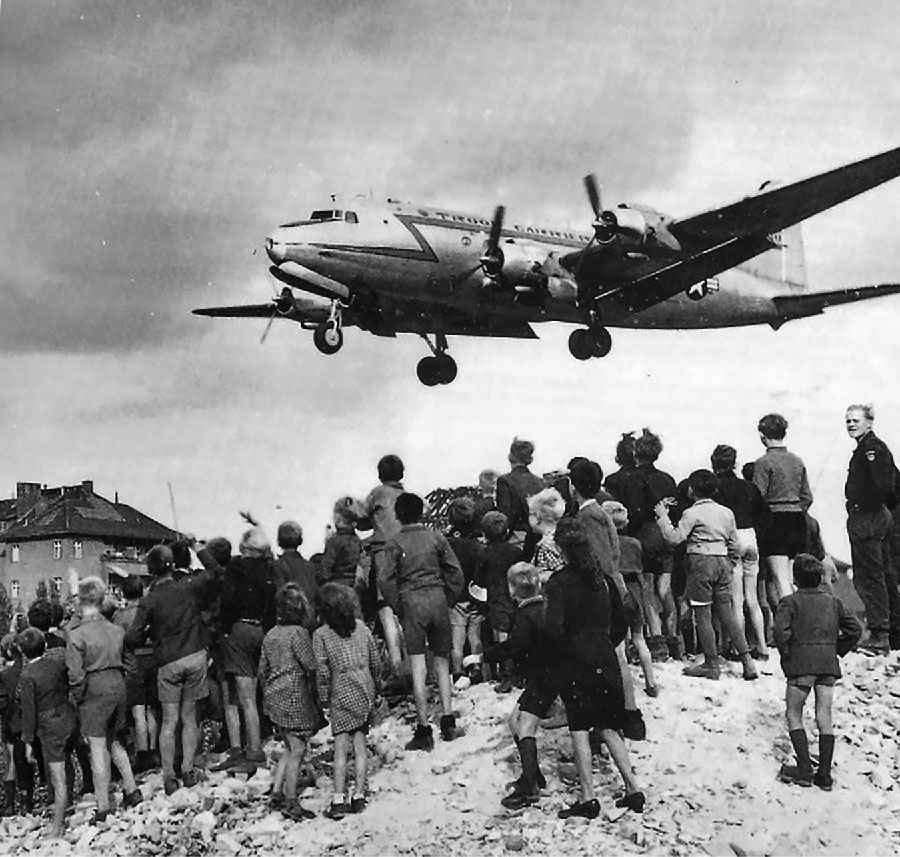
(credit: “Berliners watching a C-54 land at Berlin Tempelhof Airport, 1948” by Henry Ries/U.S. Air Force/Wikimedia Commons, Public Domain) · Public Domain
Figure 14.5 Residents of West Berlin watch as a U.S. cargo plane bearing crucial supplies lands at Tempelhof Airport in 1948. (credit: “Berliners watching a C-54 land at Berlin Tempelhof Airport, 1948” by Henry Ries/U.S. Air Force/Wikimedia Commons, Public Domain)
図14.5 1948年、不可欠な物資を載せたアメリカの輸送機がテンペルホーフ空港へ着陸するのを見守る西ベルリン市民。(出典:Henry Ries/米空軍「Berliners watching a C-54 land at Berlin Tempelhof Airport, 1948」/Wikimedia Commons、パブリックドメイン)
The Western Allies then took another step to guard against potential Soviet aggression. In 1948, Belgium, France, Luxemburg, the Netherlands, and the United Kingdom had signed the Treaty of Brussels, forming a military alliance for purposes of protection against the Soviet Union. In 1949, shortly before the Berlin blockade ended, the United States joined those nations as well as Canada, Portugal, Italy, Denmark, Norway, and Iceland to form the North Atlantic Treaty Organization (NATO), an alliance for military assistance and mutual defense. Should one of the member nations be attacked, the others agreed to come to its aid. The capitalist democratic countries that joined NATO formed a bloc, a group of countries united for a common purpose, that became known as the Western Bloc. The Western Bloc opposed communist expansion in Europe by the countries of the Eastern Bloc, composed of the Soviet Union and its allies.
英語のヒント
西側連合国は、ソ連の侵略の可能性に備えて、さらに一歩踏み込んだ。1948年、ベルギー、フランス、ルクセンブルク、オランダ、イギリスはブリュッセル条約に署名し、ソ連への防衛を目的とする軍事同盟を結んでいた。ベルリン封鎖が終わる直前の1949年、アメリカはこれらの国々に加え、カナダ、ポルトガル、イタリア、デンマーク、ノルウェー、アイスランドとともに、軍事援助と相互防衛のための北大西洋条約機構(NATO)を結成した。加盟国の一つが攻撃された場合、他の国々が援助することに合意したのである。NATOに加盟する資本主義の民主国家は、共通の目的のために結びついた国々の集団、すなわち「ブロック」を形成し、西側陣営と呼ばれるようになった。西側陣営は、ソ連とその同盟国からなる東側陣営がヨーロッパで共産主義を広めることに対抗した。
In 1955, when West Germany also joined NATO, the Soviet Union formed a military and political alliance of its own, the Warsaw Treaty Organization or the Warsaw Pact. Its other members were the communist nations of Eastern Europe: Albania, Bulgaria, Czechoslovakia, Hungary, Poland, Romania, and the German Democratic Republic (East Germany), formerly the Soviet occupation zone. The Soviets regarded the pact as a vital defense against a united Western Europe and resurgent Germany. NATO and the Warsaw Pact represented the nations on opposite sides of the Iron Curtain and hardened the lines that had been drawn between them (Figure 14.6). The Western and Eastern Blocs soon faced off against one another, not only in Europe but in the rest of the world as well.
英語のヒント
1955年に西ドイツもNATOへ加盟すると、ソ連は独自の軍事・政治同盟、ワルシャワ条約機構を結成した。ソ連以外の加盟国は、アルバニア、ブルガリア、チェコスロヴァキア、ハンガリー、ポーランド、ルーマニア、そして旧ソ連占領地区であるドイツ民主共和国(東ドイツ)という、東ヨーロッパの共産主義国だった。ソ連はこの同盟を、結束する西ヨーロッパと再興するドイツへの重要な防衛手段とみなした。NATOとワルシャワ条約機構は鉄のカーテンの両側の国々を代表し、双方の間に引かれた境界を固めた(図14.6)。西側と東側の両陣営は、ヨーロッパだけでなく世界各地でも対峙するようになった。
The Cold War in Europe.ヨーロッパの冷戦
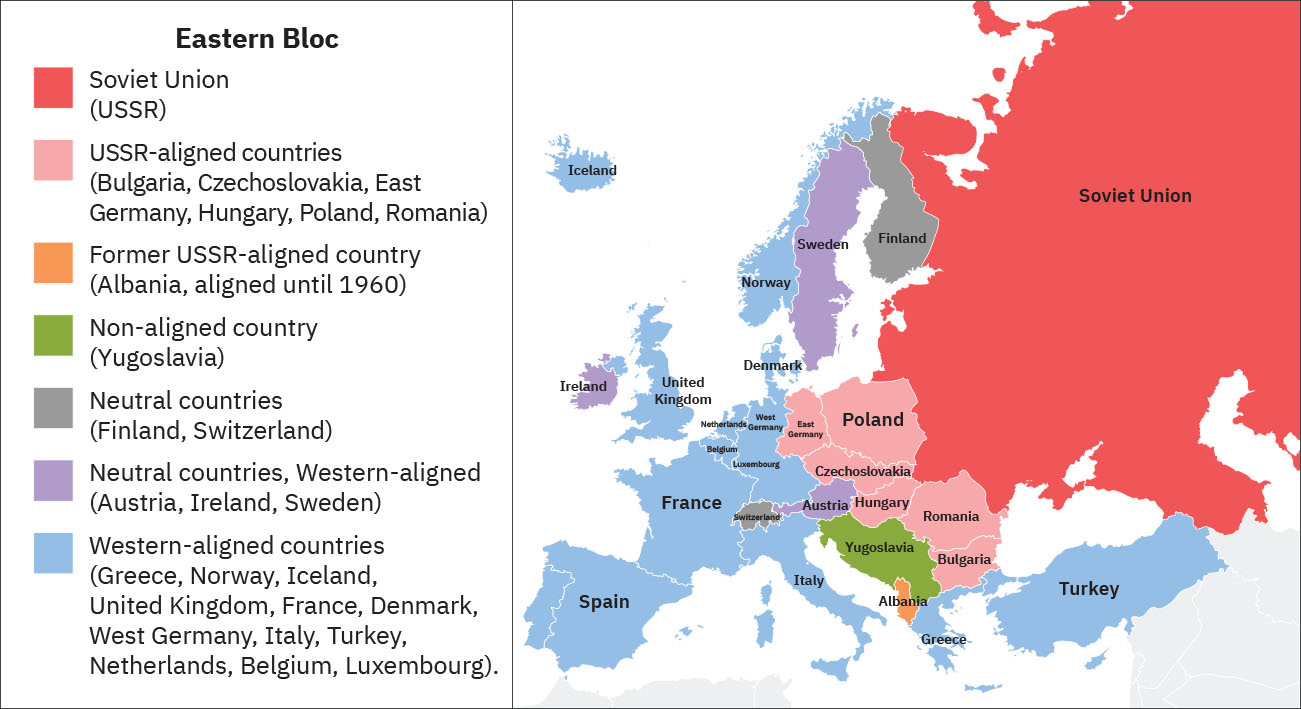
(credit: modification of work “Allegiance of European countries during the Cold War” by “UserGoldsztajn”/Wikimedia Commons, Public Domain) · Public Domain
Figure 14.6 After West Germany joined NATO in 1955, the Soviet Union and other nations formed their own alliance, resulting in the creation of the Eastern Bloc. Yugoslavia, although a communist nation and considered part of this bloc, had officially divorced itself from Soviet control prior to the Warsaw Pact. (credit: modification of work “Allegiance of European countries during the Cold War” by “UserGoldsztajn”/Wikimedia Commons, Public Domain)
図14.6 1955年に西ドイツがNATOに加盟した後、ソ連などの国々は独自の同盟を結び、東側陣営が形成された。ユーゴスラヴィアは共産主義国で、この陣営の一部とみなされたものの、ワルシャワ条約の成立以前にソ連の支配から正式に離れていた。(出典:「UserGoldsztajn」「Allegiance of European countries during the Cold War」を改変/Wikimedia Commons、パブリックドメイン)
Cold War Strategies冷戦の戦略
The Cold War between West and East was fought on many fronts with many strategies. Both sides provided aid and technical assistance to countries in Latin America, Asia, and Africa, many of which had been European colonies until the end of World War II. Through such aid, the United States hoped to contain the spread of communism by depriving countries of an economic reason for aligning themselves with the Soviet Union. Communism was attractive to many poor people. It promised that a nation’s wealth would be used to provide for all its citizens, and under the Soviet system, people were provided with jobs, housing, education, health care, and public transportation. Although the standard of living was lower than in the West, for poor people who lived with the constant threat of hunger and homelessness and saw no chance of improving their situation, communism was an attractive alternative.
英語のヒント
東西の冷戦は、さまざまな場で、多様な戦略を使って争われた。両陣営はラテンアメリカ、アジア、アフリカの国々に援助と技術支援を提供した。これらの多くは、第二次世界大戦の終わりまでヨーロッパの植民地だった。アメリカは援助によって、ソ連と連携する経済上の理由を各国から取り去り、共産主義の拡大を封じ込めようとした。共産主義は多くの貧しい人々にとって魅力的だった。国の富をすべての国民の生活のために用いると約束したからである。ソ連の体制では、人々に仕事、住居、教育、医療、公共交通が提供された。生活水準は西側より低かったが、常に飢えや住居を失う危険と隣り合わせで、暮らしが良くなる見込みを持てない貧しい人々には、魅力ある別の選択肢だった。
Propaganda in the form of literature, visual imagery, and films was also used by each side to shore up support for its policies and political ideology, and to damage the credibility and prestige of the other side. In 1950, the U.S.-funded Radio Free Europe began broadcasting news to the countries of the Eastern Bloc, and in 1953, Radio Liberty began broadcasting to the Soviet Union. Radio Free Europe and the Free Europe Committee, an organization of American business executives and lawyers established by the U.S. government, printed leaflets and posters touting the superiority of life in democratic, capitalist countries and dropped them from weather balloons over East Germany, Poland, Czechoslovakia, and Hungary.
英語のヒント
双方はまた、文章、図像、映画による宣伝を用い、自らの政策と政治思想への支持を固めるとともに、相手側の信用と威信を傷つけようとした。1950年、アメリカが資金を提供するラジオ・フリー・ヨーロッパが東側陣営へニュースを放送し始め、1953年にはラジオ・リバティがソ連向け放送を開始した。ラジオ・フリー・ヨーロッパと、アメリカ政府が設立した経営者・弁護士の組織である自由ヨーロッパ委員会は、民主的な資本主義国の暮らしの優秀さを宣伝するビラやポスターを印刷し、気象観測気球で東ドイツ、ポーランド、チェコスロヴァキア、ハンガリーの上空から投下した。
Soviet propaganda stressed the USSR’s desire for world peace and praised the communist ideals of a classless society in which people were treated equally regardless of race or gender. This message had a strong appeal for people in Latin America, Africa, and Asia. Some African Americans, confronted by racism and segregation in the United States, were also attracted by these promises. Indeed, opponents of the civil rights movement in the United States often denounced it as communist in nature.
英語のヒント
ソ連の宣伝は、自国が世界平和を望んでいることを強調し、人種や性別にかかわらず平等に扱われる階級のない社会という共産主義の理想をたたえた。この主張はラテンアメリカ、アフリカ、アジアの人々に強く訴えた。アメリカで人種差別と人種隔離に直面していた黒人の中にも、こうした約束に引かれる人がいた。実際、アメリカの公民権運動に反対する人々は、この運動の本質は共産主義だとしばしば非難した。
Sometimes propaganda took the form of athletic competitions in which each side used its swimmers, runners, weightlifters, and gymnasts to display the superiority of its system. Sports and news broadcasts kept a close watch on the number of medals won by U.S. and Soviet athletes during Olympic competitions. At other times, cultural exchanges took place. Soviet ballet dancers toured the United States, while American jazz musicians and symphony orchestras visited Eastern Bloc countries.
英語のヒント
宣伝がスポーツ競技の形を取ることもあった。双方は水泳、陸上、重量挙げ、体操の選手を使って、自国の体制の優秀さを示した。スポーツ番組やニュース番組は、オリンピックで米ソの選手が獲得するメダル数を注意深く追った。文化交流が行われることもあった。ソ連のバレエ団がアメリカを巡演し、アメリカのジャズ奏者や交響楽団が東側諸国を訪れた。
Both sides highlighted their ingenuity and technological achievements. At a 1959 exhibition in Moscow, U.S. vice president Richard Nixon proudly showed off American technology to Soviet premier Nikita Khrushchev in the form of a model kitchen. Khrushchev’s response to the labor-saving gadgetry on display was to inquire whether American families also had machines to save them the effort of putting food in their mouths and swallowing it. The two countries competed to dominate space as well. In 1957, the United States suffered a serious blow to its pride when the Soviet Union launched Sputnik, the first satellite (Figure 14.7). In response, in 1958 President Dwight D. Eisenhower called on Congress to establish an agency to explore space. The National Aeronautics and Space Administration (NASA) was established that year. In 1961 the Soviet Union sent the first astronaut into space. In 1969 the United States put the first humans on the surface of the moon.
英語のヒント
双方は、自国の創意工夫と技術的成果を強調した。1959年のモスクワの博覧会で、アメリカ副大統領リチャード・ニクソンは、モデル・キッチンを通じてアメリカの技術をソ連首相ニキータ・フルシチョフに誇らしげに披露した。フルシチョフは、展示された省力機器を見て、アメリカの家庭には食べ物を口へ入れてのみ込む手間まで省く機械があるのかと尋ねた。両国は宇宙でも優位を競った。1957年、ソ連が最初の人工衛星スプートニクを打ち上げると、アメリカの自尊心は大きく傷ついた(図14.7)。これに応じて、1958年、ドワイト・D・アイゼンハワー大統領は宇宙探査を担う機関の設置を議会に求めた。同年、アメリカ航空宇宙局(NASA)が設立された。1961年にソ連は最初の宇宙飛行士を宇宙へ送り、1969年にはアメリカが人類を初めて月面に立たせた。
The Space Race.宇宙開発競争
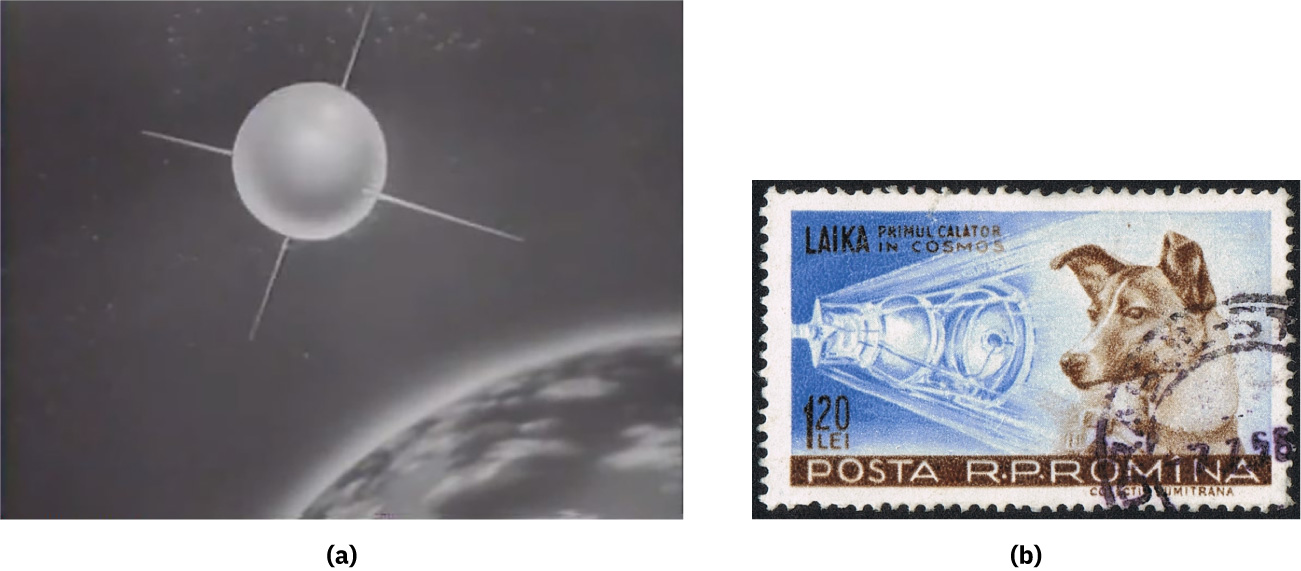
(credit a: modification of work “First report of Sputnik” by Universal Newsreel/Wikimedia Commons, Public Domain; credit b: modification of work “Laika, dog launched into space on stamp from Rumania Posta Romania, 1957” by Unknown/Wikimedia Commons, Public Domain) · Public Domain
Figure 14.7 The Soviet Union’s 1957 launching of the satellite Sputnik, shown here in an artist’s rendering, spurred the United States to create NASA, its own space agency. The following month, the Soviets topped their achievement by sending a dog, Laika, into space aboard Sputnik 2 (b), commemorated in this 1959 Romanian stamp. (credit a: modification of work “First report of Sputnik” by Universal Newsreel/Wikimedia Commons, Public Domain; credit b: modification of work “Laika, dog launched into space on stamp from Rumania Posta Romania, 1957” by Unknown/Wikimedia Commons, Public Domain)
図14.7 1957年のソ連によるスプートニク打ち上げを描いた想像図。この成功は、アメリカが独自の宇宙機関NASAを設置するきっかけとなった。翌月、ソ連は犬のライカをスプートニク2号で宇宙へ送り、さらに成果を重ねた。(b)はそれを記念する1959年のルーマニア切手。(出典a:Universal Newsreel「First report of Sputnik」を改変/Wikimedia Commons、パブリックドメイン。出典b:作者不詳「Laika, dog launched into space on stamp from Rumania Posta Romania, 1957」を改変/Wikimedia Commons、パブリックドメイン)
Espionage was another important tool, carried out by the United States through the Central Intelligence Agency (CIA) formed in 1947, and by the USSR with its spy agency the KGB. Besides surveilling the other nation, these agencies also plotted, assisted in, and carried out acts of sabotage and the assassination of those deemed enemies of their country. Both the CIA and the KGB fomented discontent in foreign nations as well, trained fighting forces, and encouraged revolution and insurgency to topple foreign governments and install leaders who would be friendly to their respective countries. The CIA, for example, trained Cuban insurgents with the goal of overthrowing the Caribbean island’s communist government under Fidel Castro in 1961. Similarly, the KGB gave assistance to Vietnamese communists attempting to defeat the government of South Vietnam during the Vietnam War.
英語のヒント
諜報活動も重要な手段だった。アメリカは1947年設立の中央情報局(CIA)を通じて、ソ連は諜報機関KGBを通じてこれを行った。これらの機関は相手国を監視するだけでなく、自国の敵とみなした者への破壊工作や暗殺を計画し、支援し、実行した。双方とも外国で不満をあおり、戦闘部隊を訓練し、革命や反乱を促して政権を倒し、自国に友好的な指導者を据えようとした。例えばCIAは1961年、カリブ海のキューバでフィデル・カストロの共産主義政権を倒すことを目指し、キューバの反乱勢力を訓練した。同様にKGBは、ベトナム戦争中、南ベトナム政府の打倒を目指すベトナムの共産主義者を援助した。
The most dangerous venue for competition, however, and the two sides’ chief means of reining in aggression on the part of the other, was the stockpiling of massive nuclear arsenals. In 1949, the Soviet Union detonated an atomic bomb, ending the U.S. monopoly on nuclear weapons. In 1952 the United States took the next step, one opposed by some of the same atomic scientists who had worked on the Manhattan Project during World War II, and developed the hydrogen bomb, testing it on the Pacific atoll of Eniwetok in 1952. This missile was one thousand times more powerful than the bomb dropped on Hiroshima. U.S. development of such a weapon meant the Soviet Union needed to do the same.
英語のヒント
しかし、最も危険な競争の場であり、相手の攻撃性を抑える双方の主要な手段となったのは、大量の核兵器の備蓄だった。1949年、ソ連が原子爆弾を爆発させ、アメリカの核独占は終わった。1952年、アメリカは次の段階へ進んだ。第二次世界大戦中にマンハッタン計画に加わった原子科学者の一部も反対した水素爆弾を開発し、同年、太平洋のエニウェトク環礁で実験した。このミサイルの威力は、広島に投下された爆弾の1,000倍だった。アメリカがこうした兵器を開発すれば、ソ連も同じことをする必要があるとされた。
In the 1950s, both the United States and the USSR developed intercontinental ballistic missiles (ICBMs) as well. Now missiles armed with nuclear warheads could be launched from within the home country’s own territory or within the borders of satellite nations; an air force capable of intercepting bomb-bearing planes was no longer sufficient to protect against nuclear attack. Although countries in both the Western and Eastern Blocs prepared for potential war by creating shelters to protect citizens in the event of nuclear war, neither side put great faith in its ability to emerge victorious. Both the United States and the USSR quickly came to believe that the key to survival lay in building an immense retaliatory capacity, the ability to unleash devastation so great that the other side would never detonate the first bomb for fear of its own annihilation. In the United States, this defense policy came to be referred to as “mutually assured destruction” (MAD). Should these nuclear stockpiles prove unsuccessful at deterring a conflict, the large military forces the rivals built up during the Cold War, along with billions of dollars’ worth of battleships, submarines, and fighter jets, ensured they possessed the capacity to fight a conventional war as well.
英語のヒント
1950年代には、アメリカとソ連の双方が大陸間弾道ミサイル(ICBM)も開発した。核弾頭を載せたミサイルを自国や衛星国の領内から発射できるようになり、爆弾を運ぶ航空機を迎撃できる空軍だけでは、もはや核攻撃を防げなくなった。西側、東側の両陣営は、核戦争の際に国民を守るシェルターを造って備えたが、どちらも勝利できると強く信じてはいなかった。双方は間もなく、生き残る鍵は巨大な報復能力にあると考えるようになった。最初の核爆弾を使えば自らも滅亡するという恐怖から、相手が先制使用できなくなるほどの破壊を与える能力である。アメリカではこの防衛政策を「相互確証破壊」(MAD)と呼ぶようになった。もし核備蓄が紛争の抑止に失敗しても、両国が冷戦中に増強した大軍と、何十億ドルもの戦艦、潜水艦、戦闘機によって、通常戦争を戦う能力も確保されていた。