第6章植民地化と経済の拡大Colonization and Economic Expansion
Introductionはじめに
Furs and Tobacco.毛皮とタバコ
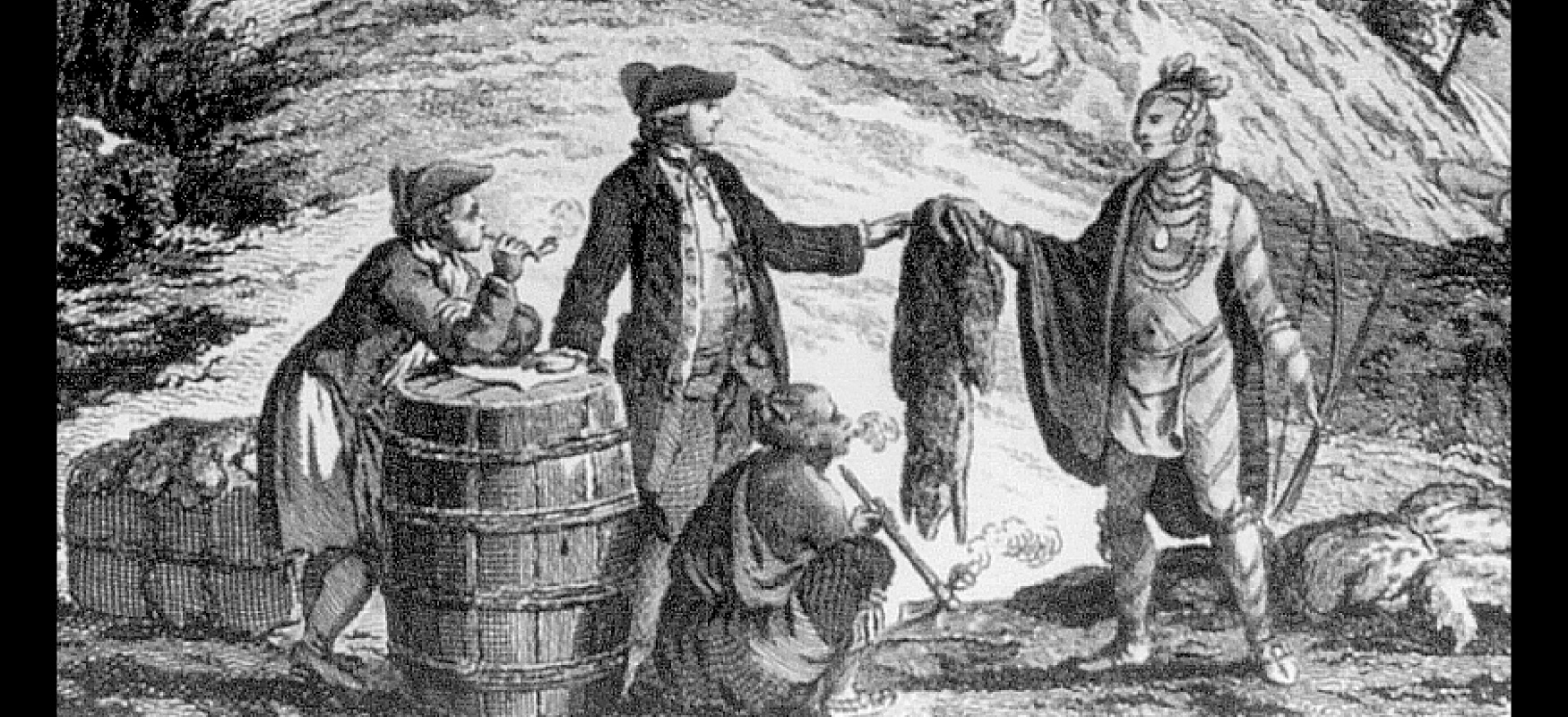
(credit: modification of work “A Map of the Inhabited Part of Canada, Frontispiece by William Faden 1777” by Library of Congress Prints and Photographs division/Wikimedia Commons, Public Domain) · Public Domain
Figure 6.1 This 1777 Canadian image depicts European traders negotiating with Native Americans (called First Nations in Canada) in the course of the era’s highly profitable fur trade. Note that a European and a Native American are both smoking pipes, probably filled with tobacco, another important trade good at this time. (credit: modification of work “A Map of the Inhabited Part of Canada, Frontispiece by William Faden 1777” by Library of Congress Prints and Photographs division/Wikimedia Commons, Public Domain)
英語のヒント
図6.1 1777年のカナダを描いたこの図は、当時きわめて利益の大きかった毛皮交易の場で、ヨーロッパの商人がアメリカ先住民(カナダではファースト・ネーションズと呼ばれる)と交渉する様子を表している。ヨーロッパ人と先住民がともにパイプを吸っている点に注目しよう。中に詰めているのはおそらくタバコで、これも当時の重要な交易品だった。(出典:米国議会図書館版画・写真部/ウィキメディア・コモンズ「ウィリアム・フェイデンによる『カナダの居住地域の地図』扉絵、1777年」を改変。パブリックドメイン)
In the eighteenth and nineteenth centuries, the world’s great oceans effectively became highways as European explorers, merchants, and laborers proved willing to journey greater distances than they had in the past and traveled to new destinations in the Americas, Africa, and Asia. New economic systems propelled exploration, communication, interaction, exchange, and—in many tragic cases—exploitation. Communities in Asia, Africa, and the Americas that had once had little or no contact with one another now found themselves enmeshed in a variety of exchanges. Confronted with a changing world, every community made hard decisions. Some, like the Native Americans seen here (Figure 6.1), embraced the newcomers as trading partners or political allies, gaining access to new goods and sometimes profiting for a time. Others resisted the newcomers, often at great cost to themselves.
英語のヒント
18世紀と19世紀には、ヨーロッパの探検家、商人、労働者が、以前よりも長い距離を進んで旅するようになり、アメリカ大陸、アフリカ、アジアの新たな目的地へ向かったため、世界の大洋は事実上の幹線道路になった。新しい経済制度が、探検、通信、交流、交換を推し進め、悲劇的な多くの場合には搾取をも推し進めた。かつて互いにほとんど、あるいはまったく接触のなかったアジア、アフリカ、アメリカ大陸の共同体は、今やさまざまな交換の関係に絡め取られていた。変化する世界に直面して、どの共同体も難しい決断を下した。ここに描かれた先住民(図6.1)のように、新来者を交易相手や政治的な同盟者として受け入れ、新しい品物を入手し、ときには一時的に利益を得た人々もいた。別の人々は新来者に抵抗し、そのために大きな犠牲を払うことも多かった。
Timeline: Colonization and Economic Expansion.年表:植民地化と経済的拡大
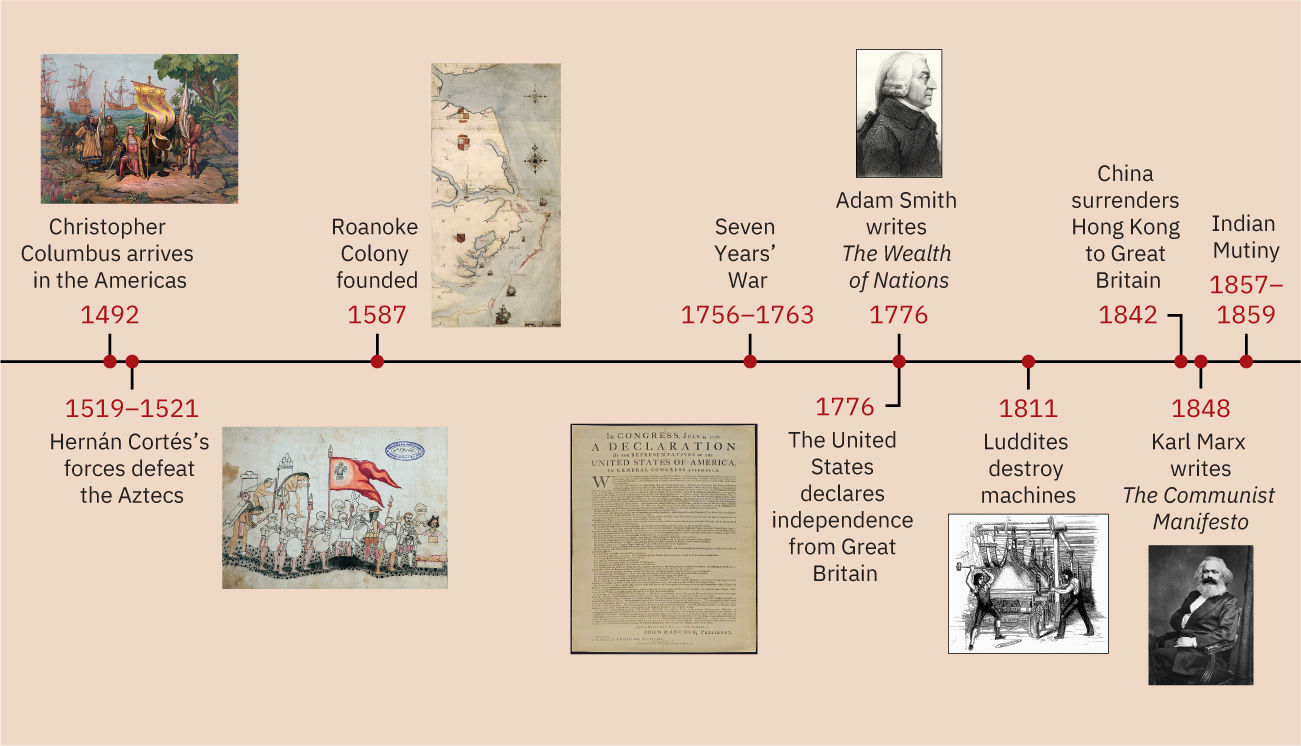
(credit “1492”: modification of work “Columbus taking possession of the new country” by Library of Congress's Prints and Photographs division/Wikimedia Commons, Public Domain; credit “1519–1521”: modification of work “Codex Azcatitlan” by Gallica Digital Library/Wikimedia Commons, Public Domain; credit “1587”: modification of work “Roanoke map 1584” by The British Museum/Wikimedia Commons, Public Domain; credit “1776 top”: modification of work “Profile of Adam Smith” by Adam Smith - Vanderblue Collection/Wikimedia Commons, Public Domain; credit “1776 bottom”: modification of work “Declaration of Independence” by Library of Congress/Wikimedia Commons, Public Domain; credit “1811”: modification of work “Frame-breakers, or Luddites, smashing a loom” by Unknown/Wikimedia Commons, Public Domain; credit “1848”: modification of work “Portrait of Karl Marx” by International Institute of Social History/Wikimedia Commons, Public Domain) · Public Domain
Figure 6.2 (credit “1492”: modification of work “Columbus taking possession of the new country” by Library of Congress's Prints and Photographs division/Wikimedia Commons, Public Domain; credit “1519–1521”: modification of work “Codex Azcatitlan” by Gallica Digital Library/Wikimedia Commons, Public Domain; credit “1587”: modification of work “Roanoke map 1584” by The British Museum/Wikimedia Commons, Public Domain; credit “1776 top”: modification of work “Profile of Adam Smith” by Adam Smith - Vanderblue Collection/Wikimedia Commons, Public Domain; credit “1776 bottom”: modification of work “Declaration of Independence” by Library of Congress/Wikimedia Commons, Public Domain; credit “1811”: modification of work “Frame-breakers, or Luddites, smashing a loom” by Unknown/Wikimedia Commons, Public Domain; credit “1848”: modification of work “Portrait of Karl Marx” by International Institute of Social History/Wikimedia Commons, Public Domain)
図6.2 (「1492年」出典:米国議会図書館版画・写真部/ウィキメディア・コモンズ「新たな土地の領有を宣言するコロンブス」を改変。パブリックドメイン。「1519~1521年」出典:ガリカ電子図書館/ウィキメディア・コモンズ『アスカティトラン絵文書』を改変。パブリックドメイン。「1587年」出典:大英博物館/ウィキメディア・コモンズ「1584年のロアノーク地図」を改変。パブリックドメイン。「1776年上」出典:アダム・スミス―ヴァンダーブルー・コレクション/ウィキメディア・コモンズ「アダム・スミスの横顔」を改変。パブリックドメイン。「1776年下」出典:米国議会図書館/ウィキメディア・コモンズ「独立宣言」を改変。パブリックドメイン。「1811年」出典:作者不詳/ウィキメディア・コモンズ「織機を破壊する機械打ち壊し人、ラッダイト」を改変。パブリックドメイン。「1848年」出典:国際社会史研究所/ウィキメディア・コモンズ「カール・マルクスの肖像」を改変。パブリックドメイン)