第6章植民地化と経済の拡大Colonization and Economic Expansion
New Englandニューイングランド
In 1620, Puritan Separatists led by William Bradford left Plymouth, England, on the Mayflower and founded a colony they called Plymouth near what is now Boston, Massachusetts. The Separatists wanted to leave England to escape the Church of England, which they felt was corrupt, and whose interpretation of scripture the Separatists considered lax. Before landing, their leaders signed the Mayflower Compact, a document that emphasized their desire to found a colony for “the glory of God, and Advancement of the Christian Faith, and the Honour of our King and Country.” More than just a religious document, the Mayflower Compact also had a major political impact with its support of direct democracy and of building governments that reflected the will of the people.
英語のヒント
1620年、ウィリアム・ブラッドフォードが率いるピューリタン分離派は、メイフラワー号でイングランドのプリマスを出発し、現在のマサチューセッツ州ボストンに近い場所に、プリマスと名づけた植民地を建設した。分離派がイングランドを去りたかったのは、イングランド国教会から逃れるためだった。彼らは国教会が腐敗しており、聖書の解釈も厳格さを欠いていると考えていた。上陸する前に、指導者たちはメイフラワー誓約に署名した。この文書は、「神の栄光、キリスト教信仰の発展、そしてわれらの国王と祖国の名誉」のために植民地を建てたいという願いを強調していた。メイフラワー誓約は単なる宗教文書にとどまらず、直接民主制と、民衆の意思を反映する政府の建設を支持したことによって、大きな政治的影響も及ぼした。
Like the English settlers far to the south in Virginia, the Separatists struggled to survive in their new homes. Roughly half died of starvation, disease, malnutrition, and cold during the difficult winter of 1620–1621. Many of the survivors became too weak to work, and soon the entire colony was dependent on the seven who were healthy enough to do so. Political disputes broke out, and the first English colony in New England almost died. Just when Plymouth seemed doomed, Native Americans decided to help. They included Samoset, a member of the Abenaki tribe who had been living with the Wampanoag tribe, and Tisquantum (Squanto) of the Pawtuxet tribe, who had learned to speak some English from fishers who visited the coast before the Separatists arrived. Tisquantum had been kidnapped by English explorer Thomas Hunt and sold into slavery in Spain but had managed to escape to England. There, he joined the Newfoundland Company, another English joint stock company, and had returned to North America in 1619. Samoset, Tisquantum, and other friendly Native Americans helped the English negotiate treaties with nearby tribes and taught them to grow corn, which became the colony’s main food source. But a relationship that may have begun as a friendly attempt to help starving strangers quickly shifted to conflict as the colonizers began seizing Indigenous lands.
英語のヒント
はるか南のヴァージニアにいたイングランド人入植者と同じく、分離派も新しい土地で生き延びるために苦闘した。1620~1621年の厳しい冬に、およそ半数が飢餓、病気、栄養不良、寒さで死亡した。生存者の多くも衰弱して働けなくなり、まもなく植民地全体が、働けるだけの健康を保っていた7人に依存するようになった。政治的な争いも起こり、ニューイングランド最初のイングランド植民地は消滅寸前になった。プリマスの破滅が迫ったかに見えたそのとき、先住民が援助を決めた。その中には、ワンパノアグ族と暮らしていたアベナキ族のサモセットと、ポートゥクセット族のティスクアントム(スクアント)がいた。ティスクアントムは、分離派が到着する前に沿岸を訪れた漁師たちから、英語をいくらか話せるようになっていた。イングランドの探検家トマス・ハントに誘拐され、スペインで奴隷として売られたことがあったが、イングランドへ逃れることに成功した。そこで別のイングランドの株式会社であるニューファンドランド会社に加わり、1619年に北アメリカへ戻っていた。サモセット、ティスクアントム、そしてほかの友好的な先住民は、イングランド人が近隣の諸部族と条約を交渉するのを助け、トウモロコシの栽培を教えた。トウモロコシは植民地の主要な食料となった。しかし、飢えた見知らぬ人々を友好的に助ける試みとして始まったのかもしれないこの関係は、植民者が先住民の土地を奪い始めるにつれ、急速に対立へ変わった。
A larger group of Puritans followed in 1630 and founded the Massachusetts Bay Colony. Their leader John Winthrop gave a speech titled “A Model of Christian Charity,” which expressed his hopes that the Puritan community in the Americas would embrace the twin goals of building economic prosperity and founding a “City upon a Hill” that would serve as a shining example of an ideal Christian community to the entire world.
英語のヒント
1630年には、さらに大きなピューリタンの集団が後に続き、マサチューセッツ湾植民地を築いた。指導者ジョン・ウィンスロップは「キリスト教的慈愛の模範」と題する演説を行った。そこでは、アメリカ大陸のピューリタン共同体が、経済的繁栄を築くことと、理想的なキリスト教共同体の輝かしい手本を全世界に示す「丘の上の町」を建設すること、という二つの目標を受け入れるよう願いを表明した。
The Puritan colonies were also scenes of religious conflict from which dissenters like Anne Hutchinson, who questioned the all-male church leadership, and Roger Williams, who championed religious toleration, were exiled. The Massachusetts Bay Colony’s darkest moment may have come during the 1692 Salem witch trials, when Puritan leaders executed nineteen people for witchcraft. Despite such conflicts, the Puritan colonies eventually became self-sustaining communities that mostly achieved their twin objectives of promoting Puritan religious ideology and building a strong economy.
英語のヒント
ピューリタンの植民地は宗教的対立の舞台でもあった。男性だけからなる教会指導部に疑問を呈したアン・ハッチンソンや、宗教的寛容を擁護したロジャー・ウィリアムズのような異論を唱える人々は、そこから追放された。マサチューセッツ湾植民地で最も暗い出来事は、1692年のセイラム魔女裁判だったかもしれない。このときピューリタンの指導者たちは、魔術を行ったとして19人を処刑した。こうした対立があったにもかかわらず、ピューリタンの植民地は最終的に自立できる共同体となり、ピューリタンの宗教思想を広めることと、強い経済を築くことという二つの目的を、おおむね達成した。
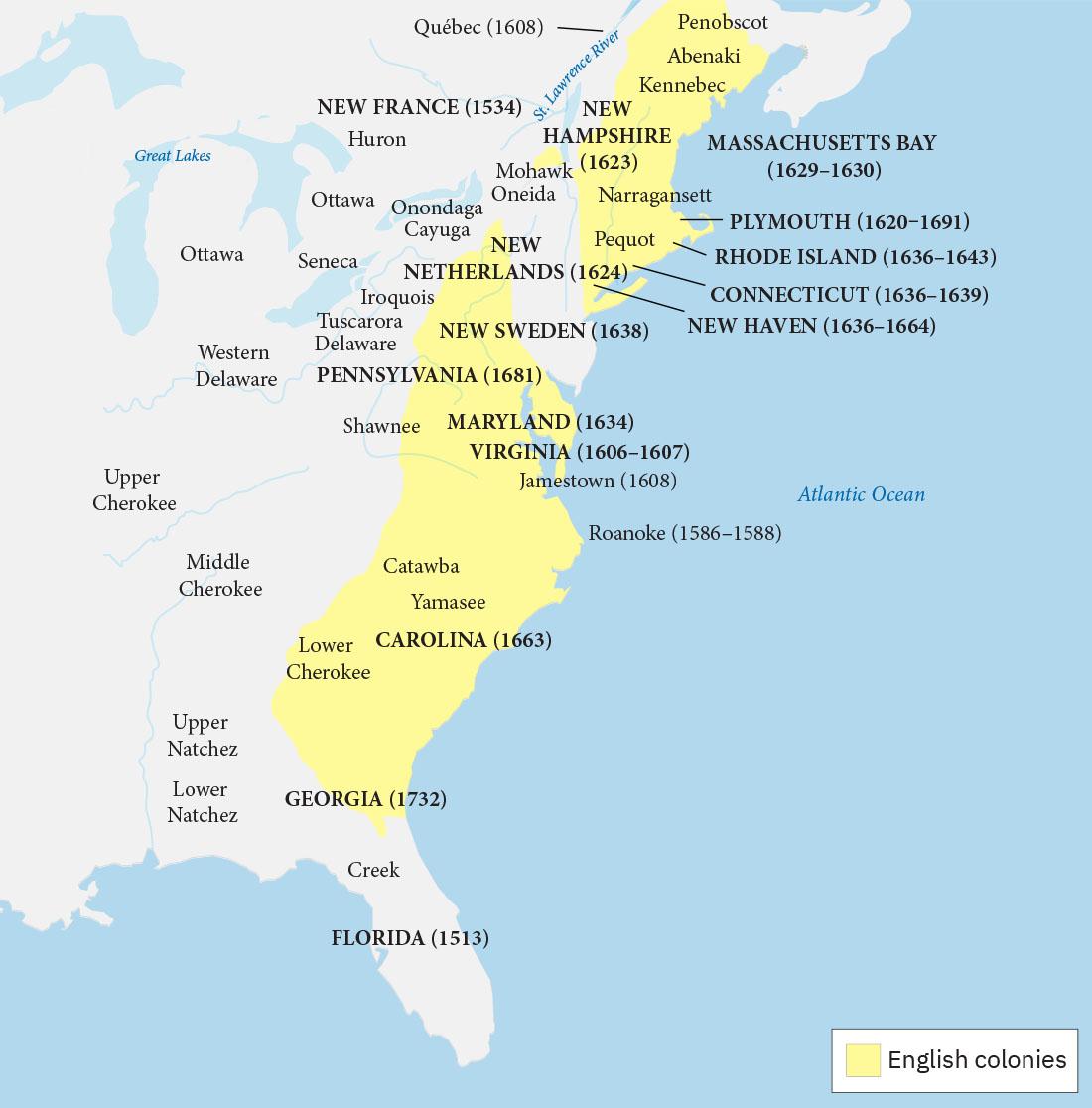
Puritan settlers hoped a strong economy would allow their colony to flourish, attract new settlers, and provide evidence of God’s favor. Like many Europeans of the 1600s and 1700s, they rooted their economic ideas in mercantilism. The desire to build economic wealth was the primary motive in many colonial ventures, such as Jamestown in Virginia, and provided a secondary motivation in more ideologically driven communities like those set up by the Puritans (Figure 6.7).
英語のヒント
ピューリタンの入植者は、強い経済があれば植民地を繁栄させ、新たな入植者を引きつけ、神の恩寵の証拠にもなると期待した。1600年代と1700年代の多くのヨーロッパ人と同様、彼らの経済観は重商主義に根ざしていた。経済的な富を築きたいという願いは、ヴァージニアのジェームズタウンなど、多くの植民地事業の第一の動機であり、ピューリタンが作った共同体のように、より強く思想に動かされた共同体でも、第二の動機となった(図6.7)。
English Settlements.イングランドの入植地
(attribution: Copyright Rice University, OpenStax, under CC BY 4.0 license) · CC BY 4.0
Figure 6.7 This map shows English colonies and key settlements in North America in the 1600s, as well as the neighboring territories inhabited by Native American tribes at the time. Many more tribes inhabited this region than the few whose names appear on the map. (attribution: Copyright Rice University, OpenStax, under CC BY 4.0 license)
英語のヒント
図6.7 この地図は1600年代の北アメリカのイングランド植民地と主要入植地、および当時先住民の諸部族が暮らした周辺の領域を示す。実際には、地図に名が載る少数の部族よりはるかに多くの部族が、この地域に暮らしていた。(帰属表示:著作権ライス大学、OpenStax。CC BY 4.0ライセンス)
French and Dutch Settlementsフランスとオランダの入植地
In 1609, Dutch merchants hired Henry Hudson, an English sea captain, to lead an expedition into the Atlantic Ocean. The Dutch hoped Hudson would find the long-sought Northwest Passage, a mythical water route thought to allow ships from Europe to sail west through the North American continent, cross the Pacific Ocean, and arrive in Asia. Hudson discovered a deep-water port, now known as New York harbor, and a large river, now known as the Hudson, that led inland. For a moment it appeared he had found the Northwest Passage. However, the Hudson River became too shallow for ocean-going ships near present-day Albany, New York, and the expedition turned back. Hudson did not find the Northwest Passage, but he did find a valuable port and rich river valley that he claimed for the Dutch.
英語のヒント
1609年、オランダの商人たちは、イングランド人船長ヘンリー・ハドソンを雇い、大西洋への遠征を率いさせた。オランダ人が期待したのは、長年探し求められていた北西航路の発見だった。これは、ヨーロッパの船が北アメリカ大陸を西へ通り抜け、太平洋を横断してアジアに至れると考えられた、想像上の水路だった。ハドソンは、現在ニューヨーク港と呼ばれる水深の深い港と、現在ハドソン川と呼ばれる、内陸へ続く大河を発見した。一時は北西航路を発見したかに見えた。しかし、現在のニューヨーク州オールバニー付近でハドソン川は外洋航行船には浅すぎるようになり、遠征隊は引き返した。北西航路は見つからなかったものの、ハドソンは価値の高い港と豊かな川沿いの谷を見つけ、そのオランダによる領有を宣言した。
After Hudson returned to Europe, the Dutch West India Company, a joint stock company much like the Virginia Company, made plans to set up a small colony in North America. In contrast to the settled agricultural model preferred by English colonists, the Dutch focused on trade. Company directors hoped their colony would improve their access to the North American fur trade, ensure their control of the valuable port eventually known as New York Harbor, and solidify their claim on the area, which they suspected might contain additional sources of wealth they had not yet discovered. In 1624, thirty families aboard the ship Nieu Nederlandt arrived in what is now New York and founded the Dutch colony of New Netherlands. They came for many reasons, but many hoped to become rich by working in the fur trade.
英語のヒント
ハドソンがヨーロッパへ戻ると、ヴァージニア会社によく似た株式会社であるオランダ西インド会社は、北アメリカに小さな植民地を設ける計画を立てた。イングランド人植民者が好んだ定住型の農業モデルと異なり、オランダ人は交易を重視した。会社の取締役たちは、植民地によって北アメリカの毛皮交易へ参加しやすくなり、後にニューヨーク港と呼ばれる価値ある港の支配が確保され、この地域への領有主張も強まると期待した。この地域には、まだ発見していない別の富の源もあるかもしれないと考えていたのである。1624年、船ニウ・ネーデルラント号に乗った30家族が現在のニューヨークに到着し、オランダのニューネーデルラント植民地を建設した。渡来の理由はさまざまだったが、多くの人は毛皮交易に携わって裕福になりたいと願っていた。
The Dutch, like their Spanish and English colonial rivals, struggled to produce goods using paid labor and sought to remedy the problem with the importation of enslaved Africans. They also encouraged immigration from across Europe with promises of economic opportunities and some level of religious toleration that extended even to Jewish people, who faced severe discrimination in most of Europe. New Netherlands soon became a prosperous colony populated by people from across Europe and Africa. Colonists lived in a band of farms and towns stretching along the Hudson River Valley from New Amsterdam, which is now New York City, north to the village of Beverwijck, now Albany. They engaged in some farming, but they mostly relied on the fur trade for their income.
英語のヒント
オランダ人も、植民地で競合するスペイン人やイングランド人と同様、賃金労働での生産に苦労し、奴隷化したアフリカ人を連れ入れることで問題を解決しようとした。また、経済的機会と一定の宗教的寛容を約束し、ヨーロッパ各地からの移住を促した。その寛容は、ヨーロッパの大部分で厳しい差別に直面していたユダヤ人にも及んだ。ニューネーデルラントはまもなく、ヨーロッパ各地とアフリカの出身者が暮らす繁栄した植民地になった。入植者は、現在のニューヨーク市であるニューアムステルダムから、現在のオールバニーであるベーヴェルウェイク村まで、ハドソン川流域を北へ延びる帯状の農場と町に住んだ。農業もいくらか行ったが、収入は主に毛皮交易に依存していた。
New Netherlands became a scene of increasing conflict as the colony grew. Initially the Dutch enjoyed friendly relationships with Native Americans eager to trade their furs for European firearms, metal tools, and wool blankets. Serious disputes began, however, when the Dutch demanded payment for the benefits they believed they had brought, including knowledge of the Christian faith and connection to global markets. Native Americans refused to pay, and violence broke out. To protect New Amsterdam from attack, the Dutch forced enslaved Africans to build fortifications along what was then the city’s northeast boundary. The street that ran along these fortifications was known as Wall Street; it later became a major economic center and the home of the New York Stock Exchange.
英語のヒント
ニューネーデルラントでは、植民地の成長につれて対立が激しくなった。当初オランダ人は、毛皮をヨーロッパ製の銃、金属製の道具、毛布と交換したがる先住民と友好関係を保っていた。しかし、自分たちがもたらしたと考える恩恵――キリスト教信仰の知識や世界市場とのつながりなど――の代価を要求すると、深刻な争いが始まった。先住民は支払いを拒み、暴力が発生した。ニューアムステルダムを攻撃から守るため、オランダ人は奴隷化されたアフリカ人に、当時の町の北東境界沿いに防御施設を築くことを強制した。その防御施設に沿う通りはウォール街と呼ばれ、後に一大経済拠点となり、ニューヨーク証券取引所が置かれるようになった。
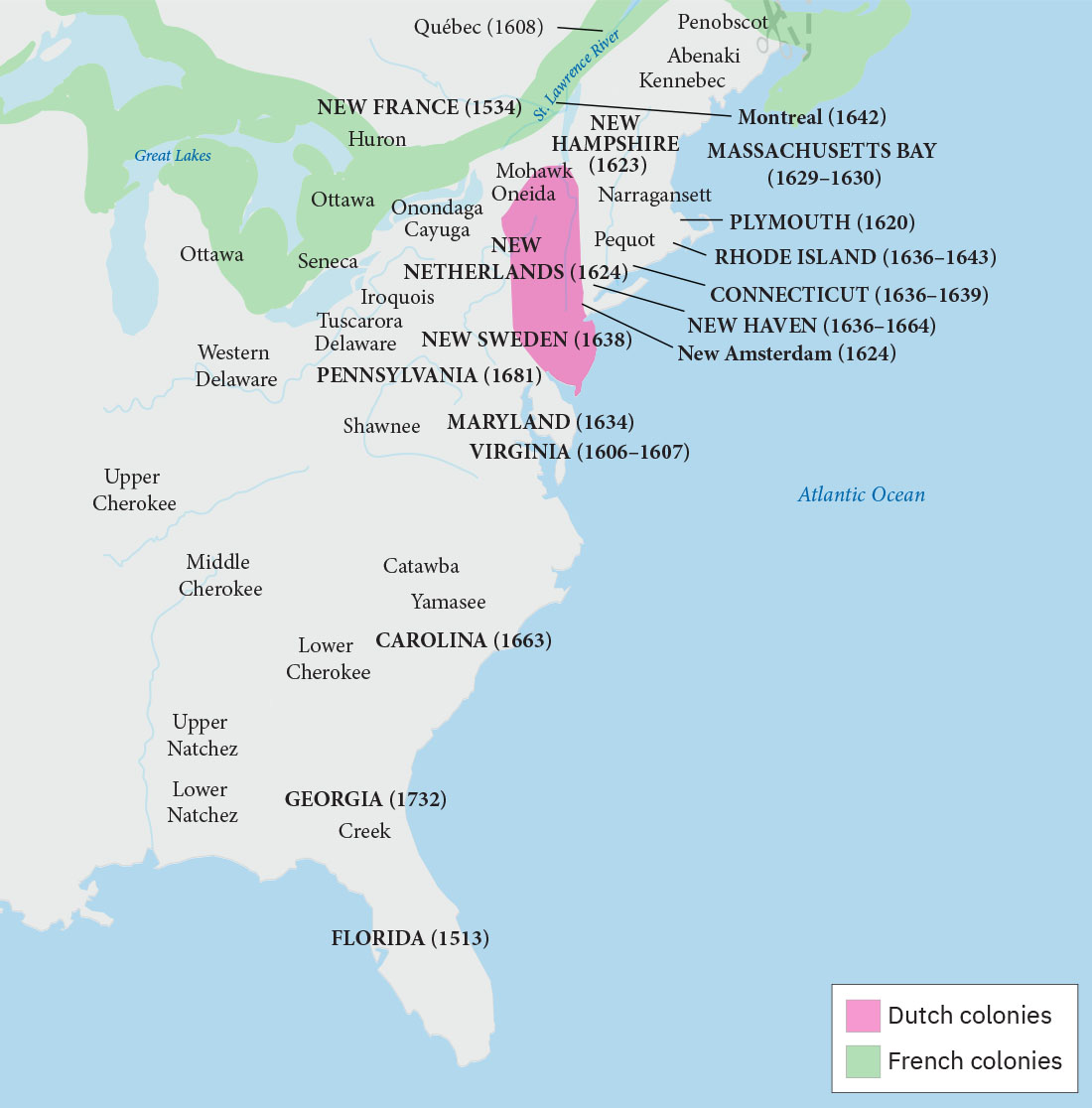
Despite intense warfare, Native Americans were unable to expel the Dutch, who faced a far more dangerous threat from the English. In 1664, an English military expedition arrived in New Amsterdam as part of a broader conflict between England and the Netherlands. With little hope of defending themselves from the English warships, the Dutch surrendered. The English gave them generous peace terms and renamed New Amsterdam New York, in honor of the Duke of York who had organized the expedition (Figure 6.9).
英語のヒント
激しい戦いをしても、先住民はオランダ人を追い出せなかった。そのオランダ人は、イングランド人から、はるかに危険な脅威を受けた。1664年、イングランドとオランダの間のより広い争いの一環として、イングランドの軍事遠征隊がニューアムステルダムに到着した。イングランドの軍艦を相手に防衛できる見込みは乏しく、オランダ人は降伏した。イングランド側は寛大な講和条件を与え、遠征を組織したヨーク公にちなんで、ニューアムステルダムをニューヨークと改名した(図6.9)。
Dutch and French Settlements.オランダとフランスの入植地
(attribution: Copyright Rice University, OpenStax, under CC BY 4.0 license) · CC BY 4.0
Figure 6.9 This map shows the location of Dutch and French colonies in North America in the seventeenth century and the tribal lands of Native Americans at the time of European conquest and resettlement. (attribution: Copyright Rice University, OpenStax, under CC BY 4.0 license)
図6.9 この地図は17世紀の北アメリカにおけるオランダとフランスの植民地の位置、およびヨーロッパ人の征服と入植の時点での先住民諸部族の土地を示す。(帰属表示:著作権ライス大学、OpenStax。CC BY 4.0ライセンス)
The French became aware of colonization opportunities in North America in 1534, when Jacques Cartier voyaged to the area now known as the Gulf of Saint Lawrence in Canada, but they did not rush to set up any colonies. Several early colonization efforts in what is now Canada struggled, mostly due to the harsh northern environment. In 1608, an expedition led by Samuel de Champlain founded Quebec, the first major French settlement in North America. The Company of New France, a joint stock company much like the Virginia Company and the Dutch West India Company, led the early French colonization efforts in North America and helped fund settlements. New France was a collection of French settlements begun in 1534 in what is now Newfoundland. It eventually included much of North America, including Canada and the Mississippi River Valley all the way to southern Louisiana on the Gulf of Mexico.
英語のヒント
フランス人が北アメリカでの植民地建設の可能性を知ったのは1534年、ジャック・カルティエが現在のカナダのセントローレンス湾として知られる地域へ航海したときだった。しかし、すぐに植民地を作ろうとはしなかった。現在のカナダにおける初期のいくつかの入植の試みは、主として北方の厳しい自然環境のために難航した。1608年、サミュエル・ド・シャンプランの率いる遠征隊が、北アメリカで最初の大規模なフランス入植地ケベックを建設した。ヴァージニア会社やオランダ西インド会社とよく似た株式会社のヌーヴェル・フランス会社が、北アメリカでのフランスの初期の植民地建設を主導し、入植地に資金を提供した。ヌーヴェル・フランスは、1534年に現在のニューファンドランドで始まったフランス入植地の集まりだった。やがて、カナダとミシシッピ川流域から、メキシコ湾に面したルイジアナ南部まで、北アメリカの大部分を含むようになった。
Like the Dutch, French colonizers focused on trade rather than the settled agricultural model preferred by the English. They earned most of their profits from the lucrative fur market and engaged in fishing off the coast of what is now Canada. Among the French settlers were a small number of French Catholic priests who attempted to convert Native Americans to Christianity, as the Spanish had done in their colonies. Most of these missionaries were members of the Society of Jesus, better known as the Jesuits, a religious organization dedicated to spreading Catholicism and opposing Protestantism. The Jesuits practiced cultural accommodation, a method of integrating a culture into the dominant society without forcing it to fully integrate and adopt all the dominant culture’s components. They just wanted Native Americans to become Catholics and did not care whether they adopted any other aspect of European culture. The Jesuits in Canada also likely realized that they had neither sufficient numbers nor the support from France that would have been necessary to force Indigenous peoples to submit to attempts to change their way of life.
英語のヒント
オランダ人と同様、フランスの植民者も、イングランド人の好んだ定住型農業のモデルより交易を重視した。利益の大部分を高収益の毛皮市場から得て、現在のカナダの沖合で漁業にも従事した。フランス人入植者の中には少数のカトリック司祭がおり、スペイン人がその植民地で行ったのと同じように、先住民をキリスト教へ改宗させようとした。宣教師の大部分は、カトリックの普及とプロテスタントへの対抗を使命とする宗教団体、イエズス会の会員だった。イエズス会士は「文化的適応」を実践した。これは、ある文化を支配的な社会に組み込みながら、全面的な同化や支配的文化の全要素の採用までは強制しない方法である。先住民がカトリック教徒になることだけを望み、ヨーロッパ文化のほかの面を取り入れるかどうかにはこだわらなかった。またカナダのイエズス会士は、先住民に生活様式の変更を強要するのに必要なだけの人数もフランスからの支援も、自分たちにはないと理解していた可能性が高い。
The French probably enjoyed the friendliest relationships with Native Americans of any European colonizers. Unlike their rivals, they usually attempted to solve the shortage of labor by allying themselves with Native Americans. The French sought wealth in furs, and the assistance of Native American tribes, who knew the land much better than did the European newcomers, was needed to best exploit this valuable resource. Also, because few French women came to New France, many French colonists married Native American women, leading to the creation of a multicultural and multiracial society.
英語のヒント
ヨーロッパの植民者の中で、先住民と最も友好的な関係を持ったのは、おそらくフランス人だった。競争相手と違い、彼らは通常、先住民と同盟することで労働力不足を解決しようとした。フランス人は毛皮に富を求めており、この貴重な資源を最大限に活用するには、新来のヨーロッパ人よりはるかによく土地を知る先住民諸部族の協力が必要だった。また、ヌーヴェル・フランスへ来たフランス人女性は少なかったため、多くのフランス人植民者が先住民女性と結婚し、多文化・多人種の社会が形成された。
In 1627, Cardinal Richelieu, chief minister to King Louis XIII, provided a spiritual justification for Franco-Indian partnerships in the Ordonnance of 1627. The Ordonnance read in part, “[Quotation omitted for rights reasons.]”
英語のヒント
1627年、国王ルイ13世の首席大臣リシュリュー枢機卿は、同年の勅令で、フランス人と先住民の協力関係に宗教上の正当性を与えた。勅令の一節には、次のようにある。「〔権利の関係で割愛〕」
Not all Native Americans wanted to give up their traditional beliefs or become French, but the Ordonnance was an important gesture that the French government was willing to accept them as equal members of society. It helped the French build strong relationships with Native Americans, particularly the Algonquin-speaking tribes that populated most of New France. The French further reinforced their alliance with the Algonquins by providing them with weapons, which they used in their wars with rival Iroquoian-speaking tribes and with Dutch and English settlers.
英語のヒント
すべての先住民が伝統的な信仰を捨てたり、フランス人になったりしたかったわけではない。しかし勅令は、フランス政府が彼らを社会の対等な構成員として受け入れる意思を示す、重要な表明だった。これは、フランス人が先住民、とりわけヌーヴェル・フランスの大部分に住むアルゴンキン語系の諸部族と強い関係を築くのに役立った。フランス人はアルゴンキンの人々へ武器を供給することによって、同盟をさらに強化した。彼らはその武器を、対立するイロコイ語系の諸部族や、オランダ人・イングランド人入植者との戦争で使った。
Even when Indigenous peoples profited from their relationship with European colonists, however, they might still suffer negative consequences. The introduction of guns, for example, made Native American warfare more deadly. As the Iroquois, who were armed by the Dutch, waged war with the French-allied Wendat nation, their European trading partners profited from the trade in stolen pelts.
英語のヒント
しかし、先住民がヨーロッパ人植民者との関係から利益を得た場合にも、悪影響を受けることはあった。たとえば銃の導入は、先住民同士の戦争をより多くの死をもたらすものにした。オランダ人から武器を供給されたイロコイが、フランスと同盟するウェンダットの人々と戦争をするなかで、ヨーロッパの交易相手は奪われた毛皮の取引から利益を得た。
The use of guns and the incentives offered for killing as many animals as possible had environmental implications as well, because it depleted beaver and deer populations in some areas. The hunger for European manufactured goods encouraged some Native Americans to go into debt to European traders, while the reduction of animal populations left some without the means to pay. Many Indigenous people also became addicted to the alcohol sold or traded by Europeans.
英語のヒント
銃の使用と、できるだけ多くの動物を殺すことへの誘因は、環境にも影響した。一部の地域で、ビーバーとシカの個体数を減らしたからである。ヨーロッパの工業製品への強い欲求のため、先住民の中にはヨーロッパ商人に借金をする者が現れたが、動物の減少によって、返済する手段を失った者もいた。また、多くの先住民は、ヨーロッパ人が売ったり交換したりするアルコールに依存するようになった。