第6章植民地化と経済の拡大Colonization and Economic Expansion
English Settlements in North America北アメリカのイングランド人入植地
The English began their colonization efforts in the Americas nearly a century after the Spanish, motivated by both economic and ideological goals. In 1584, Queen Elizabeth gave Sir Walter Raleigh a charter, a royal document that authorized him to establish a colony in North America. The Protestant queen wanted colonies that would act as an ideological counterweight to Spanish Catholicism in the Americas and provide a base of operations for privateering expeditions that would raid Spanish shipping.
英語のヒント
イングランド人がアメリカ大陸で植民地建設に着手したのは、スペイン人よりもほぼ1世紀後であり、経済的な目的と思想上の目的の両方が動機となっていた。1584年、エリザベス女王はサー・ウォルター・ローリーに特許状を与えた。これは、北アメリカで植民地を建設する権限を認める王室文書だった。プロテスタントの女王は、アメリカ大陸でスペインのカトリック信仰に思想面で対抗する重しとなり、またスペインの船舶を襲う私掠遠征の活動拠点となる植民地を望んだ。
Roanoke Islandロアノーク島
In July 1587, about 150 settlers led by explorer and artist John White established a colony on Roanoke Island, off the coast of modern North Carolina. The colonists baptized Manteo, a friendly member of the Croatoan tribe, and named him the Lord of Roanoke in an effort to build congenial relationships with the local Native Americans. In late August, White left for England with plans to gather additional investors to fund the colony. Once there, he convinced English merchants to invest in the colony in exchange for trading rights, but the arrival of the Spanish Armada in 1588 delayed his departure. When White finally returned to Roanoke Island in 1590, the colony was gone.
英語のヒント
1587年7月、探検家で画家でもあったジョン・ホワイトが率いる約150人の入植者が、現在のノースカロライナ沿岸沖にあるロアノーク島に植民地を築いた。入植者たちは、友好的なクロアトアン族の1人マンテオに洗礼を施し、ロアノーク卿と名づけた。現地の先住民との良好な関係を築こうとしたのである。8月下旬、ホワイトは植民地の資金を出す追加の投資家を募るつもりでイングランドへ出発した。帰国すると、交易権と引き換えに植民地へ投資するようイングランドの商人を説得したが、1588年にスペイン無敵艦隊が来襲したため、出航が遅れた。ようやく1590年にロアノーク島へ戻ったとき、植民地は消えていた。
The only clue White found was the word “Croatoan” carved into a tree. There are clear signs the settlers intermarried with the Native American population and joined their society, but Europeans of the era dismissed this possibility (Figure 6.6), perhaps because they found it impossible to believe Europeans would willingly join a non-White society. It is also possible the word had nothing to do with the colony’s disappearance. John White was forced to leave before completing a thorough investigation. Today, Roanoke Island is known as “the lost colony,” and its fate remains a mystery.
英語のヒント
ホワイトが見つけた唯一の手掛かりは、木に刻まれた「クロアトアン」という語だった。入植者が先住民と結婚し、その社会に加わったことを示す明白な兆候はある。しかし当時のヨーロッパ人はこの可能性を退けた(図6.6)。ヨーロッパ人が自ら進んで非白人の社会に加わるなど、信じられなかったからかもしれない。また、この語が植民地の消失と何の関係もなかった可能性もある。ジョン・ホワイトは十分な調査を終える前に立ち去らざるを得なかった。今日、ロアノーク島は「失われた植民地」として知られ、その運命は謎のままである。
The Lost Colony of Roanoke.失われたロアノーク植民地
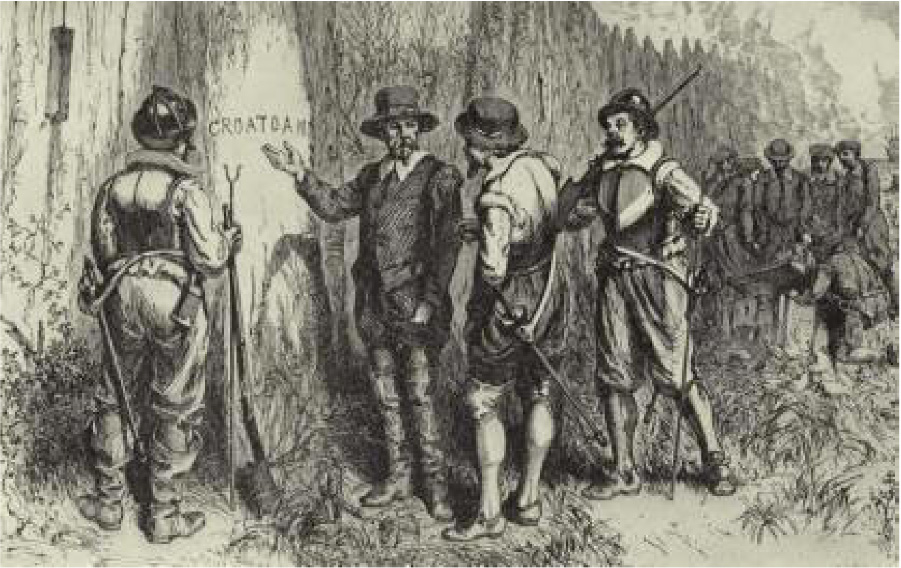
(credit: “Croatoan” by Unknown/Wikimedia Commons, Public Domain) · Public Domain
Figure 6.6 In this engraving from a nineteenth-century history of the United States, John White discovers the single word Croatoan carved in a tree on Roanoke Island in 1590. It was the only clue found after the disappearance of the colonists. (credit: “Croatoan” by Unknown/Wikimedia Commons, Public Domain)
英語のヒント
図6.6 19世紀のアメリカ合衆国史の本に載るこの版画は、1590年、ジョン・ホワイトがロアノーク島で木に刻まれたCroatoanという一語を発見する場面を描く。入植者の失踪後に見つかった手掛かりは、それだけだった。(出典:作者不詳/ウィキメディア・コモンズ「クロアトアン」。パブリックドメイン)
Jamestownジェームズタウン
The creation of joint stock companies provided English colonial efforts after Roanoke Island with improved funding that the English monarchy could not offer. A joint stock company, much like a modern corporation, raised money for its ventures by selling shares to investors. The company then used the pooled funds to conduct operations, including colonization efforts in the Americas. Shareholders were not legally liable for the actions of the company and could not lose more than the amount of their investment, but they could earn large profits if the joint stock company were successful. The combination of limited liability with the possibility of rich returns made joint stock companies an appealing investment for members of England’s growing merchant class, and the companies raised huge sums of money beginning in the early 1600s. England promoted colonization for religious and political reasons, but its reliance on private investors for funding often steered the effort toward profitable activities.
英語のヒント
株式会社の設立によって、ロアノーク島以後のイングランドの植民地建設は、王室には提供できなかった、より豊富な資金を得るようになった。株式会社は現代の会社とよく似ており、投資家に株式を売って事業資金を調達した。そして、その集めた資金を使って、アメリカ大陸での植民地建設を含む事業を行った。株主は会社の行為に法的な責任を負わず、投資額を超える損失を受けることもなかったが、会社が成功すれば大きな利益を得ることができた。有限責任と高い収益を得られる可能性の組み合わせは、成長しつつあったイングランドの商人階級にとって株式会社への投資を魅力あるものにした。会社は1600年代初頭から莫大な資金を集めた。イングランドは宗教的・政治的な理由から植民地化を推進したが、資金を民間投資家に頼ったため、その取り組みはしばしば収益の上がる活動へ向かった。
In 1606, the Virginia Company, a joint stock company named for Queen Elizabeth (who was known as the “virgin queen” because she never married), received a charter and sent 144 men and boys to North America. In 1607, these colonists founded Jamestown, named for the new English king, James I, on the banks of the Chesapeake Bay in what is now Virginia. Many of the settlers were the desperate younger sons of elite families who would not inherit property claimed by their older brothers in England. Many others were artisans, including goldsmiths and jewelers, unused to the hard physical labor that building a colony on a new continent required.
英語のヒント
1606年、ヴァージニア会社という株式会社が特許状を受け、男性と少年144人を北アメリカへ送った。会社名は、生涯結婚しなかったため「処女王」と呼ばれたエリザベス女王にちなんでいた。1607年、これらの入植者は、現在のヴァージニアにあるチェサピーク湾岸に、新しいイングランド国王ジェームズ1世にちなんだ名のジェームズタウンを建設した。入植者の多くは、イングランドでは兄たちが受け継ぐ財産を相続できず、活路を切実に求める上流家庭の次男以下の息子だった。ほかにも金細工師や宝石職人などの職人が多く、新大陸に植民地を築くのに必要な重労働には慣れていなかった。
The settlers of Jamestown, like many Europeans of the 1600s and 1700s, rooted their economic ideas in mercantilism, an economic theory in which the world’s wealth, as measured in gold and silver, is assumed to be finite, so a gain of wealth for one nation is a loss for another. Mercantilist nations expected their colonies to export raw materials, most importantly precious metals like gold and silver, back to the home country and to purchase goods from it in turn. The English government hoped the Virginia Company would find gold to improve the nation’s trade balances and increase its wealth. Many in Jamestown also hoped to find gold and thereby get rich without having to work hard or suffer any hardships.
英語のヒント
ジェームズタウンの入植者は、1600年代と1700年代の多くのヨーロッパ人と同じく、重商主義に基づく経済観を持っていた。重商主義は、金と銀で測られる世界の富は有限だと想定する経済理論であり、ある国の富の増加は、別の国の損失になると考えた。重商主義の国々は、植民地が原材料、とりわけ金や銀などの貴金属を本国へ輸出し、その代わりに本国から製品を買うことを期待した。イングランド政府は、ヴァージニア会社が金を発見して貿易収支を改善し、国の富を増やすことを望んだ。ジェームズタウンの多くの人々も、金を見つけ、苦労して働いたり困難に耐えたりせずに金持ちになりたいと願った。
The Jamestown settlers did not find gold because there was little mineral wealth in the region, but they did find suffering due to bad weather, starvation, disease, internal political disputes, and military conflicts with the Powhatan tribe (named after its chief). The Powhatans grew to loathe the newcomers for bringing disease and violence to their homeland. Many colonists died during the winter of 1609–1610, known as “the starving time.” By May 1610, fewer than a hundred remained, and the colony, which had not produced a profit for the Virginia Company, almost failed.
英語のヒント
ジェームズタウンの入植者は金を発見できなかった。この地域には鉱物資源がほとんどなかったためである。その代わり、悪天候、飢餓、病気、内部の政治的争い、そして首長の名に由来する名を持つポウハタン族との軍事衝突による苦難に見舞われた。ポウハタンの人々は、故郷に病気と暴力を持ち込んだ新来者を強く憎むようになった。「飢餓の時代」と呼ばれる1609~1610年の冬には、多くの入植者が死亡した。1610年5月までに残ったのは100人未満で、ヴァージニア会社に利益をもたらしていなかった植民地は、崩壊寸前になった。
Early Virginia colonists did find wealth and success in tobacco cultivation, however. Despite the need for hard work in difficult conditions, by 1614 Jamestown began exporting tobacco to Europe and earning profits for the Virginia Company. Smoking the highly addictive dried leaves of the plant became a popular habit in Europe.
英語のヒント
しかし、初期のヴァージニア入植者は、タバコ栽培によって富と成功を手にした。厳しい条件での重労働が必要だったものの、1614年までにジェームズタウンはヨーロッパへタバコを輸出し始め、ヴァージニア会社に利益をもたらした。この植物の、依存性の強い乾燥葉を吸う習慣がヨーロッパで広まった。
Like their rivals the Spanish, English colonists struggled to produce agricultural goods using only their own labor. Instead, they relied heavily on indentured servants, European immigrants who typically agreed to work four to seven years in exchange for transportation to the colony and the hope of a new life there after completing their service. Up to 100,000 people, mostly poor men in their twenties, traveled to the English colonies as indentured servants in the 1600s. Many died of disease, exposure, and overwork, but those who survived their term of service often became reasonably comfortable and respected members of the growing settlements. A fortunate few even became wealthy planters.
英語のヒント
ライバルのスペイン人と同様、イングランド人入植者も、自分たちの労働力だけで農産物を生産するのに苦労した。そこで大きく頼ったのが年季奉公人だった。これらのヨーロッパからの移住者は、通常、植民地への渡航と、奉公を終えた後にそこで新生活を始められるという希望を引き換えに、4~7年間働くことに同意した。1600年代には、主に20代の貧しい男性を中心に、最大10万人が年季奉公人としてイングランドの植民地へ渡った。病気、厳しい風雨や寒暑へのさらされ方、過労によって多くが死亡した。しかし奉公期間を生き抜いた者は、成長する入植地で、ある程度不自由なく暮らせる、尊敬される住民になることも多かった。幸運な少数は、富裕なプランテーション農園主にさえなった。
In 1619, the first Africans arrived in Virginia. Initially they enjoyed the same opportunities to earn their freedom and build wealth as immigrants from Europe, but their condition quickly deteriorated. They were part of a trend that began with the importation of the first Africans into the Americas by the Spanish and Portuguese a century earlier. By the middle of the 1600s, policies were beginning to develop in the Americas that bound Africans to servitude for life, unlike European indentured servants who regained their freedom once they had completed their term of service.
英語のヒント
1619年、最初のアフリカ人がヴァージニアに到着した。当初はヨーロッパからの移住者と同じように、自由を得て富を築く機会があったが、その状況は急速に悪化した。彼らの到来は、1世紀前にスペイン人とポルトガル人が最初のアフリカ人をアメリカ大陸へ連れて来たことから始まる流れの一部だった。1600年代半ばまでに、アメリカ大陸ではアフリカ人を生涯の隷属に縛り付ける政策が形成され始めた。契約した奉公期間が終われば自由を取り戻すヨーロッパ人の年季奉公人とは、異なる扱いだった。
European colonists in Virginia, like those in Mexico, South America, and the Caribbean, sought ways to maintain a permanent labor force, especially when it proved difficult to recruit sufficient indentured servants from Europe. Attempts to coerce the labor of fellow Europeans would have met with too much resistance. Faced with a growing underclass of embittered poor White former servants, who in 1676 sought to overthrow the colony’s government, Virginia’s elite sought to solve their problems by drawing legal distinctions between people of European and African ancestry. They extended privileges to Whites that were denied to Blacks and encouraged European settlers to perceive Africans as inferior people fit only for manual labor, while simultaneously depriving Africans of their freedom. In this way, slavery became associated with African ancestry and racial divisions were created that had not existed before. Racism became the basis on which the colonial labor system was built.
英語のヒント
ヴァージニアのヨーロッパ人植民者は、メキシコ、南アメリカ、カリブ海の植民者と同様、恒久的な労働力を確保する方法を求めた。とりわけ、ヨーロッパから十分な年季奉公人を集めるのが難しいと分かったときにそうだった。同じヨーロッパ人に労働を強制しようとすれば、大きすぎる抵抗を招いたはずである。不満を募らせた貧しい白人の元奉公人からなる下層集団が増え、1676年には植民地政府の転覆を企てた。これに直面したヴァージニアの支配層は、ヨーロッパ系とアフリカ系の人々の間に法的な区別を設けて問題を解決しようとした。黒人には認めない特権を白人に与え、ヨーロッパ人入植者がアフリカ人を肉体労働にしか適さない劣った人々とみなすよう促すと同時に、アフリカ人から自由を奪った。こうして奴隷制はアフリカ系の出自と結び付き、それまで存在しなかった人種的な区分が作り出された。人種主義が植民地労働制度を築く土台となったのである。
In 1680, the Virginia legislature passed “an act for preventing Negroes Insurrections” that forbid enslaved Africans from carrying weapons, gathering in public, and traveling without permission. Enslaved Africans became the most important source of coerced labor in Virginia, as well as the other English colonies established in the southern part of what became the United States, stretching from Maryland, the colony founded as a haven for English Catholics just north of Virginia, to Georgia. This enslavement in the United States ended only in 1865, after a devastating civil war and the passage of the Thirteenth Amendment to the U.S. Constitution. Slavery continued in other parts of the Western Hemisphere, with Brazil not abolishing it until 1888.
英語のヒント
1680年、ヴァージニアの立法府は「黒人の反乱を防止する法律」を可決し、奴隷化されたアフリカ人が武器を携え、公の場に集まり、許可なく移動することを禁じた。奴隷化されたアフリカ人は、ヴァージニアで最も重要な強制労働力の供給源となった。また、後のアメリカ合衆国南部に建てられた、ほかのイングランド植民地でも同様だった。その範囲は、ヴァージニアのすぐ北に、イングランドのカトリック教徒の避難先として建てられたメリーランドから、ジョージアに及んだ。アメリカ合衆国でこの奴隷化が終わったのは、破壊的な内戦と連邦憲法修正第13条の成立を経た、1865年になってからだった。西半球のほかの地域では奴隷制は続き、ブラジルが廃止したのは1888年だった。