第6章植民地化と経済の拡大Colonization and Economic Expansion
British Influence in Indiaインドにおけるイギリスの影響
After their victory in the Seven Years’ War, the British focused on expanding their control in India. In 1757, the forces of the British East India Company led by Robert Clive defeated the ruler of Bengal, a region in northeast India, who had favored the French. The British East India Company’s victory left it in control of territory larger than the island of Britain itself. Four years later, the capture of Pondicherry by the British effectively removed the French from contention in the competition to dominate Indian trade. After 1761, the Indigenous peoples of India provided the only significant source of resistance.
英語のヒント
七年戦争で勝利した後、イギリスはインドでの支配拡大に力を注いだ。1757年、ロバート・クライヴが率いるイギリス東インド会社の軍は、フランスを支持していた、インド北東部ベンガルの支配者を破った。この勝利で東インド会社は、グレートブリテン島そのものより広い領域を支配することになった。4年後、イギリスのポンディシェリ攻略によって、インド交易の支配をめぐる競争からフランスは事実上脱落した。1761年以後、重大な抵抗を行う勢力として残ったのは、インドの先住の人々だけだった。
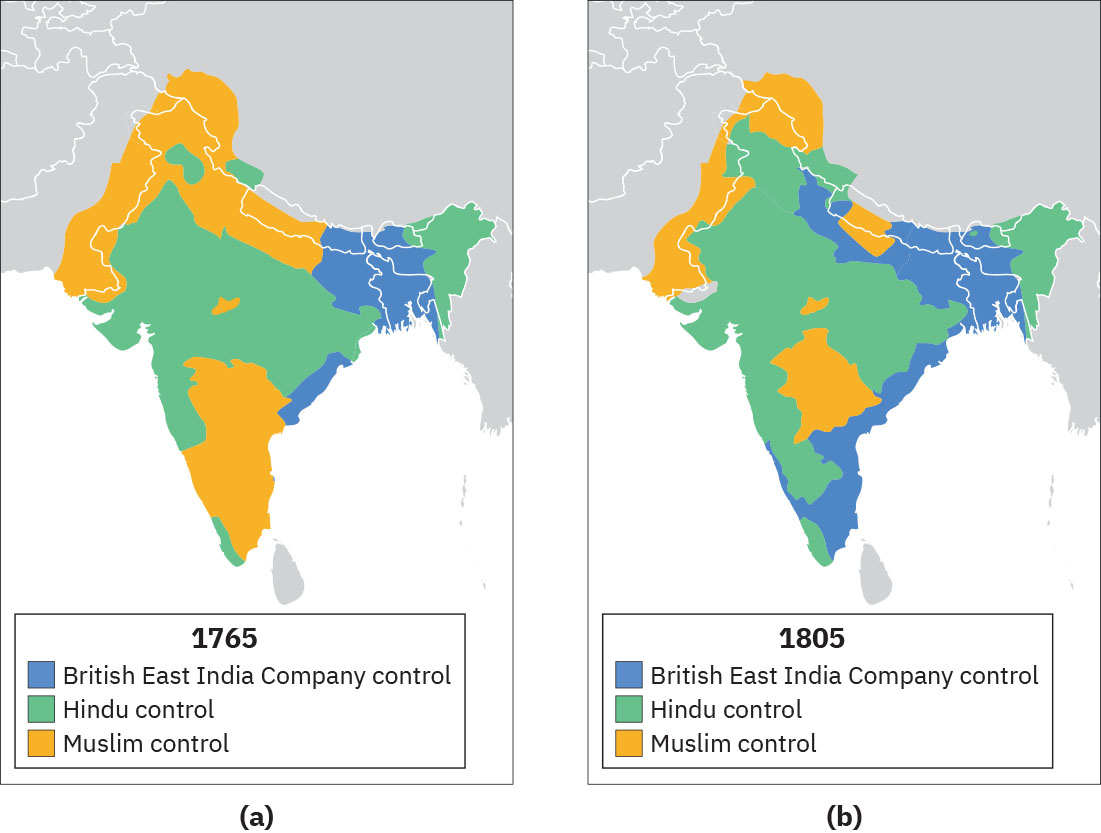
In 1764, British and Indian forces under the command of the British East India Company defeated a much larger army led by the Mughal emperor Shah Alam II at Buxar. After Buxar, the Mughals retained control of territory in northern and western India but effectively surrendered governance of much of southern and eastern India to the British East India Company. This included awarding the British East India Company the right to collect taxes in Bengal in 1765. The immense wealth gained from tax collection enabled the Company to further dominate India. Forces under the leadership of the Company defeated the Kingdom of Mysore in southern India by 1799 and the central Indian Maratha Empire by 1818 (Figure 6.13).
英語のヒント
1764年、イギリス東インド会社の指揮下にあるイギリス兵とインド兵の軍は、ブクサールで、ムガル皇帝シャー・アーラム2世が率いる、はるかに大きな軍を破った。ブクサールの戦いの後、ムガル帝国はインド北部と西部の領土の支配を保ったが、南部と東部の大部分の統治を、事実上イギリス東インド会社へ譲った。これには、1765年にベンガルでの徴税権を東インド会社へ与えたことも含まれる。徴税によって得た莫大な富は、会社がインド支配をさらに進めることを可能にした。会社が指揮する軍は、1799年までに南インドのマイソール王国を破り、1818年までに中央インドのマラーター帝国を破った(図6.13)。
Britain’s Growing Control in India.拡大するイギリスのインド支配
(attribution a and b: Copyright Rice University, OpenStax, under CC BY 4.0 license) · CC BY 4.0
Figure 6.13 These maps of India show (in blue) the area dominated by the British East India Company in 1765 (a) and the even larger area it controlled in 1805 (b). (attribution a and b: Copyright Rice University, OpenStax, under CC BY 4.0 license)
図6.13 これらのインドの地図は、イギリス東インド会社が1765年に支配した地域(a)と、1805年に支配した、さらに広い地域(b)を青色で示す。(a・bの帰属表示:著作権ライス大学、OpenStax。CC BY 4.0ライセンス)
Britain and the British East India Company both benefited economically from their colonial control of India. When investors founded the company in 1600, they initially focused on trading in spices. As spices decreased in price and profit, however, the Company turned its attention to textiles produced by highly skilled Indian artisans. Finally, when the value of hand-woven fabric began decreasing in the early nineteenth century, the company pivoted to trading Indian-produced opium for Chinese-grown tea, which became an increasingly valuable consumer good in the late eighteenth century.
英語のヒント
イギリスもイギリス東インド会社も、インドの植民地支配から経済的な利益を得た。投資家が1600年に会社を設立したとき、当初は香辛料交易を重視していた。しかし香辛料の価格と利益が低下すると、高度な技能を持つインドの職人が作る織物へ関心を移した。最後に、19世紀初頭に手織物の価値が下がり始めると、会社はインド産アヘンを中国産の茶と交換する取引へ転じた。茶は18世紀後半に、ますます価値の高い消費財になっていた。
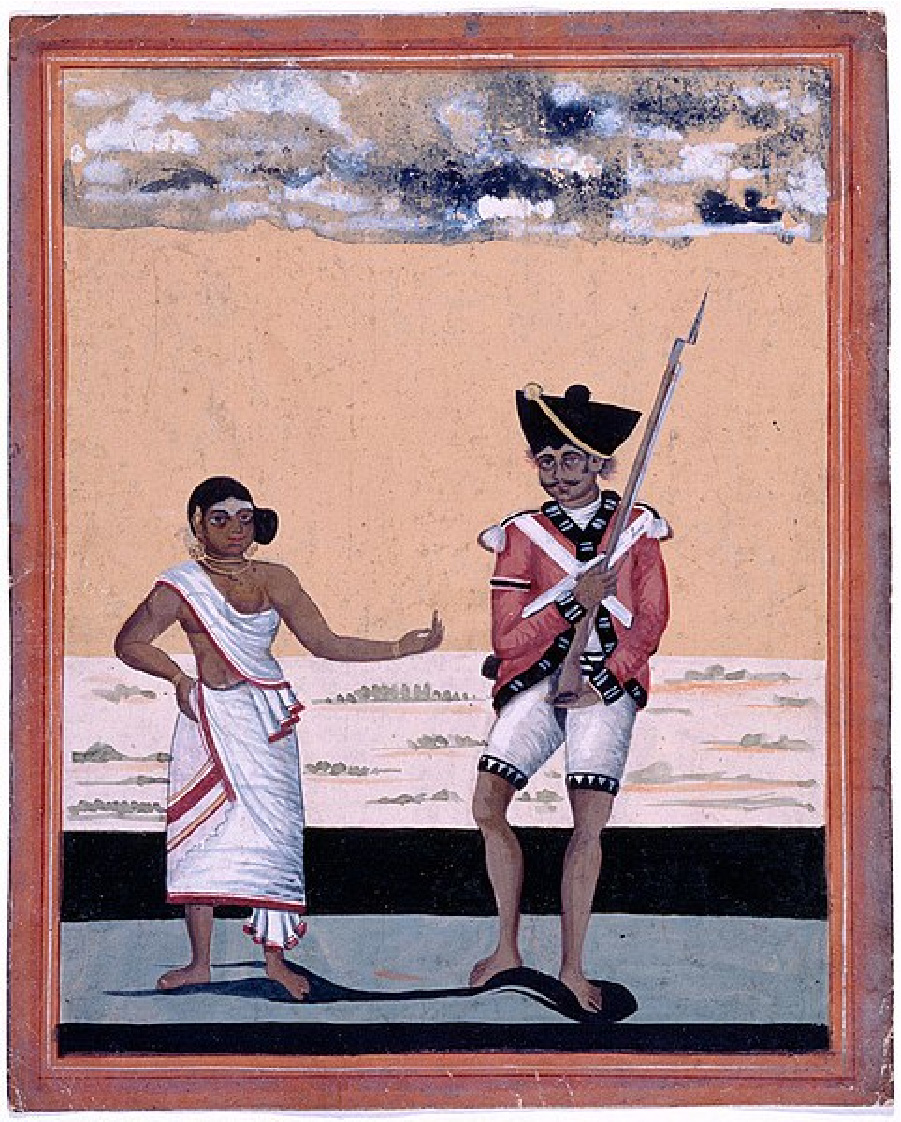
The British East India Company typically engaged in indirect rule, a system in which colonial powers cooperated with Indigenous elites and allowed local leaders to exercise some authority. In exchange for British support of their power, Indian elites upheld the company’s foreign and economic policies. Most importantly, they ensured a steady flow of taxes and soldiers from the Indigenous people to the British East India Company. Indian soldiers, called sepoys, who were often led by British officers, defended British territory in India and enforced British laws (Figure 6.14).
英語のヒント
イギリス東インド会社は通常、間接統治を行った。これは、植民地権力が先住の支配層と協力し、地元の指導者に一定の権限行使を認める制度である。インドの支配層は、権力をイギリスから支えてもらうのと引き換えに、会社の対外政策と経済政策を支持した。最も重要だったのは、先住の人々から東インド会社へ、税と兵士が安定して供給されるようにしたことだった。セポイと呼ばれるインド人兵士は、しばしばイギリス人士官に率いられ、インドにおけるイギリス領を防衛し、イギリスの法律を執行した(図6.14)。
A Sepoy and His Wife.セポイとその妻
(credit: “Sepoy of Madras Native Infantry and his wife” by National Army Museum/Wikimedia Commons, Public Domain) · Public Domain
Figure 6.14 A Hindu sepoy of the Madras Native Infantry and his wife, shown in a watercolor painting made on paper by an unknown army artist in about 1810. (credit: “Sepoy of Madras Native Infantry and his wife” by National Army Museum/Wikimedia Commons, Public Domain)
英語のヒント
図6.14 マドラス先住民歩兵連隊のヒンドゥー教徒のセポイとその妻。1810年ごろ、作者不詳の軍の画家が紙に描いた水彩画。(出典:国立陸軍博物館/ウィキメディア・コモンズ「マドラス先住民歩兵のセポイとその妻」。パブリックドメイン)
The system of indirect rule often worked within existing power structures, providing British support for elites that had already long ruled India. However, in areas where Indigenous rulers opposed colonization, the British disrupted traditional practices, removed elites who refused to cooperate, and administered those areas directly. British rule led to conflicts within Indian society, with many Indigenous communities divided between people who wanted to cooperate with the British and those who supported a series of rebellions against foreign domination. Indians who opposed the British were further divided between those who supported violent resistance and those who believed peaceful resistance was more promising.
英語のヒント
間接統治制度は、すでに長くインドを支配していたエリートをイギリスが支えることで、既存の権力構造の中で機能することが多かった。しかし現地の支配者が植民地化に反対する地域では、イギリスは伝統的な慣行を壊し、協力を拒む支配層を排除し、その地域を直接統治した。イギリスの支配はインド社会内部の対立を引き起こし、多くの先住の共同体は、イギリスに協力したい人々と、外国支配への一連の反乱を支持する人々に分裂した。イギリスに反対するインド人も、暴力による抵抗を支持する者と、平和的な抵抗のほうが見込みがあると考える者に、さらに分かれた。
In 1813, as a result of pressure exerted by religious interests on the British Parliament, the British East India Company allowed missionaries limited access to India. This was a reversal of the Company’s longstanding policy of banning Christian missionaries for fear their activities would lead to unrest that would disrupt trade. The new policy pleased nobody and led to an unlikely alliance among British Christians and Indian Muslims and Hindus, who agreed on very little other than that the British East India Company should not rule India. British Christians opposed the East India Company’s rule because of its stance on missionary activity. Indian Muslims and Hindus opposed the Company’s rule because they wished to govern themselves.
英語のヒント
1813年、宗教勢力がイギリス議会に圧力をかけた結果、イギリス東インド会社は、宣教師が限定的にインドへ入ることを認めた。これは、宣教師の活動が交易を妨げる騒乱につながることを恐れ、キリスト教宣教師を禁じてきた会社の長年の方針を転換するものだった。新方針は誰も満足させず、イギリスのキリスト教徒と、インドのムスリム・ヒンドゥー教徒の間に、意外な連携を生んだ。彼らが一致したのは、東インド会社がインドを支配すべきでないという点をほぼ唯一としていた。イギリスのキリスト教徒は、宣教活動に対する会社の姿勢を理由に会社支配へ反対した。インドのムスリムとヒンドゥー教徒は、自分たちで統治したいために会社支配に反対した。
China’s Dominance in Trade貿易における中国の優位
China had long been a major world power and became even stronger with the rise of the Qing (1644–1912), the last imperial dynasty. After defeating their Ming predecessors and consolidating their power, Qing rulers turned to rebuilding the Chinese economy. With a stable frontier, they were able to reduce military spending and lower tax burdens, which freed money for people to invest in businesses and for the wealthier classes to purchase luxuries. The Qing seized land from wealthy families that supported their political rivals and distributed it to other families that set up small farms. To help these new farms, the government gave the owners draft animals, tools, and seeds. Most farmers focused on growing rice in the river valleys, but the introduction of potatoes from the Americas allowed them to grow food on hilly ground that had never been widely cultivated before. Some began growing tobacco, which also came from the Americas and became a key cash crop for Chinese farmers.
英語のヒント
中国は長く世界の大国であり、最後の帝国王朝である清(1644~1912年)の台頭とともに、さらに強大になった。前王朝の明を倒し、支配を固めた清の君主たちは、中国経済の再建へ向かった。国境が安定したため、軍事費と税負担を引き下げることができ、人々が事業へ投資したり、富裕層がぜいたく品を買ったりする資金が生まれた。清は政治的な敵を支援した裕福な家々から土地を奪い、ほかの家々に分配した。それらの家々は小農場を作った。新しい農場を助けるため、政府は所有者に農耕用の役畜、道具、種子を与えた。農民の大部分は川沿いの谷での稲作に重点を置いたが、アメリカ大陸からジャガイモが導入されると、それまで広く耕作されていなかった丘陵地でも食料を栽培できるようになった。タバコを作り始めた者もいた。これもアメリカ大陸から来た作物で、中国の農民にとって重要な換金作物となった。
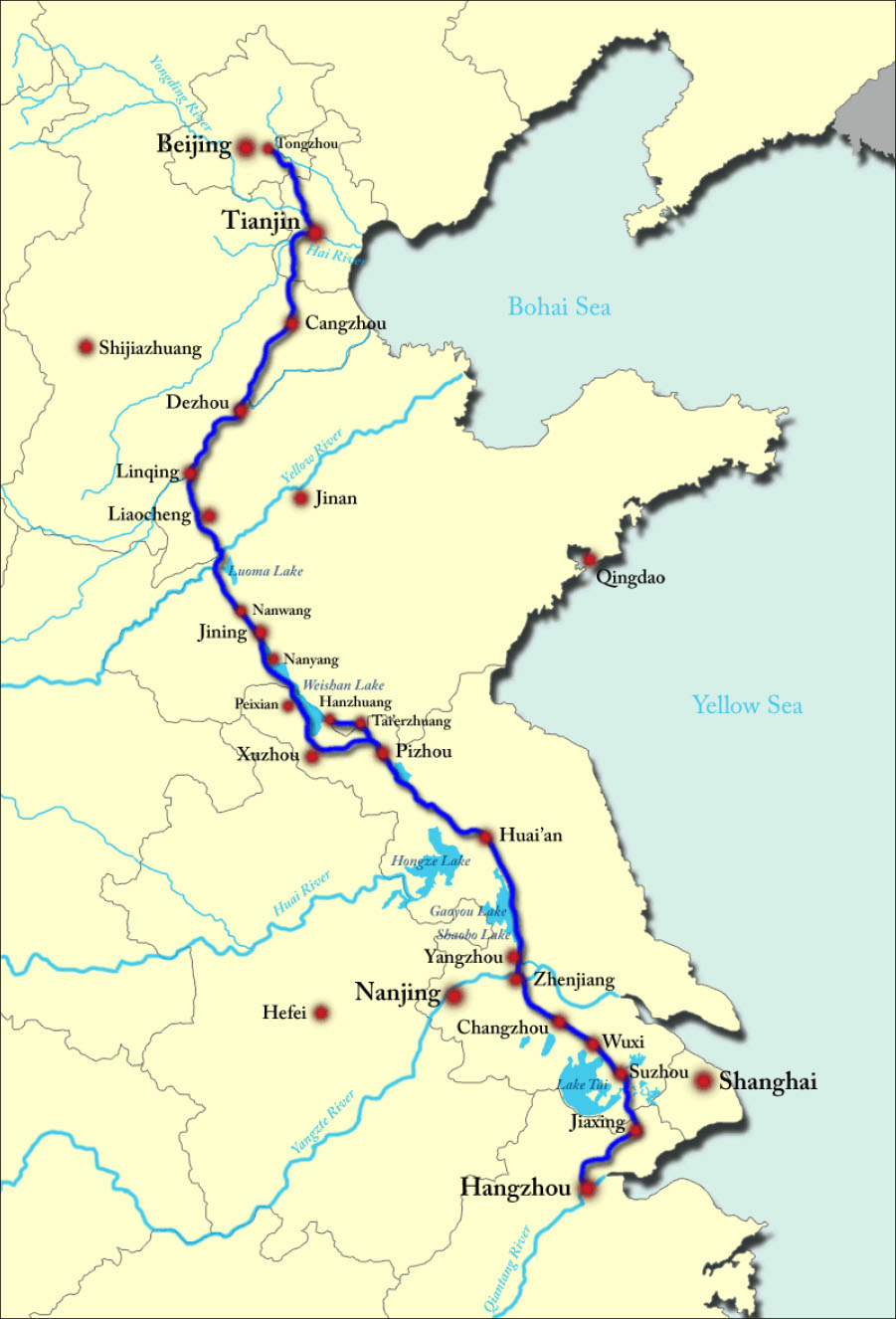
To facilitate economic development, the Qing upgraded China’s infrastructure, including rebuilding roads and improving the Grand Canal. Begun in the fifth century BCE and still in use today, this waterway stretches 1,100 miles from Beijing in the north to Hangzhou in the south. It is the world’s longest canal and connects several important waterways, including the Huang (Yellow), Huai, and Yangtze Rivers (Figure 6.15). In the Qing era, the Grand Canal transported luxuries, but most importantly it brought food from the rich agricultural river valleys of the south to the large cities of northern China such as Beijing, which became major centers of commerce and manufacturing during this time.
英語のヒント
経済発展を促すため、清は道路の再建や大運河の改良など、中国の社会基盤を整備した。この水路は紀元前5世紀に建設が始まり、現在も使われている。北の北京から南の杭州まで1,100マイルに延びる、世界最長の運河で、黄河、淮河、長江など、いくつもの重要な水路を結ぶ(図6.15)。清代の大運河はぜいたく品を運んだが、とりわけ重要だったのは、農業の豊かな南部の河川流域から、北京など中国北部の大都市へ食料を運んだことである。これらの都市は、この時代に商業と製造業の重要な中心となった。
China’s Grand Canal.中国の大運河
(credit: modification of work “Modern Course of Grand Canal of China” by Ian Kiu/Wikimedia Commons, CC BY 3.0) · CC BY 3.0
Figure 6.15 This map shows the course of the Grand Canal of China as it looks today, stretching about 1,100 miles from Hangzhou in the south all the way to Beijing in the north. (credit: modification of work “Modern Course of Grand Canal of China” by Ian Kiu/Wikimedia Commons, CC BY 3.0)
図6.15 この地図は現在の中国大運河の経路を示す。南の杭州から北の北京まで、およそ1,100マイルに延びている。(出典:イアン・キウ/ウィキメディア・コモンズ「中国大運河の現在の経路」を改変。CC BY 3.0)
The Qing dynasty’s leaders also focused on increasing China’s international trade. They signed new treaties with foreign nations, including the Treaty of Kyakhta (1727) with Russia, which opened China to new European markets. They also improved trading relationships with Japan, the nations of Southeast Asia, and the Philippines. The Qing government lifted most prohibitions on trade with the western nations. Under the Canton system, in place from 1759 to 1842, western Europeans were permitted to trade with China if they agreed to work through the Chinese guilds that enjoyed monopoly rights to the tea and silk trades. Under this system, all trade was confined to the southern Chinese port of Canton (Guangzhou) in order to limit contact with Europeans and foreign influence on China. Only members of the merchant guild authorized to transact business with Westerners were allowed to have contact with Europeans. All Europeans trading in China were subject to Chinese law, and they were required to live and do business in a small area outside the city walls. Europeans were not allowed to bring firearms or warships into the port, and European women were also prohibited from settling in Canton, which prevented a permanent European community from taking root there.
英語のヒント
清朝の指導者は、中国の国際貿易の拡大にも力を注いだ。ロシアとのキャフタ条約(1727年)など、諸外国と新しい条約を結び、中国に新たなヨーロッパ市場への道を開いた。日本、東南アジアの国々、フィリピンとの貿易関係も改善した。清政府は西洋諸国との貿易に対する禁止の大半を解除した。1759~1842年に行われた広東貿易制度のもとでは、西ヨーロッパ人は、茶と絹の交易を独占する権利を持つ中国の商人組合を介することに同意すれば、中国と交易できた。この制度では、ヨーロッパ人との接触と中国への外国の影響を抑えるため、すべての交易が南部の港、広東(広州)に限られた。ヨーロッパ人に接触できるのは、西洋人との取引を許された商人組合の構成員だけだった。中国で交易するヨーロッパ人は全員、中国の法律に従い、城壁の外の小さな区域に住んで商売をするよう求められた。港へ銃器や軍艦を持ち込むことはできず、ヨーロッパ人女性も広東に定住することを禁じられた。そのため、恒久的なヨーロッパ人共同体がそこに根づくことはなかった。
The Canton system successfully increased China’s trade with Europe and improved the Chinese economy. By 1833, the Chinese were exporting twenty-eight times more tea and welcoming thirteen times more foreign ships than before. Tea was the most important export, but China also exported large quantities of silk and porcelain. It rejected most European trade goods and insisted on payment for its exports in silver. Desperate for Chinese goods, Europeans complied, and several million dollars’ worth of silver flowed into China each year. As a result, China enjoyed a very favorable balance of trade with Europe. This encouraged European nations to find a way to chip away at China’s trade advantages.
英語のヒント
広東貿易制度は中国とヨーロッパの貿易を増やすことに成功し、中国経済を改善した。1833年までには、中国の茶の輸出は以前の28倍、受け入れる外国船は13倍になっていた。茶が最も重要な輸出品だったが、中国は絹と磁器も大量に輸出した。ヨーロッパの交易品は大半を拒み、輸出の代価を銀で払うよう求めた。中国の品々を切望するヨーロッパ人はこれに応じ、毎年、数百万ドル相当の銀が中国へ流入した。その結果、中国はヨーロッパに対して非常に有利な貿易収支を得た。これによりヨーロッパ諸国は、中国の貿易上の優位を少しずつ崩す方法を探すようになった。