第6章植民地化と経済の拡大Colonization and Economic Expansion
6.3 Capitalism and the First Industrial Revolution6.3 資本主義と第一次産業革命
Learning Objectives学習の目標
By the end of this section, you will be able to:
この節を学ぶと、次のことができるようになる。
Explain the evolution of economic theories from mercantilism to capitalism
重商主義から資本主義への経済理論の展開を説明する。
Analyze the ways in which mechanization challenged existing social, economic, and political structures
機械化が既存の社会・経済・政治構造をどう揺さぶったかを分析する。
Discuss the ideological responses to capitalism, including Marxism
マルクス主義を含む、資本主義への思想的な応答を論じる。
Just as colonial empires were the crucible of new political ideas and gave rise to new forms of resistance to exploitation, they also inspired new economic ideas. Mercantilism, which advocated building a nation’s power by increasing trade through exports, had originally propelled colonization. But as people around the world gained their political freedom, they also became interested in economic freedom, and mercantilism fell out of favor. Capitalism, a system in which prices and costs, not government intervention, serve to regulate the supply and demand of goods traded for individual profit, became popular. However, not everyone agreed with this new economic order; Marxists critiqued it and proposed systems focused on equality rather than profit.
英語のヒント
植民地帝国は、新しい政治思想が生まれる場であり、搾取に対する新たな抵抗を生み出したが、同じように新しい経済思想も刺激した。輸出による貿易拡大で国力を高めることを唱える重商主義は、もともと植民地化を推進していた。しかし世界各地の人々が政治的な自由を獲得すると、経済的自由にも関心を持ち、重商主義は支持を失った。人気を得たのは資本主義だった。これは、個人の利益のために取引される財の需要と供給を、政府の介入ではなく価格と費用が調整する制度である。ただし全員がこの新しい経済秩序に同意したわけではない。マルクス主義者はこれを批判し、利益より平等を重視する制度を提案した。
From Mercantilism to Capitalism重商主義から資本主義へ
In 1681, the French finance minister Jean-Baptiste Colbert asked a group of French business owners led by a man named Thomas Le Gendre how the government could help them. Le Gendre reportedly told Colbert, “Laissez nous faire,” meaning “let us do it.” This gave rise to the concept of laissez-faire economics, which argues that market forces alone should drive the economy and that governments should refrain from direct intervention in or moderation of the economic system. The idea of laissez-faire economics was consistent with the logistical realities of global empires. It was effectively impossible for leaders in Europe to micromanage economic operations that were on the other side of an ocean. Therefore the evolution to a laissez-faire economic model might have been as much a practical necessity as an ideological shift.
英語のヒント
1681年、フランス財務大臣ジャン=バティスト・コルベールは、トマ・ル・ジャンドルという人物が率いるフランスの事業主たちに、政府がどのような援助をできるか尋ねた。ル・ジャンドルはコルベールに「Laissez nous faire」、つまり「私たちに任せてください」と答えたと伝えられる。これが、レッセフェール(自由放任)経済の考え方を生んだ。その立場では、市場の力だけが経済を動かすべきで、政府は経済制度への直接の介入や調整を控えるべきだとする。自由放任経済の考え方は、世界各地に広がる帝国の運営上の現実にも合っていた。ヨーロッパの指導者が、大洋の向こう側の経済活動を細部まで管理することは、事実上不可能だった。そのため自由放任の経済モデルへの移行は、思想上の変化であるのと同じくらい、実務上の必要でもあったのかもしれない。
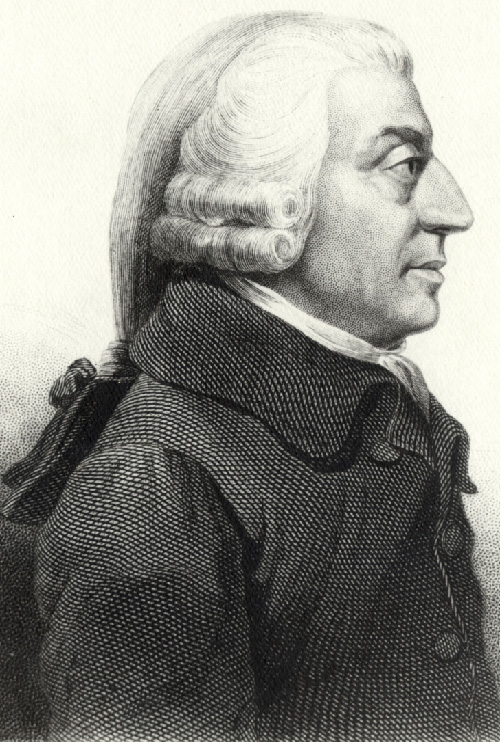
Adam Smith was a Scottish political economist and philosopher best known for writing the book An Inquiry into the Nature and Causes of the Wealth of Nations (1776), often referred to by its shortened title The Wealth of Nations (Figure 6.18). Earlier scholars had written about various aspects of economics, but with this book Smith became the first person to produce a comprehensive philosophical examination of the way nations should manage their economies.
英語のヒント
アダム・スミスはスコットランドの政治経済学者・哲学者で、1776年の『諸国民の富の性質と原因の研究』を著したことで最もよく知られる。この本は通常、短い題名の『国富論』で呼ばれる(図6.18)。以前の学者も経済のさまざまな面について書いていたが、スミスはこの本によって、国家が経済をどう運営すべきかを、包括的に哲学の観点から検討した最初の人物となった。
Adam Smith.アダム・スミス
(credit: “Profile of Adam Smith” by Adam Smith - Vanderblue Collection/Wikimedia Commons, Public Domain) · Public Domain
Figure 6.18 This nineteenth-century etching of the Scottish economist Adam Smith is based on a portrait created from life by James Tassie in 1787. (credit: “Profile of Adam Smith” by Adam Smith - Vanderblue Collection/Wikimedia Commons, Public Domain)
英語のヒント
図6.18 スコットランドの経済学者アダム・スミスを描くこの19世紀のエッチングは、ジェームズ・タッシーが1787年に本人をモデルとして制作した肖像に基づく。(出典:アダム・スミス―ヴァンダーブルー・コレクション/ウィキメディア・コモンズ「アダム・スミスの横顔」。パブリックドメイン)
In The Wealth of Nations, Smith argued that the “invisible hand” of the marketplace guided people when they made their own economic decisions. By doing the work that would bring them the greatest profit, he explained, people inadvertently tended to produce the goods and services most needed by society. To allow the invisible hand to work, Smith advocated the reduction of tariffs and most forms of governmental regulation. His work was based on rational choice theory, the idea that people understand their options and make rational choices that will help them achieve reasonable objectives. In Smith’s view, this form of selfishness is often good for the individual and for society.
英語のヒント
スミスは『国富論』で、人々が自分で経済的な決定を下すとき、市場の「見えざる手」が導くと論じた。最大の利益をもたらす仕事をすることで、人々は意図せず、社会が最も必要とする財やサービスを生産する傾向があると説明した。見えざる手を働かせるため、スミスは関税と、ほとんどの種類の政府規制を減らすよう提唱した。その議論は、人々が選択肢を理解し、合理的な目標を達成するのに役立つ合理的な選択を行う、という合理的選択理論に基づいていた。スミスの見方では、このような利己心は、しばしば個人にも社会にも有益だった。
Although Smith did not use the term, preferring to call his system commercial society, he and his supporters promoted the idea later known as capitalism, an economic system in which private individuals and companies typically own the means of production such as factories and farms, and free (unregulated) markets set the value of most goods and services based on supply and demand.
英語のヒント
スミス自身はこの語を使わず、自分の制度を「商業社会」と呼ぶことを好んだが、彼とその支持者は、後に資本主義と呼ばれる考え方を広めた。資本主義は、通常、民間の個人や会社が工場・農場などの生産手段を所有し、自由な、つまり規制されない市場が、需要と供給に基づいて大部分の財やサービスの価値を決める経済制度である。
Smith was a critic of slavery. He believed slavery was inefficient and suggested it was doomed to fail if markets were truly free. Because the cost of feeding, clothing, and housing enslaved people, however poorly, was passed on to consumers, Smith also noted that goods made using enslaved labor were more expensive. Free labor could produce goods more inexpensively because the employer did not have to pay for his laborers’ upkeep. However, Smith also used rational choice theory to minimize slavery’s horrors. In The Wealth of Nations, he acknowledged that the enslaved people living in the British Caribbean were “in a worse condition than the poorest people either in Scotland or Ireland,” but he justified their suffering on the basis that “it is the interest of their master that they should be fed well and kept in good heart in the same manner as it is his interest that his working cattle should be so.”
英語のヒント
スミスは奴隷制の批判者だった。奴隷制は非効率であり、市場が本当に自由なら、破綻を免れないと考えた。また、どれほど粗末なものであれ、奴隷化された人々の食事、衣服、住まいにかかる費用は消費者へ転嫁されるため、奴隷労働で作られた財は割高になると指摘した。自由労働であれば、雇用者が労働者の生活維持費を払う必要がないため、財をより安く生産できるとした。しかしスミスは、合理的選択理論を用いて奴隷制の恐ろしさを小さく見せてもいた。『国富論』で、イギリス領カリブ海に暮らす奴隷たちは「スコットランドまたはアイルランドの最も貧しい人々よりも悪い状態にある」と認めたが、「主人にとって、働く家畜に十分に餌を与え、元気な状態に保つことが利益であるのと同じように、彼らに十分に食べさせ、よい状態に保つことも主人の利益である」という理由で、その苦しみを正当化した。
Whether sugar plantations on which enslaved people labored were themselves capitalist enterprises has been a matter of debate among historians. One the one hand, capitalism presupposes freedom on the part of all actors engaged in an economic transaction. Merchants are free to sell what they wish at the prices they wish to charge, and consumers are free to pay the price that is set or to refuse to buy the product. Employers are free to set hours and wages for employees, and employees are supposedly free to accept the employer’s terms or hold out for better ones.
英語のヒント
奴隷化された人々が働いたサトウキビ農園そのものを、資本主義の企業と呼べるのかは、歴史家の間で議論されてきた。一方で、資本主義は経済取引に関わるすべての当事者の自由を前提とする。商人は望む物を望む価格で売る自由があり、消費者は設定された価格を払う自由も、購入を拒む自由もある。雇用者は従業員の労働時間と賃金を決める自由があり、従業員にも、雇用者の条件を受け入れるか、よりよい条件を待って譲らずにいるかの自由があるとされる。
The workforce on sugar plantations, however, consisted of enslaved people who could legally be coerced to do whatever labor their owners decided for whatever compensation they chose to give (usually the minimum of food, clothing, and shelter required to keep the laborers alive). On the other hand, plantation owners behaved in much the same way as owners of other industrial enterprises, by setting production goals, for example. Many have pointed out that the highly regimented system of labor on sugar plantations was much like that in capitalist enterprises like textile factories. The debate is ongoing. What no one disputes is that the profits earned from the sale of sugar and other plantation products grown by enslaved people were often invested in capitalist enterprises, including the factories that were coming into existence in the eighteenth century.
英語のヒント
しかしサトウキビ農園の労働力は、奴隷化された人々からなっていた。所有者が決めたどんな労働でも、所有者が選んだどんな報酬ででも、法的に強制できる人々だった。その報酬は通常、生かしておくのに必要な最低限の食事、衣服、住まいだった。他方、農園主は、生産目標を設定するなど、ほかの工業企業の所有者と非常によく似た行動をとった。サトウキビ農園の厳しく組織・統制された労働制度は、繊維工場のような資本主義企業のものに非常によく似ていた、と多くの人が指摘している。この議論は続いている。誰も争わないのは、奴隷化された人々が育てた砂糖やほかの農園産品の販売利益が、18世紀に誕生しつつあった工場などの資本主義企業へ、しばしば投資されたということである。
Adam Smith’s ideas challenged the established mercantilist economic order and attracted critics. Some governmental leaders were understandably hesitant to surrender their power to the free market. They questioned the wisdom of reformers like Smith who disagreed with the favorable-balance emphasis of mercantilism. Conservative critics pointed out that while mercantilism might not have been perfect, it had delivered tremendous wealth to Europe, or at least to Europe’s ruling classes.
英語のヒント
スミスの思想は、確立していた重商主義の経済秩序に挑み、批判も集めた。一部の政府指導者が、自由市場へ自分たちの権力を渡すのをためらったことは、理解できる。彼らは、重商主義が有利な貿易収支を重視することに反対する、スミスのような改革者の判断を疑った。保守的な批判者は、重商主義は完全ではなかったかもしれないが、ヨーロッパ、少なくともその支配階級に莫大な富をもたらしたと指摘した。
Other world leaders, most notably in Great Britain, rejected conservative critics and embraced Smith’s ideas, which promised greater potential freedoms and profits for the nation’s wealthiest citizens, and they became the dominant force in British economic reforms. The wealthy House of Commons leader Charles James Fox praised Smith’s ideas in Parliament, although he later admitted he had not read The Wealth of Nations and thought it far too long. In 1777, Prime Minister Fredrick North proposed a revised tax code based on Smith’s work. In 1792, Prime Minister William Pitt praised Smith’s work as “the best solution to every question connected with the history of commerce, or with the systems of political economy.”
英語のヒント
ほかの世界の指導者、特にイギリスの指導者は、保守的な批判者を退け、スミスの思想を受け入れた。それは、その国の最富裕層に、より大きな自由と利益の可能性を約束するものであり、イギリスの経済改革を支配する考え方となった。富裕な庶民院の指導者チャールズ・ジェームズ・フォックスは、議会でスミスの思想を称賛した。ただし後に、『国富論』は読んでおらず、長すぎると思っていたと認めた。1777年、首相フレデリック・ノースは、スミスの著作に基づく税法改正案を提案した。1792年には、首相ウィリアム・ピットが、スミスの著作を「商業の歴史、あるいは政治経済の体系に関わるあらゆる問題への最良の解答」と称賛した。
Smith’s ideas spread across the Atlantic, and in 1807 President Thomas Jefferson wrote “Smith’s Wealth of Nations is the best book to be read.” As Smith’s ideas took root, governments reduced tariffs, cut back on economic regulations, and led their nations’ transition from the quest for favorable balances of trade to the search for personal profit.
英語のヒント
スミスの思想は大西洋を越えて広がり、1807年にはトマス・ジェファソン大統領が、「スミスの『国富論』は読むべき最良の本である」と書いた。スミスの思想が根づくにつれ、各国政府は関税を下げ、経済規制を縮小し、有利な貿易収支を追求する体制から、個人の利益を追求する体制へ国を移行させた。
Smith’s ideas remain influential, but modern scholars often criticize them. In contrast to his reliance on rational choice theory, they argue that people do not always behave rationally or make the best decisions. Others condemn the moral failings of the invisible hand, which sacrificed the lives and wellbeing of enslaved people, poor workers, and colonial subjects to provide elites with profit.
英語のヒント
スミスの思想は今も影響力を持つが、現代の学者はしばしば批判する。スミスが合理的選択理論に依拠したのに対し、人々は常に合理的に行動するわけでも、最良の決定をするわけでもないと論じる。また別の批判者は、エリートに利益を与えるために、奴隷化された人々、貧しい労働者、植民地の臣民の生命と福祉を犠牲にした「見えざる手」の道徳上の欠陥を非難する。