第6章植民地化と経済の拡大Colonization and Economic Expansion
Resistance in Africaアフリカでの抵抗
Africa was also subject to European incursions, beginning with the Portuguese in the fifteenth century. In the sixteenth century, other Europeans began to arrive. The coastal areas were most likely to be targeted and were particularly vulnerable to imperialist invaders because they were more accessible to advanced warships.
英語のヒント
アフリカも、15世紀のポルトガル人を皮切りに、ヨーロッパ人の侵入を受けた。16世紀には、ほかのヨーロッパ人も到来し始めた。沿岸部は最も標的にされやすく、特に帝国主義的な侵略者に対して脆弱だった。高性能の軍艦が接近しやすかったためである。
As Native Americans had done, Africans resisted European encroachments on their lands and efforts to deprive them of their sovereignty. In the early 1500s, Europeans began enslaving Africans in large numbers as part of the trans-Atlantic slave trade, which lasted until the mid-nineteenth century. European slave traders, like the Arab slave traders before them, typically worked within Africa’s existing power structures and purchased enslaved people from rival groups of Africans, in a process that disrupted but did not initially challenge Africans’ control of the interior. Many Africans, particularly in the interior, actively resisted foreign influence.
英語のヒント
アメリカ先住民がそうしたように、アフリカ人も、ヨーロッパ人による自分たちの土地への侵食と、主権を奪おうとする試みに抵抗した。1500年代初頭、ヨーロッパ人は大西洋奴隷貿易の一環としてアフリカ人を大量に奴隷化し始め、この貿易は19世紀半ばまで続いた。ヨーロッパの奴隷商人は、先行するアラブの奴隷商人と同様、通常はアフリカの既存の権力構造の中で活動し、互いに対立するアフリカ人集団から奴隷化された人々を購入した。この過程は内陸を混乱させたが、当初はアフリカ人による内陸支配そのものを覆そうとはしなかった。多くのアフリカ人、特に内陸部の人々は、外国の影響に積極的に抵抗した。
One of the longest acts of resistance was led by Queen Nzinga of Ndongo and Matamba. Nzinga inherited the position of ruler of the kingdom of Ndongo, in what is now Angola, in 1624 following the death of her brother. She had served as emissary from her brother to the Portuguese and helped end the hostilities between them and her brother’s military forces. In 1621, she negotiated an agreement whereby the Portuguese were allowed to engage in the slave trade within Ndongo territory but not to establish forts there. Nzinga was also adamant that Ndongo would not pay tribute to the Portuguese king. To assure the Portuguese that she negotiated in good faith, she agreed to convert to Roman Catholicism and had the Portuguese governor’s wife serve as her godmother.
英語のヒント
最も長く続いた抵抗の一つを率いたのが、ンドンゴとマタンバの女王ンジンガだった。ンジンガは1624年、兄の死後、現在のアンゴラにあたるンドンゴ王国の君主の地位を継いだ。それ以前には、兄からポルトガル人への使節を務め、ポルトガル人と兄の軍の敵対関係を終わらせるのに貢献していた。1621年、彼女は、ポルトガル人がンドンゴ領内で奴隷交易を行うことは認めるが、砦を建てることは認めないという協定を交渉した。また、ンドンゴはポルトガル国王に貢納しないという点でも、ンジンガは譲らなかった。誠意をもって交渉しているとポルトガル側に示すため、ローマ・カトリックへの改宗に同意し、ポルトガル総督の妻に代母を務めてもらった。
Following Nzinga’s ascension to the throne, however, Portugal began to renege on the terms of the treaty and to insist that the nobles of Ndongo become vassals of the king of Portugal. This would mean sending the Portuguese king the soldiers, enslaved people, and supplies they otherwise owed to Nzinga. In retaliation, Nzinga encouraged enslaved people to escape from the Portuguese. In 1626, Portugal declared war on her.
英語のヒント
しかしンジンガの即位後、ポルトガルは条約の条件を破り始め、ンドンゴの貴族がポルトガル国王の臣下になるよう要求した。そうなれば、従来ンジンガに差し出す義務のあった兵士、奴隷化された人々、物資を、ポルトガル国王へ送ることになる。報復として、ンジンガは奴隷化された人々に、ポルトガル人のもとから逃げるよう促した。1626年、ポルトガルは彼女に宣戦布告した。
The common people of Ndongo and some of the lesser members of the nobility supported Nzinga, while more powerful nobles, who hoped to benefit from engaging in the slave trade with Portugal, supported the Europeans. Nzinga found allies in the kingdom of Kongo. She was also assisted by Dutch slave traders, with whom she did business. Following the conclusion of a peace treaty between the Dutch and the Portuguese, Nzinga found herself unable to force the Portuguese out of Ndongo territory and dedicated her efforts to preventing them from moving deeper into the African interior. Finally, in 1656, Nzinga concluded a peace treaty with Portugal and hostilities ceased.
英語のヒント
ンドンゴの民衆と下級貴族の一部はンジンガを支持した。一方、ポルトガルとの奴隷交易で利益を得ようとした、より有力な貴族は、ヨーロッパ人を支持した。ンジンガはコンゴ王国に同盟者を見つけた。また、取引相手であるオランダの奴隷商人からも支援を受けた。オランダとポルトガルの間で講和条約が結ばれると、ンジンガはポルトガル人をンドンゴ領から追い出せなくなり、彼らがアフリカ内陸へさらに進むのを防ぐことに力を注いだ。ついに1656年、ンジンガはポルトガルと講和条約を結び、戦闘は終わった。
Other African tribes resisted the incursions of the Dutch. In 1652, the Dutch East India Company established a settlement at the Cape of Good Hope and traded with the Indigenous people of the region, the Khoikhoi, who were hunters and cattle herders. Although the Company prohibited the enslavement of the Indigenous peoples of the Cape in order to maintain their willingness to participate in the cattle trade, conflict arose between the settlers and the Khoisan (the name by which the Khoikhoi and another people, the San, are jointly known). Dutch farmers took over Indigenous hunting and grazing lands to grow crops and herd their own cattle. The Khoisan responded by burning Dutch farms and stealing their cattle. The Dutch then retaliated by attacking Khoisan settlements. This conflict continued throughout the eighteenth century.
英語のヒント
ほかのアフリカ諸集団は、オランダ人の侵入に抵抗した。1652年、オランダ東インド会社は喜望峰に入植地を設け、狩猟と牛の牧畜を営む地域の先住民コイコイと交易した。会社は牛の取引に応じる意思を保たせるため、ケープの先住民の奴隷化を禁じたが、入植者とコイサンの間に争いが生じた。コイサンは、コイコイと別の人々であるサンを合わせた呼び名である。オランダの農民は、作物を栽培し自分たちの牛を飼うため、先住民の狩猟地と放牧地を奪った。コイサンはオランダ人の農場を焼き、牛を盗んで応じた。するとオランダ人はコイサンの集落を攻撃して報復した。この対立は18世紀を通じて続いた。
As the Khoisan lost control of their lands to the Dutch, who increasingly expanded inland from the Cape, many found themselves becoming laborers on Dutch farmsteads, either because they could not support themselves after losing their land and cattle or because they were captured by settlers during Dutch raids. In the second half of the eighteenth century, the Dutch instituted a system of forcing Khoisan children to serve “apprenticeships” until age twenty-five. Although technically the Khoisan were not enslaved, they had been reduced to a situation very much like slavery. The Dutch also employed enslaved laborers brought from elsewhere in Africa.
英語のヒント
オランダ人がケープからますます内陸へ進み、コイサンは土地の支配を失った。そのなかで多くがオランダ人の農場の労働者となった。土地と牛を失って自活できなくなった場合もあれば、オランダ人の襲撃で入植者に捕らえられた場合もあった。18世紀後半、オランダ人はコイサンの子どもに25歳まで「徒弟奉公」を強制する制度を導入した。厳密にはコイサンは奴隷とされていなかったが、奴隷制ときわめてよく似た状態へ追い落とされた。オランダ人はまた、アフリカのほかの地域から連れて来た奴隷労働者も用いた。
The movement of the Dutch inland brought them into conflict with the Xhosa people, who were farmers. Although the Dutch possessed more firepower, the Xhosa greatly outnumbered them. The Dutch fought two wars with the Xhosa and, from 1799 to 1803, also faced an armed uprising by Khoisan farm laborers, some of whom allied themselves with the Xhosa.
英語のヒント
オランダ人の内陸進出は、農耕を営むコーサの人々との対立を生んだ。オランダ人は火力に勝っていたが、人数ではコーサが大きく上回っていた。オランダ人はコーサと2度戦争をし、1799~1803年には、コイサンの農場労働者による武装蜂起にも直面した。蜂起した人々の一部はコーサと同盟した。
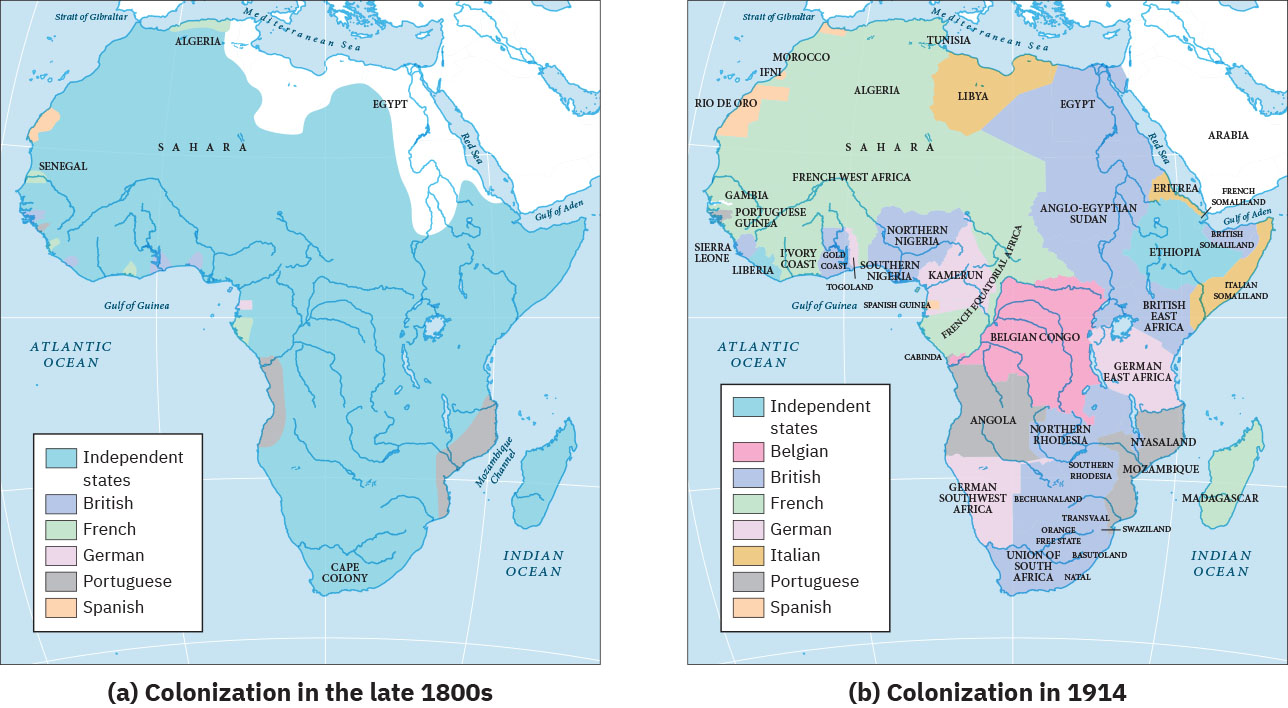
As other European empires grew more powerful in the early nineteenth century, they also began to expand beyond their coastal trading posts in Africa as the Dutch had done and became more active in events on the continent (Figure 6.17). In 1806, the British supported the Fante Confederacy, their African trading partner on what is now the coast of Ghana, in a series of conflicts with the Asante Empire and its Dutch allies. These conflicts culminated in the Anglo-Asante Wars of 1823–1900. The Asante, who hoped to replace Britain as the most powerful nation on the western coast, resisted the British slave trade and Britain’s broader pattern of economic imperialism, the practice of dominating a foreign country economically. They succeeded for many years and repeatedly forced the British to retreat to their coastal strongholds. Despite the Asante’s initial successes, however, the British and their allies eventually proved more powerful and claimed victory in 1900. The British controlled much of the African west coast until the Indigenous people in the region used a combination of nonviolent resistance and political pressure to win independence for the nation now known as Ghana in 1957.
英語のヒント
19世紀初頭にほかのヨーロッパ諸帝国が力を増すと、オランダと同様に、アフリカの沿岸交易拠点を越えて進出し始め、大陸内の動向により積極的に関与するようになった(図6.17)。1806年、イギリスは、現在のガーナ沿岸にある交易相手ファンテ連邦を支え、アサンテ帝国とその同盟者オランダとの一連の紛争に関与した。これらの対立は、1823~1900年のアングロ・アサンテ戦争へ至った。西アフリカ沿岸の最有力国としてイギリスに取って代わりたいと考えたアサンテは、イギリスの奴隷貿易と、より広く外国を経済的に支配する「経済帝国主義」に抵抗した。長年にわたり成功し、イギリス軍を沿岸の拠点へ何度も退却させた。しかし、アサンテの初期の成功にもかかわらず、最終的にはイギリスとその同盟勢力のほうが強く、1900年に勝利を宣言した。イギリスはアフリカ西岸の多くを支配したが、地域の先住の人々は、非暴力抵抗と政治的圧力を組み合わせて、現在ガーナと呼ばれる国の独立を1957年に勝ち取った。
Colonization in Africa.アフリカの植民地化
(attribution a and b: Copyright Rice University, OpenStax, under CC BY 4.0 license) · CC BY 4.0
Figure 6.17 These maps show the rapid process of European colonization in Africa, from the late 1800s (a) to 1914 (b). (attribution a and b: Copyright Rice University, OpenStax, under CC BY 4.0 license)
図6.17 これらの地図は、1800年代後半(a)から1914年(b)までの、ヨーロッパによるアフリカ植民地化の急速な進行を示す。(a・bの帰属表示:著作権ライス大学、OpenStax。CC BY 4.0ライセンス)