第6章植民地化と経済の拡大Colonization and Economic Expansion
Marxismマルクス主義
Karl Marx was a highly controversial intellectual and revolutionary. Born in 1818 in Trier, in what is now Germany, he grew up as the son of a successful lawyer and was baptized into the Evangelical Church when he was six years old. As a young man, he studied law at the University of Berlin, where a professor introduced him to the philosophy of Georg Hegel. Marx quickly embraced Hegel’s idealistic universal history, which suggested the world is progressing through conflicts toward greater freedom. After completing his education, he worked as a journalist and writer.
英語のヒント
カール・マルクスは、激しい論争を呼んだ知識人であり革命家だった。1818年、現在のドイツにあたるトリーアで生まれ、成功した弁護士の息子として育ち、6歳のとき福音主義教会で洗礼を受けた。青年期にはベルリン大学で法律を学び、ある教授からゲオルク・ヘーゲルの哲学を紹介された。マルクスは、世界は対立を通じて、より大きな自由へ向かって進歩するという、ヘーゲルの観念論的な普遍史をすぐに受け入れた。学業を終えた後は、ジャーナリスト、著述家として働いた。
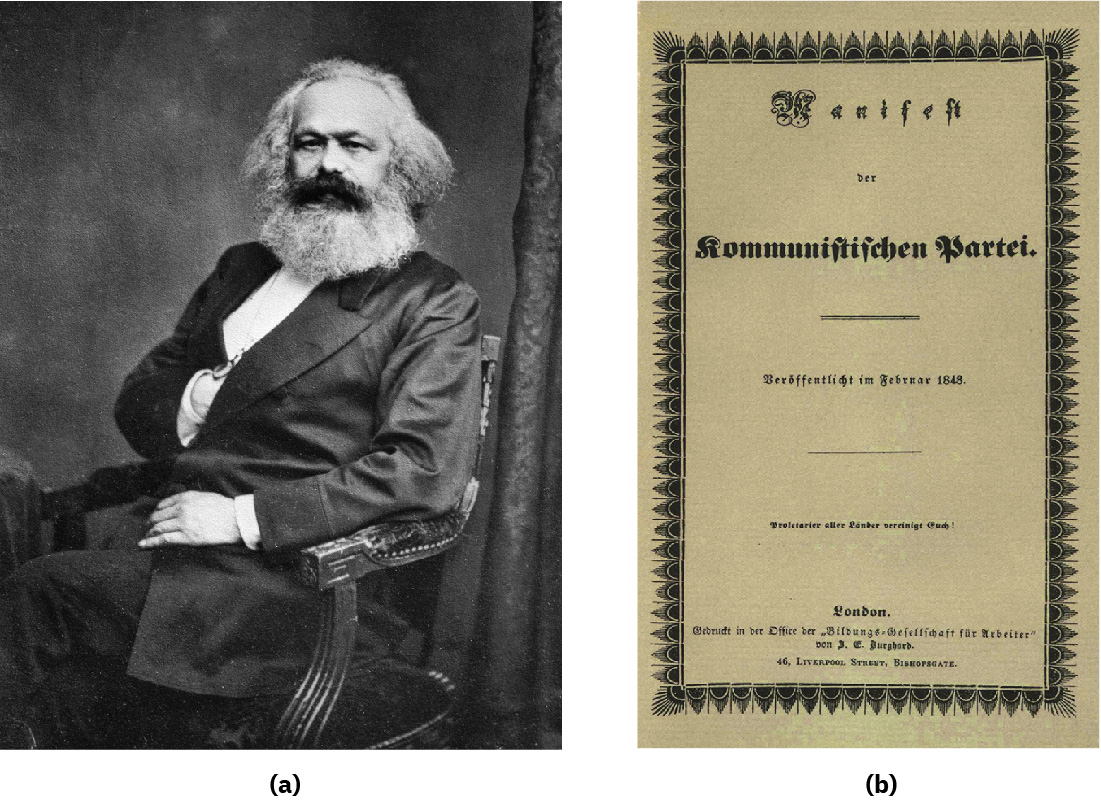
In 1848, Marx published The Communist Manifesto with his co-author Friedrich Engels. In the book, the two argued that “the history of all hitherto existing society is the history of class struggles.” Their idea, that recognizing the class struggle between workers and the ruling class is central to understanding societies, is also known as Marxism (Figure 6.20). In addition to laying out their vision of history, Marx and Engels predicted that society would eventually replace current economic systems with socialism, a system in which the public, not private companies or individuals, owns the means of production. In their view, socialism was one phase of the transition from the private ownership characteristic of capitalism to the completely classless society of communism. They called for the forcible overthrow of current societies, a statement many communists around the world embraced as a declaration of war on capitalism. The ideals of communism were inspired by the abuses of capitalism that often exploited workers.
英語のヒント
1848年、マルクスは共著者フリードリヒ・エンゲルスとともに『共産党宣言』を出版した。そこで2人は、「これまで存在したあらゆる社会の歴史は、階級闘争の歴史である」と論じた。労働者と支配階級の間の階級闘争を認識することが、社会の理解の中心になるというこの考え方は、マルクス主義とも呼ばれる(図6.20)。マルクスとエンゲルスは自分たちの歴史観を示すとともに、社会はやがて現在の経済制度を社会主義へ置き換えると予言した。社会主義とは、民間の会社や個人ではなく、公衆が生産手段を所有する制度である。彼らの見方では、社会主義は、資本主義の特徴である私有から、共産主義の完全に階級のない社会へ至る移行の一段階だった。彼らは既存社会の力による打倒を呼びかけた。世界各地の多くの共産主義者は、この主張を資本主義への宣戦布告として受け止めた。共産主義の理想は、労働者をしばしば搾取する資本主義の弊害に刺激されたものだった。
Karl Marx and His Work.カール・マルクスとその著作
(credit a: modification of work “Portrait of Karl Marx” by International Institute of Social History/Wikimedia Commons, Public Domain; credit b: modification of work “Kommunistisches Manifest” by www.marxists.org/Wikimedia Commons, Public Domain) · Public Domain
Figure 6.20 (a) This 1875 photo of Marx is probably the most famous image made by the popular British photographer John Mayall. (b) Marx and Engel’s The Communist Manifesto was first published in 1848 with this cover. (credit a: modification of work “Portrait of Karl Marx” by International Institute of Social History/Wikimedia Commons, Public Domain; credit b: modification of work “Kommunistisches Manifest” by www.marxists.org/Wikimedia Commons, Public Domain)
図6.20 (a)1875年のこのマルクスの写真は、人気のあったイギリスの写真家ジョン・メイオールによる、おそらく最も有名な写真である。(b)マルクスとエンゲルスの『共産党宣言』は、この表紙で1848年に初めて出版された。(aの出典:国際社会史研究所/ウィキメディア・コモンズ「カール・マルクスの肖像」を改変。パブリックドメイン。bの出典:www.marxists.org/ウィキメディア・コモンズ『共産党宣言』を改変。パブリックドメイン)
Marx’s book Das Kapital, published in 1867, is one of history’s most often cited sources on economics and politics. In Das Kapital, Marx argued that the bourgeoisie, members of a social class that owned the means of production, were primarily motivated by the desire to exploit labor. In his view, employers paid wages to their workers, also known as the proletariat, that were far less than their labor was worth. They then kept the excess value produced by wage earners, in a process Marx argued was unfair to the workers. Employers used their profits to purchase additional resources and to buy political influence to ensure that the law would support the wealthy instead of the workers. The wealthy became unfit to rule as they increasingly leveraged their growing economic and political power until workers were left powerless and in poverty. Eventually the capitalist system would collapse, and the workers would reclaim control of society.
英語のヒント
1867年に出版されたマルクスの『資本論』は、経済と政治について、歴史上最も頻繁に引用される文献の一つである。マルクスは『資本論』で、生産手段を所有する社会階級の成員であるブルジョワジーは、主として労働を搾取したいという欲求に動かされると論じた。彼の見方では、雇用者がプロレタリアートとも呼ばれる労働者に支払う賃金は、その労働の価値をはるかに下回る。そのうえで、賃金労働者が生み出した余剰の価値を自分のものにしており、マルクスはこの過程を労働者にとって不公正だとした。雇用者は利益を使って追加の資源を買い、法律が労働者ではなく富裕層を支えるよう、政治的影響力を買った。富裕層が増大する経済的・政治的権力をますます行使し、ついに労働者が無力で貧しい状態に置かれるにつれ、富裕層は統治するに値しなくなる。やがて資本主義制度は崩壊し、労働者が社会の主導権を取り戻すことになる、というのである。